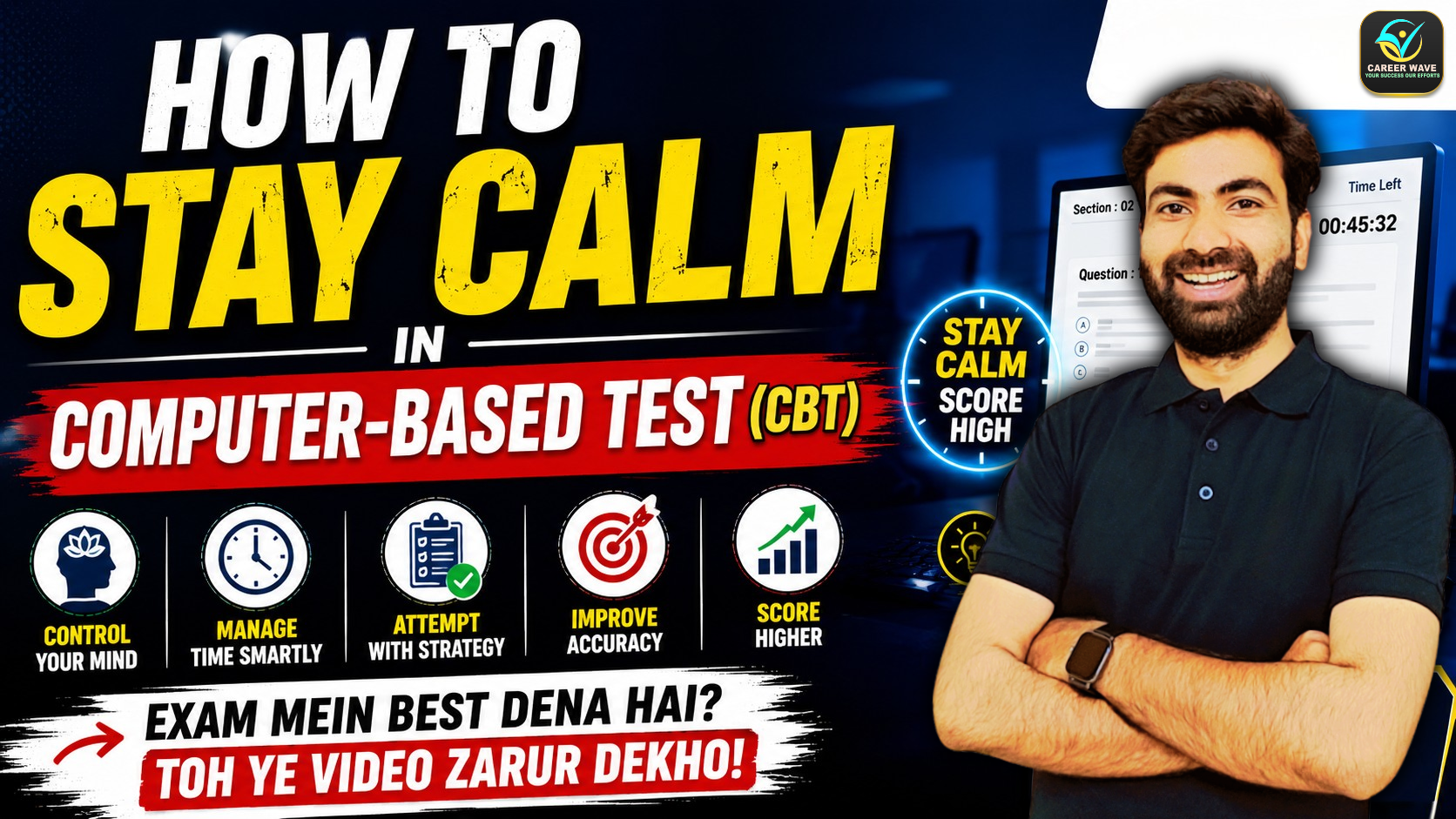
A complete Career Wave guide on
how to stay calm during a Computer-Based Test (CBT). Learn practical strategies
for AAI ATC aspirants to manage exam pressure, avoid panic, handle the timer,
skip difficult questions, prevent overthinking, and improve speed, accuracy,
and exam performance.
How to Stay Calm in Computer-Based Test (CBT)
A Practical
Guide for AAI ATC Aspirants by Career Wave
For many
aspirants, the real challenge in AAI ATC is not only the syllabus. The real
challenge begins inside the exam hall, in front of the computer screen.
You may know
the concepts.
You may have solved PYQs.
You may have attempted mocks.
But if you panic during the CBT, your score can drop.
In a
Computer-Based Test, calmness is not a luxury. It is a scoring skill.
At Career
Wave, we have seen many students who were academically strong but lost marks
because of anxiety, overthinking, rushed decisions, and poor time control. On
the other hand, many students with average preparation performed better because
they stayed calm and followed a clear strategy.
This blog
explains how to stay calm during a CBT exam, especially for AAI ATC aspirants.
Why Staying
Calm Matters in CBT
A CBT exam
is different from normal practice at home. In the exam hall, the environment is
controlled, the timer is visible, the pressure is high, and every click feels
important.
When you are
calm:
·
You read
questions properly.
·
You avoid
silly mistakes.
·
You manage
time better.
·
You skip
difficult questions smartly.
·
You trust
your preparation.
·
You recover
faster after a tough question.
When you
panic:
·
Easy
questions look difficult.
·
You misread
words like “not”, “incorrect”, or “least”.
·
Calculation
mistakes increase.
·
You change
correct answers.
·
You waste
time on one question.
·
Your
confidence drops section by section.
AAI ATC is a speed and
accuracy-based exam. So, mental balance directly affects marks.
1. Understand That Nervousness Is Normal
Feeling
nervous before a CBT exam is not a sign of weakness. Almost every serious
aspirant feels pressure before an important exam.
The problem
is not nervousness.
The problem is uncontrolled nervousness.
A small
amount of pressure keeps you alert. But when pressure turns into fear, your
brain starts overthinking. You begin doubting your answers, rechecking
unnecessarily, and rushing through questions.
Before the
exam, remind yourself:
“I do not
need to be perfect. I need to stay stable and make good decisions.”
This mindset reduces unnecessary
pressure.
2. Do Not Start the Paper in a Hurry
Many
students make a major mistake in the first 5 minutes. They start solving too
fast because they want to build speed immediately.
This creates
early panic.
In the first
few minutes:
·
Take one
deep breath.
·
Read the
instructions carefully.
·
Check the
screen layout.
·
Understand
the question palette.
·
Start with a
stable mind.
Do not try to prove anything in
the first question. Your goal is not to start fast. Your goal is to stay
controlled till the last question.
3. Use the First 10 Questions to Build Rhythm
The
beginning of the paper sets your mental tone. If the first few questions feel
tough, many students panic and think the whole paper will be difficult.
Do not judge
the complete paper from the first few questions.
Use the
first 10 questions to build rhythm.
If a
question is easy, solve it.
If it looks lengthy or confusing, skip it and move ahead.
Do not get emotionally attached to any question.
Remember:
One tough question does not mean
the full paper is tough.
4. Follow a Fixed Attempt Strategy
CBT panic
increases when students do not have a strategy. If you decide everything inside
the exam hall, your brain wastes energy.
Before the
exam, your strategy should be clear:
·
Which
section will you attempt first?
·
How much
time will you give to each section?
·
When will
you skip a question?
·
When will
you mark for review?
·
How many
minutes will you keep for final checking?
·
Which
questions will you not revisit?
A fixed
strategy gives the mind structure. Structure reduces panic.
Career Wave always advises
students to test their strategy in mocks before applying it in the final exam.
5. Use Smart Skipping
Many
aspirants think skipping is a sign of weakness. It is not.
Skipping is
an exam skill.
In CBT,
every question is not worth the same amount of time. Some questions are direct,
some are moderate, and some are time traps.
Skip a
question if:
·
You do not
understand it in the first reading.
·
It requires
lengthy calculation.
·
Two or more
concepts are getting mixed.
·
You are
spending more than the planned time.
·
You feel
stuck.
You can
return later if time allows.
A calm student knows when to
leave a question. A panicked student keeps fighting with one question and loses
the paper.
6. Do Not Watch the Timer Again and Again
The timer is
important, but constantly watching it creates stress.
Some
students look at the timer after every question. This breaks concentration and
increases anxiety.
Use the
timer in blocks.
For example:
·
Check after
completing a group of questions.
·
Check after
finishing a section.
·
Check at
planned time intervals.
Do not allow the timer to control
your emotions. Use it only as a guide.
7. Control Your Breathing During Panic
If you
suddenly feel nervous during the exam, pause for a few seconds.
Use this
simple method:
·
Stop solving
for 5 seconds.
·
Take a slow
deep breath.
·
Relax your
shoulders.
·
Look at the
screen calmly.
·
Move to the
next manageable question.
This small
pause can save many marks.
Many students avoid pausing
because they think it wastes time. In reality, a 5-second pause can prevent a
5-minute panic cycle.
8. Avoid the Second Guess Trap
One common
CBT mistake is changing correct answers due to doubt.
A student
solves a question correctly, marks the answer, then later thinks:
·
“Maybe this
is too easy.”
·
“Maybe I
missed something.”
·
“Maybe the
other option is better.”
Then the
student changes the answer and loses marks.
Change an
answer only if you find a clear mistake, such as:
·
Calculation
error
·
Misread
condition
·
Wrong
formula
·
Wrong unit
·
Wrong option
selected by mistake
Do not
change answers only because of fear.
Career
Wave’s simple rule:
No clear mistake, no answer
change.
9. Do Not Compare During the Exam
In the CBT
hall, avoid looking at other students. Do not think:
·
“He is
solving faster.”
·
“She looks
confident.”
·
“Maybe I am
slow.”
·
“Others are
ahead of me.”
You do not
know their accuracy. You do not know their strategy. You do not know whether
they are solving correctly or guessing.
Your only
competition in CBT is your own panic.
Stay focused on your screen, your
questions, and your strategy.
10. Handle Difficult Questions Emotionally
A difficult
question can disturb your confidence if you allow it.
When you see
a tough question, do not think:
“I should
know this.”
Think:
“This may be
tough for others also. I will skip and come back if time allows.”
This small
mindset shift keeps you calm.
In competitive exams, selection
is not decided by solving every difficult question. It is decided by securing
easy and moderate questions with high accuracy.
11. Maintain Energy Till the Last Section
CBT exams
can create mental fatigue. After many questions, students start making silly
mistakes.
To avoid
this:
·
Maintain a
controlled pace.
·
Do not rush
in the beginning.
·
Take
micro-pauses when needed.
·
Avoid
unnecessary rechecking.
·
Keep
attention on keywords and units.
·
Read each
question with fresh focus.
The last section matters as much
as the first section. Do not spend all your mental energy early.
12. Practice Calmness Through Mock Tests
Calmness
cannot be built by advice alone. It must be trained.
Mock tests
are the best way to train CBT calmness.
While giving
mocks, practice:
·
Sitting for
the full duration
·
Managing the
timer
·
Skipping
tough questions
·
Using review
properly
·
Avoiding
answer changes
·
Controlling
panic after a difficult section
·
Maintaining
accuracy till the end
After every
mock, analyze not only marks but also behaviour.
Ask
yourself:
·
Where did I
panic?
·
Which
question wasted time?
·
Did I change
any correct answer?
·
Did I rush
in the final phase?
·
Did my
accuracy drop after many questions?
·
Did I follow
my planned strategy?
This is how exam temperament
improves.
13. What to Do One Day Before CBT
The day
before the exam should be light and controlled.
Do:
·
Revise
formulas and short notes.
·
Check admit
card and ID proof.
·
Sleep
properly.
·
Avoid heavy
new topics.
·
Avoid random
videos.
·
Keep exam center
details ready.
·
Eat light
and stay hydrated.
·
Visualize a
calm exam attempt.
Do not:
·
Start a new
chapter.
·
Compare with
other aspirants.
·
Attempt too
many questions at night.
·
Read
negative comments online.
·
Change your
strategy suddenly.
The last day is for stability,
not overload.
14. What to Do Inside the CBT Hall
Before
starting:
·
Sit
comfortably.
·
Adjust your
posture.
·
Read
instructions.
·
Understand
the screen layout.
·
Take one
deep breath.
·
Start
calmly.
During the
exam:
·
Read
questions carefully.
·
Attempt easy
questions first.
·
Skip time
traps.
·
Watch the
timer in blocks.
·
Do not
recheck confident answers.
·
Review only
marked questions.
·
Stay
emotionally neutral.
After a
tough question:
·
Do not
panic.
·
Skip and
move ahead.
·
Protect the
rest of the paper.
Career Wave’s Approach to CBT Calmness
Career Wave
focuses not only on syllabus completion but also on exam performance. For AAI
ATC aspirants, knowledge must be supported by strategy and mental control.
Career Wave
helps students through:
·
CBT-based
mock tests
·
PYQ-based
preparation
·
Time
management training
·
Smart
attempt strategy
·
Mock
analysis
·
Mistake
tracking
·
Overthinking
control
·
Exam
temperament development
·
Final-phase
guidance
The aim is clear: students should
not only know the answer, but also mark it calmly and confidently in the actual
exam.
Final Words
Staying calm
in a CBT exam does not mean having zero fear. It means controlling fear,
following your strategy, and making stable decisions.
AAI ATC
aspirants should remember:
·
Do not rush
in the beginning.
·
Do not fight
with time-trap questions.
·
Do not
change answers without a clear reason.
·
Do not
compare with others.
·
Do not let
one tough question spoil the paper.
·
Use mocks to
train your mind.
Career
Wave’s message is simple:
Calm mind.
Clear strategy. Better score.
In CBT, your preparation gives
you knowledge, but your calmness converts that knowledge into marks.
FAQs:
1. Why do
students panic during CBT exams?
Students panic because of time
pressure, difficult questions, visible timer, fear of negative marking, and
lack of exam-like mock practice.
2. How can I
stay calm in the first 5 minutes of the CBT?
Take a deep breath, read
instructions carefully, understand the screen layout, and start with a stable
mind. Do not rush the first few questions.
3. Should I
skip difficult questions in CBT?
Yes. Skipping difficult or
lengthy questions is a smart strategy. You can return to them later if time
allows.
4. How often
should I check the timer?
Do not check the timer after
every question. Check it in planned intervals or after completing a section.
5. What
should I do if I feel panic during the exam?
Pause for 5 seconds, take a slow
breath, relax your shoulders, and move to the next manageable question.
Related Blogs -
Why Some Written-Qualified Candidates Never Join AAI ATC
AAI ATC Section Switching Strategy (When to Leave a Section)
Best Test Series for AAI ATC 2026 Preparation
AAI ATC Online Mock Test 2026 – Complete Guide (Strategy, Analysis, Score Boost Plan)
Leave a Comment
09-Sep-2026 12:05 PM
Learn the best AAI AO Full Mock Test Strategy 2026 to manage exam time effectively. Career Wave and Satyendra Sir explain section order, two-round attempt...
08-Sep-2026 02:40 PM
Learn how to improve accuracy in AAI JE Airport Operations 2026 mock tests and reduce silly mistakes. Career Wave and Satyendra Sir explain practical strategies...
08-Sep-2026 10:51 AM
Discover why mock tests are essential for AAI JE Airport Operations 2026 preparation. Learn how Full Mock Tests and Sectional Tests help improve speed, accuracy,...
07-Sep-2026 03:52 PM
Prepare for AAI JE Airport Operations 2026 with Career Wave’s exam-focused Test Series. Get Full-Length Mock Tests, Sectional Tests, latest pattern-based questions, detailed solutions, performance...
07-Sep-2026 11:27 AM
Check the complete IMD Scientific Assistant Physics Syllabus 2026 for Part-F as per the official SSC JE 2026 notification. Get chapter-wise topics including Mathematical Methods,...
05-Sep-2026 12:01 PM
Get the complete IMD Scientific Assistant Exam Pattern 2026 explained by Career Wave. Check Paper 1 and Paper 2 pattern, total questions, marks, duration, negative...
