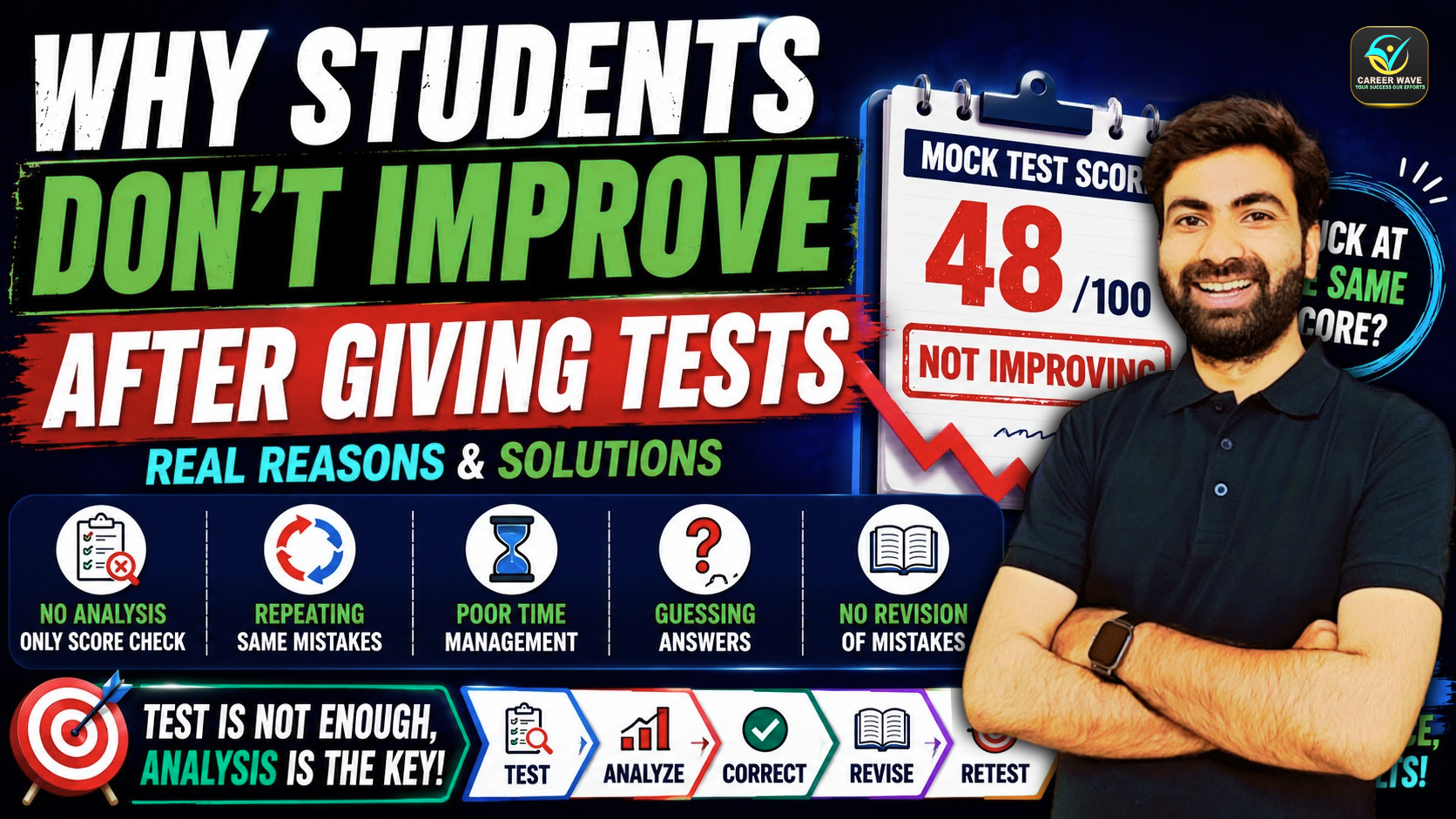
A detailed Career Wave guide
explaining why students do not improve even after giving multiple tests. Learn
how to analyze mock tests properly, identify repeated mistakes, improve
accuracy, manage time, maintain a mistake notebook, and follow the correct Test
→ Analyze → Correct → Revise → Retest method for better exam performance.
Why Students Don’t Improve After Giving Tests
A Practical
Guide for AAI ATC Aspirants by Career Wave
Many
students believe that giving more tests will automatically improve their score.
They attempt mock after mock, sectional test after sectional test, and still
their marks remain almost the same.
This is one
of the most common problems in competitive exam preparation.
The issue is
not always lack of effort. Many students are sincerely attempting tests. The
real issue is that they are not learning from those tests.
At Career
Wave, we always tell AAI ATC aspirants:
Tests do not
improve your score automatically. Test analysis improves your score.
A test is
useful only when it shows you what went wrong, why it went wrong, and how you
will correct it before the next test.
Why Giving
Tests Alone Is Not Enough
A test is
like a mirror. It shows your current level, but it does not fix your mistakes
by itself.
If a student
gives a test, checks the score, feels happy or sad, and then moves to the next
test, improvement will be slow.
To improve,
every test must answer these questions:
·
Which topics
are weak?
·
Which
mistakes are repeated?
·
Which
questions took too much time?
·
Where did
accuracy drop?
·
Which
questions should have been skipped?
·
Which
answers were guessed?
·
Which errors
were conceptual and which were careless?
Without this analysis, test
practice becomes only score checking.
1. Students Only Check Marks, Not Mistakes
The biggest
reason students do not improve after tests is that they focus only on marks.
After every
mock, they usually ask:
“How many
marks did you get?”
But a
serious aspirant should ask:
·
Why did I
lose marks?
·
Which
mistakes are repeated?
·
Which
section is weak?
·
Which
question wasted time?
·
Which
correct answer was a lucky guess?
·
Which topic
needs revision?
Marks show
the result. Mistakes show the reason.
If you check only marks, you know
where you stand.
If you analyze mistakes, you know how to move forward.
2. Students Repeat the Same Mistakes
Many
students make the same mistake in every test.
Example:
·
Same Physics
formula error
·
Same grammar
rule mistake
·
Same
calculation mistake
·
Same
reasoning puzzle time loss
·
Same GA
confusion
·
Same
answer-changing habit
If a mistake
is repeated, it means the student has not corrected the root cause.
A test
should not only expose mistakes. It should reduce them in the next attempt.
Career Wave recommends
maintaining a mistake notebook where every repeated error is written with its
correction.
3. Students Give the Next Test Without
Correction
This is a
very common problem.
A student
gives a mock on Sunday, scores low, feels bad, and gives another mock on Monday
without correcting Sunday’s mistakes.
Result?
The same
mistakes appear again.
The correct
process should be:
Test →
Analysis → Correction → Revision → Next Test
If you skip
the correction stage, your score will remain stuck.
Before
giving the next test, revise:
·
Mistake
notebook
·
Wrong
formulas
·
Weak
concepts
·
Repeated
grammar rules
·
Wrong GA
facts
·
Calculation
errors
·
Time-trap
questions
A new test should be attempted
only after learning from the previous one.
4. Students Do Not Categorize Mistakes
Every wrong
answer is not the same.
If you treat
all wrong answers equally, you will not know what exactly to improve.
Mistakes
should be divided into categories:
Conceptual
Mistake
You did not
know the concept or formula.
Correction:
Revise the topic and solve 20–30 similar questions.
Calculation
Mistake
You knew the
method but made an arithmetic or sign error.
Correction:
Practice timed calculation and note repeated patterns.
Reading
Mistake
You misread
the question or missed words like not, incorrect, least, maximum, minimum.
Correction:
Read slowly and highlight keywords mentally.
Time
Pressure Mistake
You rushed
due to less time.
Correction:
Improve section-wise time division.
Guessing
Mistake
You
attempted without logic.
Correction:
Use elimination or avoid blind guessing.
Overthinking
Mistake
Your first
answer was correct, but you changed it due to doubt.
Correction:
Follow the rule: no clear mistake, no answer change.
This classification makes
improvement targeted.
5. Students Ignore Correct Answers
Many
students analyze only wrong questions. This is incomplete.
Correct
answers also need checking.
Ask
yourself:
·
Was this
answer correct because I knew it?
·
Was it a
lucky guess?
·
Did I solve
it by the best method?
·
Did I take
too much time?
·
Could I
solve it faster?
·
Was my
concept fully clear?
Some correct
answers are accidental. If you ignore them, they may become wrong in the actual
exam.
Divide
correct answers into:
·
Confident
correct
·
Slow correct
·
Lucky
correct
·
Doubtful
correct
Lucky correct and doubtful
correct questions must be revised.
6. Students Do Not Analyze Time Management
Many
students know the topic but still lose marks because of time mismanagement.
They spend
too much time on one difficult question and later rush through easy questions.
After every
test, check:
·
Which
section took extra time?
·
Which
question wasted 3–5 minutes?
·
Did I rush
in the final part?
·
Did I leave
easy questions?
·
Did I start
with the wrong section?
·
Did I spend
too much time on calculation-heavy questions?
In AAI ATC,
time management is as important as knowledge.
A good test
analysis does not only ask:
Was my
answer correct?
It also
asks:
Was this question worth the time
I spent?
7. Students Do Not Identify Weak Topics
Clearly
After a
test, many students say:
“Physics is
weak.”
“It's Maths
week.”
“Reasoning
is weak.”
This is too
broad.
A serious
aspirant should identify exact weak areas.
Instead of
saying Physics is weak, say:
·
Current
Electricity circuit questions are weak.
·
Ray Optics
sign convention is weak.
·
EMI graphs
are confusing.
·
Semiconductor
logic gates need revision.
Instead of
saying Maths is weak, say:
·
Integration
standard formulas are weak.
·
Coordinate
geometry takes too much time.
·
Probability
questions are confusing.
Specific weakness can be
corrected. General weakness only creates fear.
8. Students Study More, But Not Better
When marks
do not improve, many students simply increase study hours. But sometimes the
issue is not quantity. The issue is direction.
A student
may study 8 hours daily and still repeat the same mistakes because they are not
fixing weak areas.
Improvement
comes from:
·
Targeted
revision
·
Repeated
error correction
·
PYQ-pattern
practice
·
Timed
sectional tests
·
Mistake
notebook revision
·
Mock
analysis
Studying more is useful only when
it is guided by test analysis.
9. Students Ignore Accuracy
Some
students only focus on attempts. They feel that attempting more questions means
better performance.
But if
attempts increase and accuracy decreases, score may not improve.
After every
test, calculate:
Accuracy =
Correct Questions ÷ Attempted Questions × 100
Example:
If you
attempted 100 questions and got 75 correct:
Accuracy =
75 ÷ 100 × 100 = 75%
Track
accuracy section-wise.
A good
improvement plan should increase both:
·
Attempt
count
·
Accuracy
percentage
For AAI ATC aspirants, accuracy
control is essential.
10. Students Panic After Low Scores
One low
score does not mean preparation is finished. It only means the test has shown a
weak area.
Many
students lose confidence after one bad mock and start changing books, teachers,
strategy, or course.
This creates
more confusion.
Instead of
panic, follow this approach:
·
Identify why
the score dropped.
·
Check if the
paper was difficult.
·
Analyze weak
sections.
·
Correct
repeated mistakes.
·
Revise the
mistake notebook.
·
Attempt a
sectional test before the next mock.
A low score is not failure. It is
feedback.
11. Students Do Not Revise Test Mistakes
Many
students analyze the test once but never revise those mistakes again.
This is why
errors repeat.
Mistake
revision should be part of the weekly schedule.
Every
Sunday, revise:
·
Wrong
questions
·
Marked
questions
·
Lucky
correct questions
·
Formula
mistakes
·
Grammar
mistakes
·
GA facts
·
Time-trap
questions
Your test mistakes are your most
personalized study material.
Career Wave’s Step-by-Step Test Improvement
Method
Career Wave
recommends this process after every test:
Step 1:
Check Score and Accuracy
Do not react
emotionally. Record the data.
Step 2:
Section-Wise Analysis
Check
performance in Physics, Maths, English, Reasoning, GA, and Aptitude.
Step 3:
Mistake Classification
Divide
mistakes into conceptual, calculation, reading, time pressure, guessing, and
overthinking mistakes.
Step 4:
Mistake Notebook
Write the
mistake, reason, correct approach, and revision date.
Step 5:
Correction Plan
Make a 2–3
day correction plan before the next test.
Step 6:
Retest Weak Areas
Give
sectional tests or topic tests for weak areas.
Step 7:
Track Progress
Compare
test-to-test improvement, not with other students.
Ideal Weekly Test Improvement
Cycle
|
Day |
Task |
|
Monday |
Analyze previous test |
|
Tuesday |
Correct conceptual mistakes |
|
Wednesday |
Practice weak topics |
|
Thursday |
Sectional test |
|
Friday |
Revise mistake notebook |
|
Saturday |
Full mock test |
|
Sunday |
Mock analysis + revision plan |
This cycle ensures that every
test improves your preparation.
Common Mistakes to Avoid
Avoid these
habits:
·
Giving too
many tests without analysis
·
Checking
only marks
·
Ignoring
silly mistakes
·
Not revising
wrong questions
·
Comparing
scores with others
·
Changing
strategy after every low score
·
Ignoring
time analysis
·
Repeating
the same weak topics
·
Not
maintaining a mistake notebook
·
Treating
mocks as final results
Career Wave’s Final Advice
If your
score is not improving after many tests, do not think that tests are useless.
The problem is not the test. The problem is the way you are using the test.
A test is
not the end of preparation. It is the beginning of correction.
Career
Wave’s message is clear:
Do not just
give tests. Learn from tests.
For AAI ATC
aspirants, improvement comes when every test is followed by honest analysis,
targeted correction, and disciplined revision.
Students do
not improve after giving tests because they treat tests as scorecards instead
of learning tools. They check marks but do not analyze mistakes, repeat the
same errors, ignore time management, skip correction, and give the next test
without preparation improvement.
To improve,
follow this formula:
Test →
Analyze → Correct → Revise → Retest
Career Wave helps students use
tests properly so that every mock becomes a step toward better accuracy,
stronger confidence, and final selection.
FAQs:
1. Why is my
score not improving even after giving many tests?
Your score may not improve if you
are not analyzing mistakes, not correcting weak topics, and not revising
previous errors before the next test.
2. Is giving
more tests enough for improvement?
No. More tests help only when
followed by proper analysis and correction. Without analysis, mistakes repeat.
3. How
should I analyze a test?
Check score, accuracy,
section-wise performance, mistake types, time usage, skipped questions, and
repeated weak areas.
4. Should I
analyze correct answers too?
Yes. Some correct answers may be
lucky guesses or slow solutions. These should also be reviewed.
5. What is
the best way to avoid repeating mistakes?
Maintain a mistake notebook and
revise it before every new test.
Related Blogs -
How Toppers Think During the AAI ATC Exam
Understanding Mental Fatigue in AAI ATC CBT
Why Solving Fewer Questions Can Mean Higher Marks
The ‘Safe Attempt Zone’ Concept Used by AAI ATC Toppers
ATC Full Test Series 2026 – Complete Mock Test Package for AAI ATC Preparation
Leave a Comment
22-Sep-2026 12:26 PM
Prepare for SSC IMD Scientific Assistant 2026 Physics Part-F with a structured strategy based on chapter-wise tests, PYQs, mixed practice, full-length mock tests, detailed solutions...
16-Sep-2026 01:04 PM
Explore the complete Career Wave IMD Scientific Assistant Physics Test Series 2026 with Previous Year Papers, sectional tests, full-length mock tests, detailed solutions, performance analytics,...
16-Sep-2026 11:55 AM
Understand why regular mock-test practice is essential for IMD Scientific Assistant 2026. Learn how mock tests improve speed, accuracy, time management, question selection, negative-marking control,...
15-Sep-2026 05:42 PM
Prepare for IMD Scientific Assistant Physics 2026 with the Career Wave Complete Part-F Physics Test Series. Practice chapter-wise tests, mixed tests and full mock tests...
15-Sep-2026 12:29 PM
Learn how to analyse mistakes in AAI AO PYQs and previous year papers. Identify concept errors, revision gaps, calculation mistakes, option confusion and silly mistakes...
14-Sep-2026 01:55 PM
Confused between AAI AO PYQs and mock tests? Learn what to practice first, when to start full mocks, how to analyse mistakes, and the best...
