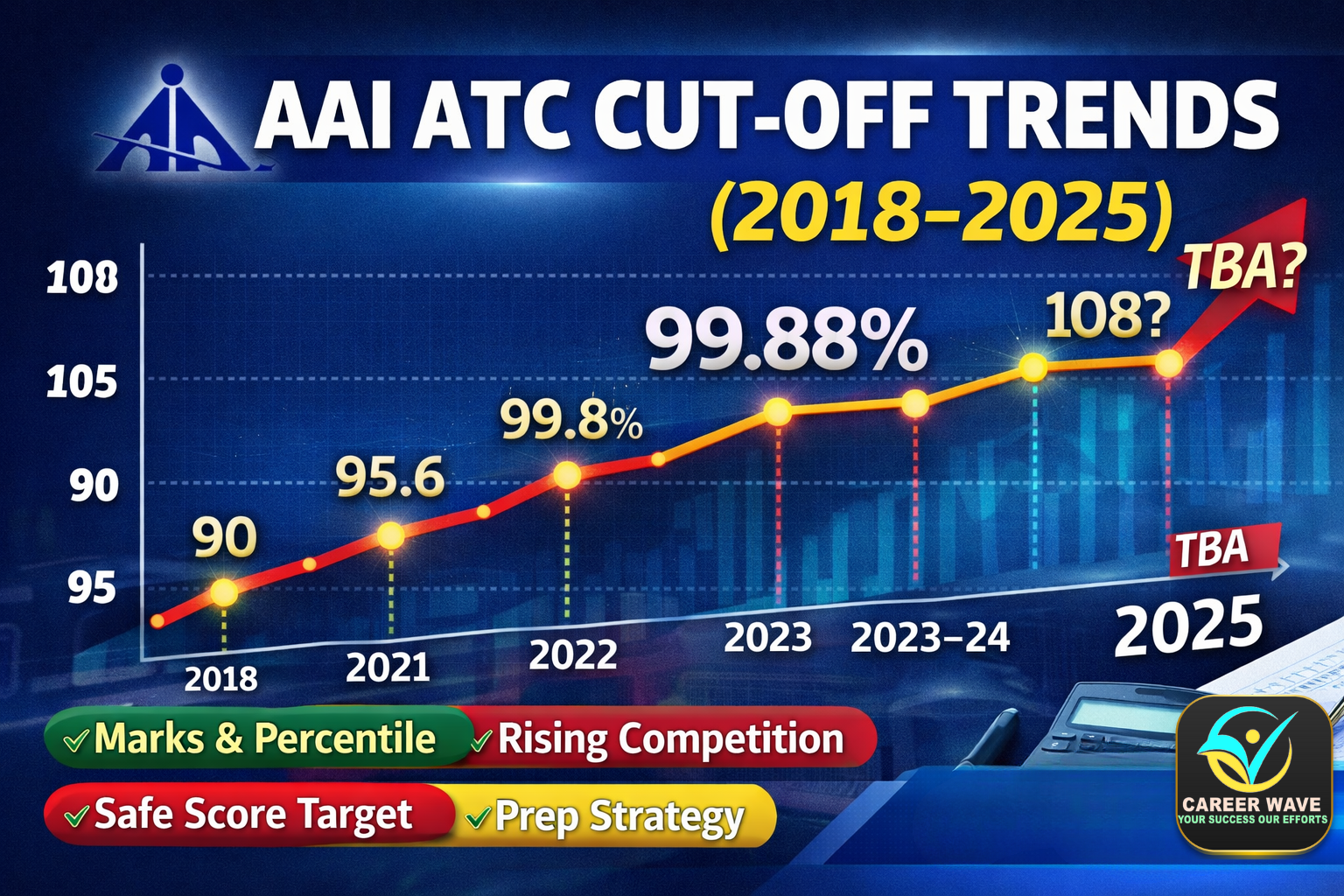
AAI ATC cutoff trends from 2018
to 2025 explained in detail. Understand marks vs percentile cutoffs, difficulty
level comparison, reasons behind rising cutoffs, expected cutoff for next
cycle, and an actionable study plan based on Career Wave’s analysis.
1. ATC Cutoff Trends (2018–2025)
|
Year |
Exam
Format |
General |
EWS |
OBC |
SC |
ST |
|
2018 |
Marks |
90.0 |
NA |
86.5 |
81.019 |
77.644 |
|
2021 |
Marks |
95.64 |
91.00 |
92.00 |
86.78 |
84.00 |
|
2022 |
Percentile |
99.82 |
99.61 |
99.60 |
98.67 |
98.001 |
|
2023
Feb |
Normalized Marks |
95.00 |
91.00 |
91.00 |
86.00 |
82.00 |
|
2023 Dec |
|
103.33 |
99.82 |
100 |
93.35 |
91.13 |
|
2025 |
Marks |
109 |
106.09 |
107 |
100.72 |
97 |
Trend: Competition increases every year → Cutoff also increases.
2. Percentile
Shift in 2022 – What Actually Happened?
Only the 2022 ATC cycle
used percentile cutoffs instead of direct marks. Reason: multi-shift CBT
where raw marks could not be compared directly; hence AAI normalized scores
similar to many national exams.
Key points:
·
A percentile
of 99.820 for GEN means the candidate scored better than 99.82% of
all test takers.
·
If 1,00,000
candidates appeared, 99.820 percentile roughly corresponds to being in the top
~180 candidates.
·
Percentile
is relative to others; raw marks can differ but percentile compares
positions.
From a strategy angle:
·
Don’t obsess
over converting percentile to marks;
·
Understand
that the relative rank needed in 2022 was tighter than any previous
year.
Later cycles (2023–24, 2025)
reverted to marks-based cutoffs, but the spirit of normalization
(fairness across shifts) remains.
3. Difficulty
Level Comparison (2018–2025)
Very
roughly, taking GEN CBT cutoffs as a proxy:
· 2018 – Moderate
paper, lower competition
o Cutoff 87/120 reflects moderate difficulty + smaller serious
crowd.
· 2021 – Slightly
easier or better-prepared crowd
o Cutoff 93/120 with similar pattern suggests either:
§ marginally easier paper or
§ more students coming with dedicated ATC preparation.
· 2022 – Multi-shift,
percentile >99.8
o Normalization + focused aspirant base made it a rank-war year;
difficulty varied shift-wise, but overall level was moderate—competition,
not toughness, pushed the bar high.
·
2023–24 – Cutoff >100
o GEN cutoff around 103/120, EWS/OBC near 99–100, indicates:
§ paper overall moderate, very few truly “hard” sections
§ serious aspirants leveraging PYQs + targeted tech prep.
·
2025 – GEN
108/120, max heat
o Highest cutoff yet; implies:
§ paper on the easier side overall, especially in Tech + English
§ very high awareness + large batch of repeaters with previous-cycle
experience.
Conclusion:
The papers are not becoming brutally difficult; instead, students are
becoming stronger and competition is denser.
4. Why Did
Cutoffs Jump After 2021?
The
post-2021 spike is structural, not random. Key reasons:
Net effect:
From a 2018 “good score = 90+” environment, we are now in a “safe score = 110
target” mindset for future cycles.
5. Graph
Representation – How to Visualize the Trend
notes, you can plot a
simple line graph:
·
X-axis: Year (2018, 2021, 2022, 2023–24, 2025)
· Y-axis: Cutoff value (marks or percentile, as appropriate)

Use two series:
I. CBT line (General)
o
2018: 87
o 2021: 93
o 2022: 99.820 (plot as “99.8 percentile”)
o 2023:94.755
o 2023: 103.06
o 2025: 108
II.
Final line
(General)
o
2018: 90.019
o 2021: 95.645
o 2022: 99.854 percentile
o 2023:95.000
o 2023: 103.33
o 2025: (leave blank / “TBA” – final not released yet)
Students instantly see a clear
upward slope from left to right, with 2022 as a percentile spike and 2025
as the highest marks-based cutoff.
6. Expected
Cutoff Range for the Next Cycle
Assuming:
·
Similar
paper difficulty (moderate, no surprise pattern change),
·
Similar or
slightly higher competition,
·
Same
no-negative-marking scheme,
A realistic target range for the
next ATC cycle (GEN category) would be:
·
GEN: 105–112 marks (safe)
·
EWS/OBC: ~3–5 marks lower than GEN
·
SC/ST: ~10–15 marks lower than GEN
This is not a prediction of
exact numbers, but a working target for preparation planning, built
on the 2018–2025 trend. Practical rule for students:
Prepare as if you need 110+
marks to feel genuinely safe, instead of aiming “just above last year’s
cutoff”.
7. Actionable
Study Plan Based on Cutoff Trend
7.1. Score Architecture – Where
should your marks come from?
For a 120-mark paper, design this
ideal distribution:
·
Technical
(Physics + Maths / Engg subjects): 65–75 marks
·
Non-Tech
(English, Reasoning, GA/Quant): 40–45 marks
·
Flex zone
/ buffer: 5–10 marks from your strongest area
With cutoffs touching 103–108,
you cannot afford a weak zone. You need one “power zone” and zero “disaster
zones”.
7.2. 90-Day Macro Plan
Phase 1 –
Foundation + PYQ Scanning (Day 1–30)
·
Finish all
ATC-relevant theory once with crisp notes.
·
Solve last 3–4
cycles of PYQs chapter-wise, tagging questions as Easy/Moderate/Tough. careerwave
·
Build a
personal “ATC Formula + Concept Sheet” for top-weight topics (Laws of Motion,
EM Waves, Optics, Current Electricity, Electrostatics, Semiconductors etc.).
Phase 2 –
Intensive Practice + Sectional Tests (Day 31–60)
·
4–5 full-length
sectional tests each week (Tech / Non-Tech alternating).
·
For every
test, compute:
o Raw score
o Attempt count
o Accuracy %
·
Your target
by Day 60: 100+ raw marks in at least 2–3 mock papers under strict exam
conditions.
Phase 3 –
Final Push + Full Mocks (Day 61–90)
·
8–12 full-length
CBT-style mocks (120 Q, 2 hrs, no breaks).
·
After each
mock:
o Redo all wrong + guessed questions.
o Note frequently missed chapters and revise them next day.
·
Try to
stabilise at 110–115 marks in the last 4–5 mocks.
7.3. Micro Daily Structure (for
serious aspirants)
A simple daily template:
a) 2 hours – Technical core
o Concept revision + 30–40 high-quality MCQs from ATC-relevant
topics.
b) 1 hour – Non-Tech
o 15–20 English Qs (RC, grammar, vocab)
o 15–20 Reasoning/Quant questions.
c) 1–1.5 hours – PYQ / Mock analysis
o Only ATC-labelled questions, not random.
d) Once a week – Full mock test
o Same time slot as actual exam; replicate real conditions.
Goal: Convert the cutoff trend
into a daily “score pressure”—you are not studying randomly; you are
studying to consistently beat 110 marks.
Leave a Comment
26-Oct-2026 11:21 AM
Want to crack AAI ATC 2026 with a smart and disciplined preparation strategy? Discover 25 daily habits of successful AAI ATC aspirants with Career Wave...
24-Oct-2026 12:21 PM
Preparing for AAI ATC 2026 but struggling with low mock scores, forgotten formulas, incomplete revision, or time management? Discover the 25 hidden challenges of AAI...
23-Oct-2026 01:25 PM
Is coaching really necessary to crack AAI ATC 2026, or can you succeed through self-study? Discover an honest comparison of AAI ATC online coaching, offline...
22-Oct-2026 11:53 AM
Starting AAI ATC 2026 preparation from zero? Discover how Satyendra Sir from Career Wave would prepare for the AAI ATC exam if starting again. Learn...
21-Oct-2026 05:46 PM
Want to score 110+ marks in AAI ATC 2026? Discover a complete subject-wise preparation strategy with Career Wave and Satyendra Sir. Learn how to maximize...
20-Oct-2026 01:39 PM
Discover the biggest myths about the AAI ATC Exam 2026 and learn the real facts about eligibility, exam difficulty, negative marking, syllabus, cutoffs, selection process,...
