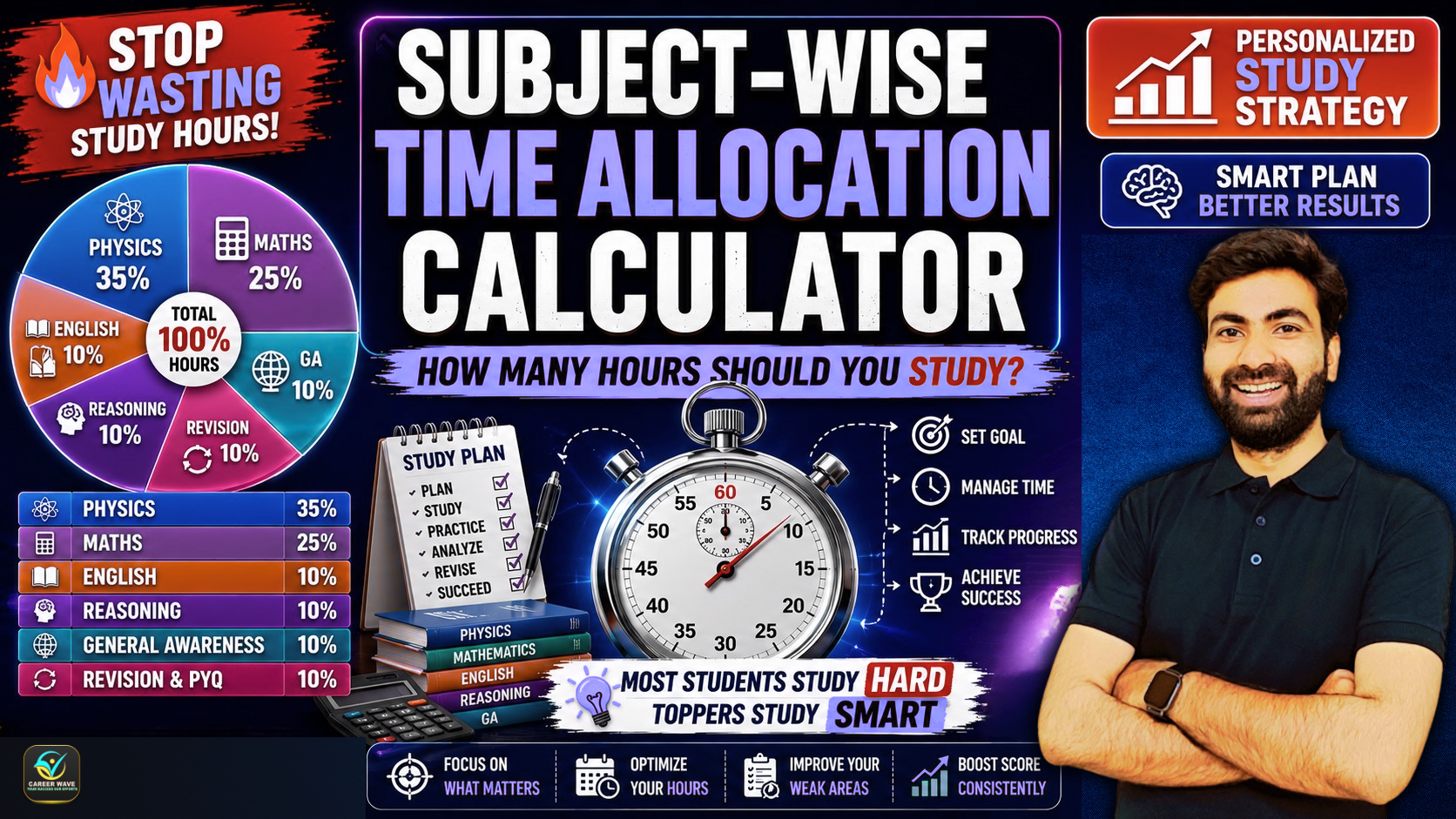
Confused about how much time to
give each subject during exam preparation? This detailed guide explains how to
use a Subject-wise Time Allocation Calculator to divide study hours based on
strengths, weaknesses, exam weightage, mock test performance, and available
study time. Learn how to create a personalized study plan with Career Wave's
scientific preparation approach.
Subject-wise Time Allocation Calculator:
Complete Guide for Smart Study Planning
Competitive
exam preparation is not only about how many hours you study. It is also about
where you invest those hours. Many students study seriously, but their time
distribution is poor. They give too much time to their favourite subject and
very little time to weak or scoring areas.
This is why
a Subject-wise Time Allocation Calculator is important.
It helps
students decide how much time they should give to each subject based on exam
weightage, personal weakness, mock test score, available study hours, and
revision need.
At Career Wave, we always guide
students to prepare with a scientific study plan. Random hard work creates
pressure. Planned hard work creates results.
What is a Subject-wise Time Allocation
Calculator?
A
Subject-wise Time Allocation Calculator is a simple planning method that tells
you how to divide your daily or weekly study hours among different subjects.
It answers
questions like:
·
How much
time should I give to Physics?
·
How much
time should I give to Mathematics?
·
Should I
spend more time on weak subjects?
·
How much
time should be reserved for PYQs?
·
How much
time should be kept for revision?
·
When should
mock tests be included?
Instead of copying someone else’s
timetable, this calculator helps you create a personal study plan.
Why Equal Time Distribution is Not Always
Correct
Many
students think that if there are five subjects, they should give equal time to
all five subjects. This sounds fair, but it is not always effective.
Every
subject is different.
Some
subjects carry more weightage.
Some subjects are more difficult.
Some subjects need daily practice.
Some subjects need more revision.
Some subjects are already strong for you.
Some subjects are weak and need extra attention.
For example,
if a student is strong in English but weak in Mathematics, giving equal time to
both is not smart. Mathematics needs more time until the weakness improves.
The purpose of time allocation is
not equality. The purpose is score improvement.
Why Students Need a Time Allocation
Calculator
A
calculator-based study plan helps because it removes guesswork.
It helps
you:
·
Use
available time properly
·
Give
priority to high-weightage subjects
·
Improve weak
areas
·
Maintain
strong subjects
·
Add PYQs and
mocks in routine
·
Avoid
overstudying one subject
·
Reduce
preparation stress
·
Build a
balanced timetable
This is especially useful for
students preparing for exams like AAI ATC, SSC CHSL, SSC CGL, Railway, Banking,
Defence, and other competitive exams.
Main Factors for Subject-wise Time Allocation
A good time
allocation plan should be based on five major factors.
1. Exam
Weightage
Subjects
with higher marks or more questions should usually get more time.
For example,
in AAI ATC, Physics and Mathematics usually need strong attention because they
are core technical areas. But English, Reasoning, General Awareness, and
Aptitude should not be ignored because they also contribute to final score.
If a subject
has high weightage, it deserves regular time in your daily routine.
2. Current
Preparation Level
You must
honestly judge your level in each subject.
Use three
categories:
Strong
Average
Weak
Strong
subjects need maintenance.
Average subjects need regular improvement.
Weak subjects need extra time.
For example:
If your
Physics is strong, you may need 1 hour daily for revision and PYQs.
If your Maths is weak, you may need 2 to 3 hours daily.
If your GA is weak, you may need daily revision in small slots.
3. Subject
Difficulty
Some
subjects need deeper understanding.
Physics
requires concepts and formulas.
Mathematics requires practice and speed.
Reasoning requires pattern recognition.
English requires grammar and vocabulary.
General Awareness requires memory and revision.
A difficult
subject should get more focused time, especially if it is also high-weightage.
4. Mock Test
Performance
Mock tests
show the real picture.
Students
often assume they are good in a subject, but mock scores reveal actual
accuracy.
After every
mock, check:
·
Which
subject had low score?
·
Which
subject consumed more time?
·
Which
subject had silly mistakes?
·
Which
subject had low accuracy?
·
Which
section created pressure?
Your next
week’s timetable should be based on this analysis.
5. Available
Study Hours
A full-time
student, college student, and working professional cannot follow the same plan.
For example:
Full-time
aspirant: 6–8 hours daily
College student: 4–5 hours daily
Working professional: 3–4 hours daily
The calculator should work
according to your available time, not according to an ideal timetable.
Basic Formula for Subject-wise Time
Allocation
Career Wave
recommends this simple rule:
Strong
subject: Give maintenance time
Average subject: Give improvement time
Weak subject: Give correction time
A practical
percentage model:
Strong
subject: 10–15% of study time
Average subject: 20–25% of study time
Weak subject: 30–40% of study time
This can be
adjusted according to exam weightage.
Example 1:
Student Studying 8 Hours Daily
Suppose a
student is preparing for AAI ATC and can study 8 hours daily.
Current
level:
Physics:
Average
Mathematics: Weak
English: Strong
Reasoning: Average
General Awareness: Weak
Recommended
allocation:
Mathematics:
2.5 hours
Physics: 2 hours
General Awareness: 1 hour
Reasoning: 1 hour
English: 45 minutes
PYQ and Revision: 45 minutes
This plan
gives extra time to weak and important areas while maintaining strong subjects.
Example 2:
Student Studying 6 Hours Daily
Current
level:
Physics:
Weak
Mathematics: Average
English: Strong
Reasoning: Strong
General Awareness: Average
Recommended
allocation:
Physics: 2
hours
Mathematics: 1.5 hours
General Awareness: 45 minutes
English: 30 minutes
Reasoning: 30 minutes
PYQ and Revision: 45 minutes
Here,
Physics gets the highest time because it is weak and important.
Example 3:
Working Student Studying 4 Hours Daily
Current
level:
Physics:
Average
Mathematics: Weak
English: Average
Reasoning: Strong
General Awareness: Weak
Recommended
allocation:
Mathematics:
1.25 hours
Physics: 1 hour
General Awareness: 45 minutes
English: 30 minutes
Reasoning: 15 minutes
Revision/PYQ: 30 minutes
Working students should keep the
plan compact and focused.
AAI ATC Subject-wise Time Allocation Model
For AAI ATC
aspirants, a balanced model can be:
Physics:
30–35%
Mathematics: 25–30%
English: 10–15%
Reasoning: 10–15%
General Awareness: 10–15%
PYQ + Revision: 10–15%
This model can be modified based
on your mock score.
SSC CHSL/CGL Subject-wise Time Allocation
Model
For SSC
aspirants:
Quantitative
Aptitude: 30–35%
Reasoning: 20–25%
English: 20–25%
General Awareness: 15–20%
Mock + Revision: 10–15%
If a student is weak in English
or GA, extra time should be added there.
How to Use the Calculator Step by Step
Step 1:
Write Your Total Study Hours
First, write
how many focused hours you can study daily.
Example:
3 hours
5 hours
8 hours
Do not write
unrealistic hours.
Step 2: List
All Subjects
Write all
subjects of your target exam.
Example for
AAI ATC:
Physics
Mathematics
English
Reasoning
General Awareness
Aptitude
Step 3: Mark
Your Level
Against
every subject, write:
Strong
Average
Weak
Be honest.
Your timetable should be based on truth, not confidence.
Step 4: Add
Exam Weightage
Mark
subjects as:
High
weightage
Medium weightage
Low weightage
High-weightage
weak subjects should get maximum time.
Step 5:
Check Mock Test Score
Use mock
results to verify your self-assessment.
If you think
English is strong but mock accuracy is low, then English is not strong yet.
Step 6:
Assign Time
Now divide
your total study hours.
Priority
order:
Weak + high
weightage
Average + high weightage
Weak + medium weightage
Strong + high weightage
Strong + low weightage
Step 7: Keep
Revision Time Separate
Never
include revision inside subject study time.
Revision
deserves separate time.
Minimum
revision:
30 minutes
daily for beginners
45–60 minutes daily for serious aspirants
1–2 hours daily in final phase
Step 8:
Review Every Week
Your
timetable should not remain fixed forever.
Every
Sunday, check:
·
Which
subject improved?
·
Which
subject is still weak?
·
Which
section took more time in mock?
·
Which
mistakes are repeated?
·
Which topic
needs extra time?
Then update next week’s
allocation.
Sample Weekly Time Allocation Table
If a student
studies 42 hours per week:
Physics: 12
hours
Mathematics: 10 hours
English: 4 hours
Reasoning: 4 hours
General Awareness: 4 hours
PYQs: 4 hours
Revision: 4 hours
This gives proper balance.
Monthly Allocation Strategy
In the first
phase of preparation:
Concepts:
50%
Practice: 25%
PYQs: 15%
Revision: 10%
In the
middle phase:
Practice:
35%
PYQs: 25%
Revision: 20%
Mocks: 20%
In the final
phase:
Mocks: 30%
Revision: 30%
PYQs: 20%
Weak topics: 20%
This phase-wise change is very
important.
Why Weak Subjects Need More Time
Many
students avoid weak subjects because they feel uncomfortable. This is a major
mistake.
Weak
subjects reduce final score.
If you are
weak in a subject, you should not run away from it. You should divide it into
smaller parts and improve step by step.
For example,
if Maths is weak:
First revise
formulas.
Then solve basic examples.
Then solve PYQs.
Then attempt sectional tests.
Then analyse mistakes.
Weak subjects improve only with
planned practice.
Why Strong Subjects Should Not Be Ignored
Some
students give all time to weak subjects and completely ignore strong subjects.
This is also wrong.
Strong
subjects give confidence and scoring advantage.
You should
give maintenance time to strong subjects through:
·
PYQs
·
Short
revision
·
Formula
recall
·
Sectional
tests
·
Mock
analysis
A strong subject can become weak
if ignored for many weeks.
Role of PYQs in Time Allocation
PYQs must be
included in every weekly plan.
PYQs help
you understand:
·
Actual exam
pattern
·
Repeated
topics
·
Question
level
·
Important
concepts
·
Time demand
Career Wave recommends solving
PYQs topic-wise first and then revising them in mixed format.
Role of Mock Tests in Time Allocation
Mock tests
are the mirror of preparation.
They help
you check:
·
Accuracy
·
Speed
·
Time
management
·
Weak areas
·
Exam
temperament
Mock test
time should include two parts:
Test attempt
Test analysis
If your mock is 2 hours, analysis
should also take proper time. Without analysis, mock practice is incomplete.
Common Mistakes in Subject-wise Time
Allocation
1. Copying
Topper Timetable
Your level
is different. Your time should be different.
2. Studying
Favourite Subject Too Much
This gives
emotional satisfaction but not always score improvement.
3. Ignoring
Weak Subject
Weak
subjects decide selection margins.
4. No
Revision Slot
Without
revision, preparation fades.
5. No PYQ
Slot
Without
PYQs, preparation becomes directionless.
6. Not
Updating Timetable
Your
timetable should change after mock analysis.
7. Studying
Too Many Subjects in One Day
Too much switching reduces focus.
Keep 3–4 major blocks per day.
Career Wave’s Smart Allocation Advice
Career Wave
suggests students follow this practical model:
Daily:
One
technical or major subject
One second major subject
One non-technical/scoring subject
One PYQ or practice block
One revision block
Weekly:
One
sectional test
One full mock or mixed test
One weak-topic correction session
One complete revision session
Monthly:
One full
performance review
One updated study plan
One major revision cycle
This makes preparation structured
and measurable.
Final Conclusion
A
Subject-wise Time Allocation Calculator is not just a timetable tool. It is a
smart preparation system.
It helps
students decide:
·
What to
study
·
How much to
study
·
When to
revise
·
Where to
give extra time
·
How to
improve mock score
The best
preparation is not equal preparation. The best preparation is need-based
preparation.
Give more
time to weak and high-weightage subjects. Maintain strong subjects. Revise
daily. Solve PYQs regularly. Analyse mocks honestly.
At Career
Wave, we believe that smart planning plus consistent execution is the real
formula for selection.
A student who studies with proper
subject-wise time allocation will always be ahead of a student who studies
randomly.
FAQs
1. What is a
Subject-wise Time Allocation Calculator?
It is a planning method that
helps students divide study hours among subjects based on exam weightage,
difficulty level, personal strengths, weaknesses, and mock performance.
2. Why
should students use subject-wise time allocation?
It helps students use study time
properly, improve weak subjects, maintain strong subjects, and increase overall
score.
3. Should I
give equal time to all subjects?
No. Equal time is not always
effective. Give more time to weak and high-weightage subjects.
4. How do I
know which subject needs more time?
Check your mock test score,
accuracy, time taken, and comfort level in each subject. Weak and low-scoring
subjects need more time.
5. How much
time should I give to Physics for AAI ATC?
Most AAI ATC aspirants should
give around 30–35% of their total study time to Physics, depending on their
level.
Leave a Comment
09-Sep-2026 12:05 PM
Learn the best AAI AO Full Mock Test Strategy 2026 to manage exam time effectively. Career Wave and Satyendra Sir explain section order, two-round attempt...
08-Sep-2026 02:40 PM
Learn how to improve accuracy in AAI JE Airport Operations 2026 mock tests and reduce silly mistakes. Career Wave and Satyendra Sir explain practical strategies...
08-Sep-2026 10:51 AM
Discover why mock tests are essential for AAI JE Airport Operations 2026 preparation. Learn how Full Mock Tests and Sectional Tests help improve speed, accuracy,...
07-Sep-2026 03:52 PM
Prepare for AAI JE Airport Operations 2026 with Career Wave’s exam-focused Test Series. Get Full-Length Mock Tests, Sectional Tests, latest pattern-based questions, detailed solutions, performance...
07-Sep-2026 11:27 AM
Check the complete IMD Scientific Assistant Physics Syllabus 2026 for Part-F as per the official SSC JE 2026 notification. Get chapter-wise topics including Mathematical Methods,...
05-Sep-2026 12:01 PM
Get the complete IMD Scientific Assistant Exam Pattern 2026 explained by Career Wave. Check Paper 1 and Paper 2 pattern, total questions, marks, duration, negative...
