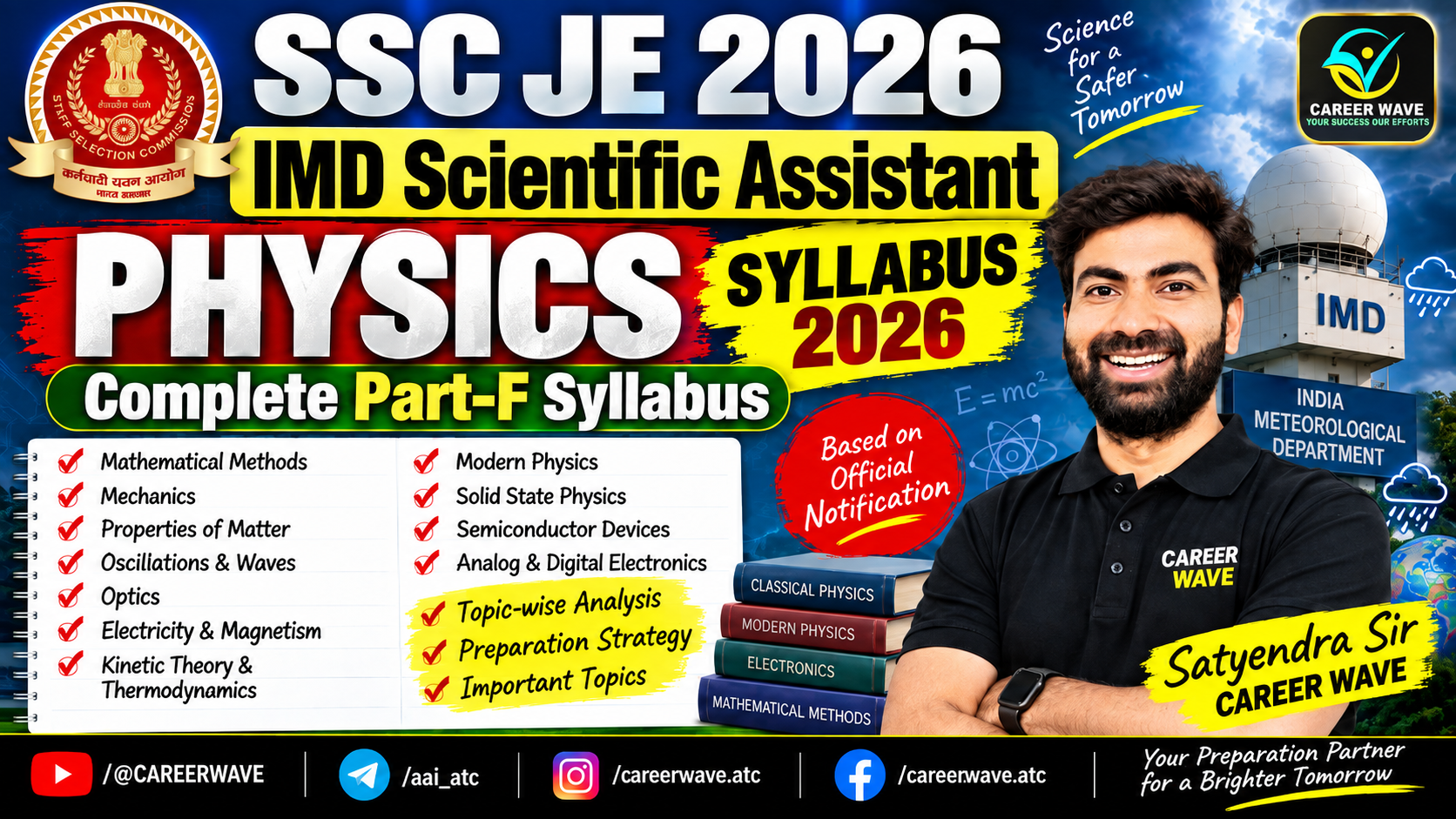
Check the complete IMD
Scientific Assistant Physics Syllabus 2026 for Part-F as per the official
SSC JE 2026 notification. Get chapter-wise topics including Mathematical
Methods, Mechanics, Optics, Electricity, Magnetism, Thermodynamics, Modern
Physics, Solid State Physics, Semiconductor Devices and Electronics, along with
preparation guidance from Career Wave and Satyendra Sir.
IMD Scientific Assistant Physics Syllabus
2026: Complete Part-F Syllabus
The IMD
Scientific Assistant 2026 Physics syllabus is extensive and clearly set at
approximately Graduation Level. Candidates opting for Part-F Physics
in the SSC Junior Engineer Examination 2026 must prepare not only basic Class
11–12 Physics but also several higher-level topics from undergraduate Physics.
For students
preparing with Career Wave, Satyendra Sir recommends following
the official syllabus line by line. Random preparation or studying only
familiar chapters can leave major gaps, especially because the same technical
subject is relevant in both Paper 1 and Paper 2.
According to the official
notification, the Part-F Physics syllabus includes the following major units:
Mathematical Methods, Mechanics, General Properties of Matter, Oscillations,
Waves, Optics, Electricity, Magnetism, Kinetic Theory, Thermodynamics, Modern
Physics, Solid State Physics, Semiconductor Devices, and Analog & Digital
Electronics.
IMD Scientific Assistant Physics Syllabus
2026: Quick Overview
Part-F
Physics Major Units
1.
Mathematical
Methods
2.
Mechanics
3.
General
Properties of Matter
4.
Oscillations
5.
Waves
6.
Optics
7.
Electricity
8.
Magnetism
9.
Kinetic
Theory
10. Thermodynamics
11. Modern Physics
12. Solid State Physics
13. Semiconductor Devices
14. Analog and Digital Electronics
The official notification states
that the standard of Physics questions will be approximately equivalent to the Graduation
Level.
1. Mathematical Methods
The
Mathematical Methods section includes:
·
Calculus
·
Integral
Calculus
·
Differential
Equations
·
Fourier
Series
·
Taylor
Expansion
·
Vector
Algebra
·
Vector
Calculus
·
Integral
Theorems
·
Linear
Algebra
·
Complex
Numbers
·
Statistics
·
Error
Analysis
This section
is important because mathematical tools are used throughout Mechanics,
Electricity, Magnetism, Waves and Modern Physics.
Career Wave
Preparation Focus
Students
should be comfortable with:
·
differentiation
·
integration
·
basic
differential equations
·
vectors
·
matrices
·
complex-number
applications
·
approximation
methods
·
errors and
uncertainty
2. Mechanics
The official
syllabus includes:
·
Newton’s
Laws of Motion and applications
·
Coordinate
systems and kinematics
·
Inertial and
non-inertial frames
·
Centrifugal
force
·
Coriolis
force
·
Motion under
a central force
·
Kepler’s
Laws
·
Gravitational
Law
·
Conservative
and non-conservative forces
·
System of
particles
·
Conservation
laws
·
Elastic and
inelastic collisions
·
Moment of
inertia
·
Rigid body
dynamics
Important
Preparation Areas
Students
should focus on:
·
force and
motion
·
rotational
dynamics
·
center of
mass
·
momentum
conservation
·
energy
conservation
·
angular
momentum
·
planetary
motion
·
collisions
·
non-inertial
frames
According to Satyendra Sir,
Mechanics should be prepared conceptually because many questions can combine
formulas with physical interpretation.
3. General Properties of Matter
This unit
includes:
·
Elasticity
·
Surface
tension
·
Viscosity
·
Fluid
dynamics
·
Kinematics
of moving fluids
·
Equation of
continuity
·
Euler’s
equation
·
Bernoulli’s
theorem
Important
Concepts
·
Stress and
strain
·
Elastic
constants
·
Surface
energy
·
Capillarity
·
Viscous
force
·
Stokes’ law
·
Streamline
flow
·
Continuity
equation
·
Bernoulli
applications
This is generally a
formula-driven area, but conceptual understanding is still necessary.
4. Oscillations
The
Oscillations syllabus contains:
·
Simple
Harmonic Oscillator
·
Superposition
of two or more SHMs
·
Lissajous
figures
·
Damped
oscillations
·
Forced
oscillations
·
Resonance
·
Quality
factor
·
Bandwidth
Key Focus
Students
should understand:
·
SHM
equations
·
energy in
SHM
·
phase
difference
·
resonance
conditions
·
damping
·
forced
motion
·
Q-factor and
bandwidth
5. Waves
The official
syllabus includes:
·
Wave
equation
·
Travelling
waves
·
Standing
waves in one dimension
·
Energy
density
·
Energy
transmission of waves
·
Group
velocity
·
Phase
velocity
·
Sound waves
·
Doppler
effect
High-Value
Areas
·
progressive
wave equation
·
stationary
waves
·
nodes and
antinodes
·
phase
velocity vs group velocity
·
sound
propagation
·
Doppler
effect numericals
6. Optics
The Optics
section is broad and includes:
Geometrical
Optics
·
Fermat’s
Principle
·
Reflection
·
Refraction
·
Mirrors
·
Lenses
·
Image
formation
Wave Optics
·
Interference
·
Diffraction
·
Rayleigh
Criterion
·
Resolving
Power
·
Diffraction
Gratings
Polarization
·
Linear
polarization
·
Circular
polarization
·
Elliptic
polarization
·
Double
refraction
·
Optical
rotation
Career Wave
Focus
Students
should prepare both theory and numericals from:
·
lenses and
mirrors
·
interference
·
diffraction
·
resolving
power
·
polarization
7. Electricity
The
Electricity section includes:
·
Coulomb’s
Law
·
Electric
field
·
Electric
potential
·
Gauss’s Law
·
Conductors
and dielectrics
·
Polarization
and bound charges
·
Capacitors
and capacitance
·
Electrostatic
energy
·
Boundary
conditions
·
Laplace
equation
·
Boundary
value problems
·
Electric
current
·
Current
density
·
Ohm’s Law
·
DC circuits
·
AC circuits
·
RC, LC and
LCR circuits
·
Resonance in
AC circuits
Most
Important Areas
·
electrostatics
·
Gauss law
·
capacitance
·
dielectric
behavior
·
current
electricity
·
network
concepts
·
AC circuits
·
resonance
This is one of the most important
units for Part-F Physics.
8. Magnetism
The official
syllabus includes:
·
Magnetic
field
·
Biot-Savart
Law
·
Ampere’s
Circuital Law
·
Magnetic
vector potential
·
Lorentz
force
·
Motion of
charged particles in electric and magnetic fields
·
Electromagnetic
induction
·
Faraday’s
Law
·
Self
induction
·
Mutual
induction
·
Maxwell’s
equations
·
Displacement
current
·
Electromagnetic
waves
·
Poynting
vector
·
Energy flow
·
Reflection
and transmission of electromagnetic waves
Preparation
Focus
Pay special
attention to:
·
magnetic
force
·
charged-particle
motion
·
induction
·
inductance
·
Maxwell
equations
·
EM waves
·
Poynting
vector
9. Kinetic Theory
The Kinetic
Theory section includes:
·
Kinetic
theory postulates
·
Ideal gas
equation
·
Pressure and
temperature
·
Degree of
freedom
·
Equipartition
theorem
·
Specific
heat of monoatomic, diatomic and triatomic gases
·
Maxwell’s
velocity distribution
·
Most
probable velocity
·
Mean
velocity
·
RMS velocity
·
Mean free
path
·
Van der
Waals gas
·
Equation of
state
Important
Areas
·
equipartition
theorem
·
degrees of
freedom
·
specific
heat
·
RMS speed
·
Maxwell
distribution
·
mean free
path
·
real gas
equation
10. Thermodynamics
The official
syllabus includes:
·
Laws of
Thermodynamics
·
Isothermal
process
·
Adiabatic
process
·
Isobaric
process
·
Isochoric
process
·
Entropy
·
Reversible
processes
·
Irreversible
processes
·
Quasi-static
processes
·
Carnot cycle
·
Heat engines
·
Efficiency
·
Maxwell
thermodynamic relations
·
Thermodynamic
potentials
·
Phase
transitions
·
Clausius-Clapeyron
equation
·
Microstate
and macrostate concepts
·
Ensembles
·
Maxwell-Boltzmann
distribution
·
Fermi-Dirac
distribution
·
Bose-Einstein
distribution
This is a
large unit and should not be limited only to basic thermodynamic laws.
Career Wave
Advice
Students
should cover:
·
first and
second law
·
entropy
·
thermodynamic
processes
·
Carnot
engine
·
thermodynamic
potentials
·
statistical
distributions
11. Modern Physics
Modern
Physics is another major area.
The syllabus
includes:
·
Inertial
frames
·
Galilean
invariance
·
Special
theory of relativity
·
Black body
radiation
·
Photoelectric
effect
·
Compton
effect
·
De Broglie
waves
·
Uncertainty
principle
·
X-rays
·
Schrödinger
equation
·
Particle in
one, two and three dimensional boxes
·
Harmonic
oscillator
·
Potential
step
·
Potential
barrier
·
Tunneling
·
Bohr atom
·
Atomic
spectra
·
Pauli
exclusion principle
·
Structure of
atomic nucleus
·
Mass and
binding energy
·
Radioactivity
·
Applications
of radioactivity
·
Laws of
radioactive decay
High-Priority
Topics
·
photoelectric
effect
·
Compton
effect
·
de Broglie
wavelength
·
uncertainty
principle
·
Bohr model
·
Schrödinger
equation
·
nuclear
binding energy
·
radioactivity
·
relativity
basics
12. Solid State Physics
The official
syllabus includes:
·
Crystal
structure
·
Unit cell
·
Lattice
parameters
·
Bravais
lattices
·
Basis
·
Crystal
systems
·
Miller
indices
·
Crystal
planes
·
Crystal
directions
·
X-ray
diffraction
·
Bragg’s Law
·
Band theory
of solids
·
Conductors
·
Semiconductors
·
Insulators
·
Energy bands
·
Fermi energy
·
Fermi level
·
Intrinsic
semiconductors
·
Extrinsic
semiconductors
·
Carrier
concentration
·
Conductivity
·
Variation of
resistivity with temperature
Important
Areas
·
crystal
lattices
·
Miller
indices
·
Bragg law
·
energy-band
theory
·
Fermi level
·
semiconductor
conductivity
13. Semiconductor Devices
This unit
contains:
·
PN junction
diode
·
Diode
characteristics
·
Zener diode
·
Zener diode
applications
·
Rectifiers
·
Bipolar
Junction Transistor
·
Common Base
configuration
·
Common
Emitter configuration
·
Common
Collector configuration
·
Transistor
characteristics
Preparation
Focus
Students
should be comfortable with:
·
diode
characteristics
·
breakdown
·
rectification
·
BJT working
·
transistor
configurations
·
current gain
relations
14. Analog and Digital Electronics
The official
syllabus includes:
Analog
Electronics
·
Single-stage
amplifiers
·
Two-stage
RC-coupled amplifiers
·
Simple
oscillators
·
Sinusoidal
oscillators
·
Barkhausen
condition
·
Operational
amplifiers
·
OPAMP
applications
·
Inverting
amplifier
·
Non-inverting
amplifier
·
Integrator
·
Differentiator
Digital
Electronics
·
Boolean
algebra
·
Binary
number system
·
Number-system
conversion
·
Binary
addition
·
Binary
subtraction
·
AND gate
·
OR gate
·
NOT gate
·
NAND gate
·
NOR gate
·
XOR gate
·
Combination
of gates
·
Truth tables
·
De Morgan’s
theorem
Career Wave
Focus
This unit can be highly scoring
if prepared properly because many questions are direct and rule-based.
IMD Scientific Assistant Physics Syllabus:
Preparation Priority
A practical
priority order can be:
Priority 1
·
Electricity
·
Magnetism
·
Modern
Physics
·
Thermodynamics
·
Mechanics
Priority 2
·
Optics
·
Oscillations
·
Waves
·
Solid State
Physics
·
Semiconductor
Devices
Priority 3
·
Mathematical
Methods
·
General
Properties of Matter
·
Kinetic
Theory
·
Analog &
Digital Electronics
This order is a preparation
strategy from Career Wave, not an official SSC weightage list.
Paper 1 and Paper 2: Same Physics Base
Candidates
should remember that Part-F Physics is relevant in both stages.
Paper 1
Technical
subject forms part of the 200-mark paper.
Paper 2
The
technical subject is the core of the 300-mark paper.
Therefore, Satyendra Sir
recommends preparing Physics at full depth from the beginning rather than
preparing only enough for Paper 1.
How to Prepare Part-F Physics with Career
Wave
A practical
approach is:
Step 1:
Complete the Official Syllabus
Do not leave
any unit completely untouched.
Step 2:
Build Formula Sheets
Maintain
chapter-wise formulas for quick revision.
Step 3:
Solve PYQs
PYQs help
identify the actual style of numerical and conceptual questions.
Step 4:
Topic Tests
After every
unit, attempt chapter-wise tests.
Step 5:
Mixed Revision
Combine
related topics such as:
·
Electricity
+ Magnetism
·
SHM + Waves
·
Modern
Physics + Semiconductor
·
Thermodynamics
+ Kinetic Theory
Step 6:
Full-Length Tests
Move to complete technical mocks
once the syllabus is largely covered.
Final Summary
The IMD
Scientific Assistant Part-F Physics Syllabus 2026 is a full
graduation-level Physics syllabus covering mathematical methods, classical
mechanics, matter properties, oscillations, waves, optics, electricity,
magnetism, kinetic theory, thermodynamics, modern physics, solid state,
semiconductors, and electronics.
Students
preparing with Career Wave and Satyendra Sir should follow the official
syllabus systematically and avoid selective preparation.
The correct
approach is:
Concepts → Formula Revision →
PYQs → Topic Tests → Mixed Practice → Full Mocks
FAQs –
1. What is
Part-F in IMD Scientific Assistant 2026?
Part-F is the Physics
technical subject for eligible candidates applying for Scientific Assistant
in IMD.
2. What is
the level of Physics in IMD Scientific Assistant?
The official notification states
that Physics questions will be approximately at the Graduation Level.
3. Is Class
11 and 12 Physics enough?
No. The syllabus includes several
graduation-level areas such as Maxwell equations, thermodynamic potentials,
statistical distributions, Schrödinger equation, crystal structure and advanced
electronics topics.
4. How many
major units are there in Part-F Physics?
The syllabus can be broadly
divided into 14 major units.
5. Is
Mathematical Methods included?
Yes. Calculus, differential
equations, Fourier series, vectors, linear algebra, complex numbers, statistics
and error analysis are included.
6. Is Modern
Physics included?
Yes. Modern Physics is a major
part of the syllabus and includes relativity, quantum concepts, atomic physics
and nuclear physics.
7. Is
Electronics included in the Physics syllabus?
Yes. Semiconductor Devices and
Analog & Digital Electronics are explicitly included.
8. Is
Thermodynamics included?
Yes. Thermodynamics includes both
classical thermodynamics and topics such as thermodynamic potentials and
statistical distributions.
9. Is Solid
State Physics included?
Yes. Crystal structures, Bravais
lattices, Miller indices, diffraction, band theory and semiconductor concepts
are included.
10. Does the
syllabus include Maxwell’s equations?
Yes. Maxwell’s equations,
displacement current, EM waves and Poynting vector are included under
Magnetism.
11. Is
Optics part of the syllabus?
Yes. Both geometrical optics and
wave optics are included.
12. Is
Mathematical Physics important?
Yes. Mathematical Methods support
several other units and should not be ignored.
Connect With Career Wave
YouTube:
https://www.youtube.com/@CAREERWAVE
Telegram:
https://t.me/aai_atc
Instagram:
https://www.instagram.com/careerwave.atc
Facebook:
https://www.facebook.com/careerwave.atc
Career Wave — Prepare the complete syllabus, revise smartly and build exam-level accuracy with Satyendra Sir.
Leave a Comment
23-Oct-2026 01:25 PM
Is coaching really necessary to crack AAI ATC 2026, or can you succeed through self-study? Discover an honest comparison of AAI ATC online coaching, offline...
22-Oct-2026 11:53 AM
Starting AAI ATC 2026 preparation from zero? Discover how Satyendra Sir from Career Wave would prepare for the AAI ATC exam if starting again. Learn...
21-Oct-2026 05:46 PM
Want to score 110+ marks in AAI ATC 2026? Discover a complete subject-wise preparation strategy with Career Wave and Satyendra Sir. Learn how to maximize...
20-Oct-2026 01:39 PM
Discover the biggest myths about the AAI ATC Exam 2026 and learn the real facts about eligibility, exam difficulty, negative marking, syllabus, cutoffs, selection process,...
19-Oct-2026 03:47 PM
Prepare for the AAI Junior Executive Airport Operations 2026 exam with Career Wave's complete last 7 days revision strategy by Satyendra Sir. Get a day-wise...
15-Oct-2026 05:09 PM
Explore the complete AAI Junior Executive Airport Operations 2026 exam pattern with Career Wave and Satyendra Sir. Get details about 120 questions, 120 marks, 2-hour...
