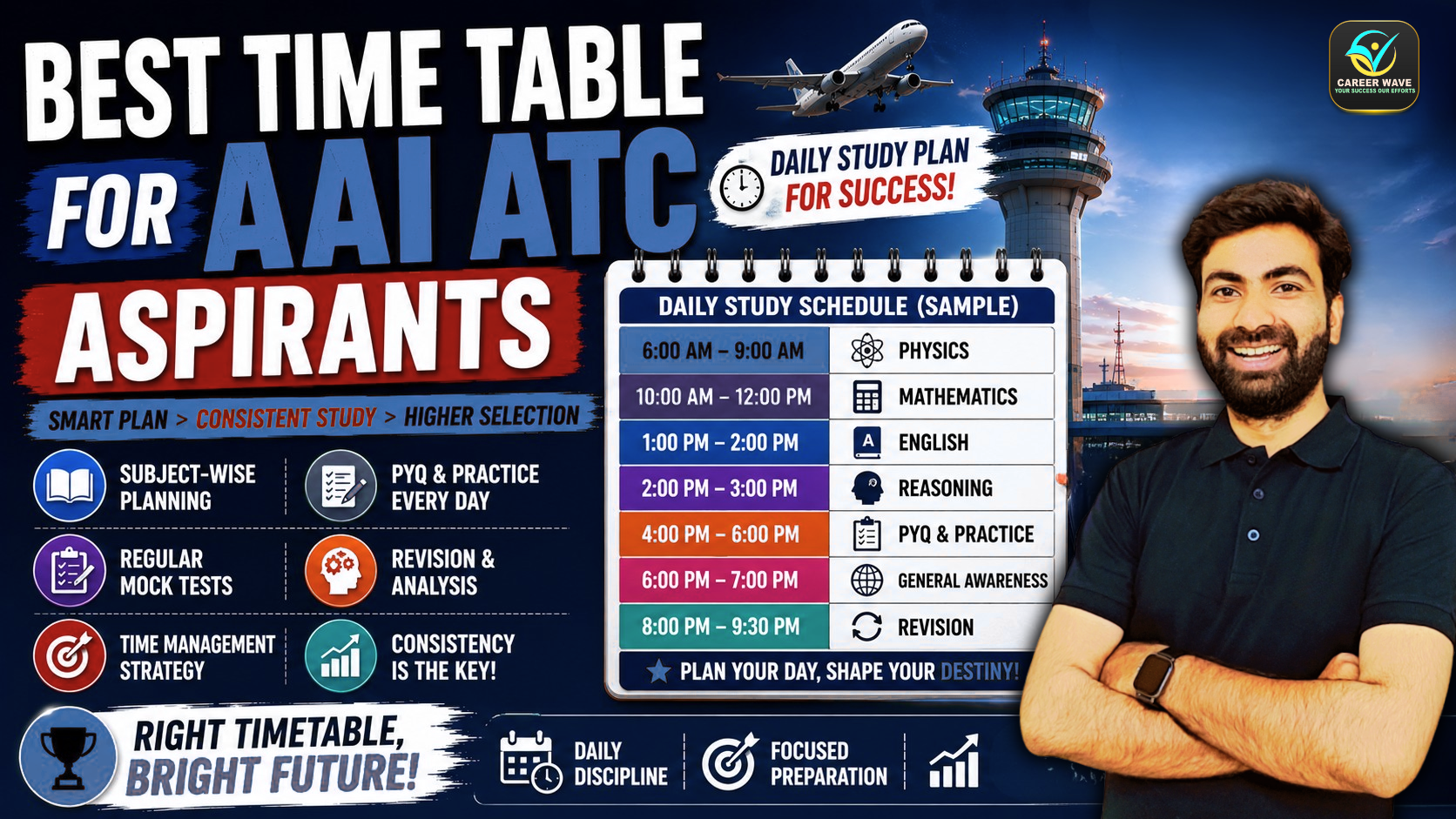
Looking for the best study timetable for AAI ATC preparation? This detailed guide covers daily, weekly, and monthly study plans for full-time aspirants, college students, and working professionals. Learn how to balance Physics, Mathematics, English, Reasoning, General Awareness, PYQs, mock tests, and revision with Career Wave's exam-oriented strategy.
Best Time Table for AAI ATC Aspirants:
Complete Study Plan
AAI ATC
preparation needs consistency, clarity, and a proper daily timetable. Many
students study for long hours but still do not get results because their
preparation is not balanced. They study Physics and Maths for many hours but
ignore English, Reasoning, General Awareness, PYQs, revision, and mock
analysis.
A good
timetable does not mean studying 12–14 hours daily. A good timetable means
studying the right subjects at the right time with proper revision and
practice.
At Career Wave, we always guide
AAI ATC aspirants to follow a realistic timetable that can be followed daily. A
perfect timetable is useless if it is not practical. A simple timetable
followed consistently can give better results than a complicated timetable
followed only for a few days.
1) Why AAI ATC Aspirants Need a Proper
Timetable
AAI ATC is a
competitive exam that requires preparation in both technical and non-technical
sections. Students must manage multiple subjects together.
The main
areas are:
·
Physics
·
Mathematics
·
English
·
Reasoning
·
General
Awareness
·
General
Aptitude
·
PYQs
·
Mock Tests
·
Revision
Without a
timetable, students usually make three common mistakes.
First, they
study only their favourite subjects. Second, they delay revision. Third, they
keep mocks and PYQs for the last phase.
This reduces
the final score.
A proper
timetable helps in:
·
Daily
syllabus coverage
·
Balanced
subject preparation
·
Regular PYQ
solving
·
Formula
revision
·
Mock test
practice
·
Time
management
·
Avoiding
backlog
· Reducing stress before exam

2) Best Study Hours for AAI ATC
There is no
fixed number of hours that works for every student. A college student, a
working professional, and a full-time aspirant cannot follow the same
timetable.
However, for
serious preparation:
·
Full-time
aspirants: 6–8 focused hours daily
·
College
students: 4–5 focused hours daily
·
Working
professionals: 3–4 focused hours daily
·
Final
revision phase: 7–9 focused hours, if possible
The key word is focused. Eight
distracted hours are not useful. Four focused hours with PYQ practice and
revision can be more productive.
3) Golden Rule of AAI ATC Timetable
The best
timetable should follow this daily structure:
Concept
Learning
PYQ Practice
Practice Sheet
Revision
Mock or Sectional Test
Mistake Analysis
This means
you should not only study theory. You must also practise and test yourself.
The best
preparation order is:
Concept → PYQ → Practice Sheet →
Test → Analysis → Revision
4) Full-Time Aspirant Timetable
This
timetable is suitable for students who can study full-time and have 6–8 hours
daily.
Morning
Session: 6:00 AM to 9:00 AM
Subject:
Physics
Morning is
the best time for technical subjects because the mind is fresh. Physics needs
concentration, formulas, concepts, and numerical practice.
Use this
session for:
·
New concept
learning
·
Formula
understanding
·
NCERT-based
concept clarity
·
Numerical
practice
·
Chapter-wise
PYQs
Example:
6:00 AM –
7:30 AM: Concept
7:30 AM – 8:15 AM: Formula revision
8:15 AM – 9:00 AM: PYQs or practice questions
Physics
should not be studied only by reading. Every topic must be followed by
questions.
Break: 9:00
AM to 10:00 AM
Take
breakfast and rest. Avoid scrolling social media immediately after study. This
break should refresh your mind.
Mid-Morning
Session: 10:00 AM to 12:00 PM
Subject:
Mathematics
Maths
requires daily practice. Many students know formulas but lose marks due to slow
speed and calculation mistakes.
Use this
session for:
·
Formula
revision
·
Concept-based
questions
·
Calculation
practice
·
PYQs
·
Practice
sheets
Example:
10:00 AM –
10:45 AM: Formula and concept
10:45 AM – 11:30 AM: Solved examples and practice
11:30 AM – 12:00 PM: PYQs
Maths should
be practised daily. If you skip Maths for many days, speed decreases.
Lunch Break:
12:00 PM to 1:00 PM
Take lunch
and rest. Do not make this break too long. Long breaks disturb the rhythm.
Afternoon
Session 1: 1:00 PM to 2:00 PM
Subject:
English
English is
scoring if practised daily. Students often ignore English and later lose easy
marks.
Focus on:
·
Grammar
rules
·
Error
detection
·
Fill in the
blanks
·
Vocabulary
·
Synonyms and
antonyms
·
Reading
comprehension
·
Sentence
improvement
Daily 45–60
minutes is enough if done consistently.
Afternoon
Session 2: 2:00 PM to 3:00 PM
Subject:
Reasoning
Reasoning
improves through regular practice, not only theory.
Focus on:
·
Series
·
Analogy
·
Classification
·
Coding-decoding
·
Blood
relation
·
Direction
sense
·
Syllogism
·
Seating
arrangement
·
Puzzle
basics
·
Venn diagram
·
Order and
ranking
Keep
reasoning practice time-bound. This improves speed.
Break: 3:00
PM to 4:00 PM
Take rest,
walk, exercise, or power nap. A tired mind cannot solve technical questions
properly.
Evening
Session: 4:00 PM to 6:00 PM
Subject: PYQ
and Practice Sheet
This is one
of the most important sessions.
Use this
time for:
·
Chapter-wise
PYQs
·
Mixed PYQs
·
Practice
sheets
·
Previous
mistakes
·
Weak topics
Many
students study theory but do not practise enough. This session converts theory
into marks.
Evening
Session: 6:00 PM to 7:00 PM
Subject:
General Awareness
General
Awareness cannot be completed in the last week. It should be prepared daily in
small portions.
Focus on:
·
Current
affairs
·
Static GK
·
Indian
polity
·
Geography
·
Economy
basics
·
Basic
science
·
Aviation-related
awareness
Study less
but revise more.
Dinner
Break: 7:00 PM to 8:00 PM
Take dinner
and relax.
Night
Session: 8:00 PM to 9:30 PM
Subject:
Revision and Mistake Analysis
This session
decides your retention.
Revise:
·
Physics
formulas
·
Maths
formulas
·
Mistake
notebook
·
Wrong PYQs
·
Important
facts
·
Short notes
Do not sleep
without revision. Daily revision reduces exam pressure.
Planning
Session: 9:30 PM to 10:00 PM
Plan the
next day.
Write:
·
Topics to
study tomorrow
·
PYQs to
solve
·
Weak area to
revise
·
Test target
·
Backlog, if
any
This habit keeps your preparation
organized.
5) Best Timetable for College Students
College
students usually have limited time. They should avoid unrealistic plans.
A practical
timetable can be:
Morning: 1
hour
Physics or Maths formula revision
College
break: 20–30 minutes
Vocabulary, current affairs, formulas
Evening: 2
hours
Physics or Maths concept and PYQ
Night: 1.5
hours
English, Reasoning, and revision
Before
sleeping: 30 minutes
Mistake notebook or formula revision
Total
productive time: 4–5 hours daily
On weekends,
college students should give:
·
One
sectional test
·
One full
mock, if syllabus is sufficient
·
Weekly
revision
·
Backlog
completion
6) Best Timetable for Working Professionals
Working
aspirants must follow a very focused plan because time is limited.
Morning:
6:00 AM to 7:30 AM
Physics or Maths
Lunch break
or commute: 20–30 minutes
Current affairs or vocabulary
Evening:
8:00 PM to 10:00 PM
Concept + PYQ practice
Night: 10:00
PM to 10:30 PM
Formula revision or mistake notebook
Weekend:
·
3–4 hours
technical subjects
·
2 hours
non-technical subjects
·
1 full mock
·
Mock
analysis
·
Weekly
revision
Working students should not
compare their study hours with full-time students. Their success depends on
consistency and smart planning.
7) 3-Month Timetable Strategy
If the exam
is near and you have around 3 months, follow this plan.
Month 1:
Concept + PYQ
Focus on:
·
Important
chapters
·
Formula
notes
·
Chapter-wise
PYQs
·
Basic
English
·
Basic
Reasoning
·
Daily GA
Target:
·
Build
syllabus base
·
Understand
exam pattern
·
Identify
weak areas
Month 2:
Practice + Sectional Tests
Focus on:
·
Practice
sheets
·
Topic-wise
tests
·
Sectional
tests
·
Speed
improvement
·
Accuracy
improvement
·
Weak-topic
correction
Target:
·
Convert
knowledge into performance
Month 3:
Mock + Revision
Focus on:
·
Full-length
mocks
·
PYQ revision
·
Formula
revision
·
Mistake
notebook
·
GA revision
·
Final
strategy
Target:
·
Improve exam
temperament
·
Reduce
mistakes
·
Maximize
score
8) Weekly Timetable for AAI ATC
A strong
weekly timetable should look like this:
Monday to
Friday:
·
Concept
learning
·
PYQ practice
·
Formula
revision
·
English/Reasoning/GA
rotation
Saturday:
·
Sectional
test
·
Practice
sheet
·
Weak-topic
correction
Sunday:
·
Full mock
·
Mock
analysis
·
Weekly
revision
·
Next week
planning
Sunday should not be a full
holiday during serious preparation. It can be a lighter day, but revision and
test analysis should be done.
9) Subject-Wise Time Distribution
A balanced
daily distribution can be:
Physics:
30–35%
Mathematics: 25–30%
English: 10–15%
Reasoning: 10–15%
General Awareness: 10–15%
If your
Physics is weak, increase Physics time. If your non-technical score is low,
increase English, Reasoning, and GA time.
The timetable must be flexible
according to your performance.
10) How to Use PYQs in Timetable
PYQs should
be included daily.
Best method:
·
Complete a
topic
·
Solve PYQs
of that topic
·
Mark
repeated concepts
·
Note
difficult questions
·
Revise wrong
questions after 3 days
·
Revise again
after 10 days
Do not treat PYQs as one-time
practice. PYQs should be revised multiple times.
11) How to Use Mock Tests in Timetable
Mock tests
should be introduced gradually.
Initial
phase:
·
One
sectional test per week
Middle
phase:
·
Two
sectional tests per week
·
One mixed
test
Final phase:
·
Two to three
full mocks per week
·
Daily mock
analysis or correction
Do not give mocks only to check
marks. Give mocks to improve performance.
12) Mistake Notebook in Daily Timetable
A mistake
notebook is compulsory for serious aspirants.
Write:
·
Wrong
formulas
·
Repeated
silly mistakes
·
Weak
concepts
·
Wrong PYQs
·
Mock
mistakes
·
Important
facts
·
Time
management errors
Revise this
notebook daily for 20–30 minutes.
Many students improve their score
only by reducing repeated mistakes.
13) Career Wave Recommended Daily Formula
Career Wave
recommends this formula for AAI ATC aspirants:
Daily:
·
2 technical
sessions
·
1
non-technical session
·
1 PYQ or
practice session
·
1 revision
session
Weekly:
·
1 sectional
test
·
1 mock or
mixed test
·
1 full
revision cycle
·
1 weak-topic
correction day
Monthly:
·
Complete one
major revision cycle
·
Analyse mock
performance
·
Update
strategy
This keeps preparation balanced
and selection-oriented.
14) Common Mistakes in Timetable Planning
Avoid these
mistakes:
1. Making an
Unrealistic Timetable
A 14-hour
timetable looks good on paper but usually fails in real life. Make a timetable
you can follow.
2. Ignoring
Non-Technical Subjects
English,
Reasoning, and GA can increase your final score. Do not ignore them.
3. Studying
Without Revision
Without
revision, you will forget formulas and concepts.
4. Giving
Mocks Without Analysis
Mock test
without analysis is incomplete preparation.
5. No Breaks
Breaks are
important for focus and long-term consistency.
6. Copying
Someone Else’s Timetable
Your timetable should match your
level, routine, and weak areas.
15) Final Conclusion
The best
timetable for AAI ATC aspirants is not the one with maximum study hours. It is
the one that balances all subjects and can be followed consistently.
A good
timetable must include:
·
Physics
·
Mathematics
·
English
·
Reasoning
·
General
Awareness
·
PYQs
·
Practice
sheets
·
Mock tests
·
Revision
·
Mistake
analysis
At Career
Wave, we always advise students to prepare with a realistic and disciplined
approach. Selection does not come from random hard work. Selection comes from
structured hard work.
Follow a
timetable that is simple, practical, and exam-oriented.
Study daily.
Practise daily. Revise daily. Analyse mistakes weekly.
This is the real formula for AAI
ATC preparation.
16) FAQs
1. What is
the best timetable for AAI ATC aspirants?
The best timetable includes daily
Physics, Mathematics, one non-technical subject, PYQ practice, revision, and
regular mock analysis.
2. How many
hours should I study daily for AAI ATC?
Full-time aspirants should study
6–8 focused hours daily. College students can manage 4–5 hours, and working
professionals can study 3–4 focused hours daily.
3. Should I
study Physics and Maths every day?
Yes. Physics and Maths need daily
practice because they are concept-based and formula-based subjects.
4. How much
time should I give to English and Reasoning?
Give at least 45–60 minutes daily
to English and Reasoning combined, or rotate them on alternate days.
5. How much
time is enough for General Awareness?
Around 30–60 minutes daily is
enough if you revise regularly.
6. When
should I solve PYQs?
Solve PYQs immediately after
completing each topic. Revise them again during weekly and monthly revision.
7. How often
should I attempt mock tests?
In the beginning, attempt
sectional tests weekly. In the final phase, attempt two to three full mocks per
week.
Related Blogs -
Is Coaching Necessary for AAI ATC? A Detailed Reality Check
Work-Life Balance in ATC Job: Reality
How to Convert AAI ATC Knowledge into Marks
Leave a Comment
09-Sep-2026 12:05 PM
Learn the best AAI AO Full Mock Test Strategy 2026 to manage exam time effectively. Career Wave and Satyendra Sir explain section order, two-round attempt...
08-Sep-2026 02:40 PM
Learn how to improve accuracy in AAI JE Airport Operations 2026 mock tests and reduce silly mistakes. Career Wave and Satyendra Sir explain practical strategies...
08-Sep-2026 10:51 AM
Discover why mock tests are essential for AAI JE Airport Operations 2026 preparation. Learn how Full Mock Tests and Sectional Tests help improve speed, accuracy,...
07-Sep-2026 03:52 PM
Prepare for AAI JE Airport Operations 2026 with Career Wave’s exam-focused Test Series. Get Full-Length Mock Tests, Sectional Tests, latest pattern-based questions, detailed solutions, performance...
07-Sep-2026 11:27 AM
Check the complete IMD Scientific Assistant Physics Syllabus 2026 for Part-F as per the official SSC JE 2026 notification. Get chapter-wise topics including Mathematical Methods,...
05-Sep-2026 12:01 PM
Get the complete IMD Scientific Assistant Exam Pattern 2026 explained by Career Wave. Check Paper 1 and Paper 2 pattern, total questions, marks, duration, negative...
