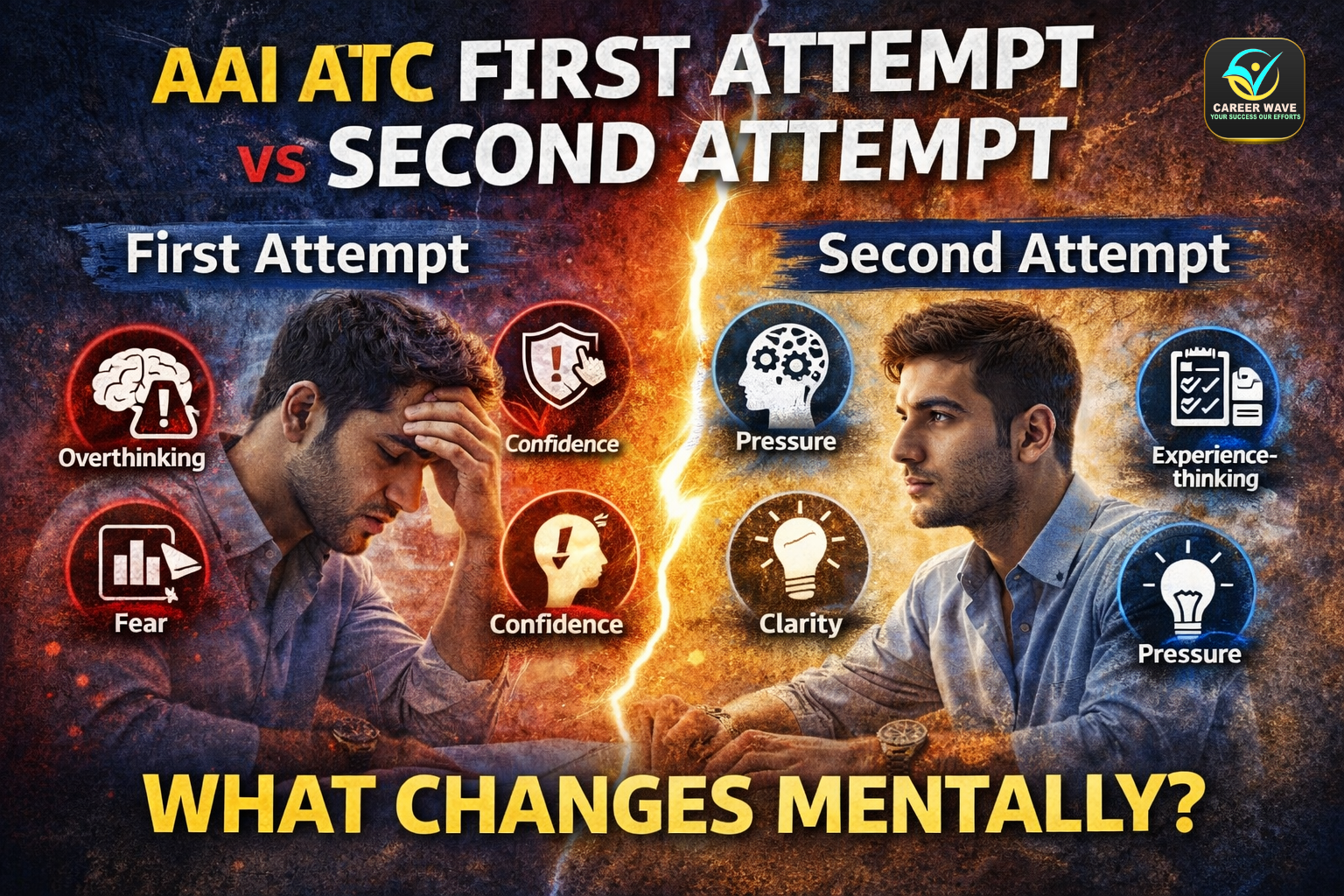
Between first-attempt and second-attempt AAI ATC aspirants, there is not only a difference in preparation but also a major difference in mindset. In this blog, we will explore in detail how candidates mentally change from their first attempt to their second attempt, which psychological mistakes tend to repeat, and how one can make their mindset truly exam-ready.
AAI ATC First Attempt vs Second Attempt: What
Changes Mentally?
The
Psychological Shift Nobody Prepares You For
Every year,
thousands of intelligent, hardworking students appear for the AAI ATC
(Junior Executive – Air Traffic Control) exam.
Most of them don’t fail because they lack knowledge.
They fail because their mind behaves differently in the exam hall than in
the study room.
If you’ve
given one attempt already—or you’re preparing for your first serious
attempt—this blog will help you understand what really changes mentally
between the first and second attempt, and how to use that shift to your
advantage.
Why Mental State Matters More Than Syllabus
in AAI ATC
AAI ATC is
not a memory-based exam.
It is a pressure-handling exam.
You are
tested on:
·
Speed +
accuracy
·
Decision-making
under time pressure
·
Emotional
stability during uncertainty
·
Ability to
recover after mistakes
This is why
two students with the same preparation level often get very different
results.
1) The First Attempt Mindset: Hope,
Overconfidence & Hidden Fear
1.1. Illusion of “I’ll Manage Somehow”
In the first
attempt, most students believe:
·
“Paper will
be easy”
·
“I’ll
attempt maximum questions”
·
“I’ve done
PYQs, that’s enough”
This
optimism feels positive—but it often leads to:
·
Poor time
management
·
No clear
attempt strategy
·
Guessing
under pressure
👉 Result: Marks
collapse despite preparation
1.2. Underestimating Exam-Day Pressure
Mock tests
are taken casually:
·
Paused
midway
·
No penalty
fear
·
No real
consequence
But in the
real exam:
·
One wrong
click feels costly
·
One tough
question shakes confidence
·
Timer
suddenly feels faster
First-time candidates are mentally
untrained for this shock.
1.3. Fear of the Unknown
First
attempt candidates silently fear:
·
New question
patterns
·
Unexpected
difficulty
·
Losing marks
early
This fear
causes:
·
Rushing easy
questions
·
Freezing on
moderate ones
·
Emotional
instability after one mistake
The Result
of the First Attempt
After the
exam, students usually say:
·
“Paper was
doable, but…”
·
“I knew this
question, still messed up”
·
“Time
management went wrong”
·
“Silly
mistakes cost me”
This is the turning point.
2) The Second Attempt Mindset: Awareness,
Pressure & Maturity
The second
attempt is mentally heavier, but also more powerful—if handled
correctly.
2.1. Reality Replaces Assumptions
Second-attempt
students now know:
·
Exam
pressure is real
·
One section
can dominate the paper
·
Guesswork is
dangerous
·
Accuracy
matters more than attempts
This awareness changes how they
study and attempt.
2.2. Pressure Increases (This Is the Trap)
With
experience comes pressure:
·
“This might
be my last chance”
·
“I can’t
afford another failure”
·
“Everyone
expects me to clear now”
If
unmanaged, this leads to:
·
Overthinking
simple questions
·
Fear-based
skipping
·
Loss of
natural problem-solving flow
👉
Many second-attempt students fail not due to lack of knowledge, but due
to excess pressure.
2.3. Better Strategy, Worse Calm (Initially)
Second-attempt
students usually have:
·
Clear
attempt order
·
Stronger
weak areas
·
Better exam
awareness
But
emotionally, they may be:
·
Less relaxed
than first attempt
·
More
self-critical
·
More afraid
of mistakes
This contradiction decides
success or failure.
Key Mental Differences: First vs
Second Attempt
|
Aspect |
First Attempt |
Second Attempt |
|
Confidence |
False / borrowed |
Earned but fragile |
|
Pressure |
Low |
High |
|
Strategy |
Vague |
Clear |
|
Mistake handling |
Panic |
Either control or collapse |
|
Awareness |
Theoretical |
Practical |
|
Risk-taking |
High |
Calculated |
|
Emotional control |
Weak |
Learnable |
3) Why Many Students Fail Even in Second
Attempt
Let’s be
honest.
Second-attempt
failure usually happens due to:
·
Carrying first-attempt
regret into the exam
·
Trying to
attempt too perfectly
·
Playing
defensively instead of smartly
·
Overloading
the brain with revision till the last day
·
Fear of
repeating the same mistakes
AAI ATC doesn’t reward fear.
It rewards clarity + composure.
4) How Toppers Think Differently in Their
Second Attempt
Clearing
candidates usually do three mental shifts:
4.1. They Stop Chasing Attempts
Instead of:
“I must
attempt 90+ questions”
They think:
“I will
secure my strong areas first.”
4.2. They Accept Imperfection
They don’t
panic after a wrong question.
They reset mentally and move on.
This skill
alone can improve your score by 10–15 marks.
4.3. They Treat the Exam as a Process, not a judgment
They focus on:
·
One question
at a time
·
One section
at a time
·
One decision
at a time
Not on:
·
Cutoffs
·
Previous
failure
·
Future
result
5) First-Time Aspirants: What You Must Learn
Early
If this is
your first attempt, don’t wait to learn the hard way.
Start
training:
·
Timed mocks
seriously
·
Pressure
simulation
·
Error
analysis, not just score analysis
·
Calm
thinking under time stress
Your first attempt can become
your last attempt—if your mindset is right.
6) Second-Time Aspirants: Your Biggest
Advantage
You already
have:
·
Exam reality
exposure
·
Pattern
clarity
·
Mistake
awareness
Your only
task now:
👉 Control
pressure, don’t let pressure control you
Second attempt is not about
studying more.
It’s about thinking better.
7) Final Truth (Read This Twice)
AAI ATC is
not cleared by:
·
The most
intelligent student
·
The one who
studied longest
·
The one who
solved most questions
It is
cleared by:
The student
whose mind stays stable when the exam tries to shake it.
Whether it’s your first
attempt or second, your mindset will decide more than your notes.
Career Wave
Final Advice
Treat preparation as mental
training, not just syllabus completion.
Because in AAI ATC, the real competition starts inside your head.
FAQs: AAI ATC First Attempt vs Second Attempt
(Student Doubts Answered)
Q1. Is the AAI ATC second attempt harder than
the first attempt?
No, the exam
level remains the same.
What changes is the mental pressure. In the second attempt, students
feel higher expectations and fear of failure, which makes the exam feel
harder—even though the paper isn’t.
Q2. Do second-attempt candidates have an
advantage over first-time candidates?
Yes—mentally
and strategically.
Second-attempt candidates understand:
·
Real exam
pressure
·
Time
management reality
·
Negative
marking impact
But this
advantage works only if pressure is controlled. Otherwise, it becomes a
disadvantage.
Q3. Many students fail despite good
preparation. Why?
Because AAI
ATC tests:
·
Calmness
under pressure
·
Decision-making
speed
·
Emotional
stability
Most
failures happen due to:
·
Panic after
one wrong question
·
Overtempting
·
Loss of
focus mid-exam
This is a psychological
failure, not a syllabus failure.
Q4. Is it normal to feel more nervous in the
second attempt?
Yes,
completely normal.
Second-attempt nervousness usually comes from:
·
“This is my
last chance” thinking
·
Fear of
repeating mistakes
·
External
expectations
The key is
to convert nervous energy into alertness, not fear.
Q5. How many attempts are usually needed to
clear AAI ATC?
There is no
fixed number.
Some clear in the first attempt, many in the second, and some
even later.
What matters
is:
·
How quickly
you correct mistakes
·
How well you
adapt mentally
·
How strong
your exam-day strategy is
Q6. Should first-time aspirants worry about
mental pressure now?
Not
worry—but prepare for it.
First-time
aspirants should:
·
Take
full-length mocks seriously
·
Practice
under strict time limits
·
Learn to
move on after mistakes
Mental training from day one can
make your first attempt your final attempt
Helpful links-
AAI ATC Is Not Hard — It Is Misunderstood (Truth Explained)
Why 90% Aspirants Prepare Extra Topics That Never Get Asked
AAI ATC Exam Pattern 2026 – Marks, Sections & Time Management
.
Leave a Comment
10-Apr-2026 11:06 AM
Understand the real reason why AAI ATC aspirants often score less in mock tests but perform better in the actual exam. This detailed analysis by...
09-Apr-2026 04:03 PM
Explore detailed AAI ATC cutoff trends from 2018 to 2025 with category-wise analysis, safe score targets, and expert insights from Career Wave. Understand how cutoff...
09-Apr-2026 12:54 PM
Confused between score and rank in AAI ATC exam? Learn how to predict your selection using mock scores, accuracy, and real competition trends. A practical...
08-Apr-2026 11:53 AM
Most AAI ATC aspirants fail not because of lack of effort, but due to lack of proper guidance and strategy. In this detailed guide, understand...
07-Apr-2026 12:56 PM
Confused between test series and self-study for AAI ATC preparation? This detailed guide explains what actually works, how toppers prepare, and why combining both is...
07-Apr-2026 11:17 AM
Discover the exact daily study routine followed by AAI ATC top rankers. Learn how to plan your day, improve accuracy, manage time, and boost your...
