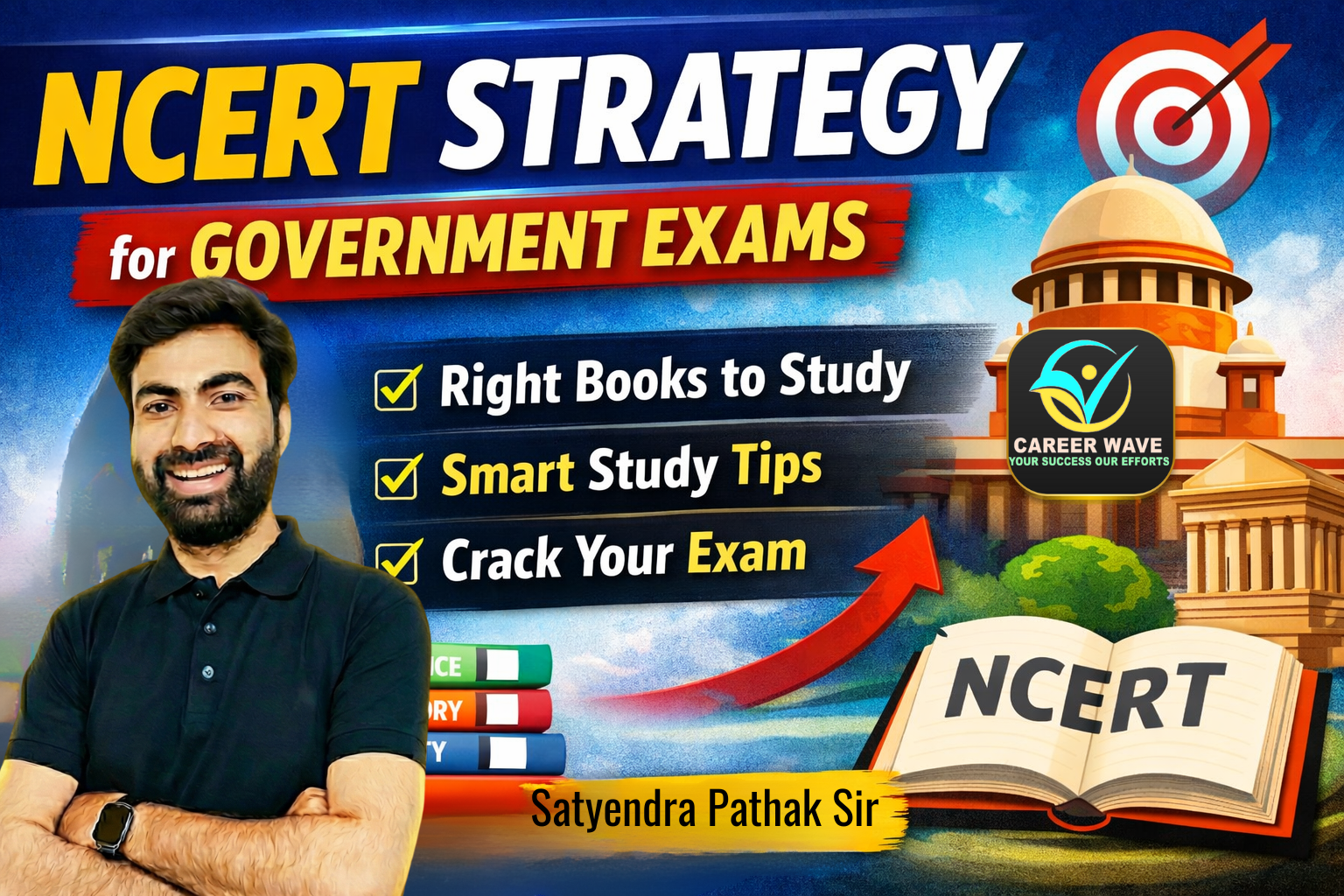
Learn the correct NCERT strategy
for government and PSU exams. Understand which NCERT books to study, how to
read them smartly, connect PYQs, and avoid common mistakes. Explained clearly
by Career Wave.
NCERT Strategy for Government Exams
(How
to Use NCERT the Right Way for Selection)
Whenever a
student starts preparing for government exams, one question always comes
up:
·
Is NCERT
really enough?
·
How should I
study NCERT properly?
·
Which
classes and subjects of NCERT are important?
Many
aspirants either ignore NCERT completely or study it blindly without
any strategy.
Both approaches are wrong.
At
Career Wave, this is the first clarity we give students:
NCERT
is not weak material. It is wrongly used material.
This blog
will give you a clear, practical NCERT strategy so that:
·
You know what to study
·
You know how deeply to study
·
You don’t
waste time memorizing unnecessary content
If used correctly, NCERT can
become your strongest foundation for government and PSU exams.
1) Why NCERT Is Important for Government
Exams
Most
government and PSU exams are designed to test:
·
Conceptual clarity
·
Basic understanding
·
Application of fundamentals
NCERT books
are written exactly for this purpose.
That
is why:
·
Many direct questions come from NCERT
·
Even advanced questions are based on NCERT concepts
·
Examiners assume NCERT knowledge as basic eligibility
At Career
Wave, students are clearly told:
NCERT is not
a low-level book.
It is the base on which selection-level questions are built.
2) Common Mistakes Students Make with NCERT
Before
learning the right strategy, understand what NOT to do:
·
Reading
NCERT like a novel
·
Memorizing
lines without understanding
·
Studying all
classes without relevance
·
Ignoring
examples, diagrams, and tables
·
Never
connecting NCERT with PYQs
NCERT works only when used
strategically, not emotionally.
3) Which NCERT Books Are Important?
(Exam-Oriented)
For Most
Government & PSU Exams
Class 6–10
NCERT
·
History
·
Geography
·
Polity
·
Economics
·
Science (basic concepts)
Used
mainly for:
·
SSC exams
·
State
government exams
·
General Awareness sections
For
Technical & PSU Exams (AAI, SSC JE, PSU JEs)
Class 11–12
NCERT (Very Important)
·
Physics
·
Mathematics
·
Chemistry
(selective)
·
Economics
Especially
critical for:
·
AAI ATC
·
Scientific
Assistant exams
·
PSU
technical roles
At Career
Wave, one rule is non-negotiable:
For
technical exams, Class 11–12 NCERT is compulsory.
4) Right Way to Study NCERT (Step-by-Step
Strategy)
Step 1: Read
for Understanding, Not Memory
When reading
NCERT:
·
Focus on why,
not just what
·
Understand
definitions and explanations
·
Read slowly but attentively
Do not
highlight everything.
Highlight only core ideas and definitions.
Step 2:
Focus on Examples, Diagrams & Tables
Many
students skip:
·
Solved
examples
·
Diagrams
·
Summary tables
This is a big
mistake.
Exams often:
·
Convert
diagrams into MCQs
·
Twist examples into numerical questions
At Career
Wave, students are reminded:
If it is drawn, boxed, or
illustrated in NCERT — it is important.
Step 3: Make
Short Notes from NCERT
After
finishing a chapter:
·
Write key
formulas
·
Write
definitions in your own words
·
Note
important facts and exceptions
Keep notes:
·
Short
·
Revisable
·
Chapter-wise
Do not rewrite NCERT.
Condense it.
Step 4:
Connect NCERT with PYQs
This is
where most students fail.
Correct
method:
·
Read NCERT
topic
·
Solve PYQs
from that topic
·
Observe:
o What repeats
o What is ignored
o What is frequently twisted
At Career
Wave, preparation follows this rule:
Books
teach concepts. PYQs teach selection.
Step 5:
Revise NCERT Multiple Times
NCERT gives
maximum return when revised:
·
First
reading → understanding
·
Second
reading → clarity
·
Third reading → retention
Short, repeated revisions are far
more powerful than one long reading.
5) Subject-Wise NCERT Strategy (Quick Guide)
Physics
& Mathematics
·
Read line by
line
·
Practice numerical
·
Focus on
derivations and concepts
·
Class 11–12 are most important
History
& Geography
·
Timelines +
maps
·
Keywords and
causes
·
Repeated factual zones
Polity
·
Articles
·
Definitions
·
Constitutional terms
Economics
·
Basic
concepts
·
Definitions
·
Flow and logic (not cramming)
6) How Much NCERT Is Enough?
You do not
need to:
·
Memories
every line
·
Study all classes equally
You do need
to:
·
Study
relevant classes
·
Understand
core concepts
·
Align NCERT with exam demand
NCERT
is a tool, not the destination.
NCERT
+ Other Books: Right Balance
NCERT should
be:
·
Your
foundation
·
Your concept clearer
Advanced
books should be:
·
Used only
after NCERT
·
Used for practice and depth
Skipping
NCERT and jumping directly to advanced books creates weak fundamentals —
something Career Wave strictly avoids in its preparation model.
7) Final Advice for Beginners
If you are
starting preparation:
·
Start with
NCERT
·
Build
confidence
·
Then move to advanced resources
If you are
already preparing:
·
Revisit
NCERT
·
Fill
conceptual gaps
·
Strengthen weak areas
Strong
basics beat smart shortcuts.
Final Note
from Career Wave
Most toppers
say only one thing later:
“I
underestimated NCERT in the beginning.”
Don’t repeat
that mistake.
Use NCERT with clarity,
patience, and strategy —
and it will silently build the foundation of your selection.
Leave a Comment
10-Apr-2026 11:06 AM
Understand the real reason why AAI ATC aspirants often score less in mock tests but perform better in the actual exam. This detailed analysis by...
09-Apr-2026 04:03 PM
Explore detailed AAI ATC cutoff trends from 2018 to 2025 with category-wise analysis, safe score targets, and expert insights from Career Wave. Understand how cutoff...
09-Apr-2026 12:54 PM
Confused between score and rank in AAI ATC exam? Learn how to predict your selection using mock scores, accuracy, and real competition trends. A practical...
08-Apr-2026 11:53 AM
Most AAI ATC aspirants fail not because of lack of effort, but due to lack of proper guidance and strategy. In this detailed guide, understand...
07-Apr-2026 12:56 PM
Confused between test series and self-study for AAI ATC preparation? This detailed guide explains what actually works, how toppers prepare, and why combining both is...
07-Apr-2026 11:17 AM
Discover the exact daily study routine followed by AAI ATC top rankers. Learn how to plan your day, improve accuracy, manage time, and boost your...
