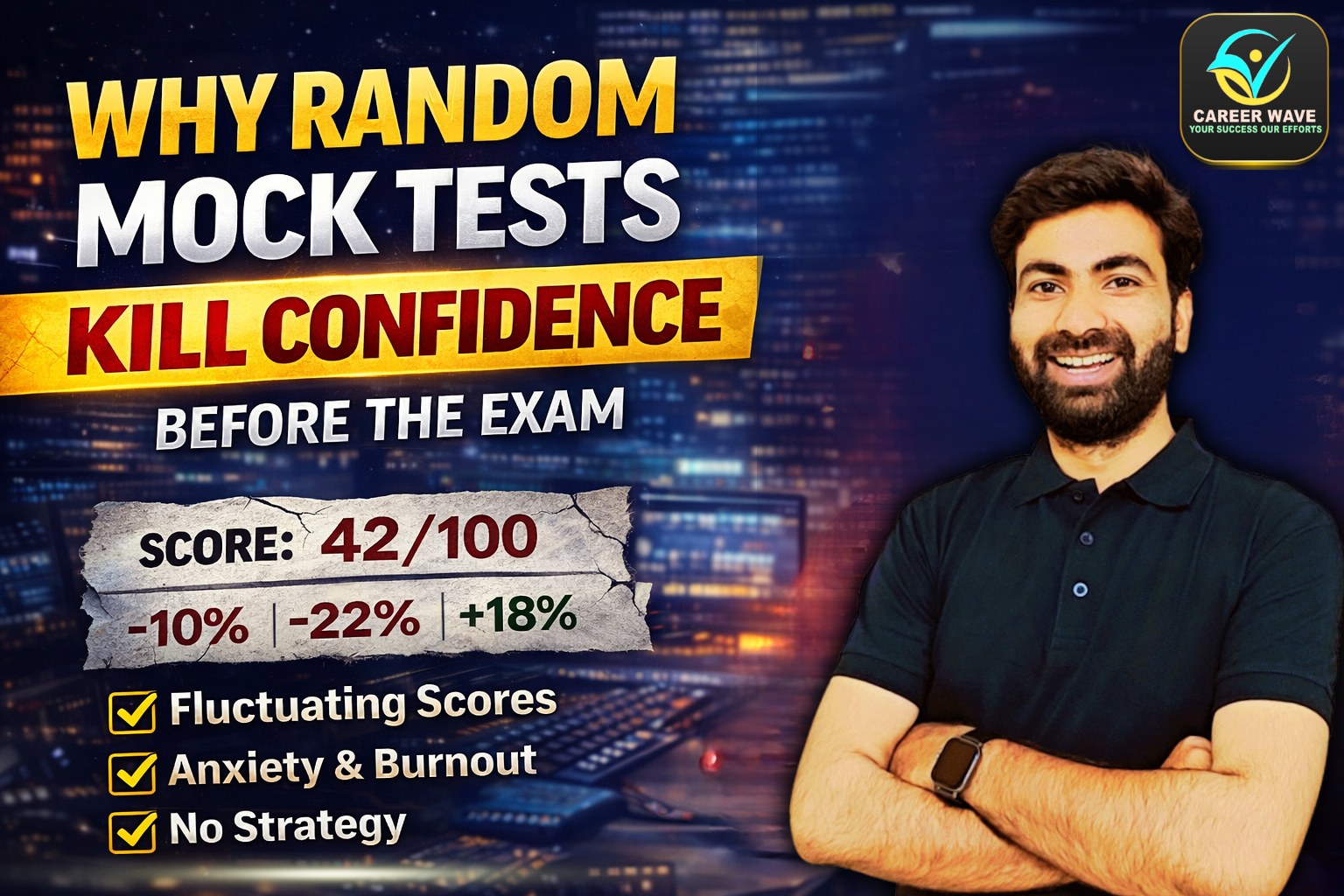
Mock tests are meant to build
confidence, but random mock practice can actually reduce your performance
before the exam. Learn why unstructured mock attempts cause anxiety, score
fluctuation, and burnout — and discover the right strategy to use mocks effectively
for exams like AAI ATC and other CBTs.
Why Random Mock Tests Kill Confidence Before
the Exam
Mock tests
are meant to build confidence.
Yet for many
aspirants, especially in competitive exams like AAI ATC, SSC, Banking, GATE,
or other CBT exams, mocks become a source of anxiety, self-doubt, and
mental pressure.
If your
confidence drops after every mock, you are not alone.
The real
problem is not low scores.
The real problem is random, unstructured mock practice.
Let’s understand this in depth.
1) The Psychological Damage of Random Mocks
When you
give random mock tests:
·
Your scores
fluctuate wildly
·
You cannot
identify a stable performance range
·
You don’t
understand why marks increase or decrease
·
You start
doubting your preparation
The brain
loves predictability.
When results are inconsistent, it interprets it as “lack of control.”
Lack of
control = anxiety.
And anxiety before an exam is
dangerous.
2) Inconsistent Difficulty Creates False
Self-Image
Not all mock
tests are aligned with the real exam level.
Some mocks
are:
·
Overly
difficult to attract serious aspirants
·
Poorly
framed with ambiguous questions
·
Concept-heavy
beyond real pattern
·
Calculation-heavy
unnecessarily
If you
attempt a mock that is much harder than the actual exam:
·
Your score
drops
·
You feel
underprepared
·
Motivation
decreases
But in
reality, your preparation might be perfectly fine.
Similarly,
if you attempt very easy mocks:
·
You score
high
·
Confidence
becomes overconfidence
·
You
underestimate the real exam
Both situations are harmful.
3) Random Mocks Destroy Strategy Consistency
Performance
exams reward consistency.
But random
mocks encourage chaos:
Day 1 → You
attempt 80 questions
Day 2 → You attempt 60 questions
Day 3 → You change section order
Day 4 → You experiment with aggressive attempts
When
strategy keeps changing, your brain never automates performance.
In
competitive exams, automation matters.
You should
enter the exam hall with:
·
Fixed time
split
·
Clear skip
rules
·
Defined
attempt range
·
Pre-decided
risk tolerance
Random mock behavior prevents
this stability.
4) The Confidence–Performance Loop
Confidence
affects performance.
Performance affects confidence.
It’s a loop.
If random
mocks repeatedly show unstable results:
Low score →
Self-doubt → Anxiety → Poor next mock → Lower confidence.
This
negative loop can start 1–2 months before the exam.
And many aspirants enter the real
exam already mentally exhausted.
5) No Deep Analysis = No Real Growth
Most
aspirants only check:
·
Total marks
·
Percentile
·
Rank
Very few
check:
·
Why did I
spend 4 minutes on Q17?
·
Which
section drained energy?
·
Did I panic
after 3 tough questions?
·
Did I change
strategy mid-exam?
·
Which
mistakes were conceptual vs careless?
Without
analysis, mock tests become entertainment — not training.
Improvement does not come from
quantity.
It comes from awareness.
6) Overexposure to Negativity Before Exam
Near exam
time, aspirants:
·
Join
multiple Telegram groups
·
See others
scoring 90+
·
Compare
constantly
·
Start
questioning their own level
But you
don’t know:
·
Which mock
they attempted
·
How many
attempts they gave
·
Whether they
are exaggerating
Random
exposure to others’ scores reduces emotional stability.
The exam is individual.
Your progress matters more than others’ screenshots.
7) Burnout from Excessive Mock Frequency
Another
major issue is over-mocking.
Students
think:
“If I give
40 mocks in the last month, I’ll be unstoppable.”
But what
actually happens:
·
Mental
fatigue increases
·
Accuracy
drops
·
Motivation
reduces
·
Sleep cycle
disturbs
·
Brain
becomes saturated
Mock tests
simulate stress.
Too many simulations = nervous system overload.
And on real exam day, you feel
drained instead of sharp.
8) Mock Tests Should Build Exam Personality
Competitive
exams are not just academic tests.
They test:
·
Decision-making
under time pressure
·
Emotional
control
·
Smart
skipping
·
Risk
management
·
Focus
retention
Mock tests
should train you in these areas.
But random
mocks only test knowledge repeatedly.
You need performance training,
not just question solving.
9) What Structured Mock Practice Looks Like
Here is the
correct approach:
Phase 1:
Foundation Stage
Before
full-length mocks:
·
Strengthen
weak topics
·
Solve PYQs
·
Do sectional
timed practice
·
Improve
calculation speed
Mocks too
early create unnecessary fear.
Phase 2:
Strategy Development Stage
Start
full-length mocks.
Focus on:
·
Fixing
section order
·
Ideal
attempt range
·
Time
management
·
Identifying
scoring zones
Do not focus
only on marks.
Focus on
pattern recognition.
Phase 3:
Optimization Stage
Now:
·
Reduce silly
mistakes
·
Improve
accuracy %
·
Improve
question selection
·
Fine-tune
risk-taking
Track
progress in a notebook:
·
Mock number
·
Score
·
Attempt
·
Accuracy
·
Key mistakes
This builds
measurable confidence.
Phase 4:
Pre-Exam Stabilization
Last 7–10
days:
·
Reduce mock
frequency
·
Revise
formulas
·
Review
mistake log
·
Sleep
properly
·
Maintain
routine
Confidence before exam is more
important than one extra mock.
10) The Real Definition of Confidence
Confidence
is not:
❌ “I scored
100 in one mock.”
❌ “I topped a
Telegram leaderboard.”
❌ “Others are
scoring less than me.”
Real
confidence is:
✔ I know my
strategy.
✔ I know my weak areas.
✔ I know my attempt range.
✔ I know how to handle tough
patches.
✔ I trust my preparation.
Confidence
is clarity about yourself.
Random mock tests blur that
clarity.
11) Final Truth
Mock tests
are like gym training.
If you lift
randomly without a plan:
·
You get
tired
·
You get
injured
·
You lose
motivation
If you train
systematically:
·
You grow
·
You gain
strength
·
You build
confidence
Similarly,
Random mocks
create panic.
Structured mocks create performance.
Before the
exam, protect your mind as much as your preparation.
Because on exam day,
The calmest mind wins.
12) FAQs
1️ Are mock tests really important for competitive exams?
Yes, mock
tests are extremely important. They help simulate real exam pressure, improve
time management, and test your strategy. However, mocks must be structured and
analyzed properly. Random mock attempts without strategy can reduce confidence
instead of improving performance.
2️ Why do my mock scores fluctuate so much?
Score
fluctuations usually happen because:
·
Different
mock platforms have different difficulty levels
·
You change
strategy frequently
·
You are not
analyzing mistakes properly
·
You are
mentally fatigued
Instead of
focusing only on scores, track accuracy, attempt range, and mistake patterns.
3️ How many mock tests should I give before the exam?
There is no
fixed number, but quality matters more than quantity.
A healthy
structure could be:
·
8–15
full-length mocks with deep analysis
·
Sectional
tests for weak areas
·
PYQ-based
revision
Giving 40–50
random mocks without analysis is less effective than 10 properly analyzed
mocks.
4️ Can too many mock tests reduce confidence?
Yes. If you
give too many mocks, especially close to the exam:
·
Mental
fatigue increases
·
Anxiety
builds up
·
Small score
drops feel bigger
·
Self-doubt
increases
Mock tests
should train your mind, not exhaust it.
5️ Should I compare my mock scores with others?
Comparison
without context is harmful.
You don’t
know:
·
Which mock
they attempted
·
Their
preparation level
·
Their
attempt strategy
Instead of
comparing with others, compare with your previous performance.
Your growth matters more than
someone else’s screenshot.
Helpful links-
Guessing Strategy in No Negative Marking Exams Like AAI ATC
When to Leave a Question in AAI ATC (Yes, Leaving Is a Skill)
Confusion to Clarity: When an AAI ATC Aspirant Becomes Serious
Best Online Coaching for AAI ATC 2026 – Why Career Wave?
Leave a Comment
14-Apr-2026 10:05 AM
Confused about what to study in Maths for AAI ATC? This detailed guide by Career Wave explains high-weight topics, what to skip, PYQ strategy, accuracy...
13-Apr-2026 03:35 PM
Explore Career Wave’s outstanding performance in AAI ATC 2025 with 125 selections. Discover selected students, their strategies, preparation approach, and how structured learning helped them...
13-Apr-2026 09:40 AM
Starting AAI ATC preparation as a beginner? This complete guide by Career Wave covers exam pattern, subject priority, study plan, PYQs, mock strategy, and beginner...
11-Apr-2026 05:25 PM
Learn the complete category-wise strategy to clear the AAI ATC exam with a safe score approach. This detailed guide by Career Wave explains cutoff trends,...
10-Apr-2026 11:06 AM
Understand the real reason why AAI ATC aspirants often score less in mock tests but perform better in the actual exam. This detailed analysis by...
09-Apr-2026 04:03 PM
Explore detailed AAI ATC cutoff trends from 2018 to 2025 with category-wise analysis, safe score targets, and expert insights from Career Wave. Understand how cutoff...
