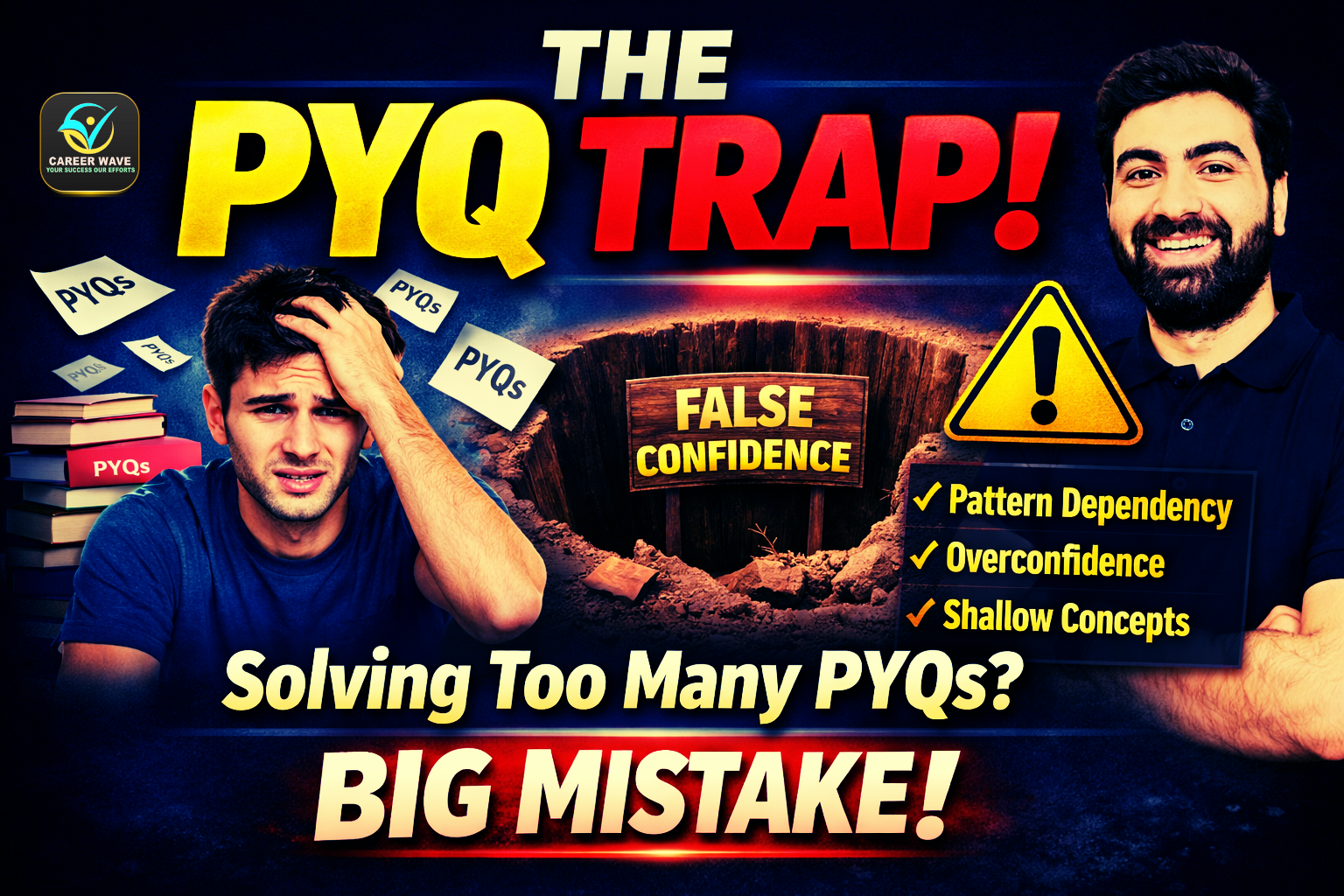
Most competitive exam aspirants believe that
solving maximum PYQs guarantees selection. But is that really true? In this
detailed guide, we uncover the hidden dangers of over-solving Previous Year
Questions and explain why blind PYQ practice can create false confidence,
pattern dependency, and shallow conceptual understanding. Learn the smart
strategy to use PYQs effectively for exams like AAI ATC and other technical
competitive exams.
The
PYQ Trap: When Solving Too Many PYQs Backfires
Every serious aspirant eventually hears this
advice:
“Just solve as many Previous Year Questions as
possible. Selection is guaranteed.”
And yes — PYQs (Previous Year Questions) are powerful.
But here’s the uncomfortable truth most coaching institutes won’t tell you:
If used incorrectly, PYQs can slow down your growth instead of accelerating
it.
Let’s break this down honestly and practically.
1) Why Students Become Addicted to PYQs
PYQs give three psychological rewards:
1.
Immediate Validation – “I
got it right!”
2.
Familiarity Comfort –
“I’ve seen this type before.”
3.
Visible Progress –
“500 questions done!”
Your brain loves familiarity.
But competitive exams reward adaptability — not familiarity.
This is where the trap begins.
The 7 Hidden Ways the PYQ Trap Backfires
1. Recognition vs Reasoning Gap
After solving many PYQs, students
develop pattern recognition reflexes.
They don’t read the full question.
They see keywords → jump to formula.
But modern exams increasingly test:
·
Concept integration
·
Logical application
·
Twisted data framing
Recognition fails when format changes.
2. Memory-Based Solving (Without
Realization)
You think:
“I solved it because I understood it.”
Reality:
You solved it because you subconsciously remembered it.
This creates false mastery.
In mocks, performance drops — because those
are new questions.
3. Conceptual Superficiality
Many students solve:
·
80 questions per day
But revise theory for:
·
20 minutes.
This builds speed without depth.
In exams like AAI ATC, conceptual clarity in
Physics and reasoning stability matter more than repetitive exposure.
4. Ignoring Weak Areas
PYQs often cover:
·
Frequently asked topics.
But what about:
·
Rarely asked but possible areas?
·
Recently added syllabus components?
·
Conceptual extensions?
Students avoid tough topics because
PYQs don’t demand them heavily.
But examiners evolve.
5. Reduced Question Tolerance
If you solve only PYQs, your brain
expects:
·
Predictable structure
·
Familiar difficulty
In the real exam, when one unfamiliar
question appears:
·
Panic starts
·
Confidence drops
·
Decision quality declines
That single unfamiliar question disturbs the
entire section.
6. Overconfidence in Accuracy
High PYQ accuracy ≠ High exam
readiness.
Why?
Because PYQs:
·
Have known solutions available
·
Are solved multiple times
·
Often follow predictable framing
Real exam:
·
Time pressure
·
Mental fatigue
·
Zero external validation
Different environment → Different performance.
7. Productivity Illusion
“Today I solved 250 questions.”
Sounds productive.
But ask:
·
Did I analyze mistakes?
·
Did I write down conceptual gaps?
·
Did I revisit weak formulas?
·
Did I check alternative solving
methods?
If not, that session was quantity-heavy,
growth-light.
2) What Toppers Actually Do Differently
Toppers don’t avoid PYQs.
They:
·
Extract patterns
·
Identify core concepts
·
Note frequently repeated traps
·
Create summary sheets
·
Re-solve mistakes after gaps
They treat PYQs as a diagnostic tool,
not a daily ritual.
3) The Correct Framework for Using PYQs
Here is a smarter 5-phase strategy:
Phase 1: Concept Foundation First
Before touching PYQs:
·
Understand theory deeply
·
Solve basic conceptual exercises
·
Build formula familiarity
PYQs should test learning — not replace
learning.
Phase 2: Topic-Wise PYQ Analysis
Solve PYQs chapter-wise.
After each topic:
·
List recurring formulas
·
Identify common distractor patterns
·
Mark high-frequency subtopics
Turn PYQs into data.
Phase 3: Error Log System
Maintain a notebook with 3 columns:
·
Question type
·
Mistake reason
·
Correct concept
Review it weekly.
Your mistakes are more valuable than your
correct answers.
Phase 4: Mixed Practice Integration
After PYQs:
·
Solve fresh mock questions
·
Attempt unseen problem sets
·
Practice multi-topic integration
This trains adaptability.
Phase 5: Simulation Training
Final stage:
·
Time-bound mocks
·
Full-length test strategy
·
Decision-making optimization
Because clearing competitive exams is not just
about knowledge — it’s about execution under pressure.
4) When PYQs Are MOST Useful
PYQs are powerful:
✔ In mid-preparation phase
✔ For pattern recognition
✔ For identifying exam weightage
✔ Before final revision
But dangerous:
❌ As primary learning source
❌ When solved blindly
❌ When counted, not analyzed
5) The Real Selection Formula
Selection ≠ Maximum PYQs solved
Selection = Concept Clarity
·
Adaptive Thinking
·
Error Analysis
·
Calm Execution
·
Strategic Practice
PYQs support this formula.
They do not replace it.
6) Final Reality Check
Exams are evolving.
If you only prepare for what has been
asked,
you remain one step behind the examiner.
The question that selects you
is often the one that doesn’t look like a PYQ.
Use PYQs wisely.
Don’t let them use you.
7) Frequently Asked Questions (FAQs)
1. How many PYQs should I solve for
AAI ATC or similar exams?
There is no magic number.
Instead of targeting quantity:
·
Solve last 10–15 years topic-wise.
·
Re-solve incorrect ones after 2–3
weeks.
·
Focus on understanding patterns, not
finishing counts.
Depth matters more than number.
2. Should I complete all PYQs before
starting mocks?
No.
Ideal order:
Concept → Topic-wise PYQs → Sectional mocks → Full mocks.
Mocks train execution. PYQs train
familiarity.
Both are necessary.
3. Is it okay if I get high accuracy
in PYQs but low in mocks?
Yes — and that’s a warning signal.
High PYQ accuracy means:
You recognize patterns.
Low mock accuracy means:
Your adaptability needs improvement.
Work on:
·
Time management
·
Question selection
·
New question exposure
4. Can PYQs alone help me clear
competitive exams?
In rare cases, maybe.
But in evolving exams:
PYQs alone are insufficient.
You must include:
·
New pattern practice
·
Analytical reasoning sets
·
Concept strengthening
·
Time-bound tests
5. When should I stop solving PYQs?
Stop when:
·
You start remembering answers.
·
Improvement plateaus.
·
You feel repetition, not challenge.
Shift focus to:
·
Mixed problem sets
·
Mock test analysis
·
Weak area strengthening
6. Is solving PYQs multiple times
useful?
Yes — but only if:
·
You forgot the method.
·
You analyze mistakes deeply.
·
You change approach (faster method,
alternate solution).
Repetition without reflection is wasteful.
7. What is the biggest mistake
students make with PYQs?
Treating them as a checklist.
PYQs are not:
“Complete 1000 and you’re safe.”
They are:
“Understand examiner thinking.”
Mindset shift changes results.
Helpful links-
Which Physics Topics Are Decision-Heavy vs Calculation-Heavy in AAI ATC
Leave a Comment
14-Apr-2026 10:05 AM
Confused about what to study in Maths for AAI ATC? This detailed guide by Career Wave explains high-weight topics, what to skip, PYQ strategy, accuracy...
13-Apr-2026 03:35 PM
Explore Career Wave’s outstanding performance in AAI ATC 2025 with 125 selections. Discover selected students, their strategies, preparation approach, and how structured learning helped them...
13-Apr-2026 09:40 AM
Starting AAI ATC preparation as a beginner? This complete guide by Career Wave covers exam pattern, subject priority, study plan, PYQs, mock strategy, and beginner...
11-Apr-2026 05:25 PM
Learn the complete category-wise strategy to clear the AAI ATC exam with a safe score approach. This detailed guide by Career Wave explains cutoff trends,...
10-Apr-2026 11:06 AM
Understand the real reason why AAI ATC aspirants often score less in mock tests but perform better in the actual exam. This detailed analysis by...
09-Apr-2026 04:03 PM
Explore detailed AAI ATC cutoff trends from 2018 to 2025 with category-wise analysis, safe score targets, and expert insights from Career Wave. Understand how cutoff...
