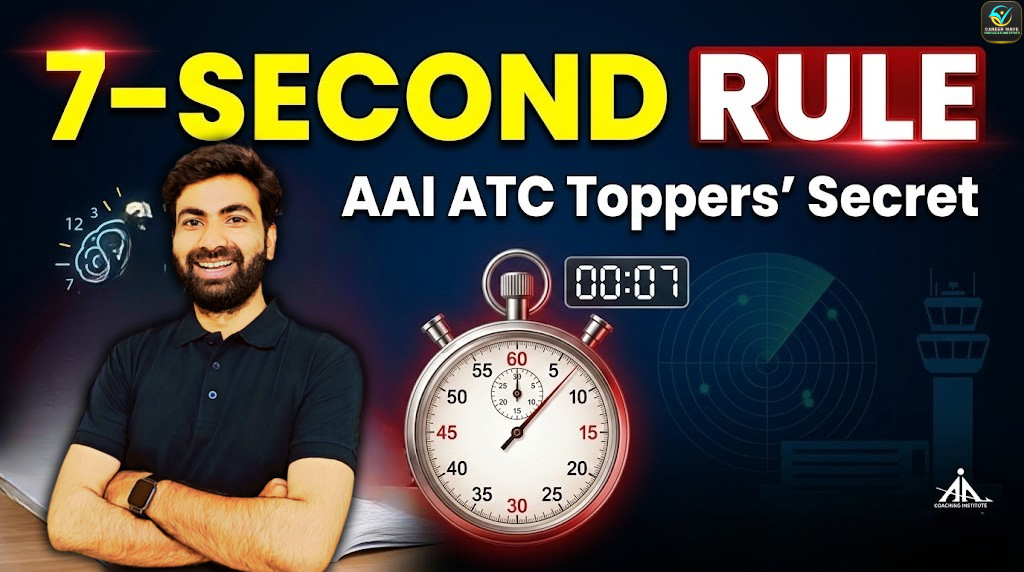
Success in the Air Traffic
Controller exam conducted by the Airports Authority of India is not just
about knowledge but also about quick decision-making. In this blog, Career
Wave explains the powerful 7-Second Rule used by toppers to identify
easy questions, avoid time traps, and improve accuracy during the AAI ATC CBT
exam.
The 7-Second Rule: How Toppers Decide Answers Fast in AAI ATC
Preparing for the Air Traffic
Controller exam conducted by the Airports Authority of India is not just
about studying formulas and solving practice questions. Many aspirants spend
months preparing but still struggle to perform well during the actual exam. One
key reason behind this gap is slow decision-making during the computer-Based
Test (CBT).
Top scorers approach the exam
very differently. They train themselves to recognize patterns quickly and
decide within seconds whether a question should be attempted immediately,
solved later, or skipped. At Career Wave, this approach is often
described as the 7-Second Rule — a mental strategy that helps candidates
maintain speed, accuracy, and control during the exam.
1) What Is the 7-Second Rule?
The 7-Second
Rule is a simple yet powerful exam strategy used by high-performing
candidates. It means that when you read a question, your brain should be able
to classify it within the first few seconds.
Within about
seven seconds of reading a question, you should know:
·
Whether the
concept is familiar
·
Whether the
solution path is clear
·
Whether the
question might take too long
Instead of
immediately starting calculations, toppers first evaluate the question
quickly. This short decision window prevents them from getting trapped in
lengthy or confusing problems.
At Career Wave, students
are trained to develop this quick recognition skill during mock tests so that
they can apply it naturally during the real exam.
2) Why Fast Decision-Making Matters in AAI
ATC
The AAI
ATC exam is designed to test not only knowledge but also speed and
presence of mind. Candidates often face a large number of questions within
limited time.
Without a
quick decision strategy, aspirants may:
·
Spend too
much time on difficult questions
·
Lose
momentum during the exam
·
Feel
mentally exhausted halfway through the paper
Toppers avoid these problems by
making fast but intelligent decisions. They know that every second saved
on easy questions can be used for moderate ones later.
3) How Toppers Use the 7-Second Rule
When a
topper reads a question in the exam, their brain automatically performs a quick
evaluation. This mental process usually follows three steps.
Step 1:
Concept Recognition
The moment
they read the question; they check whether the concept is familiar. If the
topic is something they have practiced well, the brain quickly recalls the
formula or method needed to solve it.
Step 2:
Difficulty Estimation
Within a few
seconds, they judge whether the question is straightforward or likely to
involve lengthy calculations.
Step 3:
Instant Decision
Based on
this quick evaluation, they make one of three decisions:
·
Solve
immediately if the method is clear
·
Mark for
review if it requires more thinking
·
Skip for now if it appears time-consuming
This habit allows them to
maintain flow throughout the exam.
4) The Three Question Zones
Many toppers
mentally divide questions into three zones when applying the 7-second rule.
Zone 1:
Direct Questions
These
questions are familiar and straightforward. Toppers solve them immediately to
secure quick marks.
Zone 2:
Moderate Questions
These
questions require some thinking but are still manageable. Toppers attempt them
after finishing easier ones.
Zone 3:
Time-Trap Questions
These
questions involve long calculations or complex reasoning. Toppers skip them
initially to avoid wasting time.
According to exam analysis done
by Career Wave, many high scorers actually attempt fewer questions
but maintain higher accuracy because they avoid time traps.
5) How the 7-Second Rule Improves Exam
Performance
Using this
strategy brings several advantages during the CBT.
Better Time
Management
Quick
decisions prevent candidates from spending unnecessary time on difficult
questions.
Higher
Accuracy
When
students focus first on familiar questions, their confidence and accuracy
improve.
Reduced
Stress
Knowing
which questions to skip helps candidates stay calm during the exam.
Improved
Momentum
Solving
easier questions early creates a positive rhythm that carries through the
entire paper.
Training
Your Brain to Apply the 7-Second Rule
Like any
skill, quick decision-making requires practice. It cannot be developed
overnight.
Here are
some practical ways to train this skill.
Practice
Pattern Recognition
While
solving questions, focus on identifying patterns and question types
rather than just calculating answers.
Use Timed
Mock Tests
Full-length
mock tests help your brain adapt to exam pressure and improve your decision
speed.
Analyse Your
Attempt Strategy
After each mock test, review how
much time you spent on different questions and whether you could have skipped
certain ones earlier.
At Career Wave, mock
analysis focuses not only on correct and incorrect answers but also on how
decisions were made during the test.
6) Common Mistakes Students Make
Many
aspirants unintentionally slow themselves down by following poor strategies.
Some common
mistakes include:
·
Trying to
solve every question in order
·
Spending too
long on one difficult problem
·
Rechecking
the same question multiple times
·
Ignoring the
importance of quick decisions
Avoiding these habits can
dramatically improve performance.
7) The Psychology Behind Fast Decisions
Quick
decisions during exams are possible because toppers develop strong
conceptual memory and pattern recognition.
When a
student practices enough questions from a topic, the brain begins to recognize
similar patterns instantly. This allows them to recall formulas and approaches
without long thinking processes.
This is why structured practice
and revision play an important role in AAI ATC preparation.
8) How Career Wave Helps Students Master This
Strategy
At Career
Wave, preparation is designed to build not only knowledge but also exam
intelligence.
Students are
trained to:
·
Identify
question patterns quickly
·
Apply smart
attempt strategies
·
Manage time
effectively in CBT
·
Analyze mock
tests deeply
This preparation model helps
aspirants develop the same fast decision-making mindset used by toppers.
9) Final Thoughts
Cracking the
AAI ATC exam conducted by the Airports Authority of India requires more
than just hard work. It also requires smart thinking inside the exam hall.
The 7-Second
Rule is a simple but powerful strategy that helps candidates maintain
speed, avoid time traps, and focus on high-confidence questions first.
By
practicing this method consistently and learning from mock tests, aspirants can
significantly improve their performance.
With the right preparation
techniques and guidance from Career Wave, developing topper-level
decision-making skills becomes achievable.
10) FAQs
Why is quick
decision-making important in AAI ATC?
The AAI
ATC exam has limited time and many questions. Fast decisions help
candidates avoid time-consuming problems and maintain accuracy.
Can average
students learn this strategy?
Yes. With
consistent practice and mock test analysis, any aspirant can train their brain
to recognize question patterns quickly.
How can I
practice the 7-Second Rule during preparation?
Use timed
mock tests, review your decision-making patterns, and practice identifying
question types quickly.
Does Career
Wave teach exam strategies like this?
Yes. Career Wave focuses
on CBT strategy, mock test analysis, and exam psychology to help students
improve both knowledge and in-exam performance.
Related Blogs -
AAI JE ATC Exam – Complete Details, Eligibility, Syllabus, Salary & Preparation Guide
Leave a Comment
14-Apr-2026 10:05 AM
Confused about what to study in Maths for AAI ATC? This detailed guide by Career Wave explains high-weight topics, what to skip, PYQ strategy, accuracy...
13-Apr-2026 03:35 PM
Explore Career Wave’s outstanding performance in AAI ATC 2025 with 125 selections. Discover selected students, their strategies, preparation approach, and how structured learning helped them...
13-Apr-2026 09:40 AM
Starting AAI ATC preparation as a beginner? This complete guide by Career Wave covers exam pattern, subject priority, study plan, PYQs, mock strategy, and beginner...
11-Apr-2026 05:25 PM
Learn the complete category-wise strategy to clear the AAI ATC exam with a safe score approach. This detailed guide by Career Wave explains cutoff trends,...
10-Apr-2026 11:06 AM
Understand the real reason why AAI ATC aspirants often score less in mock tests but perform better in the actual exam. This detailed analysis by...
09-Apr-2026 04:03 PM
Explore detailed AAI ATC cutoff trends from 2018 to 2025 with category-wise analysis, safe score targets, and expert insights from Career Wave. Understand how cutoff...
