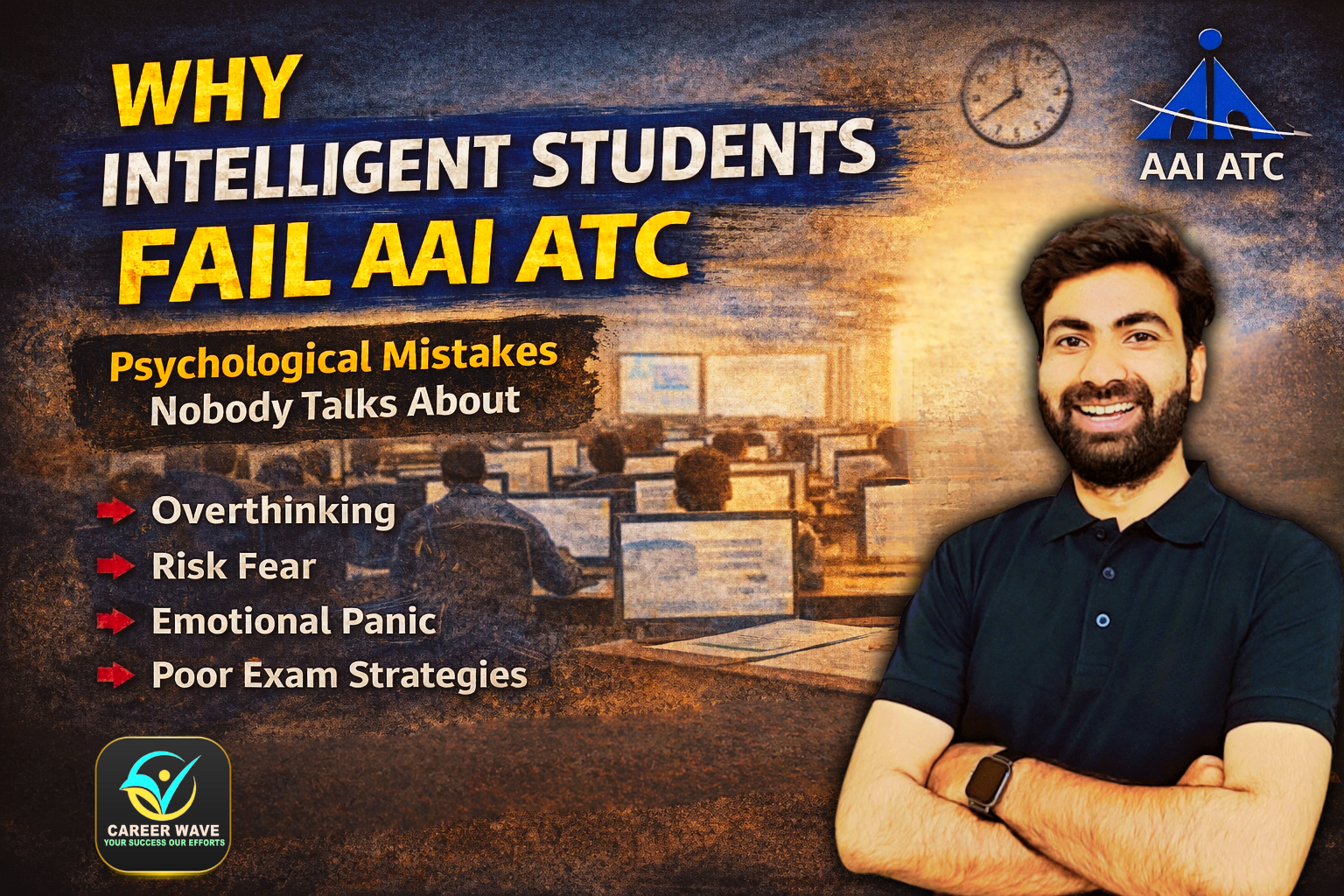
why intelligent students fail the
AAI ATC exam despite strong preparation. This detailed guide reveals the hidden
psychological mistakes, overthinking traps, and decision-making errors that
silently ruin performance in the AAI ATC CBT exam—and how toppers trained by
Career Wave avoid them.
Why Intelligent Students Fail AAI ATC
Psychological
Mistakes Nobody Talks About
Every year,
some of the brightest, most intelligent students walk into the AAI ATC
exam hall with strong preparation, good mock scores, and high confidence—yet
walk out shocked by their result.
Meanwhile,
average students with less IQ but better control clear the exam.
So, the real question is not:
“Who is more intelligent?”
but
“Who thinks better under pressure?”
AAI ATC is
not just a technical exam.
It is a psychological decision-making test hidden inside a CBT format.
Let’s uncover the silent mental mistakes that cause intelligent students
to fail—and how toppers avoid them.
1) Intelligence
Creates Overthinking Under Pressure
High-IQ
students are trained to:
·
Analyze
deeply
·
Cross-verify
·
Explore
multiple approaches
This works
well in:
·
College
exams
·
Home
practice
·
Untimed
problem-solving
But in AAI ATC CBT, this
becomes a disadvantage.
What goes
wrong?
·
Spending
extra time to “confirm” an already correct answer
·
Re-solving
questions due to self-doubt
·
Getting
stuck between two options even after knowing the concept
⏱ Result:
Time pressure increases → anxiety spikes → accuracy drops in later sections.
How toppers
think:
Toppers
don’t aim for perfect logic; they aim for maximum correct decisions
per minute.
Career Wave
mentors often emphasize:
“In ATC, speed with acceptable
accuracy beats slow perfection.”
2) Fear of
Negative Marking Freezes the Brain
Intelligent
students are more aware of risk, which ironically hurts them.
They think:
·
“What if
this is a trap question?”
·
“What if I
misread the data?”
·
“Should I
skip this to stay safe?”
This leads
to:
·
Excessive
skipping
·
Leaving
doable questions
·
Attempting
fewer questions than required for cutoff
📉
Many high-rankers in mocks fail the real exam simply because they
under-attempt.
Topper
mindset:
·
Calculated
risk > blind safety
·
They know which
questions deserve confidence-based attempts
Career Wave
trains students to identify:
·
High-probability
questions
·
Low-risk
elimination-based attempts
·
Smart
guessing zones
3) Emotional
Reaction After One Bad Question
One tricky
question can mentally hijack intelligent students.
They think:
·
“If this was
tough, paper must be very hard”
·
“I’m
underperforming today”
This
triggers:
·
Panic
·
Loss of
rhythm
·
Rushing
through next 5–6 questions
💥 One emotional reaction can ruin an entire section.
What toppers do differently:
·
They
mentally reset after every question
·
They treat
each question as independent
·
No emotional
attachment to past mistakes
Career Wave repeatedly teaches:
“AAI ATC rewards emotional
stability more than raw intelligence.”
4) Smart
Students Trust Concepts, Not Patterns
AAI ATC
often includes:
·
Repeated
concepts
·
Pattern-based
numerical logic
·
Familiar
non-technical traps
Intelligent
students insist on:
·
Full
derivations
·
Conceptual
validation
But CBT is
designed to reward:
·
Pattern
recognition
·
Shortcut
awareness
·
Memory-based
recall
📌
This is why students who revise previous ATC-level patterns outperform
students who study only theory.
Career
Wave’s structured approach focuses on:
·
ATC-specific
thinking
·
Repeated CBT
exposure
·
Pattern
familiarity over textbook depth
5) Ego Trap:
“I’m Prepared Enough”
This is a
silent killer.
Intelligent
students often believe:
·
“Mocks are
just for practice”
·
“Actual exam
will go better”
·
“I don’t
need exam temperament training”
So, they:
·
Underestimate
CBT pressure
·
Ignore weak
sections
·
Skip
full-length timed simulations
Reality hits
only inside the exam hall.
Toppers, on
the other hand:
·
Respect the
exam
·
Over-prepare
psychologically
·
Treat mocks
as real battles
Career
Wave’s topper batches focus heavily on:
·
CBT mindset
training
·
Exam-day
simulation
·
Mental
stamina building
6) Lack of a
Pre-Planned Exam Strategy
Many
intelligent students enter the exam with:
·
Knowledge ✔
·
Practice ✔
·
Confidence ✔
·
No fixed
attempt strategy ❌
They decide inside the exam:
·
Which
section first
·
How much
time per question
·
When to skip
This wastes
precious mental energy.
Toppers
already know:
·
Section-wise
time limits
·
Attempt
thresholds
·
Skip rules
·
Final
5-minute plan
Career Wave provides clear
exam execution frameworks, so students don’t think during the
exam—they execute.
7) Mental
Fatigue in the Final Phase
AAI ATC is
long and mentally demanding.
Intelligent
students often:
·
Start strong
·
Burn mental
energy early
·
Crash in the
final sections
Because
intelligence ≠ stamina.
Toppers
train for:
·
Long-focus
endurance
·
Consistent
attention
·
Mental
recovery during exam
This is why disciplined mock
routines matter more than raw talent.
What Truly
Separates Toppers from Intelligent Failures?
|
Intelligent Students |
AAI ATC Toppers |
|
Overthink |
Decide fast |
|
Fear mistakes |
Manage risk |
|
Emotionally reactive |
Emotionally neutral |
|
Concept-heavy |
Pattern-smart |
|
Ego-driven |
Exam-respectful |
|
Knowledge-focused |
Execution-focused |
8) Final Truth:
AAI ATC Is a Mind Game
AAI ATC
doesn’t reject intelligent students.
It rejects unstable decision-makers under pressure.
If you’re
intelligent and still struggling:
·
Your brain
is not the problem
·
Your exam
psychology is
This is
exactly why Career Wave emphasizes:
·
CBT mindset
·
Decision-making
training
·
Psychological
preparation along with syllabus
Because in AAI ATC, the calm
mind wins.
FAQs – Why Intelligent Students Fail AAI ATC
Q1. Is AAI
ATC more about intelligence or strategy?
AAI ATC is
more about strategy, speed, and emotional control than pure
intelligence.
Q2. Can
average students really outperform intelligent ones?
Yes.
Students with average IQ but strong exam temperament often outperform high-IQ
candidates.
Q3. How can
intelligent students fix these psychological mistakes?
By:
·
Practicing
timed CBT mocks
·
Learning
risk management
·
Developing a
fixed exam strategy
·
Training
emotional stability (Career Wave focuses heavily on this)
Q4. Is
overthinking common in AAI ATC?
Extremely
common—and one of the biggest hidden reasons for failure.
Q5. Does
Career Wave address these psychological issues?
Yes. Career Wave’s preparation
model combines concepts + CBT mindset + decision training, which is
crucial for AAI ATC success.
Leave a Comment
14-Apr-2026 10:05 AM
Confused about what to study in Maths for AAI ATC? This detailed guide by Career Wave explains high-weight topics, what to skip, PYQ strategy, accuracy...
13-Apr-2026 03:35 PM
Explore Career Wave’s outstanding performance in AAI ATC 2025 with 125 selections. Discover selected students, their strategies, preparation approach, and how structured learning helped them...
13-Apr-2026 09:40 AM
Starting AAI ATC preparation as a beginner? This complete guide by Career Wave covers exam pattern, subject priority, study plan, PYQs, mock strategy, and beginner...
11-Apr-2026 05:25 PM
Learn the complete category-wise strategy to clear the AAI ATC exam with a safe score approach. This detailed guide by Career Wave explains cutoff trends,...
10-Apr-2026 11:06 AM
Understand the real reason why AAI ATC aspirants often score less in mock tests but perform better in the actual exam. This detailed analysis by...
09-Apr-2026 04:03 PM
Explore detailed AAI ATC cutoff trends from 2018 to 2025 with category-wise analysis, safe score targets, and expert insights from Career Wave. Understand how cutoff...
