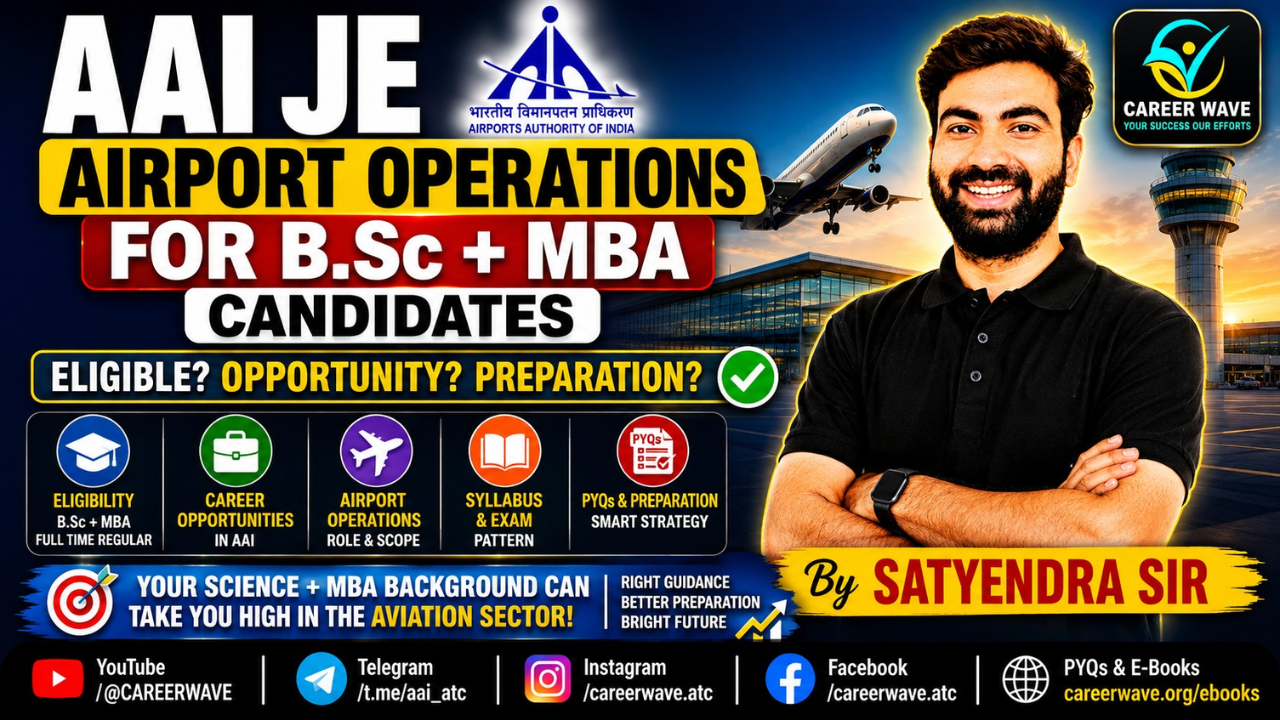
Can B.Sc + MBA candidates apply
for AAI JE Airport Operations 2026? Understand eligibility, qualification
requirements, career opportunities, Aviation Awareness, Business Management,
PYQs and smart preparation strategy with Career Wave and Satyendra Sir.
AAI JE Airport Operations for B.Sc + MBA
Candidates: Eligibility, Opportunity & Preparation Guide
If you have
completed a B.Sc. and MBA and want to enter the aviation sector, AAI
Junior Executive (Airport Operations) can be an important career opportunity to
understand.
One of the
most common questions students ask is:
“I am a
B.Sc. graduate with an MBA. Am I eligible for AAI JE Airport Operations?”
AAI's
prescribed educational route for Junior Executive (Airport Operations) includes
Graduate in Science + full-time regular MBA of two years duration, as an
alternative to a full-time regular Bachelor's Degree in Engineering.
This means
eligible B.Sc. + MBA candidates should not assume that Airport Operations is an
engineering-only opportunity.
At Career Wave, Satyendra
Sir recommends that candidates first understand their eligibility clearly
and then shift immediately to syllabus-based, exam-oriented preparation.
Why AAI JE Airport Operations Matters for
B.Sc. + MBA Candidates
Many B.Sc.
graduates complete an MBA because they want to move toward management,
administration, operations or corporate roles.
But when
government or PSU recruitment notifications appear, they sometimes find that:
·
Some posts
require engineering.
·
Some require
a specific technical degree.
·
Some require
specialized postgraduate qualifications.
·
General MBA
eligibility may not be enough.
AAI Airport
Operations creates a different opportunity because the prescribed qualification
includes the Science graduate + regular two-year MBA combination.
For the right candidate, this
creates a combination of:
Science Background + Management Education +
Aviation Operations Career
1. Can B.Sc. + MBA Candidates Apply for AAI
JE Airport Operations?
As per AAI's
stated educational qualification for Junior Executive (Airport Operations), one
qualifying route is:
Graduate in
Science + Full-Time Regular MBA of 2 Years Duration.
AAI also
lists another route:
Full-Time
Regular Bachelor's Degree in Engineering.
Therefore,
the post is not restricted only to engineering graduates.
For B.Sc. candidates, however,
the MBA requirement is important.
2. Is Only a
B.Sc. Degree Enough?
No, not
under the B.Sc.-based qualification route stated by AAI.
The
requirement is not simply:
B.Sc.
It is:
Graduate in
Science + Full-Time Regular MBA of 2 Years Duration.
This
distinction is critical.
A candidate
should never interpret “Graduate in Science” independently and ignore the MBA
component.
Always read the complete
qualification condition.
3. Does the MBA Need to Be Full-Time?
This is
another important eligibility point.
The
qualification wording specifically mentions a:
Full-Time
Regular MBA of 2 Years Duration.
Therefore,
candidates with other MBA modes or durations should not automatically assume
equivalence.
Your degree
must satisfy the conditions prescribed in the recruitment notification
applicable to your recruitment cycle.
When eligibility depends on
degree mode, duration or recognition, verify your exact qualification before
submitting the application.
4. Why Can a B.Sc. + MBA Background Fit
Airport Operations?
The
combination is logically relevant to an operations-oriented career.
A Science
background can develop:
·
Analytical
thinking
·
Numerical
understanding
·
Problem-solving
ability
·
Scientific
approach
An MBA can
develop exposure to:
·
Management
·
Business
operations
·
Organizational
behaviour
·
Decision-making
·
Communication
·
Planning
·
Coordination
Airport
Operations itself requires coordination between multiple functions and
stakeholders.
Therefore, B.Sc. + MBA candidates
should view their academic combination as relevant preparation rather than
thinking they are at a disadvantage simply because they do not hold an
engineering degree.
5. What Does Airport Operations Actually
Mean?
Airport
Operations is much broader than sitting in an airport office.
An airport
is a complex operational environment where multiple systems and agencies must
work together.
Depending on
organizational requirements and assigned responsibilities, an airport
operations professional may work around areas involving:
·
Operational
coordination
·
Airport
facilities
·
Terminal
operations
·
Airside-related
activities
·
Safety
procedures
·
Passenger
movement
·
Stakeholder
coordination
·
Emergency
preparedness
·
Operational
compliance
·
Day-to-day
airport functioning
The exact responsibilities depend
on the position, posting and AAI's organizational requirements.
6. Is AAI JE Airport Operations an MBA-Type
Desk Job?
Candidates
should not assume this.
The word “Operations”
is important.
Airports
operate beyond conventional office hours, and operational roles can involve
shift-based responsibilities and coordination in a live airport environment.
Your MBA can
help with management-related understanding, but the job itself is associated
with airport operations.
Therefore,
candidates should enter this career because they are genuinely interested in:
Aviation +
Operations + Management + Responsibility
and not simply because they have
an MBA.
7. Why Should B.Sc. + MBA Candidates Take
This Opportunity Seriously?
There are
several reasons.
Limited
Specialized Opportunities
Not every
PSU recruitment provides a direct pathway combining Science graduation and MBA
for an aviation operations role.
Aviation
Exposure
The position
provides an opportunity to work within the airport ecosystem.
Structured
Career
AAI provides
an organizational career structure rather than a short-term aviation course or
placement promise.
Management
Relevance
Your MBA
knowledge can complement the operational nature of the position.
Science
Background
A science
education can support analytical and quantitative sections of competitive
examinations.
For eligible candidates
interested in aviation, this combination makes the recruitment worth examining
carefully.
8. Does MBA Specialization Matter?
Do not
assume that every MBA specialization automatically satisfies a recruitment
requirement simply because the degree is called MBA.
For Airport
Operations, candidates should follow the exact educational qualification
wording in the applicable AAI advertisement.
This is
particularly important because other AAI posts may explicitly require a
specialization.
For example,
qualification requirements can differ across HR, Finance, Commercial and other
disciplines.
Always match your qualification
with the exact post—not with another AAI post.
9. B.Sc. + MBA vs Engineering Candidates: Who
Has an Advantage?
Eligibility
and examination performance are two different things.
Once
candidates from both eligible routes enter the competition, selection is not
automatically decided by whether someone studied engineering or B.Sc. + MBA.
Your
preparation matters.
A B.Sc. +
MBA candidate may be comfortable with:
·
Business
concepts
·
Management
concepts
·
Aptitude
·
Communication-related
areas
An
engineering candidate may have strengths in other analytical areas.
But
competitive examinations reward correct answers, not assumptions about
academic backgrounds.
The correct
mindset is:
“I am eligible. Now I need to
become competitive.”
10. Do Not Prepare Like a General MBA
Entrance Exam
This is a
common mistake.
Having an
MBA does not mean your AAI preparation should resemble CAT, MAT or another
management entrance examination.
Similarly, a
Science background does not mean you should start revising your complete B.Sc.
syllabus.
Your
preparation should be based on the AAI AO syllabus and examination
requirements applicable to the recruitment.
At Career
Wave, Satyendra Sir emphasizes:
Notification
→ Syllabus → PYQ Analysis → Topic Preparation → Practice → Mock Tests
Do not study
according to your degree.
Study according to the exam.
11. Aviation Awareness Needs Special
Attention
For many
B.Sc. + MBA candidates, aviation may be completely new.
Terms such
as:
·
AAI
·
DGCA
·
ICAO
·
IATA
·
BCAS
·
Airport
codes
·
Runway
·
Taxiway
·
Apron
·
Airside
·
Landside
·
Ground
handling
may
initially feel unfamiliar.
Do not worry
about the terminology.
Build
Aviation Awareness systematically:
AAI &
Indian Aviation → Organizations → Airport Basics → Aircraft Basics → Aviation
Terminology → Current Aviation → MCQs
Aviation Awareness becomes much
easier when studied conceptually rather than as random facts.
12. Your MBA Background Can Help in Business
Management
B.Sc. + MBA
candidates may already have studied several fundamental management concepts
during their postgraduate program.
This can
provide a useful starting point.
However,
there is a major difference between:
“I studied
this during MBA”
and
“I can
answer an objective question on this topic quickly and accurately.”
Therefore,
revise concepts from an MCQ perspective.
Focus on:
·
Definitions
·
Features
·
Differences
·
Functions
·
Principles
·
Applications
·
Important
examples
·
Statement-based
questions
Your previous education can
reduce learning time, but it does not replace exam practice.
13. PYQs Should Guide Your Preparation
Previous
Year Questions are extremely useful because they help answer three questions:
What should
I study?
PYQs
identify recurring themes and important areas.
How deeply
should I study?
They reveal
the actual conceptual depth expected.
What kind of
questions should I practise?
They show
whether questions are factual, conceptual, calculation-based or
application-oriented.
At Career
Wave, PYQ analysis is used to keep preparation aligned with the actual
examination level.
You can
access AAI PYQs and e-books here:
AAI PYQs & E-Books:
https://careerwave.org/ebooks
14. A Smart Preparation Framework for B.Sc. +
MBA Candidates
Instead of
studying randomly, use a structured process.
Stage 1:
Understand the Exam
Read:
·
Official
notification
·
Eligibility
conditions
·
Syllabus
·
Exam pattern
·
Selection
process
Stage 2:
Identify Your Strengths
A B.Sc. +
MBA candidate may already have strengths in some management, aptitude or
analytical areas.
Identify
them.
Stage 3:
Identify New Areas
Aviation
Awareness may require fresh preparation.
Start early.
Stage 4:
Study Topic-Wise
Complete one
topic and immediately practise MCQs.
Stage 5:
Solve PYQs
Understand
the actual question standard.
Stage 6:
Give Sectional Tests
Measure
individual subject performance.
Stage 7:
Start Full Mocks
Develop
speed and exam temperament.
Stage 8:
Analyse Every Mock
Your mistakes should determine
your next revision session.
15. Do Not Let Your MBA Create Overconfidence
This is
particularly important.
A candidate
may think:
“Business
Management will be easy because I have an MBA.”
But
competitive-exam MCQs often test:
·
Similar
terminology
·
Exact
definitions
·
Conceptual
differences
·
Statement
combinations
·
Exceptions
·
Application-based
understanding
You may
understand a chapter broadly but still mark the wrong option.
Therefore:
Academic
familiarity ≠ Exam readiness
Convert your MBA knowledge into
objective-question accuracy.
16. Do Not Let Your B.Sc. Background Create
Self-Doubt
The opposite
mistake also happens.
Some B.Sc. +
MBA candidates see engineering graduates in the competition and immediately
assume:
“Engineers
will have an advantage, so my chances are low.”
This mindset
is unnecessary.
If your
qualification satisfies the prescribed eligibility criteria, you are part of
the same recruitment competition.
Your task is
to maximize:
Concept
Clarity + Accuracy + Speed + Revision + Mock Performance
Your degree
gets you eligibility.
Your score gets you selection.
17. What Should You Do Before Applying?
Before
submitting your application, verify your details carefully against the
applicable official notification.
Check:
·
Exact degree
title
·
Graduation
stream
·
MBA mode
·
MBA duration
·
Recognition
requirements
·
Age criteria
·
Required
documents
·
Other
post-specific conditions
Do not rely
only on social media posts or screenshots for eligibility.
The official AAI recruitment
advertisement should remain your final reference.
18. Common Mistakes B.Sc. + MBA Candidates
Should Avoid
Avoid these
mistakes:
·
Assuming
B.Sc. alone is sufficient
·
Ignoring the
full-time regular MBA condition
·
Preparing
without reading the syllabus
·
Treating
Aviation Awareness as random GK
·
Depending
entirely on old MBA knowledge
·
Ignoring
PYQs
·
Collecting
too many study sources
·
Delaying
mock tests
·
Giving mocks
without analysis
·
Comparing
yourself unnecessarily with engineering candidates
Preparation becomes easier when
you remove confusion first.
Career Wave
Strategy for AAI JE Airport Operations
At Career Wave, Satyendra Sir recommends a simple
principle:
First confirm eligibility. Then forget your academic label and
prepare like a serious AAI aspirant.
Whether you come from:
B.Sc. + MBA
or
Engineering
the objective remains the same:
Build the knowledge and accuracy required to outperform the
competition.
A smart preparation cycle is:
Syllabus → Concepts → Topic MCQs → PYQs → Revision → Sectional
Tests → Full Mocks → Analysis
Consistency with the right
resources is far more valuable than continuously changing study material.
Final Words
For eligible
B.Sc. + MBA candidates, AAI Junior Executive (Airport Operations) can
provide a route into a structured aviation operations career.
Do not
reject the opportunity because you are not an engineer.
At the same
time, do not assume your MBA automatically makes the examination easy.
Your
academic qualification provides eligibility.
Your
preparation determines competitiveness.
And your
final performance determines selection.
As Satyendra
Sir at Career Wave emphasizes:
Know the
eligibility. Understand the exam. Prepare according to the syllabus. Practise
according to the question level.
That is the smarter way to
approach AAI Airport Operations.
Frequently Asked Questions (FAQs)
1. Can B.Sc.
+ MBA candidates apply for AAI JE Airport Operations?
AAI has prescribed Graduate in
Science with a full-time regular MBA of two years duration as one educational
qualification route for Junior Executive (Airport Operations). Candidates
should verify the exact conditions in the recruitment advertisement applicable
to them.
2. Can I
apply with only a B.Sc. degree?
Under the Science-graduate route
stated by AAI, the qualification includes both Graduate in Science and a
full-time regular MBA of two years duration. A B.Sc. alone does not satisfy
that complete route.
3. Is an MBA
compulsory after B.Sc. for this eligibility route?
Yes, under the
B.Sc./Science-graduate route cited above, AAI specifies a full-time regular MBA
of two years duration.
4. Can
engineering graduates also apply?
AAI also lists a full-time
regular Bachelor's Degree in Engineering as an alternative educational
qualification route for Junior Executive (Airport Operations).
5. Is AAI
Airport Operations only for engineering students?
No. The stated qualification
includes both an Engineering route and a Science graduate + two-year full-time
regular MBA route.
6. Does my
MBA make Business Management preparation unnecessary?
No. Familiarity can help, but
competitive MCQs require precise recall, conceptual clarity and practice.
Revise according to the prescribed syllabus and question level.
7. How
should B.Sc. + MBA candidates prepare Aviation Awareness?
Start with AAI and the Indian
aviation ecosystem, then study important aviation organizations, airport
terminology, airport and aircraft basics, relevant current affairs, PYQs and
MCQs.
8. Are PYQs
useful for AAI Airport Operations preparation?
Yes. PYQs help you understand
question level, important concepts, framing and the depth of preparation
required.
9. Should I
compare my preparation with engineering candidates?
No. Once you satisfy the
applicable eligibility conditions, focus on the syllabus and your own
examination performance. Selection depends on the recruitment process and your
competitive performance.
10. Where
can I prepare for AAI JE Airport Operations?
Follow Career Wave and
Satyendra Sir for AAI-focused preparation, Aviation Awareness, Business
Management, PYQs, practice and exam strategy.
Connect with Career Wave
YouTube: https://www.youtube.com/@CAREERWAVE
Telegram: https://t.me/aai_atc
Instagram: https://www.instagram.com/careerwave.atc
Facebook: https://www.facebook.com/careerwave.atc
AAI PYQs & E-Books: https://careerwave.org/ebooks
Career Wave — AAI Exam Preparation with Satyendra Sir
Leave a Comment
18-Aug-2026 06:21 PM
Can B.Sc + MBA candidates apply for AAI JE Airport Operations 2026? Understand eligibility, qualification requirements, career opportunities, Aviation Awareness, Business Management, PYQs and smart...
17-Aug-2026 02:39 PM
Preparing Aviation Awareness for AAI AO 2026? Learn the complete smart strategy for AAI, DGCA, ICAO, IATA, airport codes, aviation terminology, aircraft basics, current affairs,...
15-Aug-2026 01:18 PM
Confused between AAI Airport Operations and private airport jobs? Compare job security, salary, career growth, work pressure, shifts, recruitment, benefits and long-term opportunities. Career Wave...
14-Aug-2026 01:31 PM
AAI AO has no negative marking, but your score may still remain stuck. Understand why high attempts do not guarantee high marks and how accuracy,...
13-Aug-2026 02:19 PM
Understand the real work profile of AAI AO, including airport operations, terminal management, passenger facilitation, airside support, coordination duties, shift work, salary, and Career Wave...
13-Aug-2026 01:46 PM
Learn why Business Management and Aviation Awareness are hidden scoring sections in AAI AO, including important topics, preparation strategy, PYQ approach, revision plan, and Career...
