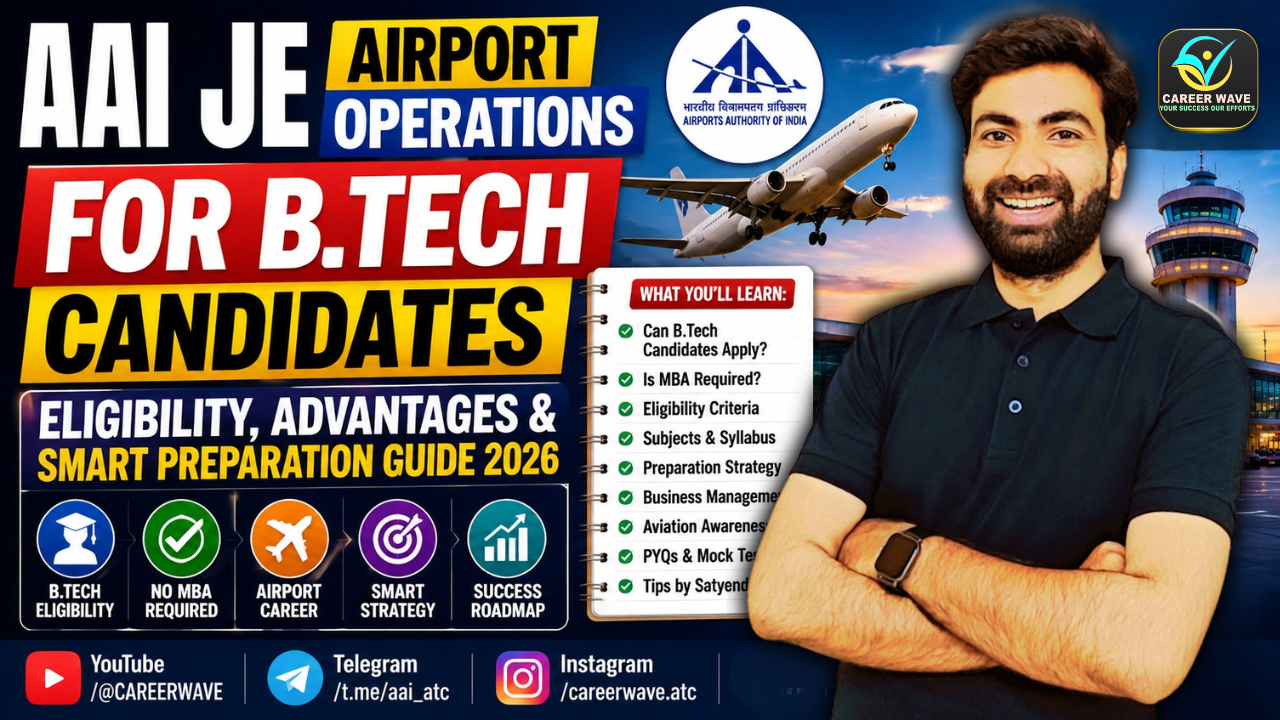
Can B.Tech candidates apply for
AAI JE Airport Operations 2026? Understand eligibility, MBA requirements,
advantages for engineering graduates, Business Management, Aviation Awareness,
PYQs and the right preparation strategy with Career Wave and Satyendra Sir.
AAI JE Airport Operations for
B.Tech Candidates: Eligibility, Advantages & Smart Preparation Strategy
If you are a
B.Tech candidate looking for a government career beyond conventional
engineering jobs, AAI Junior Executive (Airport Operations) can be an
important opportunity to consider.
One of the
most common questions among engineering graduates is:
“Can B.Tech
candidates apply for AAI JE Airport Operations?”
For the
recruitment route prescribing a full-time regular Bachelor's Degree in
Engineering, eligible B.Tech/engineering graduates can apply subject to
fulfilling the other conditions mentioned in the applicable AAI notification.
And there is
another important point:
An MBA is
not additionally required for candidates who satisfy the prescribed Engineering
qualification route.
However,
eligibility is only the first step.
At Career Wave, Satyendra
Sir advises B.Tech aspirants not to make the mistake of treating Airport
Operations as another purely technical engineering examination. Your
engineering background can help, but selection requires preparation according
to the actual AAI AO syllabus and exam pattern.
Can B.Tech
Candidates Apply for AAI JE Airport Operations?
Yes,
candidates meeting the prescribed full-time regular Bachelor's Degree in
Engineering qualification route can be eligible for AAI JE Airport
Operations, subject to the complete conditions of the recruitment notification.
This means a
B.Tech candidate should not automatically think:
“I need an
MBA to apply for Airport Operations.”
The
Engineering route and the Science Graduate + MBA route are separate
qualification routes.
A simple way to understand it is:
|
Qualification
Route |
MBA
Required? |
|
Prescribed
Full-Time Regular Bachelor's Degree in Engineering |
No
additional MBA required under this route |
|
Graduate
in Science + prescribed Full-Time Regular 2-Year MBA |
MBA
required as part of this route |
Candidates should always verify
their exact qualification against the official notification for the recruitment
cycle.
1. Why AAI
Airport Operations Can Be Relevant for B.Tech Candidates
Engineering
develops skills that can be useful in an operations-oriented environment:
·
Analytical
thinking
·
Problem-solving
·
Quantitative
ability
·
Technical
understanding
·
Logical
decision-making
·
Process-oriented
thinking
·
Working with
systems
·
Handling
structured information
Airport
Operations is not simply about sitting in an office and managing paperwork.
An airport
is a complex operational environment involving infrastructure, safety,
coordination, procedures, airlines, agencies and multiple stakeholders.
An
engineering mindset can therefore be useful.
But it does not automatically
make you exam-ready.
2. B.Tech
Candidates Do Not Necessarily Need an MBA
This is an
important eligibility-related doubt.
If you
satisfy the prescribed Engineering qualification route for the applicable
recruitment, you do not need to complete an additional MBA merely to satisfy
that educational route.
This is
different from candidates applying through the Science-graduate route where the
prescribed MBA forms part of that qualification combination.
Therefore:
B.Tech +
prescribed conditions → Engineering eligibility route
Do not
confuse it with:
Science
Graduation + MBA → Alternative eligibility route
Always read the complete official
qualification wording before applying.
3. Don't
Assume Every B.Tech Degree Automatically Qualifies
This is
equally important.
Students
often hear:
“B.Tech
candidates are eligible.”
and stop
checking the notification.
Never do
that.
You should
verify:
·
Exact
educational qualification
·
Full-time/regular
requirement
·
Degree
status
·
Cut-off date
·
Age
requirement
·
Required
licence, where prescribed
·
Category-related
conditions
·
Documentation
requirements
Eligibility is determined by the
official AAI recruitment conditions—not by a generic statement on social media.
4.
Engineering Background Can Help in Quantitative Areas
Many B.Tech
candidates already have reasonable familiarity with mathematics, calculations
and analytical problem-solving.
This can
provide a useful foundation for relevant quantitative areas.
But
competitive-exam Mathematics and Aptitude require a different skill:
Speed.
Knowing how
to solve a problem is not enough.
You should
be able to:
Recognize →
Select Method → Calculate → Answer
within
limited time.
Therefore, engineering graduates
should practise timed MCQs rather than assuming their academic Mathematics
background is sufficient.
5. Reasoning
Can Become a Scoring Area
Engineering
students often have a useful analytical foundation for Reasoning.
But again:
Analytical
ability ≠ Exam preparation
You still
need practice in relevant areas such as:
·
Series
·
Analogy
·
Coding-decoding
·
Blood
relations
·
Direction
sense
·
Ranking
·
Syllogism
·
Logical
reasoning
·
Puzzles
·
Seating
arrangements
The
objective is to build pattern recognition.
With sufficient practice, you
should be able to identify the likely method almost immediately after reading a
standard question.
6. The
Biggest Challenge for Many B.Tech Candidates: Business Management
This is
where technical-background candidates should be careful.
If your
academic background is Engineering, Business Management concepts may initially
feel unfamiliar.
You may
encounter concepts involving areas such as:
·
Business
·
Management
·
Business
organization
·
Management
functions
·
Planning
·
Organizing
·
Staffing
·
Directing
·
Controlling
·
Business
environment
·
Business
services
·
Social
responsibility and ethics
The mistake
is thinking:
“This is
theory. I can complete it near the exam.”
Theory-based
MCQs can be highly precise.
Two options
may look almost identical unless you understand the exact concept.
At Career
Wave, Satyendra Sir recommends:
Concept →
Short Notes → MCQs → Revision → Tests
for Business Management
preparation.
7. Don't
Study Business Management Like Engineering Theory
Engineering
students sometimes approach management chapters the same way they approach
descriptive university examinations.
They read
long explanations and try to memorize everything.
For an
objective competitive examination, your approach should be more focused.
For every
topic, identify:
Definition
Features
Functions
Important Differences
Examples
Applications
Commonly Confused Concepts
Then
immediately solve MCQs.
Your
objective is not to write a 10-page management answer.
Your objective is to identify the
correct option quickly.
8. Aviation
Awareness Is a New Territory for Many Engineers
Being an
engineer does not automatically mean you understand the aviation ecosystem.
Depending on
the applicable syllabus, you may need familiarity with areas such as:
·
Airports
Authority of India
·
DGCA
·
BCAS
·
ICAO
·
IATA
·
Airport
terminology
·
Aviation
abbreviations
·
Airports and
airport codes
·
Runway
terminology
·
Taxiways
·
Airport
infrastructure
·
Indian civil
aviation
·
Aviation-related
current affairs
This subject
should be built gradually.
Do not leave it for the last
week.
9. Learn
Aviation Through Connections, Not Random Facts
Suppose you
learn:
ICAO
Do not
memorize only its full form.
Build a
small information cluster around it:
What is it?
What does it broadly do?
Where is its headquarters?
How is it different from IATA?
Similarly,
when studying DGCA, BCAS or AAI, understand their roles rather than memorizing
isolated abbreviations.
Connected information is easier
to recall than random one-liners.
10. Don't
Confuse AAI AO with AAI ATC
Many B.Tech
candidates may also be preparing for AAI ATC.
That can
provide a useful foundation.
But:
AAI ATC and
AAI Airport Operations are different posts.
The
preparation requirements are not identical.
If you have
already prepared for ATC, carry forward your useful strengths in overlapping
areas.
But identify what is new for
AO and allocate preparation time accordingly.
11. Physics
and Maths Can Become a Comfort-Zone Trap
Technical
candidates naturally enjoy subjects where they already feel confident.
So a B.Tech
aspirant may continue solving:
Physics →
Maths → Physics → Maths
while
postponing:
Business
Management → Aviation Awareness → GA → English
This feels
productive because difficult numerical questions are being solved.
But
competitive preparation should be measured by:
Total Score
Improvement
not:
Difficulty
of Questions Solved
If Physics or Maths is already
strong, maintain it efficiently and invest more time in areas where you are
losing marks.
12. English
Should Not Be Ignored
Engineering
graduates sometimes focus heavily on technical and quantitative preparation
while treating English casually.
That can be
a mistake.
Where
applicable, objective English preparation may involve:
·
Grammar
·
Vocabulary
·
Sentence
correction
·
Error
detection
·
Reading
comprehension
·
Usage
·
Context-based
questions
Do not
assume conversational fluency automatically converts into competitive-exam
accuracy.
Test
yourself first.
Then prepare according to your
actual weaknesses.
13. General
Awareness Requires Consistency
General
Awareness cannot be handled effectively by collecting hundreds of PDFs
immediately before the exam.
Use a
filtered system:
Relevant
Current Affairs → Short Notes → Revision → MCQs
Avoid source
overload.
One well-revised source is
usually more useful than five sources you have only read once.
14. PYQs
Should Be Part of Your Core Preparation
Engineering
students are often comfortable solving large numbers of questions.
But random
question volume is not the same as exam-oriented practice.
Previous
Year Questions help you understand:
·
Question
framing
·
Difficulty
·
Important
concepts
·
Expected
depth
·
Repeated
patterns
·
Examiner
approach
At Career
Wave, Satyendra Sir recommends using PYQs to determine how deeply a
topic actually needs to be prepared.
You can
access AAI-oriented resources here:
Career Wave AAI PYQs & E-Books
15. Don't
Collect Too Many Books and PDFs
A common
preparation cycle looks like this:
Download
PDF.
Save
Telegram notes.
Buy another
book.
Watch
another playlist.
Download
another question bank.
After one
month, the student has enormous material but very little revision.
Avoid this.
Use:
Primary
Notes + PYQs + MCQ Practice + Tests + Error Notebook
The purpose
of resources is to improve your score.
Collecting resources is not
preparation.
16. Start
Sectional Tests Early
Do not wait
for the entire syllabus to finish.
Once you
have completed a reasonable portion of a subject, attempt a sectional test.
It will tell
you whether your preparation is actually converting into marks.
For example:
You may feel
Business Management is easy.
A sectional
test may reveal that you confuse similar definitions.
You may feel
Reasoning is strong.
A timed test
may reveal that you are too slow.
Testing removes assumptions.
17. Maintain
an Error Notebook
Create
subject-wise sections.
Physics
Concept or formula errors
Mathematics
Calculation or method errors
Aptitude
Formula, shortcut or time-management errors
Business
Management
Confused concepts, definitions or principles
Aviation
Awareness
Wrong abbreviations, organizations, codes or terminology
Reasoning
Pattern-recognition or logical errors
English
Grammar or vocabulary errors
General
Awareness
Incorrect or outdated facts
Revise this
notebook before every major mock.
Repeated
mistakes should gradually disappear.
18. Mock
Analysis Matters More Than Mock Count
Suppose
Candidate A attempts 25 mocks but barely analyses them.
Candidate B
attempts 15 mocks and carefully analyses every error.
Candidate B
may improve faster.
After each
mock, ask:
·
Which easy
questions did I miss?
·
Which
subjects consumed too much time?
·
Which
mistakes were conceptual?
·
Which
mistakes were careless?
·
Where did I
guess?
·
Which topics
need revision?
·
Did I repeat
an old mistake?
A mock
without analysis is only a score.
A mock with analysis becomes a
learning tool.
19. Your
Engineering Branch Does Not Decide Your Selection
Students
often compare:
Mechanical
vs Civil vs Electrical vs Electronics vs Computer Science
But once you
satisfy the prescribed eligibility conditions, your preparation quality becomes
critical.
A candidate
from one branch does not automatically deserve a higher score than another.
Competitive
examinations reward:
Knowledge +
Accuracy + Speed + Revision + Exam Strategy
Your branch
may influence your starting point.
It does not determine your final
performance.
20. Create a
Gap-Based Preparation Strategy
For a B.Tech
candidate, classify the syllabus into:
Strong
Already
comfortable and scoring well.
Average
Concepts
understood but accuracy/speed inconsistent.
New/Weak
Little prior
exposure or poor test performance.
Then
allocate your study time accordingly.
For example:
Strong →
Revision + Tests
Average →
Practice + Error Correction
Weak/New →
Concepts + Notes + MCQs + Repeated Revision
This is far more efficient than
giving equal time to every subject.
21. Sample
Daily Strategy for B.Tech Candidates
A balanced
study day could include:
Block 1: Business Management
Block 2: Aviation Awareness
Block 3: Maths/Physics/Aptitude Revision
Block 4: Reasoning or English
Block 5: PYQs/Sectional Test
Block 6: Error Notebook Revision
The exact
duration should depend on your strengths and available time.
The
principle is more important:
Do not allow your technical
comfort zone to consume the entire day.
22. B.Tech
Candidates Should Use Their Background Strategically
Your
engineering degree may have already trained you to:
·
Handle large
syllabi
·
Solve
numerical problems
·
Think
analytically
·
Study
technical concepts
·
Work under
examination pressure
Use these
skills.
But do not
carry unnecessary engineering habits into every subject.
Business
Management requires conceptual differentiation.
Aviation
Awareness requires repeated recall.
Reasoning
requires pattern recognition.
English
requires language accuracy.
Different subjects require
different preparation methods.
23.
Eligibility Is Only the Entry Gate
Being
eligible is important.
But
thousands of candidates can satisfy eligibility conditions.
The real
question becomes:
Can you
outperform enough candidates in the examination?
Once you have verified your
eligibility, stop repeatedly searching:
“Can B.Tech
students apply?”
Move to:
“How can I
maximize my AAI AO score?”
That is the
question that affects selection.
Career Wave
Strategy for B.Tech Candidates
At Career
Wave, Satyendra Sir recommends the following sequence:
Verify
Eligibility → Understand Syllabus → Identify Existing Strengths → Learn
AO-Specific Subjects → Solve PYQs → Take Sectional Tests → Full Mocks → Analyse
Errors → Revise
For
technical-background students, the key principle is:
Use
Engineering as an Advantage, Not as a Preparation Limitation.
Your
analytical foundation can help.
But you must still become an AAI
AO-specific candidate.
Final
Takeaway
AAI JE
Airport Operations can be a relevant opportunity for eligible B.Tech/Engineering
candidates.
The
Engineering qualification route means an additional MBA is not necessarily
required merely to satisfy that route, subject to the exact conditions in the
applicable AAI recruitment notification.
But B.Tech
candidates should avoid three major mistakes:
1. Assuming
eligibility means selection will be easy
2. Spending
most preparation time only on familiar technical subjects
3.
Underestimating AO-specific areas such as Business Management and Aviation
Awareness
Your
engineering degree can give you a foundation.
Your exam-specific
preparation has to convert that foundation into selection.
As Satyendra
Sir at Career Wave emphasizes:
Don't prepare like an engineering
student appearing in another college exam. Prepare like an AAI AO aspirant
competing for selection.
Frequently
Asked Questions
1. Can
B.Tech candidates apply for AAI JE Airport Operations?
Candidates satisfying the
prescribed full-time regular Bachelor's Degree in Engineering route can be
eligible, subject to all other requirements of the applicable AAI recruitment
notification.
2. Is MBA
compulsory for B.Tech candidates?
Under the prescribed Engineering
qualification route, an additional MBA is not required merely to satisfy that
educational route. Candidates should still verify the exact notification
applicable to their recruitment.
3. Can
engineering candidates from any branch apply?
Eligibility depends on the
precise wording of the applicable AAI notification. Candidates should verify
whether the advertisement specifies particular engineering disciplines or
permits Engineering generally.
4. Is AAI AO
a technical job?
Airport Operations involves
operational, coordination and airport-related responsibilities. Candidates
should not assume that the recruitment or job is equivalent to a conventional
core-engineering post.
5. Do B.Tech
candidates have an advantage in AAI AO?
They may have useful analytical,
quantitative and problem-solving skills. However, these advantages matter only
when combined with complete AO-specific preparation.
6. Is
Business Management difficult for B.Tech candidates?
It can initially be unfamiliar,
but systematic concept study, short notes, MCQ practice and revision can make
it manageable.
7. How
should engineers prepare Aviation Awareness?
Study aviation organizations,
terminology, airport concepts and relevant current information systematically.
Use repeated revision and MCQ practice rather than one-time memorization.
8. Should
ATC-preparing engineers use the same notes for AO?
Use relevant overlapping
preparation where appropriate, but do not assume ATC and AO have identical
requirements. Prepare new AO-specific areas separately.
9. Are PYQs
important for B.Tech candidates?
Yes. PYQs help identify the
actual question level, framing, important concepts and preparation depth
required.
10. Should I
focus more on technical or non-technical subjects?
Follow the applicable AO syllabus
and your test performance. Strong subjects require maintenance; new and weak
areas generally need more learning time.
11. How
should I start AAI AO preparation as a B.Tech candidate?
Start with:
Eligibility Check → Syllabus
Analysis → Strong/Weak Topic Classification → Concepts → PYQs → Sectional Tests
→ Mocks → Revision
12. Where
can I get AAI AO preparation guidance and PYQs?
Follow Career Wave and
Satyendra Sir for AAI-focused preparation, strategy, Aviation Awareness,
Business Management and PYQ-based practice.
Connect with
Career Wave
YouTube: Career Wave YouTube
Telegram: Career Wave AAI Telegram
Instagram: Career Wave Instagram
Facebook: Career Wave Facebook
AAI PYQs & E-Books: Career Wave E-Books
Career Wave — AAI Exam Preparation with Satyendra Sir
Leave a Comment
25-Aug-2026 06:05 PM
Can B.Tech candidates apply for AAI JE Airport Operations 2026? Understand eligibility, MBA requirements, advantages for engineering graduates, Business Management, Aviation Awareness, PYQs and the...
22-Aug-2026 01:25 PM
Preparing for AAI JE Airport Operations 2026? Learn the most common preparation mistakes aspirants make, from studying only strong subjects and ignoring Business Management or...
21-Aug-2026 03:49 PM
Are you preparing for AAI JE Airport Operations by focusing only on Physics and Maths? Understand why ignoring Business Management, Aviation Awareness, Reasoning, English, Aptitude...
20-Aug-2026 04:36 PM
Will AAI ATC preparation give you an advantage in AAI JE Airport Operations? Understand the syllabus overlap, benefits in Reasoning, Aptitude, English and Aviation, challenges...
19-Aug-2026 12:04 PM
Is MBA compulsory for AAI JE Airport Operations? Understand the eligibility criteria for B.Sc. + MBA and Engineering candidates, MBA mode requirements, qualification routes and...
18-Aug-2026 06:21 PM
Can B.Sc + MBA candidates apply for AAI JE Airport Operations 2026? Understand eligibility, qualification requirements, career opportunities, Aviation Awareness, Business Management, PYQs and smart...
