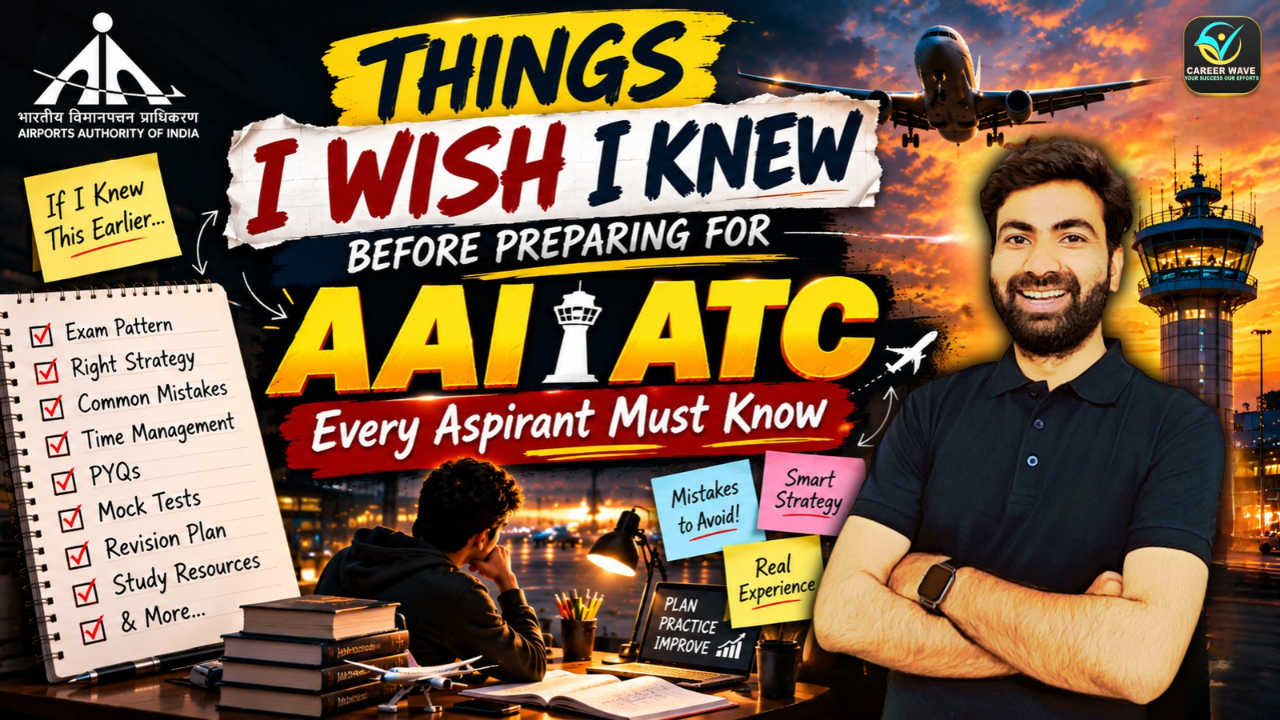
Starting your AAI ATC 2026
preparation? Discover 25 important lessons every aspirant should know before
preparing for the AAI Junior Executive Air Traffic Control exam. Career Wave
and Satyendra Sir explain common preparation mistakes, Physics and Mathematics
strategies, non-technical subject preparation, PYQ practice, mock test
analysis, revision techniques, and time management. Learn how to select the
right study resources, create an effective timetable, improve accuracy, avoid
common mistakes, and build a smart preparation strategy for AAI ATC 2026.
Things I Wish I Knew Before Preparing for AAI
ATC 2026: 25 Important Lessons Every Aspirant Should Know
AAI ATC 2026
Preparation Guide | Common Mistakes | Physics & Mathematics Strategy | PYQs
| Mock Tests | Career Wave | Satyendra Sir
When
students begin preparing for the AAI Junior Executive (Air Traffic Control)
examination, they usually have plenty of questions.
Where should
I start? Which books should I follow? How difficult are Physics and
Mathematics? Is coaching necessary? How many hours should I study? When should
I begin solving previous year questions?
Most
aspirants eventually find answers to these questions, but often only after
wasting valuable preparation time.
Some
students spend months collecting study material. Others focus entirely on
Physics and Mathematics while neglecting the non-technical section. Many
complete the syllabus but realize too late that they have not practised enough
mock tests.
What if you
could avoid these mistakes from the beginning?
At Career
Wave, Satyendra Sir regularly emphasizes the importance of
understanding the examination, choosing reliable resources, and following a
structured preparation strategy.
In this article, we will discuss 25
important things every AAI ATC aspirant should know before starting preparation,
along with practical strategies, common mistakes, study planning tips, and
frequently asked questions.
1. I Wish I
Knew That Understanding the Exam Pattern Comes Before Studying
One of the
first mistakes aspirants make is beginning preparation without carefully
understanding the examination pattern.
Students
start watching Physics lectures or solving Mathematics questions without
knowing the subject-wise weightage.
AAI ATC Exam
Pattern
The recent
AAI ATC Computer-Based Test has followed this structure:
|
Subject |
Questions |
Marks |
|
Physics |
30 |
30 |
|
Mathematics |
30 |
30 |
|
English
Language |
20 |
20 |
|
Reasoning |
15 |
15 |
|
General
Aptitude |
15 |
15 |
|
General Awareness |
10 |
10 |
|
Total |
120 |
120 |
This table
reflects the recent examination pattern. Candidates should verify the
applicable official AAI recruitment notification for the latest syllabus and
marking scheme.
What I Would
Do Differently
Before
starting preparation, I would understand the complete syllabus, examination
pattern, subject weightage, and selection process.
Satyendra Sir's Advice: Preparation becomes more effective when you know exactly what the
examination requires.
2. I Wish I
Knew That Physics and Mathematics Are Only Half the Paper
Many
aspirants assume that AAI ATC is primarily a Physics and Mathematics
examination.
These
subjects are important, but they contribute 60 marks out of 120 under the
recent pattern.
The
remaining 60 marks come from English, Reasoning, General Aptitude, and General
Awareness.
The Mistake
Students
devote most of their time to technical subjects and leave non-technical
preparation for the final month.
What I Would
Do Differently
I would
prepare technical and non-technical subjects simultaneously.
A balanced
preparation plan reduces last-minute pressure and provides opportunities to
improve scores across all sections.
3. I Wish I
Knew That Completing Lectures Is Not the Same as Completing Preparation
Watching a
lecture can help you understand a concept.
However,
understanding a teacher's explanation and solving a question independently are
different skills.
The Mistake
Students
finish several lectures but do not practise enough questions.
When they
attempt a mock test, they struggle to apply the concepts.
What I Would
Do Differently
After every
lecture, I would:
1.
Revise the
concept.
2.
Solve
standard questions.
3.
Attempt
questions independently.
4.
Analyse
mistakes.
5.
Practise
relevant PYQs.
Important Lesson: A chapter should be considered prepared only when you can apply
its concepts to examination-level questions.
4. I Wish I
Had Started Solving PYQs from the Beginning
Previous
year questions are among the most useful resources for understanding an
examination.
However,
many aspirants postpone PYQ practice until after completing the syllabus.
Why This Is
a Problem
Without
PYQs, students may not understand which concepts have been tested or how
questions are framed.
What I Would
Do Differently
After
completing each chapter, I would solve relevant previous year questions.
I would
analyse the underlying concepts instead of memorizing answers.
AAI ATC
Previous Year Questions
Explore
Career Wave's PYQs and e-books:
Career Wave Tip: PYQs should guide preparation, but they should not be the only
source of practice.
5. I Wish I
Knew That Formula Memorization Alone Is Not Enough
Physics and
Mathematics contain numerous formulas.
Students
often assume that memorizing formulas will help them solve most numerical
questions.
The Reality
A formula
becomes useful only when you understand its meaning, conditions, and
application.
What I Would
Do Differently
For every
important formula, I would learn:
·
Meaning of
variables.
·
Units and
dimensions.
·
Conditions
of applicability.
·
Relevant
assumptions.
·
Common
mistakes.
·
Representative
numerical applications.
Satyendra Sir's Advice: Understand why a formula works and when it should be used.
6. I Wish I
Had Maintained a Formula Notebook from Day One
During
preparation, students study multiple chapters involving different formulas.
Without
organized revision, remembering all formulas becomes difficult.
What I Would
Do Differently
I would
create separate formula notebooks for Physics and Mathematics.
Physics
Notebook: Formulas, units, conditions,
diagrams, and important concepts.
Mathematics
Notebook: Standard formulas, identities,
methods, and frequently confused concepts.
I would revise these notebooks
regularly instead of creating them during the final weeks.
7. I Wish I
Knew That Mathematics Requires Method Selection, Not Just Calculation
Students
sometimes understand Mathematics formulas but struggle to identify the correct
method for a question.
The Mistake
Memorizing
shortcuts without understanding the mathematical principles behind them.
What I Would
Do Differently
I would
practise different question types and compare possible solving methods.
I would
focus on selecting the correct approach before trying to improve speed.
Important Lesson: Accuracy and method selection should come before shortcuts.
8. I Wish I
Had Taken English More Seriously
English is
often underestimated by students with strong technical backgrounds.
However, the
recent AAI ATC pattern has included 20 English questions.
Important
Areas
·
Error
Detection
·
Sentence
Improvement
·
Tenses
·
Subject-Verb
Agreement
·
Articles
·
Prepositions
·
Vocabulary
·
Idioms and
Phrases
·
Reading
Comprehension
What I Would
Do Differently
I would
practise English regularly instead of leaving it for the final revision period.
Even short daily sessions can
help students improve their understanding of grammar and vocabulary.
9. I Wish I
Knew That Reasoning and Aptitude Need Separate Preparation
Some
aspirants treat Reasoning and General Aptitude as subjects that can be managed
through general intelligence.
But both
require specific practice.
Reasoning
Requires
Logical
understanding, pattern recognition, and accuracy.
Aptitude
Requires
Calculation
skills, conceptual clarity, and time management.
What I Would
Do Differently
I would
practise both subjects through short, timed question sets.
I would also record recurring
mistakes and revise the methods that consume excessive time.
10. I Wish I
Had Not Ignored General Awareness
General
Awareness may contribute fewer marks than Physics or Mathematics, but it
remains part of the overall examination.
The Mistake
Students
postpone the subject because its syllabus appears broad.
What I Would
Do Differently
I would
study General Awareness in small daily sessions.
Important
areas include:
·
Indian
History
·
Geography
·
Polity
·
Economy
·
General
Science
·
Current
Affairs
I would maintain concise notes
and revise them regularly.
11. I Wish I
Had Used Fewer Study Resources
Many
aspirants believe that collecting more books, PDFs, and video playlists
improves preparation.
In reality,
excessive resources can create confusion.
The Mistake
Switching
between multiple teachers, books, and question banks without completing any
resource properly.
What I Would
Do Differently
I would
select:
·
One reliable
source for concepts.
·
One
organized set of notes.
·
Previous
year questions.
·
A practice
question bank.
·
A suitable
mock-test series.
Satyendra Sir's Advice: The quality of your preparation matters more than the number of
resources you collect.
12. I Wish I
Knew That Revision Should Start Before Syllabus Completion
Students
often plan to revise only after finishing the entire syllabus.
This can
lead to forgetting previously studied chapters.
What I Would
Do Differently
I would use
a regular revision cycle.
Same Day: Review important concepts.
Weekly: Revise completed chapters.
Monthly: Revisit older topics.
Before
Tests: Revise formulas and recurring
mistakes.
The frequency would depend on how
well I remember each topic.
13. I Wish I
Had Maintained an Error Notebook
One of the
most useful preparation habits is recording mistakes.
The Problem
Students
repeatedly make the same errors because they do not review them systematically.
What I Would
Do Differently
I would
maintain an error notebook for every subject.
|
Subject |
Mistakes
to Record |
|
Physics |
Formula,
unit, sign and conceptual errors |
|
Mathematics |
Calculation and method mistakes |
|
English |
Grammar
and vocabulary confusion |
|
Reasoning |
Logical and pattern-recognition errors |
|
Aptitude |
Calculation
and shortcut errors |
|
General Awareness |
Incorrect facts and outdated information |
Before
important mock tests, I would revise the recurring mistakes.
14. I Wish I
Had Started Mock Tests Earlier
Many
students wait until the entire syllabus is complete before attempting mock
tests.
Why This Is
a Problem
They may
discover time-management and accuracy problems too late.
What I Would
Do Differently
I would
begin with chapter-wise and sectional tests.
As
preparation progressed, I would attempt full-length mock tests.
This gradual
approach helps develop examination familiarity.
Career Wave
AAI ATC Full Test Series 2026
Explore
structured mock-test practice:
https://careerwave.org/test-series/22-atc-full-test-series-2026
15. I Wish I
Knew That Mock-Test Analysis Matters More Than Mock-Test Quantity
Attempting
many mock tests does not automatically improve scores.
The Mistake
Students
check their marks and immediately move to the next test.
What I Would
Do Differently
After every
mock, I would analyse:
·
Incorrect
answers.
·
Unattempted
questions.
·
Weak
chapters.
·
Calculation
errors.
·
Time-consuming
questions.
·
Repeated
mistakes.
·
Subject-wise
accuracy.
I would
revise the concepts responsible for mistakes before attempting similar
questions.
Satyendra Sir's Advice: Every mock test should tell you what needs to improve.
16. I Wish I
Had Focused on Accuracy Before Speed
Many
aspirants try to solve questions faster from the beginning.
This often
increases careless mistakes.
What I Would
Do Differently
I would
follow this sequence:
Conceptual
Clarity → Correct Method → Accuracy → Speed
Once accuracy became consistent,
I would gradually introduce stricter time limits.
17. I Wish I
Had Practised Question Selection
One
difficult question can consume several minutes.
During a
competitive examination, poor question selection can reduce overall
performance.
What I Would
Do Differently
I would
practise identifying questions that can be solved quickly and accurately.
I would
attempt familiar questions first and return to lengthy problems later.
I would test different strategies
during mock examinations.
18. I Wish I
Had Created a Realistic Study Timetable
Many
students create extremely demanding timetables that they cannot maintain.
The Mistake
Planning 12
hours of study daily without considering classes, breaks, sleep, and personal
responsibilities.
What I Would
Do Differently
I would
create a timetable based on my actual available time.
Sample
Six-Hour Daily Study Plan
|
Activity |
Duration |
|
Physics |
90
Minutes |
|
Mathematics |
90 Minutes |
|
English
and Reasoning |
60
Minutes |
|
Aptitude and General Awareness |
60 Minutes |
|
PYQs
and Revision |
60
Minutes |
|
Total |
6 Hours |
This is an illustrative plan.
Students should adjust it according to their preparation level and available
time.
19. I Wish I
Had Tracked My Weekly Progress
Without
tracking progress, students may not recognize whether their preparation
strategy is working.
What I Would
Do Differently
Every week,
I would review:
·
Chapters
completed.
·
Questions
attempted.
·
Accuracy
improvement.
·
Mock-test
performance.
·
Weak
subjects.
·
Revision
progress.
·
Recurring
mistakes.
This information would help me
make practical changes to my study plan.
20. I Wish I
Had Stopped Comparing My Mock Scores with Others
Mock-score
comparisons can create unnecessary pressure.
A student
scoring 75 marks may become discouraged after seeing another aspirant score
105.
What I Would
Do Differently
I would
compare my current performance with my previous performance.
I would
focus on improving accuracy, reducing mistakes, and strengthening weak areas.
Important Lesson: Another student's mock score does not determine your examination
result.
21. I Wish I
Had Understood the Importance of Consistency
Studying for
ten hours on one day and doing nothing for the next three days is not an
effective long-term strategy.
What I Would
Do Differently
I would
maintain a sustainable routine.
Even on busy
days, I would try to complete a manageable amount of revision or practice.
Consistency helps prevent
unnecessary backlogs.
22. I Wish I
Had Protected My Study Time from Distractions
Mobile
phones are useful for online classes, notes, and practice tests.
However,
unnecessary notifications and social media can interrupt concentration.
What I Would
Do Differently
I would:
·
Silence
unnecessary notifications.
·
Use focused
study blocks.
·
Keep social
media separate from study time.
·
Take planned
breaks.
·
Avoid
switching repeatedly between apps.
23. I Wish I
Had Paid Attention to Sleep and Health
Some
aspirants sacrifice sleep to increase study hours.
However,
fatigue can reduce concentration and increase mistakes.
What I Would
Do Differently
I would
maintain a reasonable sleep schedule, take short breaks, and include regular
physical activity.
I would
avoid treating exhaustion as proof of productive preparation.
Career Wave Tip: A sustainable routine is more useful than an extreme timetable
followed for only a few days.
24. I Wish I
Had Understood the Complete AAI ATC Selection Process
Some
students focus only on the written examination.
However, the
recruitment process may include additional stages.
Depending on
the applicable official notification, these can include:
·
Voice Test
·
Psychological
Assessment
·
Psychoactive
Substances Test
·
Document
Verification
·
Medical
Examination
What I Would
Do Differently
I would
carefully read the official notification before beginning preparation.
I would understand the
eligibility conditions, selection stages, and applicable medical requirements.
25. I Wish I
Knew That Smart Preparation Is More Important Than Studying Randomly
The most
important lesson is that preparation should follow a clear system.
Students
often study for long hours without analysing whether their methods are
effective.
What I Would
Do Differently
I would
follow a structured preparation cycle:
Learn
Concepts → Practise Questions → Solve PYQs → Attempt Tests → Analyse Mistakes →
Revise → Improve
This
approach helps connect conceptual learning with examination performance.
Satyendra Sir's Advice: The objective is not simply to complete the syllabus. It is to
develop the ability to solve questions accurately and efficiently under
examination conditions.
What I Would
Do in My First 30 Days of AAI ATC Preparation
If I were
beginning AAI ATC preparation again, I would organize the first month into four
stages.
|
Week |
Preparation
Focus |
Main
Objective |
|
Week 1 |
Understand
syllabus and assess fundamentals |
Identify
strengths and weaknesses |
|
Week 2 |
Build Physics and Mathematics concepts |
Establish a strong foundation |
|
Week 3 |
Add
regular non-technical practice and PYQs |
Develop
balanced preparation |
|
Week 4 |
Revision, sectional tests and analysis |
Evaluate progress and improve strategy |
This plan is intended for
beginners and can be adjusted according to individual preparation levels.
Common AAI
ATC Preparation Mistakes: What to Avoid
|
Common
Mistake |
Better
Approach |
|
Studying
only Physics and Mathematics |
Prepare
technical and non-technical subjects together |
|
Watching lectures without practice |
Solve questions independently |
|
Starting
PYQs too late |
Practise
chapter-wise PYQs |
|
Collecting excessive resources |
Use limited, reliable materials |
|
Ignoring
revision |
Follow
a regular revision cycle |
|
Attempting mocks without analysis |
Review mistakes after every test |
|
Focusing
only on speed |
Improve
accuracy before speed |
|
Comparing scores with others |
Track personal improvement |
|
Creating
unrealistic timetables |
Follow
a sustainable routine |
|
Ignoring selection requirements |
Read the complete official notification |
How Career
Wave Helps AAI ATC Aspirants Prepare More Effectively
At Career
Wave, Satyendra Sir emphasizes conceptual clarity, structured
practice, previous year question analysis, and regular performance evaluation.
Aspirants
can use Career Wave's preparation resources to organize their studies.
1.
Concept-Based Preparation
Develop a
strong understanding of Physics and Mathematics instead of relying only on
memorized formulas.
2. AAI ATC
Previous Year Questions
Use PYQs to
understand previous examination trends and practise important concepts.
AAI ATC PYQs
and E-Books:
3. AAI ATC
Full Mock Tests
Practise
full-length mock tests to evaluate speed, accuracy, and examination readiness.
Career Wave
AAI ATC Full Test Series 2026:
https://careerwave.org/test-series/22-atc-full-test-series-2026
4.
Preparation Guidance by Satyendra Sir
Follow
Career Wave's educational content for subject preparation, revision strategies,
and examination guidance.
Career Wave
YouTube Channel:
https://www.youtube.com/@CAREERWAVE
Satyendra
Sir's Advice for Students Starting AAI ATC Preparation
If you are
beginning AAI ATC preparation, do not make the process unnecessarily
complicated.
Start by
understanding the syllabus.
Choose
reliable resources.
Build your
Physics and Mathematics fundamentals.
Prepare
English, Reasoning, Aptitude, and General Awareness consistently.
Solve PYQs
after completing relevant concepts.
Attempt
tests regularly and analyse your mistakes.
Most
importantly, maintain a realistic preparation schedule.
At Career
Wave, Satyendra Sir emphasizes that students should focus on measurable
improvement rather than simply increasing study hours.
A well-organized preparation
strategy can help you avoid many common mistakes and use your available time
more effectively.
Frequently
Asked Questions (FAQs)
1. What
should I know before starting AAI ATC preparation?
Understand the official
eligibility conditions, examination pattern, syllabus, subject weightage,
selection stages, and available preparation resources.
2. How
should beginners start preparing for AAI ATC 2026?
Begin with syllabus analysis,
assess your fundamentals, study Physics and Mathematics concepts, and gradually
introduce non-technical subjects, PYQs, and tests.
3. Is AAI
ATC preparation difficult for beginners?
Difficulty depends on your
academic background and preparation level. Students with weak fundamentals may
need additional time for Physics and Mathematics.
4. Are
Physics and Mathematics enough to crack AAI ATC?
No. The recent examination
pattern has also included English, Reasoning, General Aptitude, and General
Awareness.
5. Should I
start solving PYQs before completing the syllabus?
Yes, you can begin chapter-wise
PYQ practice after studying the relevant concepts.
6. How many
hours should I study daily for AAI ATC?
There is no fixed requirement.
Choose a sustainable study duration based on your current preparation level and
available time.
7. What is
the biggest mistake students make during AAI ATC preparation?
A common mistake is focusing on
syllabus completion without sufficient revision, independent practice, and
mock-test analysis.
8. Is
coaching compulsory for AAI ATC preparation?
No. Coaching is not a compulsory
eligibility requirement. Students can prepare through self-study, although
structured guidance may help those who need additional support.
9. How can I
improve Mathematics accuracy?
Practise different question
types, strengthen fundamentals, record calculation mistakes, and gradually
introduce timed practice.
10. When
should I begin attempting mock tests?
Begin with chapter-wise and
sectional tests as you complete topics. Introduce full-length mocks as your
preparation develops.
11. Where
can I find AAI ATC previous year questions?
Explore
Career Wave's PYQs and e-books:
12. Where
can I attempt AAI ATC Full Mock Tests 2026?
Explore
Career Wave's AAI ATC Full Test Series 2026:
https://careerwave.org/test-series/22-atc-full-test-series-2026
Conclusion:
Learn These Lessons Before You Start AAI ATC Preparation
If there is
one thing every AAI ATC aspirant should understand, it is that preparation
becomes easier to manage when the right decisions are made early.
You do not
need to collect every available book.
You do not
need to study for unrealistic hours.
And you
should not wait until the final month to discover your weak subjects.
Instead,
focus on understanding concepts, practising questions, revising regularly, and
learning from mistakes.
Start PYQs
early, maintain an error notebook, and use mock tests to evaluate your
progress.
At Career
Wave, Satyendra Sir encourages aspirants to follow a structured
preparation approach that supports consistent improvement.
Remember: The earlier you
identify common preparation mistakes, the more time you have to correct them
before the examination.
Connect with
Career Wave
Stay
connected with Career Wave and Satyendra Sir for AAI ATC 2026
preparation strategies, Physics and Mathematics guidance, PYQs, mock tests, and
examination updates.
YouTube
Channel:
https://www.youtube.com/@CAREERWAVE
Telegram
Channel:
https://t.me/aai_atc
Instagram:
https://www.instagram.com/careerwave.atc
Facebook:
https://www.facebook.com/careerwave.atc
AAI ATC Full
Test Series 2026:
https://careerwave.org/test-series/22-atc-full-test-series-2026
AAI ATC PYQs
and E-Books:
https://careerwave.org/ebooks
Career Wave — Your Success, Our Efforts
Leave a Comment
30-Oct-2026 02:39 PM
Can an average student crack AAI ATC 2026? Discover the truth with Career Wave and Satyendra Sir. Learn how students with average academic performance can...
29-Oct-2026 04:50 PM
Starting your AAI ATC 2026 preparation? Discover 25 important lessons every aspirant should know before preparing for the AAI Junior Executive Air Traffic Control exam....
27-Oct-2026 12:09 PM
RRB Station Master Recruitment 2026: Explore 1250 tentative vacancies under CEN No. 08/2026. Check application dates, eligibility criteria, salary, selection process, exam pattern, and preparation...
26-Oct-2026 11:21 AM
Want to crack AAI ATC 2026 with a smart and disciplined preparation strategy? Discover 25 daily habits of successful AAI ATC aspirants with Career Wave...
24-Oct-2026 12:21 PM
Preparing for AAI ATC 2026 but struggling with low mock scores, forgotten formulas, incomplete revision, or time management? Discover the 25 hidden challenges of AAI...
23-Oct-2026 01:25 PM
Is coaching really necessary to crack AAI ATC 2026, or can you succeed through self-study? Discover an honest comparison of AAI ATC online coaching, offline...
