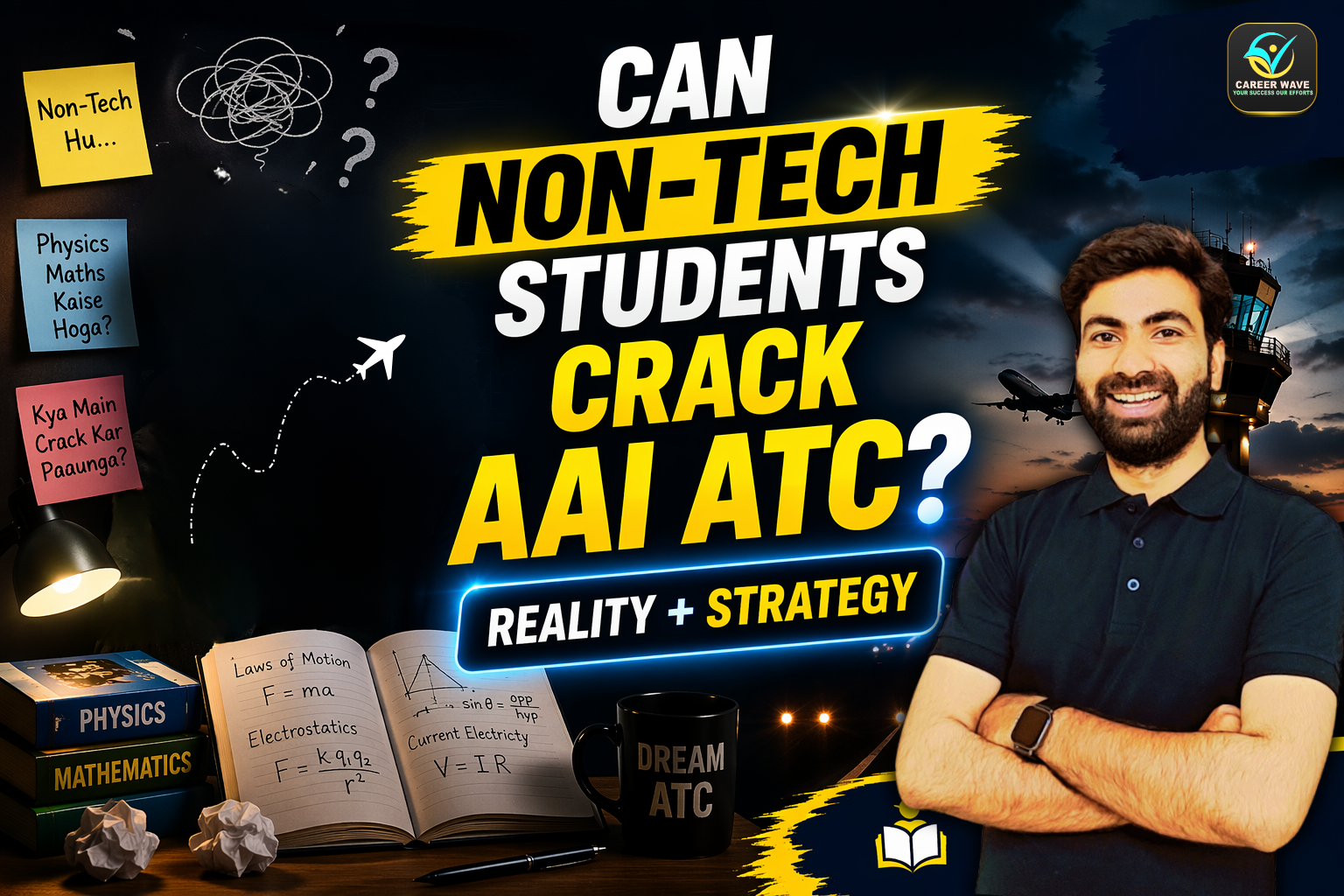
Can non-technical students crack
the AAI ATC exam? This detailed guide by Career Wave explains the real
challenges, preparation strategy, common mistakes, and a step-by-step plan to
help non-technical aspirants succeed in AAI ATC 2025.
Can Non-Technical Students Crack AAI ATC?
This is one
of the most common questions among aspirants, and honestly, it comes from a
very real fear.
Many
students look at the AAI ATC exam and immediately feel that it is only for
highly technical or exceptionally strong science students. They assume that if
they are not from a hardcore engineering background, or if they have been away
from Physics and Mathematics for some time, their chances are weak. Because of
this fear, many capable students either do not start seriously or lose
confidence midway.
But the
truth is very clear:
Yes,
non-technical students can absolutely crack AAI ATC.
Not only can
they crack it, but many students from relatively average academic backgrounds
have done extremely well in this exam when they prepared with the right
strategy, the right guidance, and the right consistency.
The exam
does not reward only “brilliant” students. It rewards students who are
disciplined, conceptually clear, exam-focused, and consistent over time.
That is exactly why this question
should not be:
“Am I technical enough for AAI ATC?”
It should be:
“Am I ready to prepare in the right direction?”
First, let us understand the fear behind this
question
When
students say they are “non-technical,” they usually mean one of these things:
·
They are not
from an engineering mindset
·
They are
weak in Mathematics
·
They are not
confident in Physics
·
They have
forgotten Class 11 and 12 concepts
·
They feel
others are already far ahead
·
They think
technical students have a natural advantage
This fear is
understandable. AAI ATC is not an exam where you can ignore the technical
section and still hope to clear it comfortably. Physics and Mathematics matter
a lot. Part B becomes the game-changer for serious selection.
But this
does not mean only toppers or technical prodigies can qualify.
It simply means that your
preparation must be structured.
AAI ATC is not impossible for non-technical
students — it is just unforgiving without direction
The problem
is not background.
The problem is unplanned preparation.
A
non-technical student usually fails for these reasons:
·
Starts late
·
Avoids
difficult chapters
·
Keeps
switching resources
·
Watches
lectures but does not practice questions
·
Does not
revise properly
·
Ignores
mocks
·
Gets scared
after seeing numerical questions
·
Focuses too
much on theory and too little on application
So, the
issue is not that non-technical students cannot crack the exam.
The issue is that many of them prepare emotionally, not strategically.
And AAI ATC is an exam where
strategy matters a lot.
What actually matters in AAI ATC preparation?
To crack
this exam, especially as a non-technical student, you need to build preparation
on four strong pillars:
1. Basic conceptual clarity
You do not
need to become a scientist.
You need to understand Class 11–12 level Physics and Mathematics in a practical
exam-oriented way.
A lot of
students get scared because they think the syllabus is too vast or too
technical. But once concepts are taught properly from the basics, many chapters
become manageable.
Topics look
scary before understanding.
After understanding, they become scoring.
2. Question-solving ability
Just
watching lectures is never enough.
In AAI ATC,
your selection depends on how well you can apply concepts under time pressure.
That is why PYQs, class questions, practice sheets, and mock tests are
essential.
A student
who solves regularly will outperform a student who only studies passively.
3. Revision discipline
Most
students think they have studied a chapter once, so it is done.
That is one of the biggest mistakes.
In technical
preparation, retention matters as much as learning.
If you do not revise, you start forgetting formulas, concepts, and question
patterns very quickly.
4. Guided preparation
This is
where many non-technical students gain an edge.
A student
with average background but strong mentorship often performs better than a
student with strong background but no direction.
When you
know:
·
what to
study,
·
what to
skip,
·
which
chapters carry weight,
·
how to
revise,
·
how to
attempt mocks,
·
and how to
recover from weak areas,
your preparation becomes much
more efficient.
Do non-technical students have any real
chance against technical students?
Yes, and
sometimes even a better chance than you think.
Why?
Because many
so-called technical students become overconfident. They assume their background
is enough, and they do not prepare with seriousness. They underestimate the
exam, delay revision, and ignore practice.
On the other
hand, non-technical students who are serious often prepare with more sincerity.
They know they need to work harder, so they stay more consistent.
And in
competitive exams, consistency beats background very often.
This is why many selections come
not from the “smartest” student in the room, but from the student who studied
the most correctly for the longest time.
What should a non-technical student do first?
The first
step is to stop comparing and start building.
You do not
need to compete with someone’s degree.
You need to compete with the exam.
A smart path
for non-technical students is:
·
Start with
basics, not advanced books
·
Understand
the chapter before judging it
·
Practice a
limited number of quality questions daily
·
Keep a
formula/revision notebook
·
Follow PYQ
trends seriously
·
Take
sectional tests after every chapter
·
Slowly move
toward full-length mocks
This gradual
build-up creates confidence.
Confidence in AAI ATC does not
come from motivation.
It comes from repeated correct practice.
Which part is toughest for non-technical
students?
Usually,
students feel difficulty in one of these two areas:
Mathematics
Students
often fear:
·
trigonometry
·
calculus
basics
·
algebraic
manipulation
·
speed in
solving questions
But in
reality, Maths improves with repetition. It is less about intelligence and more
about familiarity.
Physics numericals
Students
understand theory but struggle when a numerical is asked in a new way.
This happens
because they are not practicing enough application-based questions.
The solution
is simple:
·
learn
concept
·
note formula
·
solve
standard questions
·
solve PYQs
·
revise again
The more this cycle repeats, the
more confidence grows.
Can a student with weak basics still crack
AAI ATC?
Yes, but
only if they are honest about their weakness and start early.
A weak
student can improve.
A careless student usually does not.
That is the
real difference.
If your
basics are weak, your preparation plan should include:
·
foundation
lectures
·
slow and
clear concept building
·
topic-wise
practice
·
extra
revision of formulas
·
regular
doubt-solving
·
performance
tracking
Once you
accept your starting point, improvement becomes much faster.
The biggest mistake is pretending
everything is fine while avoiding weak areas.
How Career Wave helps non-technical students
At Career
Wave, the focus is not only on teaching chapters. The focus is on making
students exam-ready in a practical and guided way.
Many
students need more than content.
They need structure, mentorship, accountability, and clarity.
That is
where Career Wave becomes useful for aspirants who feel confused, weak in
technical subjects, or lost in preparation.
Career Wave provides:
·
concept-based
teaching from basics
·
exam-oriented
coverage of Physics and Mathematics
·
PYQ-focused
approach
·
regular
practice and test support
·
mentorship
for disciplined preparation
·
structured
roadmap instead of random study
·
doubt-solving
environment to reduce fear and confusion
For a
non-technical student, this kind of system matters a lot because it reduces
panic and saves time.
Instead of asking, “Where should
I study from?” every week, the student can focus on actually studying.
Why mentorship matters more for non-technical
students
A technical
student may recover from confusion faster because of prior familiarity.
A non-technical student usually needs cleaner explanation and stronger
hand-holding in the early phase.
That is why
mentorship is not a luxury here.
It is a multiplier.
When a
mentor tells you:
·
this chapter
is important,
·
this topic
is repeatedly asked,
·
this formula
is enough,
·
this level
of question practice is sufficient,
·
this mock
score is acceptable at this stage,
you stop
wasting energy on unnecessary anxiety.
This saves months.
Common myths that stop non-technical students
Myth 1:
“Only engineers can crack AAI ATC”
Wrong.
Eligibility and preparation are not the same thing. Many serious
non-engineering science students can do very well.
Myth 2:
“Physics and Maths are too hard for average students”
Wrong. They
are difficult only when studied without sequence and revision.
Myth 3: “I
forgot everything, so I am too late”
Wrong. Many
students restart from zero and still improve strongly with disciplined study.
Myth 4: “I
need very high IQ to clear”
Wrong. You
need accuracy, consistency, and exam-focused practice more than anything else.
Myth 5: “If
I am weak now, I cannot compete”
Wrong. Your current level is not
your final level.
What kind of study approach works best for
non-technical students?
A practical
approach looks like this:
Phase 1: Foundation
·
Understand
basic concepts chapter by chapter
·
Remove fear
from Maths and Physics
·
Make short
notes and formula sheets
Phase 2: Application
·
Solve
chapter-wise questions
·
Practice
previous year questions
·
Identify
weak areas
·
Improve
speed and accuracy slowly
Phase 3: Testing
·
Give
sectional tests
·
Give
mixed-topic tests
·
Start
full-length mocks
·
Learn time
management
Phase 4: Revision and polish
·
Revise
formulas again and again
·
Reattempt
weak-topic questions
·
Analyse
mocks deeply
·
Avoid
studying everything from scratch repeatedly
This type of preparation is far
more effective than random long study hours.
What is the biggest advantage a non-technical
student can build?
The biggest
advantage is discipline.
If a
non-technical student studies daily with direction, tracks progress, revises
properly, and stays emotionally stable, they can become stronger month by
month.
Many
students lose because they study emotionally:
·
one day 10
hours
·
next day
zero
·
frequent
fear
·
frequent
course switching
·
frequent
doubt about self
A serious student with moderate
pace but strong consistency will almost always improve better.
Final truth
AAI ATC is
definitely challenging.
It is not an easy exam.
But it is
also not reserved for a special category of students.
It is a
competitive exam where preparation quality decides outcome.
If you are a
non-technical student and you are willing to:
·
start
honestly,
·
build your
basics,
·
practice
regularly,
·
revise
consistently,
·
and follow a
proper system,
then
cracking AAI ATC is absolutely possible.
And if you
want a more guided, exam-focused, and student-friendly path, Career Wave
can help you prepare in a structured way so that fear does not control your
journey.
Your background may decide your
starting point.
It does not decide your result.
FAQs
1. Can a
non-technical student really crack AAI ATC?
Yes. A non-technical student can
crack AAI ATC with the right strategy, strong basics, regular practice, and
consistent revision. Background matters less than preparation quality.
2. Is AAI
ATC only for engineering students?
No. The exam may feel technical,
but success is not limited to engineering students alone. Many students from
normal science backgrounds can perform well if they prepare correctly.
3. What is
the biggest challenge for non-technical students in AAI ATC?
The biggest challenge is fear of
Physics and Mathematics. Most students struggle more with confidence and
consistency than with actual difficulty level.
4. Can I
crack AAI ATC if my Maths is weak?
Yes, but you must work on it
seriously. Weak Maths can improve through basics, repeated practice, and
chapter-wise testing.
5. Can I
crack AAI ATC if I have forgotten Class 11 and 12 concepts?
Yes. Many students restart from
basics. With proper guidance and step-by-step teaching, forgotten concepts can
be rebuilt.
6. How much
time does a non-technical student need to prepare well?
It depends on the starting level,
but with disciplined study, many students can build strong preparation in 4 to
8 months.
7. Is
self-study enough for non-technical students?
It can be enough for some
students, but many non-technical aspirants benefit a lot from mentorship,
structured classes, doubt-solving, and a guided plan.
8. Which is
more important in AAI ATC: theory or practice?
Both matter, but practice is what
converts understanding into marks. Without question-solving and mocks, theory
alone is not enough.
9. How does
Career Wave help non-technical students?
Career Wave helps by providing structured teaching, exam-oriented coverage,
PYQ focus, mentorship, mock tests, and a guided roadmap that makes preparation
more manageable.
10. What
should a non-technical student avoid during AAI ATC preparation?
Avoid comparing yourself with
others, skipping weak topics, changing resources frequently, studying without
revision, and fearing technical subjects before actually learning them.
Conclusion
So, can
non-technical students crack AAI ATC?
Yes,
definitely.
They do not
need magic.
They need method.
With proper guidance, consistent
effort, and a structured platform like Career Wave, even students who
begin with fear and weak confidence can move toward a strong and realistic
chance of selection.
Related Blogs -
Ray Optics in AAI ATC: PYQ Pattern + Expected Questions (Detailed Guide by Career Wave)
Revision Framework: 3-Layer Revision Strategy for AAI ATC (Complete System by Career Wave)
Maths for AAI ATC: What to Study & What to Skip (Deep, Practical Guide by Career Wave)
Why Students Score Less in Mocks but Perform Better in Exam (AAI ATC – Detailed Analysis)
Leave a Comment
09-Sep-2026 12:05 PM
Learn the best AAI AO Full Mock Test Strategy 2026 to manage exam time effectively. Career Wave and Satyendra Sir explain section order, two-round attempt...
08-Sep-2026 02:40 PM
Learn how to improve accuracy in AAI JE Airport Operations 2026 mock tests and reduce silly mistakes. Career Wave and Satyendra Sir explain practical strategies...
08-Sep-2026 10:51 AM
Discover why mock tests are essential for AAI JE Airport Operations 2026 preparation. Learn how Full Mock Tests and Sectional Tests help improve speed, accuracy,...
07-Sep-2026 03:52 PM
Prepare for AAI JE Airport Operations 2026 with Career Wave’s exam-focused Test Series. Get Full-Length Mock Tests, Sectional Tests, latest pattern-based questions, detailed solutions, performance...
07-Sep-2026 11:27 AM
Check the complete IMD Scientific Assistant Physics Syllabus 2026 for Part-F as per the official SSC JE 2026 notification. Get chapter-wise topics including Mathematical Methods,...
05-Sep-2026 12:01 PM
Get the complete IMD Scientific Assistant Exam Pattern 2026 explained by Career Wave. Check Paper 1 and Paper 2 pattern, total questions, marks, duration, negative...
