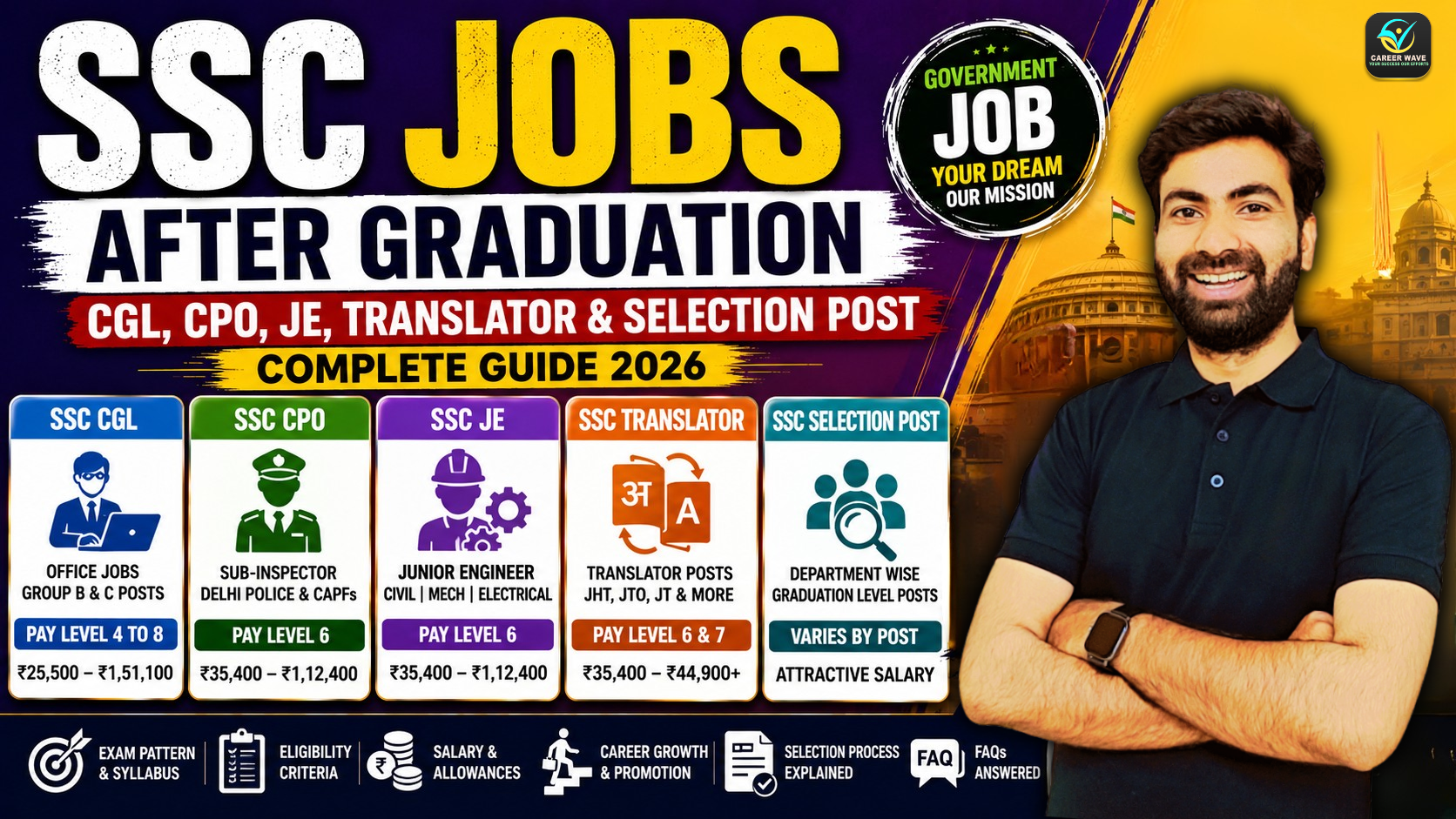
Explore the complete guide to SSC
jobs after graduation including SSC CGL, CPO, JE, Translator and Selection
Post. Check eligibility, salary, posts, selection process, job profile and
Career Wave preparation guidance.
SSC Jobs After Graduation: CGL, CPO, JE,
Translator and Selection Post
Graduation
opens the door to some of the most respected SSC government jobs in India. Many
students think SSC means only CGL, but that is not correct. After graduation,
candidates can target several SSC exams depending on their qualification,
interest, physical fitness, language skills and technical background.
The major
SSC job opportunities after graduation include SSC CGL, SSC CPO, SSC JE,
Combined Hindi Translator and SSC Selection Post Graduation Level. Each exam
has a different job profile. Some are office-based, some are field-oriented,
some are technical, and some are language-specialist posts.
At Career
Wave, we always advise students to choose the exam according to their
personality and career goal. A student who wants an office job may prefer CGL.
A physically fit candidate interested in uniformed service may prefer CPO. An
engineering candidate can target JE. A Hindi-English language specialist can
prepare for Translator posts. Candidates looking for department-specific
opportunities should also track SSC Selection Post.
This blog explains all major SSC
jobs after graduation in a clear and practical way.
SSC Jobs After Graduation: Quick Overview
|
Exam |
Main Posts |
Suitable For |
|
SSC CGL |
ASO, Inspector, Auditor, Accountant, Tax
Assistant, AAO, AEO, SI CBI |
General graduates |
|
SSC CPO |
Delhi Police SI, CAPF SI |
Graduates interested in uniformed service |
|
SSC JE |
Junior Engineer Civil, Mechanical,
Electrical |
Engineering diploma/degree candidates |
|
SSC Combined Hindi Translator |
JHT, JTO, JT, SHT, STO |
Hindi-English language specialists |
|
SSC Selection Post |
Department-specific graduate-level posts |
Candidates looking for post-wise
opportunities |
Important point: Not every
graduate is eligible for every exam. SSC CGL and SSC CPO are broad
graduation-level exams. SSC JE is for engineering diploma/degree holders.
Translator posts usually require specific Hindi-English postgraduate
qualifications. Selection Post eligibility depends on the individual post.
1. SSC CGL After Graduation
SSC CGL is
the most popular SSC exam after graduation. CGL stands for Combined Graduate
Level Examination. It recruits candidates for various Group B and Group C
posts in central government ministries, departments, constitutional bodies,
statutory bodies and tribunals.
For most
graduates, SSC CGL is the first choice because it offers multiple posts, good
salary levels, office-based jobs, field jobs, promotion opportunities and
central government stability.
Major Posts
Under SSC CGL
Some
important posts under SSC CGL include:
·
Assistant
Audit Officer
·
Assistant
Accounts Officer
·
Assistant
Section Officer
·
Inspector of
Income Tax
·
Inspector,
Central Excise
·
Inspector,
Preventive Officer
·
Inspector,
Examiner
·
Assistant
Enforcement Officer
·
Sub
Inspector in CBI
·
Inspector
Posts
·
Junior
Statistical Officer
·
Statistical
Investigator Grade-II
·
Auditor
·
Accountant
·
Tax
Assistant
·
Senior
Secretariat Assistant
·
Upper
Division Clerk
SSC CGL
Eligibility
The basic
qualification for most SSC CGL posts is a Bachelor’s Degree from a recognized
university or equivalent.
Some posts
have additional requirements:
|
Post |
Extra Requirement |
|
Junior Statistical Officer |
Graduation with Statistics or required
Mathematics marks at Class 12 level |
|
Statistical Investigator Grade-II |
Graduation in
Statistics/Mathematics/Economics/Demography or related subjects |
|
Assistant Audit Officer / Assistant
Accounts Officer |
Bachelor’s degree required;
commerce/finance-related qualifications are desirable |
Final-year
students may be eligible if they possess the required qualification by the
cut-off date mentioned in the official notification.
SSC CGL
Salary
SSC CGL
posts are divided into different pay levels.
|
Pay Level |
Salary Range |
|
Pay Level 8 |
₹47,600 – ₹1,51,100 |
|
Pay Level 7 |
₹44,900 – ₹1,42,400 |
|
Pay Level 6 |
₹35,400 – ₹1,12,400 |
|
Pay Level 5 |
₹29,200 – ₹92,300 |
|
Pay Level 4 |
₹25,500 – ₹81,100 |
The actual
in-hand salary depends on basic pay, DA, HRA, TA, posting city, department and
deductions.
SSC CGL
Selection Process
SSC CGL
selection generally includes:
1.
Tier-I
Computer Based Examination
2.
Tier-II
Computer Based Examination
3.
Document
Verification by user departments
4.
Final post
allotment based on merit, preference and eligibility
Tier-I is
mainly qualifying for Tier-II shortlisting, while final merit is primarily
based on Tier-II performance.
SSC CGL Job
Profile
The job
profile depends on the post.
Office-based
posts may include:
·
File work
·
Administrative
support
·
Noting and
drafting
·
Data
handling
·
Departmental
coordination
·
Record
management
Field or
inspection posts may include:
·
Tax
inspection
·
Enforcement
work
·
Customs-related
duties
·
Investigation
support
·
Departmental
field verification
Who Should
Choose SSC CGL?
Choose SSC
CGL if:
·
You are a
graduate
·
You want a
central government job
·
You want
multiple post options
·
You prefer
administrative, clerical, tax, audit or inspection-related work
·
You want
better salary levels and promotion scope
SSC CGL is best for students who
want flexibility in post preference and long-term government career growth.
2. SSC CPO After Graduation
SSC CPO is a
strong option for graduates who want a uniformed government job. CPO stands for
Central Police Organization. Through this exam, SSC recruits
Sub-Inspectors in Delhi Police and Central Armed Police Forces.
This exam is
not only about written marks. Candidates must also clear physical standards,
endurance tests, medical examination and document verification.
Main Posts
Under SSC CPO
|
Post |
Department |
|
Sub-Inspector Executive |
Delhi Police |
|
Sub-Inspector General Duty |
CAPFs |
CAPFs
generally include forces such as BSF, CISF, CRPF, ITBP and SSB.
SSC CPO
Eligibility
The basic
qualification is a Bachelor’s Degree from a recognized university or
equivalent.
For male
candidates applying for Delhi Police SI, a valid LMV driving licence may be
required at the physical test stage as per official rules. Candidates without
it may still be eligible for CAPF SI, depending on notification conditions.
SSC CPO Age
Limit
The usual
age limit is 20 to 25 years, with relaxation for reserved categories as per
government rules. Candidates should verify the exact age date from the official
notification of that year.
SSC CPO
Salary
Delhi Police
SI and CAPF SI carry Pay Level 6.
|
Post |
Pay Level |
Pay Scale |
|
Delhi Police SI |
Level 6 |
₹35,400 – ₹1,12,400 |
|
CAPF SI |
Level 6 |
₹35,400 – ₹1,12,400 |
The final
salary depends on allowances, posting and deductions.
SSC CPO
Selection Process
The
selection process generally includes:
1.
Paper-I
Computer Based Examination
2.
Physical
Standard Test / Physical Endurance Test
3.
Paper-II
Computer Based Examination
4.
Detailed
Medical Examination
5.
Document
Verification
6.
Final
selection and post/force allocation
SSC CPO
Paper-I Exam Pattern
|
Subject |
Questions |
Marks |
|
General Intelligence and Reasoning |
50 |
50 |
|
General Knowledge and General Awareness |
50 |
50 |
|
Quantitative Aptitude |
50 |
50 |
|
English Comprehension |
50 |
50 |
|
Total |
200 |
200 |
SSC CPO
Paper-II Exam Pattern
|
Subject |
Questions |
Marks |
|
English Language and Comprehension |
200 |
200 |
Physical
Test in SSC CPO
Physical
test is mandatory. It usually includes running, long jump, high jump and other
standards like height and chest for male candidates. The standards are
different for male and female candidates.
Who Should
Choose SSC CPO?
Choose SSC
CPO if:
·
You are a
graduate
·
You want a
uniformed job
·
You are
physically fit
·
You are
comfortable with field duty
·
You want
police or paramilitary service exposure
·
You can
prepare for both written and physical stages
SSC CPO is ideal for disciplined
candidates who want responsibility, field service and respect.
3. SSC JE After Graduation or Engineering
Qualification
SSC JE
stands for Junior Engineer Examination. It is not a general graduation
exam. It is mainly for candidates with Civil, Mechanical or Electrical
Engineering qualifications.
Engineering
diploma and degree holders can apply depending on the post and department. Some
departments may require work experience, especially for diploma holders.
Branches
Under SSC JE
|
Branch |
Post Type |
|
Civil Engineering |
Junior Engineer Civil |
|
Mechanical Engineering |
Junior Engineer Mechanical |
|
Electrical Engineering |
Junior Engineer Electrical |
|
Electrical & Mechanical |
JE E&M posts, depending on department |
SSC JE
Departments
SSC JE
recruitment may include departments such as:
·
CPWD
·
CWC
·
MES
·
BRO
·
Farakka
Barrage Project
·
DGQA Naval
·
Central
Water Power Research Station
·
Other
technical government organizations
The final
department list changes according to vacancy.
SSC JE
Eligibility
Eligibility
is post-wise.
Common
requirements include:
·
Diploma in
relevant engineering branch
·
Degree in
relevant engineering branch
·
Experience,
if prescribed for specific posts
Students
should not assume that a general graduation degree is enough for SSC JE. It is
a technical exam, and engineering qualification is essential.
SSC JE
Salary
SSC JE posts
generally come under Pay Level 6.
|
Component |
Details |
|
Pay Level |
Level 6 |
|
Pay Scale |
₹35,400 – ₹1,12,400 |
|
Post Type |
Group B, Non-Gazetted |
|
Job Nature |
Technical government job |
SSC JE
Selection Process
The
selection process generally includes:
1.
Paper-I
Computer Based Examination
2.
Paper-II
Computer Based Examination
3.
Document
Verification
4.
Final
allocation based on merit, preference and eligibility
SSC JE
Paper-I Pattern
|
Subject |
Questions |
Marks |
|
General Intelligence and Reasoning |
50 |
50 |
|
General Awareness |
50 |
50 |
|
General Engineering |
100 |
100 |
|
Total |
200 |
200 |
SSC JE
Paper-II Pattern
Paper-II is
a technical paper of 300 marks based on the candidate’s engineering branch.
SSC JE Job
Profile
A Junior
Engineer may handle:
·
Site
supervision
·
Technical
inspection
·
Measurement
work
·
Maintenance
work
·
Estimation
and costing
·
Quality
control
·
Project
execution support
·
Contractor
coordination
·
Technical
reporting
·
Bill
verification
Who Should
Choose SSC JE?
Choose SSC
JE if:
·
You have an
engineering diploma or degree
·
You want a
technical government job
·
You are
comfortable with field and technical work
·
You want Pay
Level 6 salary
·
You want to
build a career in government engineering departments
SSC JE is one of the best options
for engineering candidates who want stability with technical responsibility.
4. SSC Combined Hindi Translator After
Graduation
SSC Combined
Hindi Translator is a specialized exam for candidates with strong Hindi and
English language ability. It is not a simple graduation-level exam. It usually
requires postgraduate-level qualification in Hindi or English with the required
language combination.
This exam
recruits candidates for translation and official language posts in various
central government ministries and departments.
Major Posts
Under SSC Translator Exam
|
Post |
Pay Level |
|
Junior Translation Officer |
Level 6 |
|
Junior Hindi Translator |
Level 6 |
|
Junior Translator |
Level 6 |
|
Senior Hindi Translator |
Level 7 |
|
Senior Translator |
Level 7 |
|
Senior Translation Officer |
Level 7 |
SSC
Translator Eligibility
The exact
eligibility depends on the post, but common requirements include:
·
Master’s
Degree in Hindi with English as a compulsory/elective subject, or
·
Master’s
Degree in English with Hindi as a compulsory/elective subject, or
·
Related
language combinations as mentioned in the notification
·
Translation
diploma/certificate or experience where required
This exam is
best suited for candidates who have strong command over both Hindi and English.
SSC
Translator Selection Process
The
selection process generally includes:
1.
Paper-I
Computer Based Examination
2.
Paper-II
Translation and Essay
3.
Document
Verification
4.
Final
selection based on merit and preference
Paper-I
Paper-I
tests Hindi and English language knowledge through objective questions.
Paper-II
Paper-II is
descriptive and tests:
·
Hindi to
English translation
·
English to
Hindi translation
·
Essay
writing in Hindi
·
Essay
writing in English
Job Profile
of Translator Posts
Selected
candidates may handle:
·
Translation
of official documents
·
Hindi-English
correspondence
·
Implementation
of official language policy
·
Drafting and
proofreading
·
Translation
of reports, circulars and notices
·
Departmental
language work
·
Terminology
and administrative translation
Who Should
Choose SSC Translator?
Choose this
exam if:
·
You are
strong in Hindi and English
·
You have
relevant postgraduate qualification
·
You like
translation, writing and language work
·
You want an
office-based central government role
·
You are
comfortable with formal government language
This is a good option for
language-specialized candidates who do not want to compete only in general
aptitude-based exams.
5. SSC Selection Post After Graduation
SSC
Selection Post is one of the most underrated SSC opportunities after
graduation. Unlike CGL or CPO, this exam is post-specific. Different
departments send vacancies to SSC, and candidates apply for posts according to
qualification, age and eligibility.
Selection
Post includes three levels:
·
Matriculation
Level
·
Higher
Secondary Level
·
Graduation
and Above Level
For
graduates, the important category is Graduation and Above Level.
SSC
Selection Post Eligibility
Eligibility
depends entirely on the post.
Some posts
may require:
·
Any
graduation
·
Graduation
in a specific subject
·
Computer
knowledge
·
Typing skill
·
Field
experience
·
Technical
qualification
·
Regional
language knowledge
·
Physical or
medical standards, wherever required
Candidates
must read post-wise eligibility carefully before applying.
SSC
Selection Post Job Profile
The job
profile depends on the department. It may include:
·
Research
assistance
·
Clerical
work
·
Data
handling
·
Technical
assistance
·
Laboratory
support
·
Field work
·
Documentation
·
Statistical
assistance
·
Department-specific
duties
SSC
Selection Post Selection Process
The
selection process generally includes:
1.
Computer
Based Examination
2.
Scrutiny of
documents
3.
Skill test,
wherever prescribed
4.
Document
Verification by user department
5.
Final
selection
Candidates
applying for more than one post category usually need to apply separately for
each post category.
Who Should
Choose SSC Selection Post?
Choose
Selection Post if:
·
You are a
graduate
·
You want
more opportunities beyond CGL
·
You are open
to department-specific roles
·
You have
subject-specific eligibility
·
You want to
increase your selection chances through less-publicized vacancies
Selection
Post should not be ignored by serious SSC aspirants.
SSC Jobs
After Graduation: Salary Comparison
|
Exam |
Main Pay Level |
|
SSC CGL |
Level 4 to Level 8 |
|
SSC CPO |
Level 6 |
|
SSC JE |
Level 6 |
|
SSC Translator |
Level 6 and Level 7 |
|
SSC Selection Post |
Varies by post |
Salary should not be the only
factor while choosing an exam. Students should also consider job profile,
physical requirements, transfer policy, work pressure, promotion and personal
comfort.
Which SSC Exam Is Best After Graduation?
There is no
single best exam for everyone. The best exam depends on the student.
Choose SSC
CGL if:
·
You want
maximum post options
·
You prefer
administrative, tax, audit or clerical roles
·
You want a
mix of office and field job options
·
You want
strong promotion opportunities
Choose SSC
CPO if:
·
You want a
uniformed job
·
You are
physically fit
·
You are
ready for field duty
·
You want
police or paramilitary service
Choose SSC
JE if:
·
You have
Civil, Mechanical or Electrical Engineering background
·
You want a
technical government job
·
You are
comfortable with site work and engineering responsibilities
Choose SSC
Translator if:
·
You are
strong in Hindi and English
·
You have the
required language qualification
·
You want an
office-based language-specialist role
Choose SSC
Selection Post if:
·
You want
more post-specific opportunities
·
You have
subject-specific qualification
·
You want to
apply to multiple department-wise vacancies
Preparation Strategy for SSC Jobs After
Graduation
1. Choose
One Main Exam First
Do not
prepare for all exams blindly. Choose one main exam according to your
qualification and career goal.
Examples:
·
General
graduate: CGL main, Selection Post backup
·
Physically
fit graduate: CPO main, CGL backup
·
Engineering
candidate: JE main, CGL/Selection Post backup
·
Language
specialist: Translator main, Selection Post backup
2.
Understand Exam Pattern
Before
starting preparation, understand:
·
Number of
stages
·
Subjects
·
Negative
marking
·
Physical
test, if any
·
Skill test,
if any
·
Final merit
criteria
·
Document
verification process
3. Build
Core Subjects
For CGL and
CPO, focus on:
·
Quantitative
Aptitude
·
Reasoning
·
English
·
General
Awareness
For JE,
focus on:
·
Technical
branch subjects
·
Reasoning
·
General
Awareness
For
Translator, focus on:
·
Hindi
grammar
·
English
grammar
·
Translation
practice
·
Essay
writing
·
Vocabulary
·
Official
language terminology
For
Selection Post, focus on:
·
Graduation-level
subject requirement
·
General
awareness
·
Reasoning
·
English
·
Post-specific
skills
4. Solve
Previous Year Questions
PYQs help
students understand the real level of the exam. They also show repeated topics,
exam style and scoring areas.
Students
should solve PYQs topic-wise first and then year-wise.
5. Practice
Mock Tests
Mock tests
help improve:
·
Time
management
·
Accuracy
·
Question
selection
·
Exam
pressure handling
·
Weak topic
identification
·
Revision
planning
Mock
analysis is more important than the score.
6. Keep
Documents Ready
Many
candidates lose opportunities because they ignore document requirements.
Keep these
ready:
·
Graduation
marksheets
·
Degree/provisional
certificate
·
Category
certificate, if applicable
·
EWS/OBC-NCL
certificate, if applicable
·
Photo ID
·
Domicile
certificate, wherever required
·
Driving
licence for Delhi Police SI male candidates, if required
·
Engineering
diploma/degree for JE
·
Translation/experience
certificate for Translator posts, wherever required
Common Mistakes Students Should Avoid
·
Choosing an
exam only because it is popular
·
Ignoring
post-wise eligibility
·
Preparing
for CPO without physical fitness
·
Preparing
for JE without technical depth
·
Applying for
Translator without checking language qualification
·
Ignoring
Selection Post vacancies
·
Not reading
the official notification
·
Depending
only on mock scores without analysis
·
Studying too
many sources
·
Not revising
regularly
·
Filling post
preferences casually
·
Keeping
documents incomplete
Career Wave Guidance for Graduate Aspirants
At Career
Wave, our guidance for SSC graduate-level aspirants is simple: choose
wisely, prepare systematically and avoid random strategy.
A graduate
student should not ask only “Which exam is best?” The better question is:
“Which exam matches my qualification, strength and career goal?”
A good SSC
preparation plan should include:
·
Clear exam
target
·
Backup exam
·
Syllabus
mapping
·
Previous
year question analysis
·
Weekly mock
tests
·
Regular
revision
·
Current
affairs and static GK preparation
·
Document
readiness
·
Physical
preparation if targeting CPO
·
Technical
revision if targeting JE
·
Language
practice if targeting Translator
SSC jobs after graduation can
provide stability, salary, respect and long-term career growth. But selection
requires clarity and consistency.
FAQs
Q1. Which
SSC exams can I apply for after graduation?
After graduation, candidates can
apply for SSC CGL, SSC CPO, eligible SSC Selection Post vacancies, and other
exams depending on qualification. Engineering candidates can apply for SSC JE,
while language-specialized candidates can apply for SSC Translator posts.
Q2. Which is
the best SSC exam after graduation?
SSC CGL is the most popular exam
after graduation because it offers multiple Group B and Group C posts. However,
the best exam depends on your interest. CPO is better for uniformed jobs, JE
for engineering candidates and Translator for language specialists.
Q3. Can any
graduate apply for SSC CGL?
Yes, most SSC CGL posts require a
Bachelor’s Degree from a recognized university. Some posts like JSO and
Statistical Investigator have specific subject requirements.
Q4. Can any
graduate apply for SSC CPO?
Yes, the basic qualification for
SSC CPO is graduation. Candidates must also satisfy physical, medical and age
requirements.
Q5. Is SSC
JE for all graduates?
No. SSC JE is mainly for
candidates with Civil, Mechanical or Electrical Engineering diploma/degree. A
general BA, BCom or BSc graduate is not eligible unless the post specifically
allows it.
Conclusion
SSC jobs
after graduation offer multiple career paths. SSC CGL is best for general
graduates who want broad post options. SSC CPO is suitable for candidates who
want a uniformed service career. SSC JE is ideal for engineering diploma or
degree holders. SSC Translator is a strong option for Hindi-English language
specialists. SSC Selection Post gives additional department-wise opportunities.
The right
exam depends on your qualification, age, interest, fitness and long-term career
goal. Do not follow the crowd blindly. Choose the exam that matches your
strengths.
Career Wave recommends every graduate aspirant to start with clarity, read
official notifications carefully, prepare with a fixed plan and revise
consistently. With the right strategy, SSC can become a strong pathway to a
stable and respected government career.
Related Blogs -
SSC JE 2026 Complete Guide: Civil, Mechanical and Electrical Engineering Jobs
SSC Jobs After 12th: CHSL, MTS, GD and Other Opportunities
SSC CPO 2026 Complete Guide: Delhi Police SI and CAPF SI
SSC Jobs After 10th: Eligibility, Salary, Posts and Selection Process
SSC Exams List 2026: Complete List of SSC Jobs After 10th, 12th and Graduation
Leave a Comment
29-Jul-2026 12:42 PM
Check AAI JE Airport Operations cutoff analysis with previous year trends, expected safe score, category-wise cutoff discussion, exam pattern, subject weightage, and Career Wave guidance...
27-Jul-2026 01:52 PM
Check the complete AAI JE Airport Operations Syllabus 2026, eligibility criteria, 79 vacancies, exam pattern, subject-wise weightage and preparation strategy by Career Wave and Satyendra...
23-Jul-2026 02:09 PM
Learn whether female candidates can join AAI ATC, eligibility requirements, shift duty, job suitability, preparation strategy, and guidance from Career Wave by Satyendra Sir.
22-Jul-2026 04:47 PM
Learn whether AAI ATC is a stressful job, why the role demands alertness and responsibility, how ATCOs manage pressure, and how Career Wave with Satyendra...
21-Jul-2026 02:43 PM
Learn why most students quit AAI ATC preparation and how to stay consistent with the right study plan, Physics-Maths strategy, mock analysis, revision cycle, and...
20-Jul-2026 12:29 PM
Learn how to complete the AAI ATC syllabus without burnout using a realistic study plan, smart revision cycle, PYQ practice, mock test analysis, short notes,...
