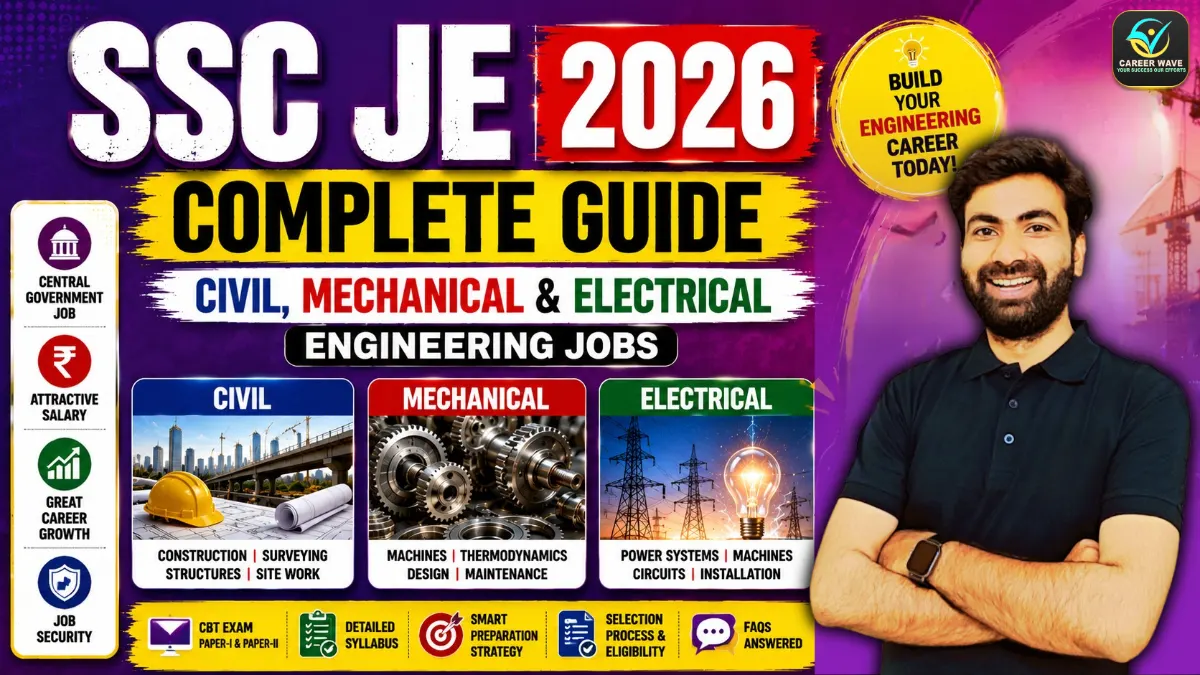
Read the complete SSC JE 2026
guide for Civil, Mechanical and Electrical Engineering candidates. Check
eligibility, salary, posts, exam pattern, selection process, syllabus, job
profile, preparation strategy and Career Wave guidance.
SSC JE 2026 is one of the most important government job exams for engineering students who want a stable technical career in central government departments. SSC JE stands for Staff Selection Commission Junior Engineer Examination. It is mainly conducted for Civil, Mechanical and Electrical Engineering candidates.
This exam is different from general SSC exams like CGL, CHSL or MTS because SSC JE is a technical recruitment exam. It tests engineering knowledge along with reasoning, general awareness and exam-oriented accuracy.
As per the SSC tentative calendar for 2026–27, Junior Engineer Civil, Mechanical & Electrical Examination 2026 is listed with Paper-I as a Computer Based Examination. The calendar mentioned advertisement in March 2026, closing date in April 2026 and tentative Paper-I exam period in May–June 2026. Candidates should always verify the latest official notification for final dates and rules.
At Career Wave, we advise engineering students to treat SSC JE as a serious technical career opportunity. A good SSC JE preparation plan should include branch-wise technical clarity, formula revision, PYQ practice, mock tests and non-technical scoring strategy.
|
Particular |
Details |
|
Exam Name |
SSC JE 2026 |
|
Full Form |
Staff Selection Commission Junior Engineer Examination |
|
Conducting Body |
Staff Selection Commission |
|
Main Branches |
Civil, Mechanical, Electrical |
|
Post Name |
Junior Engineer |
|
Job Type |
Central Government Technical Job |
|
Post Category |
Group B, Non-Gazetted, Non-Ministerial |
|
Pay Level |
Level 6 |
|
Pay Scale |
₹35,400 – ₹1,12,400 |
|
Selection Process |
Paper-I, Paper-II, Document Verification |
|
Exam Mode |
Computer Based Examination |
|
Question Type |
Objective Multiple Choice Questions |
SSC JE posts have been mentioned in official SSC JE notices as Group B Non-Gazetted, Non-Ministerial posts in Level 6, with pay scale ₹35,400 to ₹1,12,400 under the 7th CPC pay matrix.
SSC JE is a national-level recruitment exam for Junior Engineer posts in various government departments and organizations. It is suitable for candidates who want a technical government job after completing an engineering diploma or degree.
A Junior Engineer usually works under senior engineers and assists in technical supervision, maintenance, project execution, quality control and departmental engineering work.
A Junior Engineer may be responsible for:
SSC JE is a good option for candidates who want to stay connected with engineering work instead of shifting to a purely clerical or administrative profile.
SSC JE recruitment is generally conducted for Junior Engineer posts in different central government departments. The exact list of departments may change every year as per vacancy requirements.
Common departments in SSC JE recruitment include:
SSC’s tentative vacancy data for SSC JE 2025 included departments such as CPWD, Central Water Commission, Central Water Power Research Station, DGQA Naval, Farakka Barrage Project and MES, showing that vacancies are department-wise and branch-wise.
SSC JE mainly covers three engineering branches:
Civil Engineering candidates can apply for Junior Engineer Civil posts where the department requires construction, building, road, water, structural or maintenance-related technical work.
Mechanical Engineering candidates can apply for Junior Engineer Mechanical posts or E&M posts where machinery, equipment, mechanical systems and maintenance work are required.
Electrical Engineering candidates can apply for Junior Engineer Electrical posts or E&M posts where electrical systems, power distribution, installations and maintenance work are involved.
Some departments may also mention specific combinations like Electrical & Mechanical or related branches. Therefore, students must check the post-wise qualification carefully in the official notification.
Civil Engineering is one of the most popular branches in SSC JE. Civil JE vacancies are commonly available in departments dealing with construction, roads, buildings, water resources, maintenance and public infrastructure.
A Civil Junior Engineer may handle:
|
Subject |
Importance |
|
Building Materials |
Cement, concrete, bricks, timber, steel and construction materials |
|
Surveying |
Levelling, compass survey, theodolite, errors and measurements |
|
Soil Mechanics |
Soil properties, permeability, consolidation, bearing capacity |
|
Hydraulics |
Fluid properties, flow, pumps, turbines, open channel flow |
|
Irrigation Engineering |
Canal, dams, water requirement, irrigation methods |
|
Transportation Engineering |
Roads, pavements, railway basics, traffic engineering |
|
Environmental Engineering |
Water supply, sewage, treatment process, pollution |
|
RCC Design |
Beams, slabs, columns, limit state method |
|
Steel Design |
Tension, compression, beams, connections |
|
Estimation and Costing |
Rate analysis, quantity estimation, valuation |
SSC JE Civil is suitable for candidates who are comfortable with field work, construction supervision, drawings, measurements, materials and site-based responsibility.
Mechanical Engineering candidates can apply for Junior Engineer Mechanical and certain Electrical & Mechanical posts, depending on departmental eligibility.
A Mechanical Junior Engineer may handle:
|
Subject |
Importance |
|
Engineering Mechanics |
Force, equilibrium, friction, centroid, moment of inertia |
|
Strength of Materials |
Stress, strain, bending, torsion, columns |
|
Theory of Machines |
Gears, governors, flywheels, balancing, vibrations |
|
Machine Design |
Shafts, bearings, clutches, brakes, springs |
|
Thermodynamics |
Laws, entropy, cycles, properties of steam |
|
Fluid Mechanics |
Flow, Bernoulli theorem, pumps, turbines |
|
IC Engines |
Petrol engine, diesel engine, efficiency, combustion |
|
Refrigeration and Air Conditioning |
Refrigeration cycles, COP, psychrometry |
|
Power Plant Engineering |
Boilers, turbines, power generation systems |
|
Production Engineering |
Welding, casting, machining, metal cutting |
SSC JE Mechanical is suitable for candidates who are comfortable with machinery, thermodynamics, manufacturing, maintenance systems and mechanical project work.
Electrical Engineering candidates can apply for Junior Engineer Electrical and certain Electrical & Mechanical posts depending on the department.
An Electrical Junior Engineer may handle:
|
Subject |
Importance |
|
Basic Electrical Engineering |
Voltage, current, resistance, power, energy |
|
Circuit Theory |
DC circuits, AC circuits, network theorems |
|
Electrical Machines |
DC machines, transformers, induction motors, synchronous machines |
|
Power Systems |
Generation, transmission, distribution, fault analysis |
|
Measurement and Instrumentation |
Instruments, errors, bridges, transducers |
|
Control Systems |
Transfer function, stability, block diagram, root locus |
|
Power Electronics |
Rectifiers, inverters, choppers, thyristors |
|
Utilization of Electrical Energy |
Heating, welding, traction, illumination |
|
Switchgear and Protection |
Relays, circuit breakers, protection schemes |
SSC JE Electrical is suitable for candidates who are comfortable with machines, circuits, power systems, electrical maintenance and technical safety work.
SSC JE is attractive because it offers a technical government job with a good salary structure. Junior Engineer posts are generally placed in Pay Level 6.
|
Salary Component |
Details |
|
Pay Level |
Level 6 |
|
Pay Scale |
₹35,400 – ₹1,12,400 |
|
Post Type |
Group B, Non-Gazetted |
|
Job Nature |
Technical Government Job |
Selected Junior Engineers generally receive:
The actual in-hand salary depends on posting location, department, city category, allowances and deductions.
SSC JE eligibility is post-wise and department-wise. In general, candidates need a diploma or degree in the relevant engineering branch.
|
Branch |
Common Qualification |
|
Civil Engineering |
Diploma or Degree in Civil Engineering |
|
Mechanical Engineering |
Diploma or Degree in Mechanical Engineering |
|
Electrical Engineering |
Diploma or Degree in Electrical Engineering |
|
Electrical & Mechanical |
Electrical, Mechanical or related branch as per department rule |
Some departments may require work experience, especially for diploma holders. In earlier SSC JE notices, some posts required a three-year diploma along with two years of relevant experience, while some accepted a degree directly.
Therefore, students should not assume that one qualification is valid for all departments. Always check the exact post-wise qualification.
SSC JE age limit varies by department and post. In previous SSC JE notices, many posts had an upper age limit of 30 years, while some departments such as CPWD had upper age limits up to 32 years.
Expected age relaxation is generally available as per government rules:
|
Category |
Relaxation |
|
SC/ST |
5 years |
|
OBC |
3 years |
|
PwBD |
As per rules |
|
Ex-Servicemen |
As per rules |
Final age limit must be checked only from the SSC JE 2026 official notification.
Candidates are generally required to be:
The final nationality rules will be given in the SSC JE 2026 notification.
The SSC JE selection process generally includes:
In official SSC JE exam notices, Paper-I and Paper-II are conducted as computer-based exams, and final selection is based on performance in both papers along with preference, eligibility and vacancy conditions.
|
Subject |
Questions |
Marks |
|
General Intelligence and Reasoning |
50 |
50 |
|
General Awareness |
50 |
50 |
|
General Engineering |
100 |
100 |
|
Total |
200 |
200 |
The official SSC JE notice requires candidates to attempt the engineering part according to the stream selected in the application form. Wrong selection can create serious candidature issues.
|
Subject |
Marks |
|
General Engineering Civil / Electrical / Mechanical |
300 |
In recent SSC JE pattern, both Paper-I and Paper-II are objective-type computer-based exams.
|
Paper |
Negative Marking |
|
Paper-I |
0.25 marks for each wrong answer |
|
Paper-II |
1 mark for each wrong answer |
This is very important. Paper-II has higher negative marking, so blind guessing can seriously reduce the score. Students should focus on accuracy, concept clarity and controlled attempt strategy.
This section tests logical thinking and problem-solving ability.
Important topics:
This section checks awareness of current and static topics.
Important topics:
Important topics:
Important topics:
Important topics:
Technical subjects carry the highest weightage. Paper-I has 100 technical marks and Paper-II is fully technical for 300 marks. So, the technical section decides the final selection.
Students should first complete core subjects, then move to revision and PYQs.
SSC JE is formula-heavy. Formula notes should include:
Formula revision should be daily, especially in the final 60 days.
PYQs are compulsory for SSC JE because they show the real exam trend.
PYQs help in understanding:
At Career Wave, we recommend solving PYQs topic-wise first and then year-wise.
Many engineering students lose marks because they focus only on technical subjects. Paper-I includes 100 marks from Reasoning and General Awareness. These marks can improve rank significantly.
Paper-II is fully technical and carries 300 marks. Students should not wait for Paper-I result to start Paper-II preparation. Deep technical preparation should continue from day one.
Mock tests help improve speed and accuracy, but only when students analyze them properly.
After every mock, check:
A good SSC JE revision cycle:
Priority subjects:
Civil students should focus heavily on formulas, standard values, design basics and theory-based facts.
Priority subjects:
Mechanical students should balance numericals and theory because SSC JE asks both types of questions.
Priority subjects:
Electrical students should focus on machines, power systems and circuits because these areas are usually high-value.
At Career Wave, our guidance for SSC JE aspirants is simple: prepare like a technical professional, not like a casual exam candidate.
A serious SSC JE preparation plan should include:
SSC JE can become a strong career opportunity for diploma and degree engineers if the preparation is disciplined and exam-oriented.
SSC JE 2026 is a strong opportunity for Civil, Mechanical and Electrical Engineering candidates who want a stable technical government job. It offers Pay Level 6 salary, technical work, departmental growth and long-term career security.
However,
selection requires structured preparation. Students must prepare technical
subjects deeply, revise formulas daily, solve PYQs, practice mock tests and
maintain accuracy because negative marking can affect the final score.
Career Wave recommends every SSC JE aspirant to start early, follow a
branch-wise plan, prepare Paper-I and Paper-II together and focus on consistent
revision. With disciplined preparation, SSC JE 2026 can become a powerful
career path for engineering students.
Leave a Comment
22-Nov-2026 03:58 PM
RRB Group D score card is out till 1 Dec and ALP CBT-1 objections are closed. Check your score, qualifying marks, PET standards and next...
22-Nov-2026 11:51 AM
AAI JE Operations 2026 answer key status, how to calculate your score out of 120, the 26 Oct paper analysis and the expected cut-off of...
22-Nov-2026 11:23 AM
SSC JE 2026 Paper-I answer key for IMD Scientific Assistant is out. Learn how to calculate your score, raise objections before 22 Nov 6 PM...
19-Nov-2026 03:50 PM
B.Sc vs B.Tech: Who has an advantage in AAI ATC 2027? Discover the right preparation strategy for B.Sc Physics, B.Sc Mathematics and Engineering graduates. Compare...
18-Nov-2026 11:30 AM
What happens after becoming an Air Traffic Controller? Explore the first 100 days after AAI ATC selection, including joining formalities, ATC training, aviation communication, simulator...
17-Nov-2026 03:57 PM
Learn how to crack AAI ATC 2027 in your first attempt with practical topper-style preparation strategies, a complete 6-month study plan, subject-wise preparation tips, daily...
 Career WaveOn WhatsApp
36,000+ learners · 4.8★ on Google