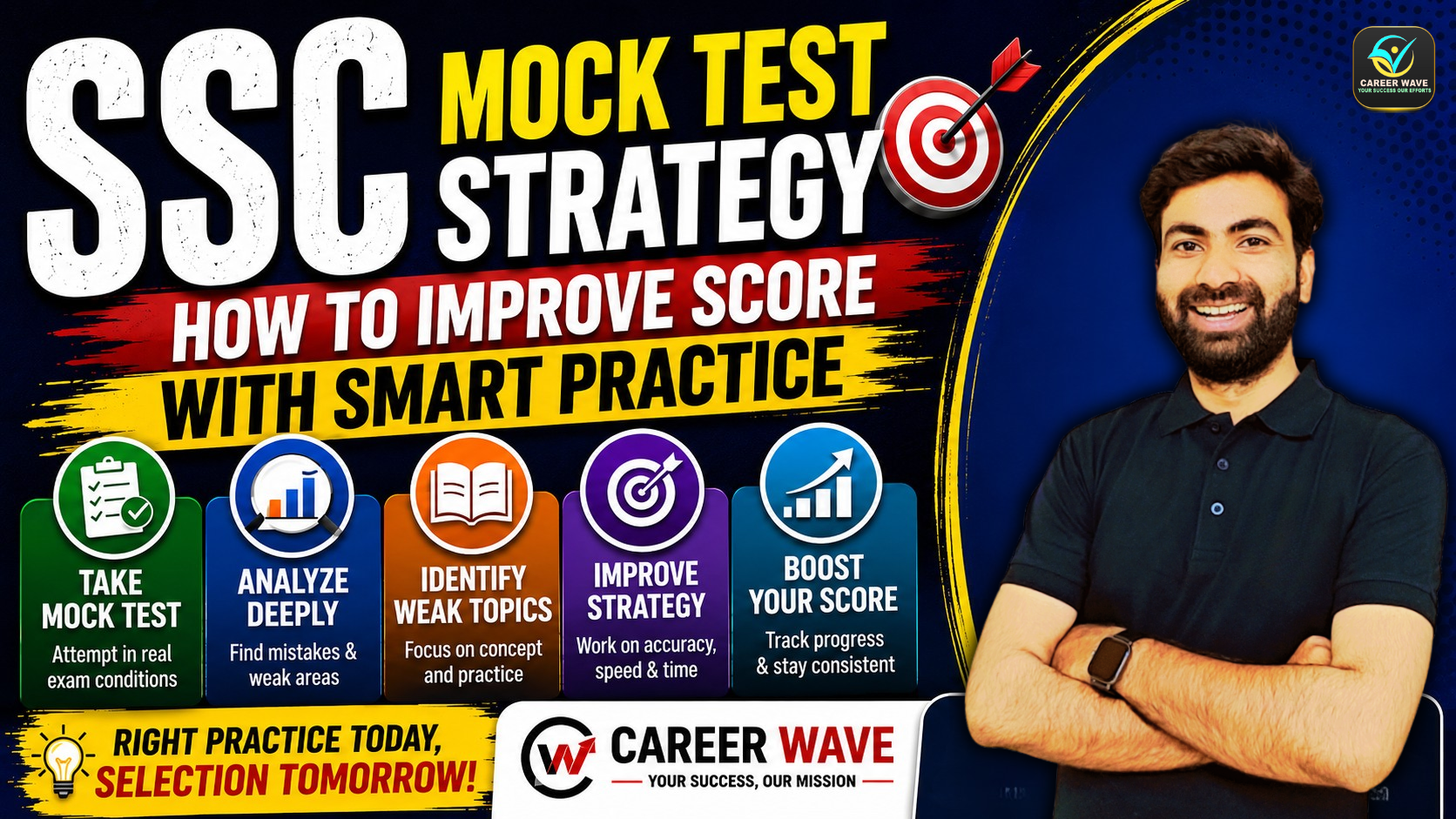
Read the complete SSC mock test
strategy with topic-wise tests, sectional tests, full mocks, previous year
papers, mock analysis, error notebook, accuracy improvement and Career Wave
preparation guidance.
SSC Mock Test Strategy: How to Improve Score
with Smart Practice
Mock tests
are one of the most important parts of SSC preparation. Whether you are
preparing for SSC CGL, CHSL, MTS, GD, CPO, JE, Stenographer or Selection Post,
mock tests help you understand your real preparation level.
Many
students complete the syllabus but still fail to score well in the exam. The
reason is simple: they study topics but do not practice in exam-like
conditions. SSC exams are not only about knowledge. They are also about speed,
accuracy, time management, question selection and pressure handling.
At Career
Wave, we always tell students that mock tests are not just for checking
marks. Mock tests are for improving marks. A mock test becomes useful only when
you analyze it properly and work on your mistakes.
This blog explains the complete
SSC mock test strategy for beginners and serious aspirants.
Why Mock Tests Are Important in SSC
Preparation
Mock tests
create an exam-like environment before the real exam. They help students
understand how they perform under time pressure.
Main
Benefits of Mock Tests
·
Improve
speed
·
Improve
accuracy
·
Build exam
temperament
·
Identify
weak topics
·
Improve time
management
·
Reduce exam
fear
·
Help in
question selection
·
Improve
confidence
·
Show real
preparation level
·
Help in
revision planning
Without mock tests, students may
feel prepared but remain unaware of their actual performance level.
What is an SSC Mock Test?
An SSC mock
test is a practice test based on the real exam pattern. It includes similar
subjects, number of questions, marks, time limit and negative marking.
For example,
if you are preparing for SSC CHSL, the mock test should follow the CHSL
pattern. If you are preparing for SSC GD, the mock should follow GD pattern.
A good mock test should be close
to the real exam level. It should not be too easy or unnecessarily difficult.
When Should You Start Giving Mock Tests?
Many
students ask: “Should I start mocks after completing the full syllabus?”
The answer
is no.
You should
not wait for 100% syllabus completion. But you should also not start full mocks
from the first day if your basics are very weak.
Best Mock
Test Timeline
|
Preparation Stage |
Test Type |
|
First 20–30 days |
Topic-wise tests |
|
After basic syllabus coverage |
Sectional tests |
|
After 50–60% syllabus completion |
Full mock tests |
|
Final 30–45 days |
Regular full mocks + PYQ mocks |
At Career Wave, we
recommend beginners to start with topic tests and sectional tests first. Full
mocks should begin once basic concepts are clear.
Types of Mock Tests for SSC Preparation
1.
Topic-Wise Mock Test
Topic-wise
mock tests focus on one topic.
Examples:
·
Percentage
test
·
Coding-decoding
test
·
Error
detection test
·
Polity test
·
Profit and
loss test
Best For
·
Beginners
·
Topic
improvement
·
Concept
checking
·
Weak area
practice
Topic-wise
tests are useful when you are still completing the syllabus.
2. Sectional
Mock Test
Sectional
tests focus on one subject.
Examples:
·
Quant mock
·
Reasoning
mock
·
English mock
·
General
Awareness mock
Best For
·
Subject-wise
score improvement
·
Time
management within one subject
·
Identifying
subject weakness
·
Section-level
practice
Sectional
tests are very useful before starting full mocks.
3.
Full-Length Mock Test
Full mocks
follow the complete exam pattern.
Best For
·
Real exam
practice
·
Time
management
·
Overall
performance check
·
Score
improvement
·
Exam
pressure handling
Full mocks
should be taken seriously. Sit in a quiet place and attempt the test like the
real exam.
4. Previous
Year Mock Test
Previous
year mocks are based on actual SSC papers.
Best For
·
Understanding
real exam level
·
Knowing
repeated topics
·
Checking
actual difficulty
·
Practicing
official question pattern
Previous
year mock tests are compulsory for every SSC aspirant.
How Many
Mock Tests Are Enough for SSC?
The number
of mock tests depends on the exam and preparation level.
Suggested
Mock Test Plan
|
Stage |
Mock Frequency |
|
Foundation stage |
2–3 topic tests per week |
|
Practice stage |
2 sectional tests per week |
|
Revision stage |
2 full mocks per week |
|
Final stage |
4–5 full mocks per week |
Quality matters more than
quantity. Giving 100 mocks without analysis is less useful than giving 30 mocks
with proper analysis.
Correct Way to Attempt an SSC Mock Test
1. Attempt
in Exam-Like Environment
Do not
attempt mocks casually.
Follow these
rules:
·
Sit at one
place
·
Keep phone
away
·
Use timer
·
Do not pause
the test
·
Do not take
help from notes
·
Attempt like
real exam
·
Follow
negative marking seriously
The more
seriously you attempt mocks, the better your exam temperament becomes.
2. Decide
Your Section Order
Every
student should have a fixed section order.
For example:
For SSC CGL
/ CHSL
Option 1:
1.
Reasoning
2.
English
3.
General
Awareness
4.
Quant
Option 2:
1.
General
Awareness
2.
Reasoning
3.
English
4.
Quant
The best
order depends on your strength. Attempt your strong and quick sections first to
build confidence.
3. Do Not
Get Stuck on One Question
SSC exams
are time-based. If one question takes too much time, leave it and move ahead.
A common
mistake is spending 3–4 minutes on one Quant question. This affects the entire
paper.
Golden Rule
If you are
not getting direction within 30–40 seconds, mark it for review and move ahead.
4. Avoid
Blind Guessing
Negative
marking can reduce your score. Guess only when you can eliminate at least two
options.
Do not
attempt questions only because you want to increase attempts. Accuracy is more
important than random attempts.
5. Keep Last
5 Minutes for Review
Use the last few minutes to
review marked questions, check unanswered easy questions and avoid accidental
mistakes.
Do not start a lengthy new
question in the final minute.
Mock Test Analysis: Most Important Step
Mock test
analysis is more important than the mock itself.
Many
students only check marks after mock. This is not analysis. Proper analysis
means understanding why marks were lost and how to improve them.
How to
Analyze a Mock Test
After every
mock, divide your mistakes into categories.
1. Concept
Mistake
You did not
know the concept.
Example:
·
Wrong
formula
·
Wrong
grammar rule
·
Weak GK fact
·
Wrong
reasoning pattern
Solution
Revise the
concept and solve 20–30 questions from that topic.
2.
Calculation Mistake
You knew the
method but made a calculation error.
Solution
Practice
calculation daily. Revise tables, squares, cubes, percentage values and
simplification.
3. Silly
Mistake
You read the
question incorrectly or marked the wrong option.
Solution
Slow down
slightly while reading. Underline important words mentally.
4. Time
Management Mistake
You spent
too much time on difficult questions.
Solution
Practice
question selection. Leave lengthy questions early.
5. Guesswork
Mistake
You
attempted doubtful questions and lost marks due to negative marking.
Solution
Control
attempts. Focus on accuracy.
Mock Test
Analysis Table
Students can
use this simple table after every mock.
|
Mistake Type |
Number of Questions |
Action Required |
|
Concept Mistake |
Revise topic |
|
|
Calculation Mistake |
Practice calculation |
|
|
Silly Mistake |
Improve reading |
|
|
Time Mistake |
Improve selection |
|
|
Guesswork Mistake |
Reduce risky attempts |
At Career Wave, we
recommend maintaining a separate mock analysis notebook.
How to Improve Score Through Mock Tests
1. Track
Your Accuracy
Accuracy is
the most important factor in SSC exams.
Accuracy
formula:
Accuracy =
Correct Attempts / Total Attempts × 100
If your
accuracy is low, reduce blind attempts and revise weak topics.
2. Track
Your Section-Wise Score
Do not check
only total marks. Check subject-wise performance.
Example:
|
Subject |
Score |
Problem |
|
Quant |
Low |
Weak arithmetic |
|
Reasoning |
Good |
Maintain practice |
|
English |
Average |
Grammar revision needed |
|
GA |
Low |
Revision weak |
This helps
you decide where to focus.
3. Revise
Wrong Questions
Wrong
questions are your best teacher. Do not ignore them.
After every
mock:
·
Read all
wrong questions
·
Understand
the correct method
·
Write
important points
·
Solve
similar questions
·
Revise after
3 days
4. Make an
Error Notebook
An error
notebook should include:
·
Wrong
formulas
·
Grammar
rules
·
GK facts
·
Repeated
mistakes
·
Difficult
reasoning patterns
·
Calculation
tricks
·
Mock
observations
Revise this
notebook weekly.
5. Improve
Attempt Strategy
More
attempts do not always mean more marks. Smart attempts matter.
A good
attempt strategy includes:
·
Easy
questions first
·
Moderate
questions next
·
Difficult
questions at the end
·
No blind
guessing
·
Time control
·
Section-wise
discipline
Subject-Wise Mock Test Strategy
Quant Mock
Strategy
Quant needs
both concept and speed.
Focus Areas
·
Arithmetic
·
Algebra
·
Geometry
·
Mensuration
·
Trigonometry
·
Data
Interpretation
How to
Improve Quant Score
·
Revise
formulas daily
·
Practice
calculation
·
Solve
topic-wise PYQs
·
Avoid
lengthy questions in first round
·
Use
approximation where possible
·
Learn
shortcut after concept clarity
Reasoning
Mock Strategy
Reasoning is
scoring if practiced regularly.
Focus Areas
·
Series
·
Coding-Decoding
·
Analogy
·
Classification
·
Blood
Relation
·
Direction
·
Syllogism
·
Venn Diagram
·
Non-verbal
reasoning
How to
Improve Reasoning Score
·
Practice
daily
·
Learn
pattern recognition
·
Solve mixed
sets
·
Avoid
overthinking
·
Use
elimination
·
Keep speed
high
English Mock
Strategy
English can
improve total score if grammar and vocabulary are strong.
Focus Areas
·
Error
Detection
·
Sentence
Improvement
·
Cloze Test
·
Reading
Comprehension
·
Synonyms and
Antonyms
·
Idioms and
Phrases
·
One Word
Substitution
·
Active-Passive
·
Direct-Indirect
How to
Improve English Score
·
Revise
grammar rules
·
Learn
vocabulary daily
·
Read short
passages
·
Practice
PYQs
·
Analyze
wrong grammar questions
·
Make
vocabulary notebook
General
Awareness Mock Strategy
GA is a
time-saving section. Either you know the answer or you do not.
Focus Areas
·
History
·
Polity
·
Geography
·
Economy
·
General
Science
·
Current
Affairs
·
Static GK
How to
Improve GA Score
·
Revise short
notes
·
Practice
MCQs
·
Focus on
repeated SSC topics
·
Read monthly
current affairs
·
Revise wrong
answers
·
Avoid random
GK overload
Mock Test
Strategy for Different SSC Exams
SSC CGL Mock
Strategy
SSC CGL
needs strong Quant, English, Reasoning and GA. Tier-II requires deeper
preparation, so mocks should include both speed and accuracy practice.
SSC CHSL
Mock Strategy
CHSL
aspirants should practice Tier-I and Tier-II pattern separately. Typing
practice should continue along with mock tests.
SSC MTS Mock
Strategy
MTS students
should focus on basic-level questions, speed, accuracy and GK revision.
SSC GD Mock
Strategy
GD aspirants
should balance written mock tests with physical training. Do not ignore running
and fitness.
SSC CPO Mock
Strategy
CPO
aspirants should practice written mocks and physical preparation together.
English Paper-II should also be practiced.
SSC JE Mock
Strategy
JE aspirants
should attempt technical subject mocks along with reasoning and general
awareness tests.
SSC
Stenographer Mock Strategy
Stenographer aspirants should
attempt CBT mocks and also practice shorthand and transcription daily.
Weekly SSC Mock Test Plan
For
Beginners
|
Day |
Task |
|
Monday |
Quant topic test |
|
Tuesday |
Reasoning topic test |
|
Wednesday |
English topic test |
|
Thursday |
GA MCQ test |
|
Friday |
Weak topic revision |
|
Saturday |
Sectional test |
|
Sunday |
Mock analysis |
For Intermediate Students
|
Day |
Task |
|
Monday |
Full mock |
|
Tuesday |
Mock analysis + weak topics |
|
Wednesday |
Sectional test |
|
Thursday |
PYQ practice |
|
Friday |
Full mock |
|
Saturday |
Error notebook revision |
|
Sunday |
Revision + rest |
For Final Month
|
Day |
Task |
|
Monday |
Full mock |
|
Tuesday |
Full mock analysis |
|
Wednesday |
Full mock |
|
Thursday |
PYQ mock |
|
Friday |
Full mock |
|
Saturday |
Error notebook revision |
|
Sunday |
Light revision |
How to Handle Low Mock Scores
Low mock
score is not failure. It is feedback.
If your mock
score is low, check:
·
Is the
syllabus incomplete?
·
Are basics
weak?
·
Are you
making silly mistakes?
·
Is accuracy
low?
·
Are you
wasting time?
·
Are you
guessing too much?
·
Are you not
revising?
What to Do After Low Score
·
Do not panic
·
Analyze
mistakes
·
Revise weak
topics
·
Give
sectional tests
·
Reduce risky
attempts
·
Improve
basics
·
Attempt next
mock with strategy
At Career Wave, we remind
students that mock scores are temporary. The final exam score matters. Use
mocks for improvement, not fear.
What is a Good Mock Score?
A good mock
score depends on:
·
Exam level
·
Difficulty
of mock
·
Stage of
preparation
·
Category
·
Target post
·
Previous
year cut-off trend
Do not
compare your first mock with toppers. Compare your current score with your
previous score.
Best
Progress Rule
Try to improve 5 to 10 marks
every few mocks through better accuracy and revision.
Final 30-Day Mock Test Strategy
Last 30 Days
Plan
·
Attempt
15–20 full mocks
·
Revise all
wrong questions
·
Solve
previous year papers
·
Focus on
weak sections
·
Revise
formulas daily
·
Revise GK
notes repeatedly
·
Avoid new
sources
·
Maintain
sleep and health
·
Practice
exam-time routine
Do Not Do
This in Final Month
·
Do not
change books
·
Do not start
random material
·
Do not give
mocks without analysis
·
Do not panic
after one bad score
·
Do not
attempt blindly
·
Do not
ignore revision
Career Wave Guidance for SSC Mock Tests
At Career
Wave, our mock test strategy is simple: every mock should improve your next
mock.
A serious
SSC aspirant should follow this cycle:
1.
Attempt mock
seriously
2.
Analyze
every question
3.
Identify
mistake type
4.
Revise weak
topic
5.
Practice
similar questions
6.
Update error
notebook
7.
Attempt next
mock with improvement
Mock tests
are not for showing marks. They are for building selection-level performance.
Students who analyze mocks
properly improve faster than students who only keep giving tests.
Common Mistakes Students Make in Mock Tests
·
Giving mocks
without syllabus completion
·
Not
analyzing wrong answers
·
Checking
only total marks
·
Ignoring
accuracy
·
Attempting
too many doubtful questions
·
Spending too
much time on hard questions
·
Not revising
mock mistakes
·
Comparing
scores with others
·
Changing
strategy every mock
·
Attempting
mocks casually
·
Ignoring
previous year papers
·
Not
maintaining an error notebook
FAQs
Q1. When
should I start mock tests for SSC?
Start topic-wise tests after
basic preparation. Full mocks should start after completing around 50–60%
syllabus.
Q2. Are mock
tests important for SSC preparation?
Yes. Mock tests improve speed,
accuracy, time management and exam temperament.
Q3. How many
mock tests should I give for SSC?
The number depends on preparation
level. In the final stage, 15–20 full mocks with proper analysis can be very
useful.
Q4. Should
beginners give full mocks?
Beginners should first give
topic-wise and sectional tests. Full mocks should start after basic concepts
are clear.
Q5. What
should I do after a mock test?
Analyze wrong questions, identify
mistake type, revise weak topics and update your error notebook.
Q6. Why is
my mock score not improving?
Your score may not improve
because of weak basics, poor revision, low accuracy, too much guessing or lack
of mock analysis.
Q7. How can
I improve accuracy in SSC mocks?
Avoid blind guessing, revise
concepts, read questions carefully and analyze mistakes after every mock.
Q8. How can
I improve speed in SSC mocks?
Practice timed quizzes, improve
calculation, solve PYQs and follow a fixed section order.
Conclusion
Mock tests
are a powerful tool in SSC preparation, but only when used correctly. Simply
giving tests is not enough. A student must analyze mistakes, revise weak
topics, maintain an error notebook and improve attempt strategy.
A smart SSC
mock test strategy includes topic-wise tests, sectional tests, full mocks,
previous year papers and regular analysis. Accuracy, time management and
revision are the real keys to improvement.
At Career Wave, we advise
every SSC aspirant to treat each mock as a training session for the final exam.
Study, test, analyze, improve and repeat. This cycle can turn average
preparation into selection-level performance.
Leave a Comment
13-Aug-2026 02:19 PM
Understand the real work profile of AAI AO, including airport operations, terminal management, passenger facilitation, airside support, coordination duties, shift work, salary, and Career Wave...
13-Aug-2026 01:46 PM
Learn why Business Management and Aviation Awareness are hidden scoring sections in AAI AO, including important topics, preparation strategy, PYQ approach, revision plan, and Career...
11-Aug-2026 02:39 PM
Learn which topics to prioritize and which topics to keep for later in AAI AO preparation, including Physics, Maths, Business Management, Reasoning, English, Quant, Aviation...
10-Aug-2026 01:05 PM
AAI AO has no negative marking, but does that make selection easy? Understand why high attempts, rising competition, limited vacancies, accuracy, PYQs and smart exam...
08-Aug-2026 12:27 PM
Learn why AAI AO is a golden opportunity for freshers, including no work experience requirement, ₹14 lakh approximate CTC, aviation-sector exposure, exam pattern, eligibility, preparation...
07-Aug-2026 04:05 PM
Understand the real job profile of AAI AO, including salary, actual airport operations work, shift duty, passenger facilitation, coordination responsibilities, work pressure, and Career Wave...
