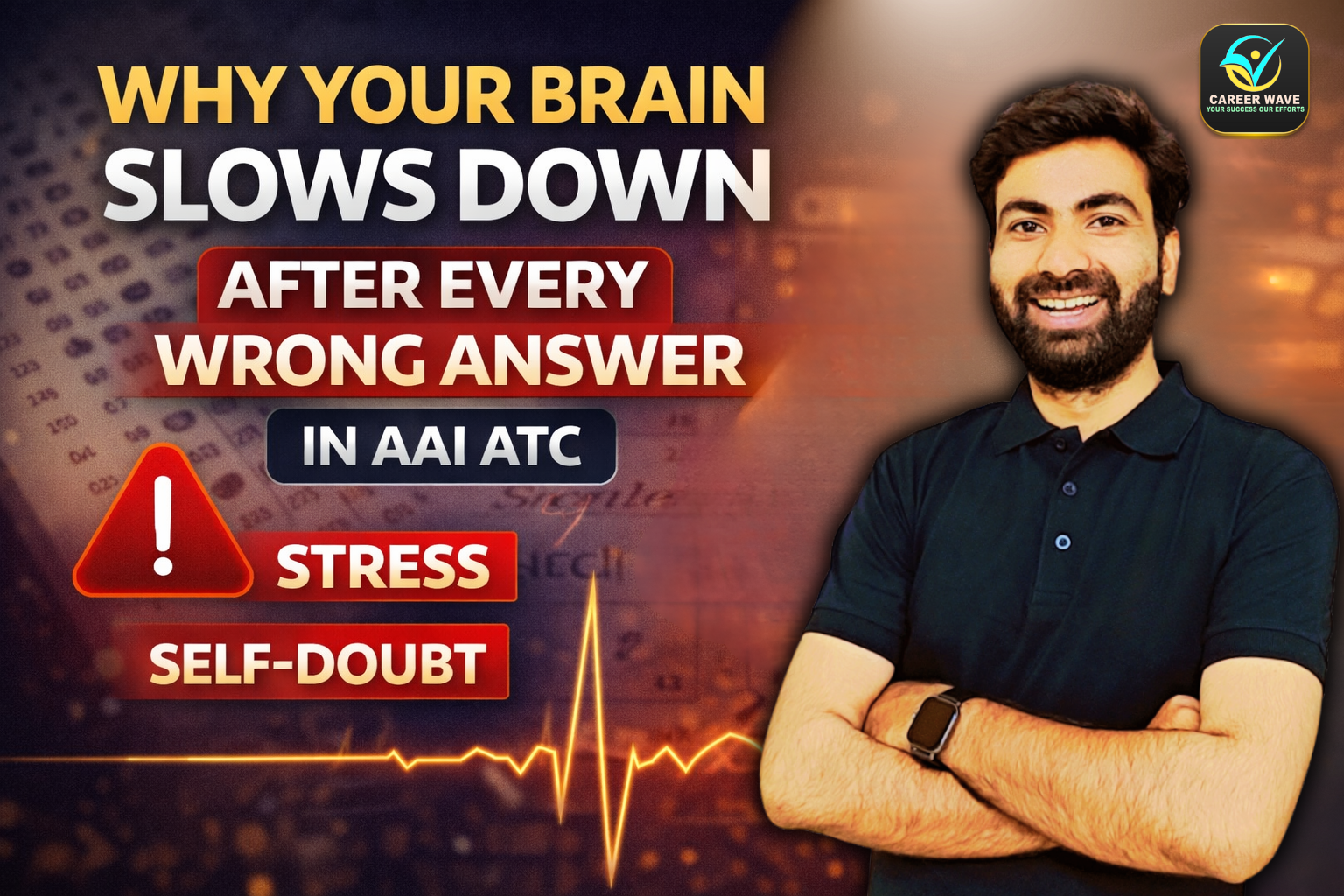
Discover the psychological reason
why your brain slows down after every wrong answer in AAI ATC mock tests and
CBT. Learn how stress, self-doubt, and momentum breaks affect performance — and
how Career Wave helps you build exam stability and mental control.
Why Your Brain Slows Down After Every Wrong Answer in AAI ATC
The Hidden
Psychological Trap Most Aspirants Ignore
By Career
Wave
Have you
ever noticed this during a mock test?
You solve
8–10 questions smoothly.
Then you get one question wrong.
Suddenly, your speed drops.
Confidence shakes.
Simple questions start looking difficult.
This is not
lack of knowledge.
This is your brain reacting to a mistake.
At Career
Wave, we’ve observed this pattern in hundreds of AAI ATC mock test analyses.
The slowdown after a wrong answer is real — and it’s psychological, not
academic.
Let’s understand what actually
happens inside your brain.
1) The “Error Shock” Effect
When you
realize you’ve made a mistake, your brain triggers a mild stress response.
·
Cortisol
(stress hormone) increases
·
Focus shifts
from solving → self-doubt
·
Working
memory capacity reduces
·
Speed drops
automatically
Instead of
thinking:
“Next
question.”
Your mind
starts thinking:
“How did I
make that mistake?”
“What if I lose cutoff?”
“Am I underprepared?”
This internal dialogue consumes
mental bandwidth.
2) AAI ATC Exam Is Speed + Stability
The CBT has:
·
120
questions
·
2 hours
·
No negative
marking
That means
momentum matters.
One wrong
answer should statistically mean nothing.
But
mentally, it feels bigger than it is.
At Career
Wave, we call this:
The Momentum
Break Trap
A single mistake breaks flow, and
flow is everything in a time-bound exam.
3) Why Your Brain Freezes After a Wrong Physics or Maths Question
Technical
sections demand high working memory:
·
Formulas
·
Units
·
Logical
sequencing
·
Numerical
accuracy
When you
make an error:
·
Your brain
switches from “solving mode” to “threat detection mode.”
·
Analytical
speed reduces.
·
You become
overly cautious.
·
You
double-check even easy English or reasoning questions.
Result?
Speed collapse.
4) The Confidence Spiral
Wrong Answer
→ Self Doubt → Slow Solving → More Mistakes → Panic
This spiral
is common in:
·
First-time
serious aspirants
·
Candidates
aiming for 105+ marks
·
Over-perfectionists
Career Wave mock analysis shows:
Top rankers are not those who make zero mistakes.
They are those who recover instantly.
5) The Brain
Science Behind It
Your brain
has limited cognitive resources.
After a
mistake:
·
Emotional
processing consumes resources.
·
Logical
reasoning temporarily reduces.
·
Reaction
time increases.
This is
called Cognitive Interference.
The more emotionally attached you
are to performance, the stronger the slowdown.
6) Why High Scorers Recover Faster
Career Wave
analysis of high scorers shows 3 habits:
✔ They expect
mistakes.
✔ They don’t
emotionally react.
✔ They focus only on next
question.
Their
mindset:
“Wrong answer doesn’t reduce my
preparation. It’s just one data point.”
7) How to Prevent Brain Slowdown During AAI ATC Exam
🔹 Rule 1: Pre-decide Your Reaction
Before the
exam, decide:
“If I get a question wrong, I will move on in 3 seconds.”
Condition
your brain beforehand.
🔹 Rule 2: Never Recalculate Immediately
Do NOT
revisit a mistake mid-section.
Mark it. Move ahead.
🔹 Rule 3: Maintain Sectional Rhythm
If Physics
shakes you,
Switch to English or Reasoning briefly.
Regain rhythm.
Then return.
🔹 Rule 4: Mock with Pressure Simulation
Most
aspirants practice in comfort.
Real exam = stress environment.
At Career
Wave, we train students with:
·
Timed mock
pressure
·
Momentum
control drills
·
Psychological
resilience practice
Because ATC selection requires
mental stability — not just formulas.
8) Remember This About AAI ATC
There is no
negative marking.
One wrong
answer does not reduce your score.
But slowing down after it does.
Your rank is affected more by
lost speed than by one mistake.
9) The Bigger Truth
AAI ATC is
not only testing knowledge.
It is
testing:
·
Emotional
regulation
·
Decision
stability
·
Operational
mindset
·
Error
recovery ability
The same qualities required in
live air traffic control.
Final
Message from Career Wave
Mistakes are
normal.
Slowdown is optional.
The
candidate who learns to recover instantly after a wrong answer is the candidate
who clears rising cutoffs.
If you are
preparing for AAI ATC 2026:
Train your brain as much as your syllabus.
At Career Wave, we don’t just
prepare students to clear the exam —
We prepare them to stay stable under pressure.
FAQs
1. Why do I
panic after one wrong answer in mock tests?
Because your
brain interprets mistakes as performance threats, triggering stress response
and reducing working memory efficiency.
2. Does one wrong answer affect AAI ATC rank significantly?
No. There is
no negative marking. Speed loss after the mistake affects rank more than the
mistake itself.
3. Why do I become overly cautious after a mistake?
Your brain
shifts to “error avoidance mode,” slowing processing to prevent further
mistakes.
4. How can I train myself to recover quickly?
·
Practice
timed mocks
·
Simulate
real exam pressure
·
Pre-decide
your reaction strategy
·
Focus on
momentum, not perfection
5. Is this slowdown common among serious aspirants?
Yes. Especially among
high-expectation candidates aiming for top ranks.
Related blogs-
How the Brain Switches Modes Between Physics & Maths in AAI ATC
Leave a Comment
09-Sep-2026 12:05 PM
Learn the best AAI AO Full Mock Test Strategy 2026 to manage exam time effectively. Career Wave and Satyendra Sir explain section order, two-round attempt...
08-Sep-2026 02:40 PM
Learn how to improve accuracy in AAI JE Airport Operations 2026 mock tests and reduce silly mistakes. Career Wave and Satyendra Sir explain practical strategies...
08-Sep-2026 10:51 AM
Discover why mock tests are essential for AAI JE Airport Operations 2026 preparation. Learn how Full Mock Tests and Sectional Tests help improve speed, accuracy,...
07-Sep-2026 03:52 PM
Prepare for AAI JE Airport Operations 2026 with Career Wave’s exam-focused Test Series. Get Full-Length Mock Tests, Sectional Tests, latest pattern-based questions, detailed solutions, performance...
07-Sep-2026 11:27 AM
Check the complete IMD Scientific Assistant Physics Syllabus 2026 for Part-F as per the official SSC JE 2026 notification. Get chapter-wise topics including Mathematical Methods,...
05-Sep-2026 12:01 PM
Get the complete IMD Scientific Assistant Exam Pattern 2026 explained by Career Wave. Check Paper 1 and Paper 2 pattern, total questions, marks, duration, negative...
