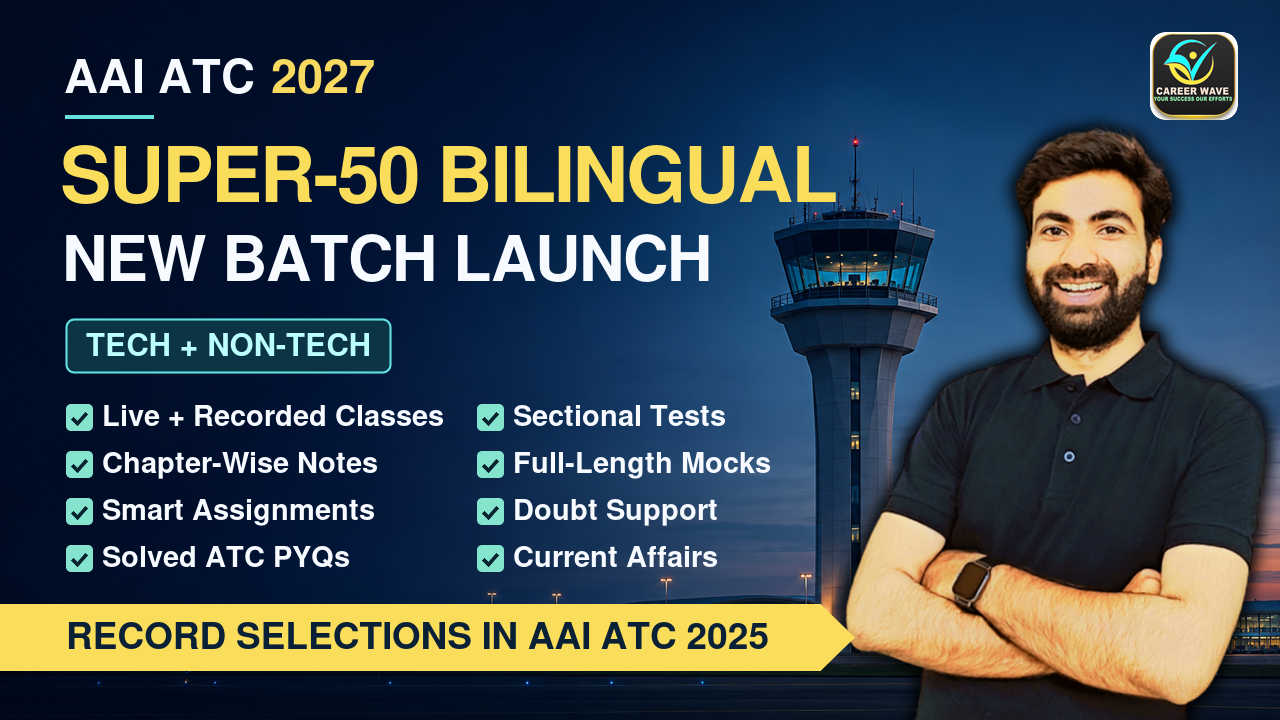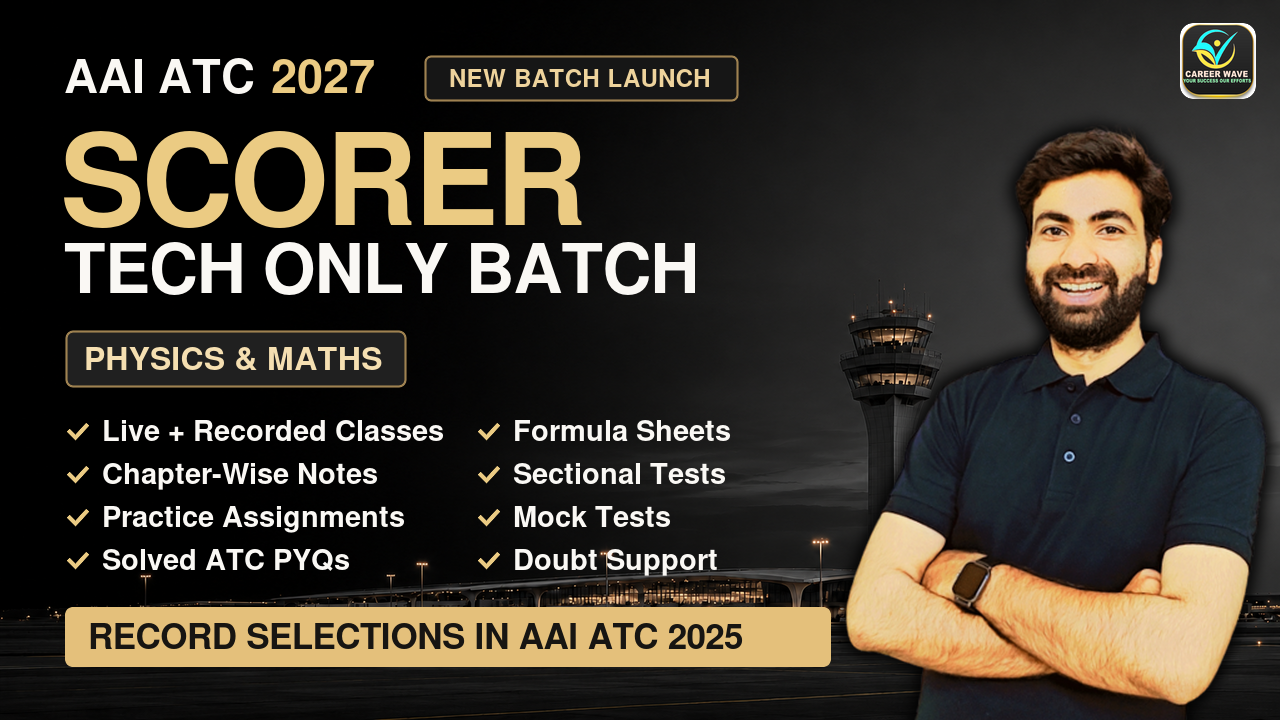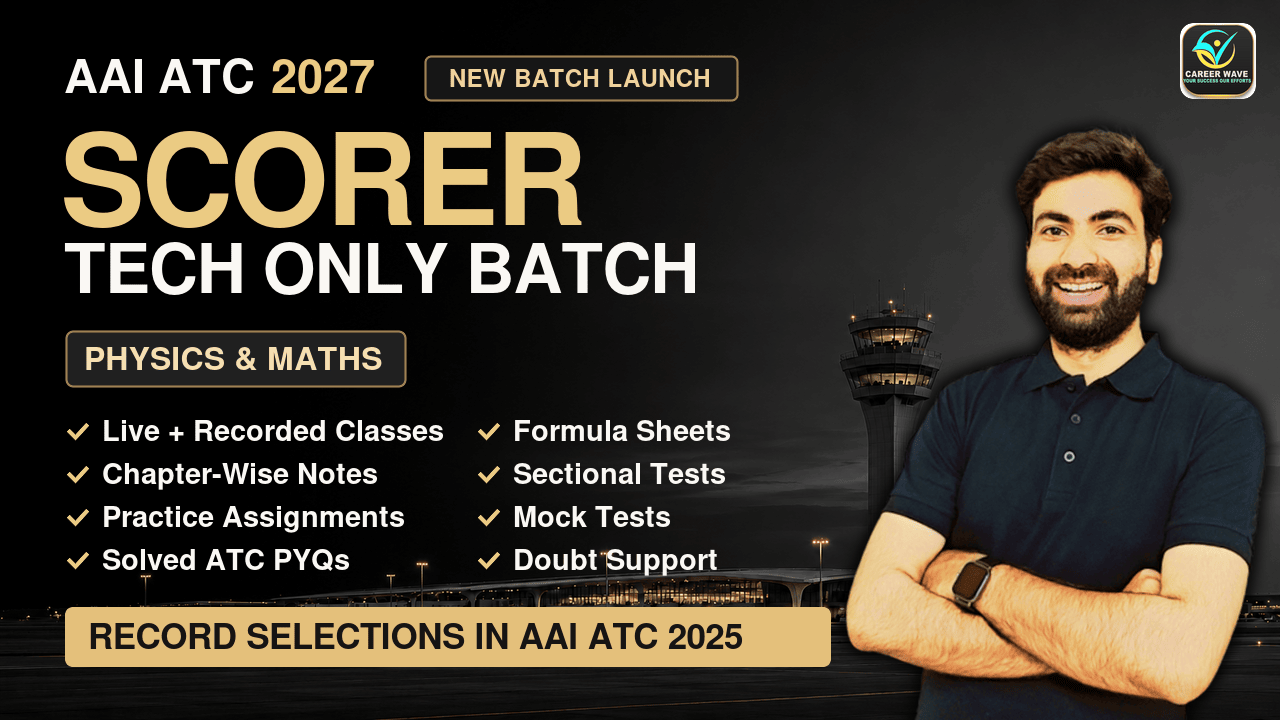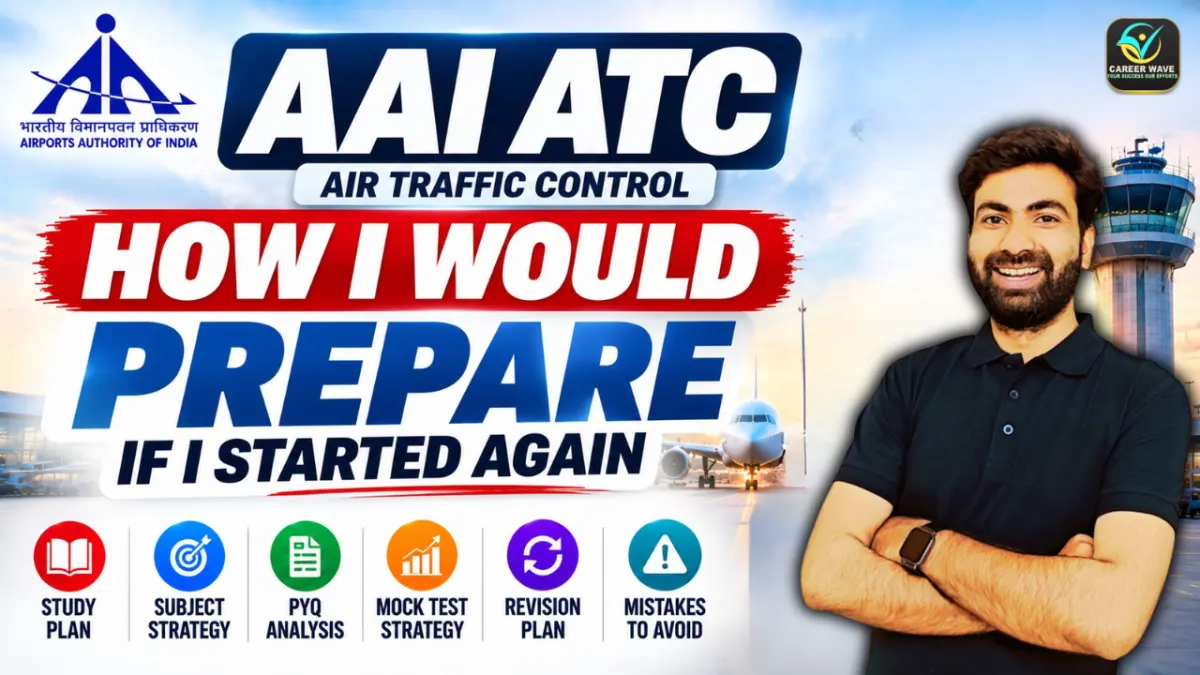
Starting AAI ATC 2026 preparation
from zero? Discover how Satyendra Sir from Career Wave would prepare for the
AAI ATC exam if starting again. Learn the complete subject-wise strategy for
Physics, Mathematics, English, Reasoning, Aptitude and General Awareness.
Explore smart study plans, PYQ analysis, formula revision, mock test
strategies, time management techniques and common mistakes to avoid. Build a
structured preparation plan to improve your accuracy, confidence and exam
performance.
If I had to start preparing for the AAI Junior Executive (Air Traffic Control) examination again from zero, I would approach my preparation differently.
I would not begin by collecting ten books, watching random lectures, or preparing only Physics and Mathematics.
Instead, I would focus on understanding the examination, building strong concepts, following a realistic timetable, solving previous year questions, and improving my performance through regular mock tests.
Many AAI ATC aspirants work extremely hard but still struggle to achieve their expected scores. The problem is not always a lack of effort. Sometimes, it is the absence of a clear preparation strategy.
At Career Wave, Satyendra Sir emphasizes that effective preparation should be systematic, measurable, and based on the actual requirements of the examination.
So, if I were starting my AAI ATC preparation again, here is exactly how I would plan it.
Before studying any chapter, I would understand what the examination actually demands.
Many students begin preparation without properly analysing the syllabus, subject weightage, or selection process.
This leads to poor time allocation and unnecessary confusion.
The recent AAI ATC CBT pattern has included the following subject distribution:
|
Subject |
Questions |
Marks |
|
Physics |
30 |
30 |
|
Mathematics |
30 |
30 |
|
English Language |
20 |
20 |
|
General Intelligence / Reasoning |
15 |
15 |
|
General Aptitude |
15 |
15 |
|
General Knowledge / Awareness |
10 |
10 |
|
Total |
120 |
120 |
Recent AAI ATC CBTs have followed a no-negative-marking pattern. Candidates should confirm the examination pattern, marking scheme, and eligibility requirements in the official notification for their recruitment cycle.
The first thing I would notice is that Physics and Mathematics contribute 60 marks, while non-technical subjects contribute another 60 marks.
That means preparing only the technical section would be a major strategic mistake.
My First Rule: Understand the exam before preparing for the exam.
One of the biggest mistakes aspirants make is collecting more material than they can realistically complete.
Students often have multiple books, different formula sheets, hundreds of PDFs, several YouTube playlists, and numerous question banks.
But collecting resources is not the same as completing preparation.
If I started again, I would keep my resources limited.
For each subject, I would select:
I would avoid switching resources whenever I encountered a difficult topic.
Satyendra Sir's Advice: A limited set of reliable resources, revised multiple times, is generally more useful than a large collection that is never completed.
Before creating my study plan, I would attempt a diagnostic test to understand my current preparation level.
I would not worry about obtaining a low score.
The objective would be to identify:
For example, suppose my initial performance looked like this:
|
Subject |
Maximum Marks |
Initial Score |
|
Physics |
30 |
14 |
|
Mathematics |
30 |
12 |
|
English |
20 |
13 |
|
Reasoning |
15 |
9 |
|
Aptitude |
15 |
8 |
|
General Awareness |
10 |
4 |
|
Total |
120 |
59 |
This hypothetical result would tell me where to begin.
Instead of studying everything randomly, I would prioritize weak areas while maintaining regular practice in stronger subjects.
Physics carries significant weightage in AAI ATC.
If I were starting again, I would not begin by memorizing hundreds of formulas.
I would first understand the physical concepts behind them.
I would organize my preparation around important areas such as:
1. Units, Dimensions, and Measurements
2. Kinematics
3. Laws of Motion
4. Work, Energy, and Power
5. Rotational Motion and Gravitation
6. Properties of Matter
7. Thermodynamics
8. Oscillations and Waves
9. Electrostatics
10. Current Electricity
11. Magnetism and Electromagnetic Induction
12. Alternating Current
13. Ray Optics and Wave Optics
14. Modern Physics
15. Semiconductor Electronics
These are major preparation areas rather than an exhaustive official syllabus.
Step 1: Understand the basic theory.
Step 2: Learn the important formulas and their conditions.
Step 3: Solve standard numerical problems.
Step 4: Practise chapter-wise PYQs.
Step 5: Attempt a short chapter test.
Step 6: Record incorrect questions for revision.
I would avoid moving to the next chapter without understanding the fundamental concepts of the current one.
Career Wave Tip: Physics becomes easier when you connect formulas with physical meaning instead of treating every numerical as a separate problem.
Mathematics is another important part of AAI ATC preparation.
If I started again, I would focus on developing reliable problem-solving methods.
My preparation would include:
For every chapter, I would follow:
I would not attempt difficult questions immediately after reading the formula.
First, I would solve standard problems and understand common question patterns.
Then I would gradually increase the difficulty.
I would avoid:
Satyendra Sir's Advice: Mathematics requires consistency. Regular practice and formula revision are more effective than irregular, lengthy study sessions.
If I were starting again, this would be one of my most important decisions.
I would not postpone English, Reasoning, Aptitude, or General Awareness until the final month.
These subjects collectively contribute 60 marks under the recent AAI ATC pattern.
I would focus on:
I would practise English regularly, even if only for a short period each day.
I would cover:
My focus would be on recognizing patterns and improving solving speed.
I would prepare:
I would strengthen basic calculations before relying on shortcuts.
I would study:
I would maintain concise notes and revise them regularly.
My Rule: Technical and non-technical preparation should progress together.
If I started again, I would introduce AAI ATC previous year questions early in my preparation.
PYQs are valuable because they reveal how concepts have been tested in previous examinations.
However, I would not simply memorize their answers.
After solving every important PYQ, I would ask:
One common problem among aspirants is forgetting formulas from previously completed chapters.
If I started again, I would not wait until the syllabus was complete to begin revision.
I would create separate formula sheets for Physics and Mathematics.
Revise formulas from recently studied chapters.
Revise formulas from all chapters completed during the week.
Review important formulas from previously completed subjects.
Revise frequently confused formulas and important applications.
Add forgotten formulas to the revision notebook.
I would also include one or two representative questions wherever a formula is frequently misapplied.
If I were preparing from the beginning, I would create a timetable that I could follow consistently.
I would not design an unrealistic 12-hour routine simply because other students were following one.
|
Activity |
Duration |
|
Physics Concepts and Numericals |
90 Minutes |
|
Mathematics Concepts and Practice |
90 Minutes |
|
English and Reasoning |
60 Minutes |
|
Aptitude and General Awareness |
60 Minutes |
|
PYQs and Formula Revision |
60 Minutes |
|
Total |
6 Hours |
This timetable is only an example.
Students can adjust it according to their available time, current preparation level, and weak subjects.
On mock-test days, I would replace part of the regular schedule with full mock practice and detailed analysis.
My Rule: A realistic timetable followed consistently is better than an ambitious timetable abandoned after a few days.
Instead of studying randomly, I would organize my preparation into three clear stages.
Objective: Develop strong fundamentals.
During this phase, I would:
I would prioritize understanding over speed.
Objective: Convert concepts into problem-solving ability.
During this phase, I would:
I would begin tracking accuracy and solving time.
Objective: Improve examination performance.
During this phase, I would:
The duration of each phase would depend on the time available before the examination.
One mistake I would avoid is waiting until the syllabus is completely finished before attempting any tests.
As soon as I completed a chapter or subject unit, I would test myself.
For example:
After completing Electrostatics, I would attempt an Electrostatics chapter test.
After completing several Mathematics chapters, I would attempt a sectional test covering those topics.
This would help me identify weaknesses while the concepts were still fresh.
They help with:
I would use sectional tests as part of learning rather than treating them only as final assessments.
If I started again, I would never treat mock tests as casual practice.
I would attempt full mocks under examination-like conditions.
That means:
|
Parameter |
My Analysis |
|
Total Score |
How much did I score? |
|
Accuracy |
How many attempts were correct? |
|
Physics |
Which concepts caused mistakes? |
|
Mathematics |
Where did I lose time? |
|
English |
Which grammar rules were confusing? |
|
Reasoning |
Which patterns took too long? |
|
Aptitude |
Where did calculations go wrong? |
|
General Awareness |
Which facts did I forget? |
|
Unattempted Questions |
Were any easy questions left? |
I would not move directly from one mock to another without reviewing the previous test.
For structured full-length practice
Satyendra Sir's Advice: A mock test is useful not only because it gives you a score, but because it tells you what needs to improve before the actual examination.
If I started again, I would create an error notebook from my very first practice test.
The notebook would contain mistakes that I should not repeat.
Before every major mock, I would revise the recurring errors recorded in this notebook.
My Rule: Every mistake should teach me something that improves my next attempt.
Many aspirants believe that solving questions faster automatically improves examination performance.
But speed without accuracy can reduce the score.
If I started again, I would first learn to solve questions correctly.
Then I would gradually reduce the time required.
Step 1: Solve questions without unnecessary time pressure.
Step 2: Understand the correct method.
Step 3: Identify recurring mistakes.
Step 4: Practise similar questions.
Step 5: Introduce timed practice.
Step 6: Track both speed and accuracy.
I would not force shortcuts when the standard method was more reliable.
During full mock tests, I would experiment with a two-round approach.
I would attempt questions that are:
The objective would be to secure accessible marks without getting stuck.
I would return to questions requiring:
This strategy would help prevent difficult questions from consuming time that could be used to solve easier ones.
I would also test different section orders and choose the one that consistently produced the best results.
If I started again, I would not change my entire study plan every time I watched a new strategy video.
Frequent changes can create confusion and reduce consistency.
I would select a reasonable preparation plan and follow it long enough to evaluate its effectiveness.
I would make changes only when mock-test data or genuine preparation difficulties indicated a need.
For example:
If Mathematics accuracy remained low, I would increase targeted practice.
If General Awareness was consistently weak, I would improve revision frequency.
If I repeatedly ran out of time, I would modify my question-selection strategy.
My Rule: Change the strategy based on evidence, not anxiety.
Instead of judging my preparation only by study hours, I would track measurable progress.
|
Parameter |
Weekly Review |
|
Physics |
Chapters completed and revised |
|
Mathematics |
Questions solved and accuracy |
|
English |
Grammar and vocabulary progress |
|
Reasoning |
Timed practice performance |
|
Aptitude |
Speed and calculation accuracy |
|
General Awareness |
Topics revised |
|
PYQs |
Questions attempted and analysed |
|
Mock Tests |
Score and recurring mistakes |
This would help me understand whether my preparation was actually improving.
A weekly review would also prevent weak subjects from being ignored for too long.
One of the biggest distractions in competitive examination preparation is constant comparison.
Students often see someone scoring 100+ in a mock and immediately question their own preparation.
But different students begin at different levels.
If I started again, I would compare my current performance with my previous performance.
For example:
|
Mock Test |
Score |
|
Mock 1 |
65 |
|
Mock 2 |
72 |
|
Mock 3 |
78 |
|
Mock 4 |
84 |
|
Mock 5 |
91 |
This is an illustrative progression, not a guaranteed improvement pattern.
What matters is whether mistakes are reducing and performance is becoming more consistent.
Satyendra Sir's Advice: Use other students' performance as a reference, not as a reason to abandon your own preparation plan.
One of the most common preparation problems is forgetting previously studied topics.
If I started again, I would reserve time for revision every week.
My revision system would include:
First Revision: Shortly after completing the chapter.
Second Revision: During the weekly review.
Third Revision: During the next major revision cycle.
Fourth Revision: Through PYQs and mock-test questions.
I would give extra revision time to concepts that repeatedly caused mistakes.
This would help improve long-term retention.
AAI ATC preparation should not be limited to the CBT alone.
Depending on the applicable recruitment notification, the selection process may include additional assessments and verification stages such as:
The exact stages and requirements should always be checked in the relevant official notification.
I would understand these requirements early rather than discovering them after the written examination.
For communication-related assessments, I would work on clear pronunciation, listening ability, and understandable spoken English.
If I were starting AAI ATC preparation again, these are the mistakes I would consciously avoid.
Mistake 1: Beginning preparation without understanding the official syllabus.
Mistake 2: Studying only Physics and Mathematics.
Mistake 3: Collecting too many resources.
Mistake 4: Memorizing formulas without understanding concepts.
Mistake 5: Ignoring previous year questions.
Mistake 6: Postponing revision until the syllabus is complete.
Mistake 7: Attempting mocks without analysing mistakes.
Mistake 8: Spending too much time on difficult questions.
Mistake 9: Frequently changing preparation strategies.
Mistake 10: Comparing my progress with every other aspirant.
Avoiding these mistakes would make my preparation more organized and effective.
If my syllabus was substantially complete and only 30 days remained, I would focus on revision and examination performance.
I would avoid making major changes to my preparation strategy during the final days.
At Career Wave, Satyendra Sir focuses on helping aspirants develop a structured and exam-oriented preparation approach.
Students can use Career Wave resources for concept revision, PYQ practice, and mock-test preparation.
Full-length mock tests can help students evaluate their preparation, practise time management, and identify weak areas.
PYQs help students understand previous examination patterns and practise important concepts.
The most effective approach is to combine these resources with regular revision and honest performance analysis.
If I were starting AAI ATC preparation again, I would not try to study everything in the shortest possible time.
I would focus on developing a preparation system that I could follow consistently.
My strategy would be:
Understand the Exam → Build Concepts → Practise Questions → Solve PYQs → Attempt Tests → Analyse Mistakes → Revise → Improve
I would measure my preparation through accuracy, concept retention, and mock-test performance rather than simply counting completed lectures.
Most importantly, I would not wait for the perfect timetable, perfect book, or perfect preparation environment.
I would begin with a realistic plan and improve it as I progressed.
At Career Wave, Satyendra Sir's core message is simple: Preparation becomes more effective when every study session has a clear purpose.
If I had the opportunity to restart my AAI ATC preparation, I would focus less on collecting resources and more on building a reliable preparation system.
I would study Physics and Mathematics conceptually, prepare non-technical subjects consistently, solve previous year questions, and analyse every mock test.
I would also make revision a regular part of preparation rather than leaving it for the final weeks.
The most important lesson is that effective preparation is not about doing everything. It is about doing the right things consistently.
At Career Wave, Satyendra Sir encourages aspirants to approach the AAI ATC examination with discipline, conceptual clarity, and a practical study plan.
Start with the syllabus. Build your concepts. Practise consistently. Analyse your mistakes. Improve with every test.
Stay connected with Career Wave and Satyendra Sir for AAI ATC preparation strategies, Physics and Mathematics guidance, PYQs, mock tests, and examination updates.
Career Wave — Your Success, Our Efforts
 What Can We Learn from Career Wave's Selected AAI ATC Students? Success Stories...
23 Nov 2026
 AAI ATC 2027: Notification, Eligibility, Syllabus, Exam Pattern, Salary, Cut-Off...
23 Nov 2026
 RRB Group D Score Card 2026 and ALP CBT-1 Answer Key: Score, Cut-off and Next St...
22 Nov 2026
 AAI JE AO 2026 Answer Key: Status, Score Calculation, Paper Analysis and Expecte...
22 Nov 2026
 SSC JE 2026 IMD Scientific Assistant Answer Key: Score Calculation, Objections a...
22 Nov 2026
 B.Sc vs B.Tech for AAI ATC 2027: Best Preparation Strategy for Each
19 Nov 2026
Leave a Comment
23-Nov-2026 02:05 PM
What Career Wave's selected AAI ATC students did differently: real testimonials, PYQ and mock-test methods, a 6-month plan and mistakes to avoid in 2027.
23-Nov-2026 01:23 PM
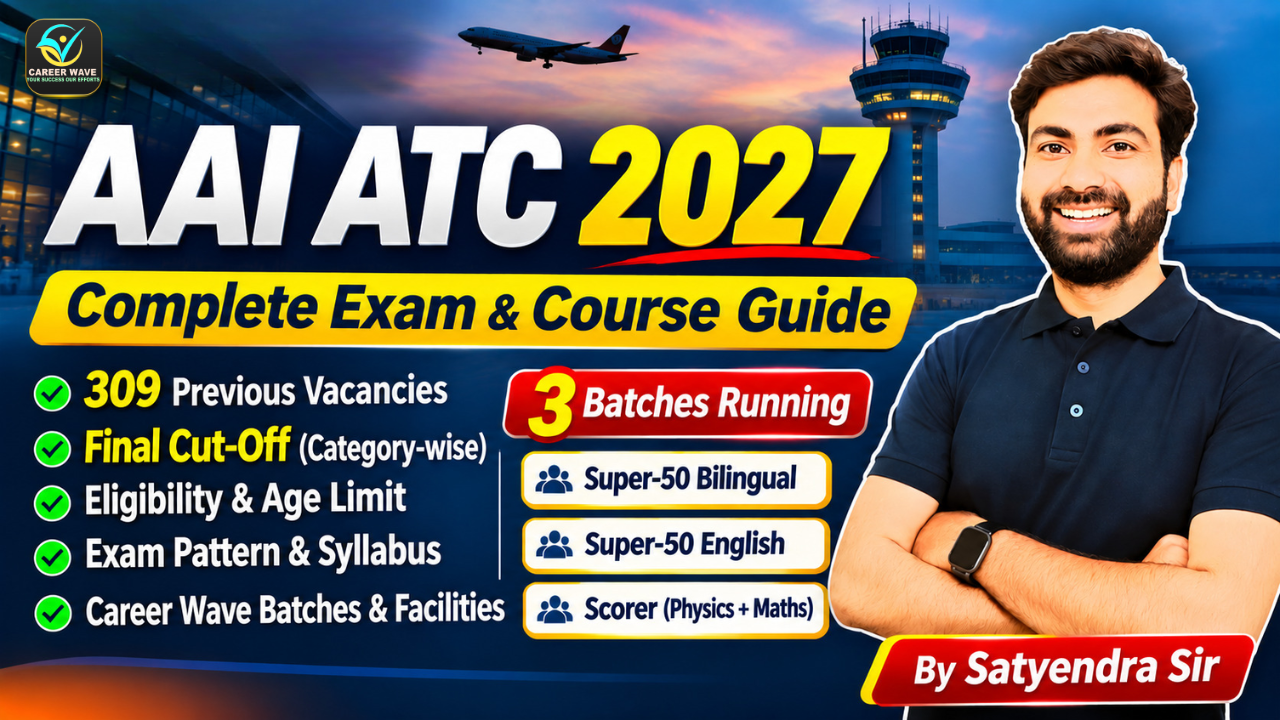
AAI ATC 2027 guide: notification status, eligibility, age limit, exam pattern, syllabus, salary, 2025 cut-offs and Career Wave’s 3 live batches compared.
22-Nov-2026 03:58 PM
RRB Group D score card is out till 1 Dec and ALP CBT-1 objections are closed. Check your score, qualifying marks, PET standards and next...
22-Nov-2026 11:51 AM
AAI JE Operations 2026 answer key status, how to calculate your score out of 120, the 26 Oct paper analysis and the expected cut-off of...
22-Nov-2026 11:23 AM
SSC JE 2026 Paper-I answer key for IMD Scientific Assistant is out. Learn how to calculate your score, raise objections before 22 Nov 6 PM...
19-Nov-2026 03:50 PM
B.Sc vs B.Tech: Who has an advantage in AAI ATC 2027? Discover the right preparation strategy for B.Sc Physics, B.Sc Mathematics and Engineering graduates. Compare...
 Career WaveOn WhatsApp
36,000+ learners · 4.8★ on Google