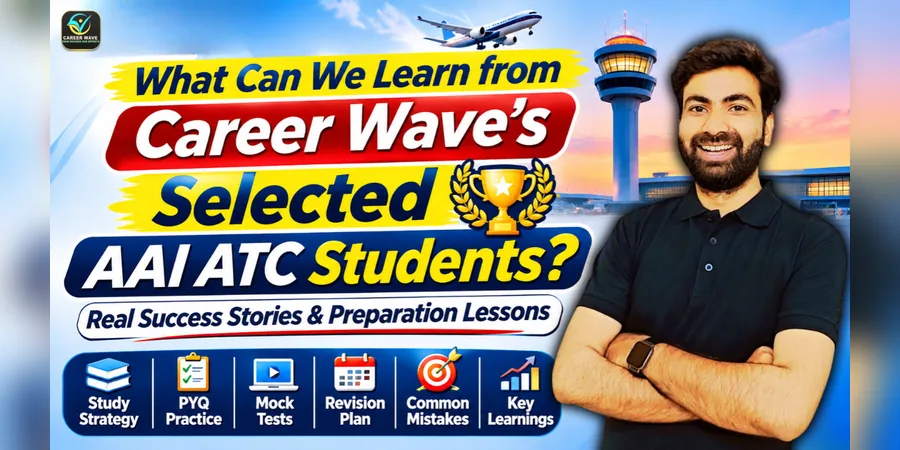
What Career Wave's selected AAI ATC students did differently: real testimonials, PYQ and mock-test methods, a 6-month plan and mistakes to avoid in 2027.
What do students who clear AAI ATC do differently? How do they manage Physics and Mathematics, practise previous year questions, improve mock-test scores and stay consistent throughout their preparation?
Quick answer: Career Wave's selected AAI ATC students report a common pattern: clear concepts first, chapter-wise practice and PYQs, regular mock tests with proper error analysis, and planned revision. Use their experiences as lessons, not as a timetable to copy, and build a plan around your own weak areas.
Every year, thousands of aspirants prepare for the Airports Authority of India (AAI) Junior Executive (Air Traffic Control) examination.
Some are fresh graduates. Others are working professionals or candidates preparing for another attempt. Their educational backgrounds, strengths and available study hours may be very different.
Yet their common objective remains the same: to qualify for a career in Air Traffic Control.
One of the most useful ways to improve preparation is to learn from candidates who have already gone through the process.
However, learning from successful students does not mean blindly copying their study timetable or expecting identical results.
It means understanding the decisions they made, the difficulties they faced and the preparation methods they found useful.
At Career Wave, under the guidance of Satyendra Sir, students are encouraged to prepare through conceptual learning, previous year questions, regular practice, revision and performance analysis.
Career Wave also publishes selection records and student testimonials that provide insights into different preparation journeys.
In this article, we will explore what AAI ATC 2027 aspirants can learn from Career Wave's selected students, including actual student-reported experiences, practical preparation lessons, common mistakes, study strategies and frequently asked questions.
Editorial Note: The student experiences discussed below are based on testimonials published on Career Wave's official website. They are presented as students' own reported experiences, not independently verified interviews or proof that a particular method guarantees selection.
Every selection represents an individual student's effort, academic preparation and performance during a competitive recruitment process.
Career Wave has published a dedicated selection showcase featuring students associated with its AAI ATC preparation programmes.
According to Career Wave's results record, 218 of the 373 candidates selected in AAI ATC 2025 prepared with Career Wave.
These results are part of Career Wave's published institutional records.
However, numbers alone do not explain how individual students prepared.
To learn something useful, we should look more closely at the preparation experiences students have shared.
They can help us understand:
These are practical lessons to evaluate and adapt, rather than guaranteed formulas for selection.
One of the more detailed testimonials published by Career Wave comes from Abhishek Mali.
In his account, Abhishek describes narrowly missing selection in an earlier AAI JE ATC attempt.
He reported that he had fallen short by two marks.
Instead of continuing with exactly the same preparation approach, he decided to strengthen his preparation.
He subsequently enrolled in Career Wave's Super-50 programme.
In his testimonial, he discussed several aspects of preparation that he found useful.
These included concept revision, methods for remembering complicated formulas, chapter-wise practice sheets, classroom question discussions and homework.
He also mentioned practising NCERT-based questions.
Abhishek reported that he was eventually selected in the AAI JE ATC recruitment under Advertisement 05/2023.
Lesson 1: A Previous Failure Can Provide Valuable Information
When a candidate misses selection narrowly, it is important to understand what needs improvement rather than simply repeating the same preparation.
Lesson 2: Small Score Improvements Matter
A few additional correct answers can make a meaningful difference in a competitive examination.
Lesson 3: Practice Must Support Conceptual Learning
Understanding a chapter is important, but solving different types of questions helps develop examination readiness.
Lesson 4: Revision Should Be Planned
Formula retention and repeated practice are important, especially in Physics and Mathematics.
How to Apply This Lesson:
After every mock test, record your score, incorrect answers, weak topics and calculation mistakes.
Then prepare an improvement plan instead of immediately attempting another test.
Remember: Abhishek's experience is an individual testimonial. Your preparation needs and results may be different.
Another Career Wave testimonial comes from Divyansh Joshi.
In his published feedback, Divyansh reported qualifying for AAI JE ATC 2024 and highlighted the support he received in the Technical section through Career Wave's Scorer batch.
For AAI ATC, Physics and Mathematics require both conceptual understanding and regular question practice.
Students who already have a strong academic background may still need examination-focused revision.
Similarly, those who struggle with Technical subjects may benefit from rebuilding their fundamentals.
A Practical Technical Preparation Method:
Step 1: Identify weak Physics and Mathematics chapters.
Step 2: Revise the underlying concepts.
Step 3: Practise chapter-wise questions.
Step 4: Solve relevant previous year questions.
Step 5: Attempt sectional tests and review mistakes.
This sequence is a recommended preparation method, not a verbatim description of Divyansh's personal timetable.
In her Career Wave testimonial, Devi Priya reported qualifying for AAI JE ATC 2024.
She expressed appreciation for the support she received through the Super-50 batch.
Her feedback highlights an important consideration for aspirants: preparation becomes easier to organise when students have a structured academic framework.
Without a defined plan, students may face several problems.
They may spend too much time on familiar chapters, delay difficult subjects or keep collecting resources without completing them.
A structured plan creates a sequence for learning, practice and revision.
Recommended Preparation Sequence:
| Stage | Main Objective |
|---|---|
| Concept Classes | Understand fundamental topics |
| Chapter-Wise Practice | Apply what you have learned |
| PYQs | Understand past examination questions |
| Sectional Tests | Identify subject weaknesses |
| Full-Length Mocks | Assess complete examination readiness |
| Revision | Improve retention and correct mistakes |
For AAI ATC 2027 preparation, students can use this sequence as a starting framework.
The exact timetable should depend on their current preparation level.
Sarvesh Kumar shared a testimonial stating that he was a Career Wave Scorer batch student and had qualified for AAI JE ATC 2024.
His experience reflects one possible preparation route for students who are already studying for the examination and want additional support.
Complete Preparation vs Focused Preparation:
Not every student needs the same amount of instruction.
A beginner may need comprehensive concept classes for Physics, Mathematics and Non-Technical subjects.
A candidate who has already completed much of the syllabus may benefit more from focused revision, PYQs and testing.
| Student Profile | Suggested Preparation Approach |
|---|---|
| Starting from Zero | Complete concept-based preparation |
| Weak in Physics and Mathematics | Technical concept strengthening |
| Strong Fundamentals but Low Speed | Timed practice and PYQs |
| Completed Most of the Syllabus | Focused revision and mock tests |
| Preparing for Another Attempt | Error analysis and targeted improvement |
The important point is to match your preparation method to your actual academic needs.
The published testimonials highlight different aspects of preparation.
Some students mention conceptual teaching. Others discuss revision, assignments, focused courses or academic encouragement.
These experiences suggest several useful areas for current aspirants to examine.
Lesson 1: Conceptual Clarity Should Come Before Shortcuts
Physics and Mathematics are not subjects that can be mastered through formula memorisation alone.
A student may know a formula but still struggle to identify the situation in which it applies.
For example, in Mechanics, understanding the relationship between force, mass and acceleration is more useful than remembering equations without knowing their limitations.
Satyendra Sir's Physics Teaching Approach at Career Wave emphasizes building conceptual understanding and then applying it to numerical questions.
Recommended Method:
Abhishek Mali's testimonial specifically discusses chapter-wise practice sheets and question-solving activities.
This provides a useful reminder that attending classes is only one part of preparation.
Students must also work independently.
How to Build a Practice Routine:
After completing a chapter, solve a set of questions without immediately checking the answers.
Review incorrect attempts and classify the mistakes.
Repeat difficult question types during revision.
The number of questions should depend on difficulty and the student's understanding. Accuracy and learning are more important than an arbitrary daily target.
Lesson 3: Use PYQs as a Learning Resource
AAI ATC Previous Year Questions can help students understand the nature of questions asked in earlier examinations.
However, PYQs should not be treated as a guarantee that particular questions or chapters will repeat.
A Useful PYQ Method:
Explore Career Wave AAI ATC PYQs & eBooks
Lesson 4: Identify Weak Areas Early
Students often prefer studying topics they already understand.
While this may feel productive, it can leave important syllabus areas underprepared.
A diagnostic test can help identify your actual preparation level.
Example:
| Subject | Illustrative Accuracy | Preparation Priority |
|---|---|---|
| Physics | 58% | High |
| Mathematics | 82% | Moderate |
| English | 75% | Moderate |
| Reasoning | 90% | Maintain |
| Numerical Aptitude | 62% | High |
These are sample scores, not the scores of any selected Career Wave student.
In this example, Physics and Numerical Aptitude require additional attention.
Lesson 5: Mock Tests Need Proper Analysis
Attempting numerous mock tests without reviewing mistakes may limit improvement.
After each mock, students should analyse their performance.
A useful test-analysis record should include the score, accuracy and a short improvement plan.
Career Wave AAI ATC Full Test Series
This is the existing 2026 test-series product. Students preparing for 2027 should verify its current validity and suitability before enrolling.
Lesson 6: Consistency Matters More Than Occasional Long Study Sessions
Regular study helps students retain concepts and maintain preparation momentum.
A timetable should be realistic enough to follow consistently.
For example, a student studying six focused hours daily may benefit from dividing the day across Technical subjects, Non-Technical subjects and revision.
A working professional may require a shorter weekday schedule and longer weekend sessions.
The appropriate timetable depends on individual circumstances.
Lesson 7: Academic Support Can Help Students Stay Organised
Several published Career Wave testimonials appreciate the guidance and encouragement received during preparation.
However, emotional support and academic resources do not independently guarantee examination success.
Students still need to attend classes, solve questions, revise consistently and evaluate their progress.
A good preparation system should help students understand what they need to study and how to measure improvement.
Before building your strategy, understand the previous official examination pattern.
The AAI JE ATC 2025 Computer-Based Test included 120 questions carrying 120 marks.
Previous AAI ATC Exam Pattern:
| Subject | Questions | Marks |
|---|---|---|
| English Language | 20 | 20 |
| General Intelligence / Reasoning | 15 | 15 |
| General Aptitude / Numerical Ability | 15 | 15 |
| General Knowledge / Awareness | 10 | 10 |
| Physics and Mathematics (Combined) | 60 | 60 |
| Total | 120 | 120 |
Duration: 120 Minutes
Medium: Hindi and English
Negative Marking: None under the 2025 pattern.
The official syllabus specified 60 combined questions from Physics and Mathematics rather than separately guaranteeing 30 questions from each subject.
Both Technical and Non-Technical subjects are important.
Aspirants should avoid preparing only Physics and Mathematics while ignoring the other four subjects.
Similarly, students strong in Non-Technical topics should allocate enough time to Technical preparation.
Note: The official 2027 examination pattern is subject to confirmation.
The following plan converts the preparation principles discussed above into a schedule for new aspirants.
It is a suggested roadmap, not a reconstruction of any selected student's actual study plan.
| Month | Main Focus | Recommended Activities |
|---|---|---|
| Month 1 | Fundamentals | Syllabus analysis, diagnostic tests, basic concepts |
| Month 2 | Core Chapters | Physics and Mathematics practice |
| Month 3 | Syllabus Progress | Technical and Non-Technical preparation |
| Month 4 | PYQ Practice | Chapter-wise PYQs and sectional tests |
| Month 5 | Mock Tests | Full-length tests and error analysis |
| Month 6 | Final Revision | Formula notes, PYQs, mocks and weak-topic improvement |
Month 1: Understand Your Preparation Level
Start with the official syllabus and assess your strengths and weaknesses.
Do not immediately imitate another student's study plan.
Month 2: Strengthen Important Concepts
Focus on fundamental Physics and Mathematics topics.
Prepare English, Reasoning, Numerical Aptitude and General Awareness regularly.
Month 3: Increase Independent Practice
Solve chapter-wise questions and start reviewing your accuracy.
Use an error notebook to record repeated mistakes.
Month 4: Develop PYQ Familiarity
Practise relevant previous year questions and sectional tests.
Identify topics that need additional revision.
Month 5: Improve Examination Performance
Attempt full-length mocks and analyse every test.
Focus on accuracy, question selection and time management.
Month 6: Consolidate Your Preparation
Revise formulas, concepts, PYQs and previously incorrect questions.
Avoid unnecessary resource changes immediately before the examination.
Aspirants can begin with the following six-hour study framework.
| Activity | Daily Time |
|---|---|
| Physics | 1 Hour 30 Minutes |
| Mathematics | 1 Hour 30 Minutes |
| English | 30 Minutes |
| Reasoning | 30 Minutes |
| Numerical Aptitude | 30 Minutes |
| General Awareness | 30 Minutes |
| PYQs and Revision | 1 Hour |
| Total | 6 Hours |
The schedule can be adjusted for college students, working professionals and repeat candidates.
The main objective is regular progress.
Related: Best Daily Routine for Working + ATC Aspirants: Complete Study Plan by Career WaveMistake 1: Copying Another Student's Timetable Exactly
Different students have different strengths, responsibilities and study hours.
Better Approach: Create your schedule using diagnostic-test results.
Mistake 2: Assuming One Course Guarantees Selection
No course, book or test series can guarantee selection.
Better Approach: Focus on how effectively you use the resources available.
Mistake 3: Comparing Your Mock Scores with Unverified Claims
Students may discuss scores without specifying examination difficulty or the circumstances of the test.
Better Approach: Compare your performance across multiple representative mock tests.
Mistake 4: Memorising Solutions Instead of Understanding Concepts
Memorisation alone may not help with unfamiliar questions.
Better Approach: Understand the reasoning behind each solution.
Mistake 5: Ignoring Your Own Weaknesses
A strategy that worked for a Physics graduate may not work equally well for someone weak in Physics.
Better Approach: Identify and improve your own problem areas.
Related: Mistakes That Stop Students from Clearing AAI ATC (And How to Avoid Them)Career Wave provides a playlist of selected-student interviews on YouTube.
These videos can help aspirants explore different preparation experiences.
Watch Career Wave Selected Students' Interviews
Questions to Consider While Watching:
Academic Background: Was the student from B.Sc, B.Tech or another eligible qualification route?
Preparation Duration: How long did they prepare, and what was their starting level?
Strong and Weak Subjects: Which subjects required additional effort?
PYQ Approach: How did they practise previous year questions?
Mock Tests: What role did mock tests play in their preparation?
Revision: How did they retain formulas and concepts?
Mistakes: What would they do differently if they prepared again?
These questions can help students extract useful information from interviews instead of focusing only on the final result.
Do not attribute a specific score, number of study hours or preparation technique to an individual unless the student actually states it in an accessible interview or testimonial.
Career Wave, founded by Satyendra Sir, provides preparation resources for AAI JE ATC aspirants.
The institute's academic approach combines concept learning with examination-oriented practice.
Career Wave Preparation Resources:
These resources are intended to help students organise preparation according to the examination requirements.
The most effective use of any course involves regular attendance or lesson completion, independent practice and consistent revision.
Explore Career Wave:
For AAI ATC preparation, Physics and Mathematics classes, previous year questions, mock tests and academic guidance, follow Career Wave.
Career Wave's published AAI ATC selection records and student testimonials offer useful lessons for future aspirants.
The experiences of students such as Abhishek Mali, Divyansh Joshi, Devi Priya and Sarvesh Kumar demonstrate that different candidates can benefit from different forms of academic support.
One student may need stronger fundamentals. Another may need more question practice. A repeat candidate may need to analyse the mistakes that affected an earlier attempt.
The most important lesson is that successful preparation should be personal, structured and measurable.
At Career Wave, Satyendra Sir and the academic team encourage aspirants to develop conceptual clarity, practise previous year questions, attempt mock tests and revise systematically.
For AAI ATC 2027, use selection experiences as a source of practical learning, not as a substitute for identifying your own strengths and weaknesses.
Learn from their experiences. Understand your weaknesses. Build your preparation plan.
Disclaimer: Updated November 19, 2026. Student experiences are based on publicly available Career Wave testimonials, and the reported selection count is an institutional claim. Individual results and preparation experiences do not guarantee similar outcomes. The AAI ATC 2027 recruitment requirements remain subject to official confirmation.
Leave a Comment
23-Nov-2026 02:05 PM
What Career Wave's selected AAI ATC students did differently: real testimonials, PYQ and mock-test methods, a 6-month plan and mistakes to avoid in 2027.
23-Nov-2026 01:23 PM
AAI ATC 2027 guide: notification status, eligibility, age limit, exam pattern, syllabus, salary, 2025 cut-offs and Career Wave’s 3 live batches compared.
22-Nov-2026 03:58 PM
RRB Group D score card is out till 1 Dec and ALP CBT-1 objections are closed. Check your score, qualifying marks, PET standards and next...
22-Nov-2026 11:51 AM
AAI JE Operations 2026 answer key status, how to calculate your score out of 120, the 26 Oct paper analysis and the expected cut-off of...
22-Nov-2026 11:23 AM
SSC JE 2026 Paper-I answer key for IMD Scientific Assistant is out. Learn how to calculate your score, raise objections before 22 Nov 6 PM...
19-Nov-2026 03:50 PM
B.Sc vs B.Tech: Who has an advantage in AAI ATC 2027? Discover the right preparation strategy for B.Sc Physics, B.Sc Mathematics and Engineering graduates. Compare...
 Career WaveOn WhatsApp
36,000+ learners · 4.8★ on Google