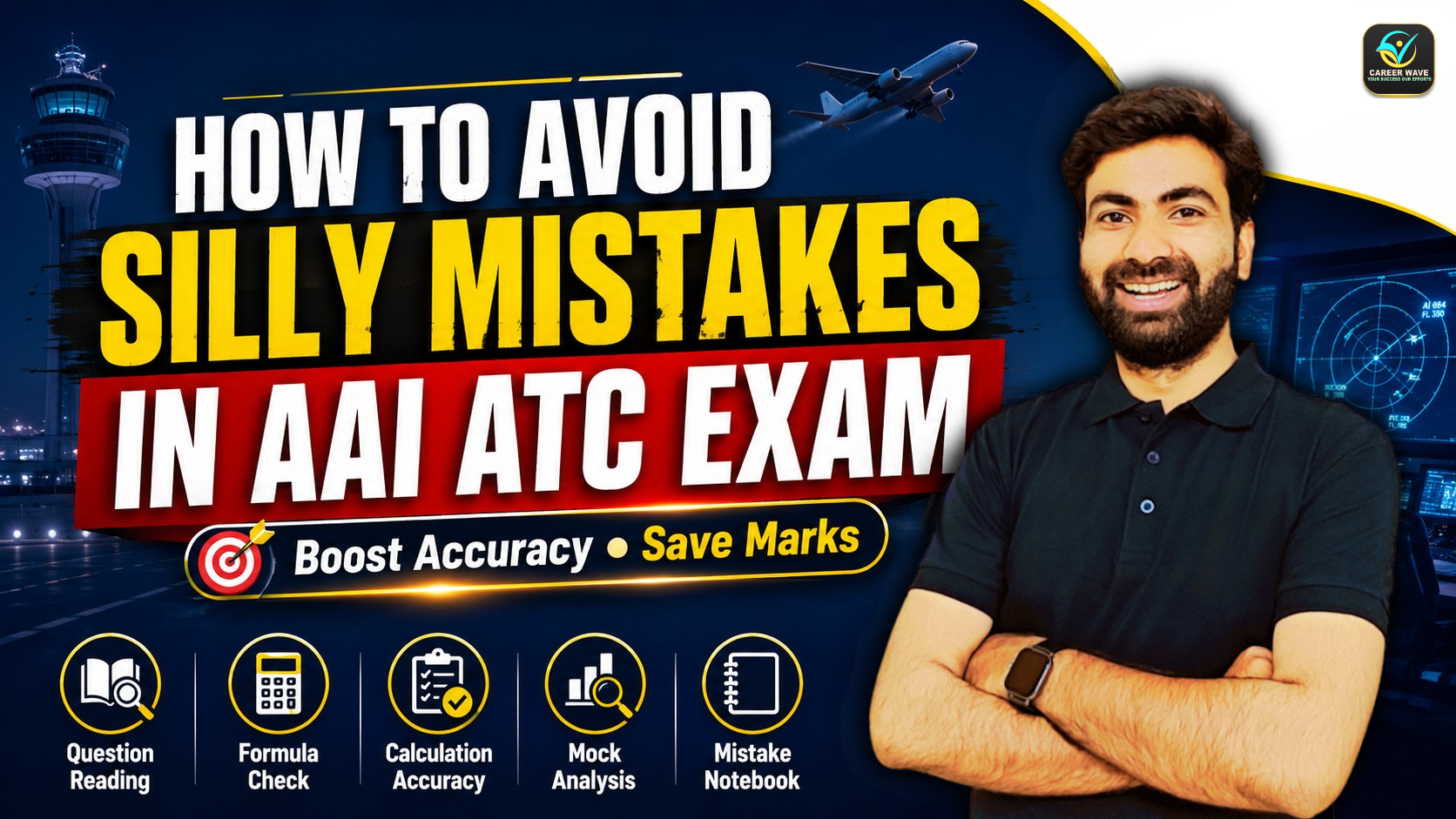
Learn practical ways to avoid
silly mistakes in the AAI ATC exam with mock test analysis, formula revision,
mistake notebook strategy, accuracy improvement tips, and guidance from Career
Wave by Satyendra Sir.
How to Avoid Silly Mistakes in AAI ATC Exam
Preparing
for the AAI ATC exam is not only about completing the syllabus. It is also
about accuracy, speed, and exam discipline. Many students know the concept,
solve mock tests, and revise regularly, but still lose marks because of silly
mistakes.
In a
competitive exam like AAI ATC, even 2–3 avoidable mistakes can affect your
final score. That is why smart preparation means learning how to reduce
mistakes, not just learning more topics.
At Career Wave, Satyendra Sir
always tells students that selection depends on three things: concept clarity,
practice, and mistake control. If you can reduce silly mistakes, your score can
improve without even studying anything new.
Why Silly Mistakes Matter in AAI ATC
AAI ATC is a
speed-based and accuracy-based exam. Students have to solve questions from
Physics, Mathematics, Reasoning, English, General Awareness, and Aptitude
within a limited time.
Most silly
mistakes happen due to:
·
Overconfidence
·
Hurry during
calculation
·
Not reading
the question properly
·
Wrong option
marking
·
Unit
conversion error
·
Formula
confusion
·
Poor mock
test analysis
·
Lack of
revision
·
Exam
pressure
Silly mistakes are dangerous
because you already know the answer, but still lose marks. These are not
knowledge gaps; these are execution errors.
Common Silly Mistakes Students Make in AAI
ATC Exam
1. Not
Reading the Question Carefully
Many
students read only half of the question and start solving. This leads to wrong
answers, especially in questions where words like “not correct,” “except,”
“minimum,” “maximum,” or “nearest value” are used.
Before
solving, read the question properly and underline the key demand mentally.
2. Wrong
Unit Conversion
In Physics
and Mathematics, unit conversion is one of the most common mistakes.
Examples:
·
km/h to m/s
·
cm to m
·
mm to m
·
minutes to
seconds
·
kW to W
·
μF to F
Always check
the units before applying the formula.
3. Formula
Confusion
Students
often remember formulas but apply them in the wrong condition. This happens
when revision is weak or formulas are not organized chapter-wise.
For example,
in Physics, using the wrong equation in motion, current electricity, optics, or
work-energy questions can easily change the answer.
To avoid
this, maintain a separate formula notebook and revise it regularly.
4.
Calculation Errors
Calculation
mistakes usually happen due to speed pressure. Students sometimes skip steps,
assume values wrongly, or make basic arithmetic errors.
To reduce
this:
·
Write clean
rough work
·
Avoid mental
calculation in lengthy questions
·
Use
approximation carefully
·
Cross-check
final values
·
Do not rush
in easy questions
Easy
questions are often where students make the most careless mistakes.
5. Marking
the Wrong Option
Sometimes
students solve correctly but mark the wrong option. This usually happens when
options are close or when the student is in a hurry.
After
solving, match the final answer with the option carefully. Do not click
randomly or mechanically.
6. Ignoring
Negative Marking Strategy
If the exam
has negative marking, random guessing can damage your score. Even if there is
no negative marking in a particular pattern, blind guessing wastes time and
reduces focus.
Attempt only
those questions where you have reasonable confidence. Use elimination only when
you can remove at least two wrong options.
7. Not
Revising Mistakes from Mock Tests
Mock tests
are not useful if you only check the score. The real benefit comes from
analysis.
After every
mock test, write:
·
Which
questions went wrong?
·
Why did they
go wrong?
·
Was it a
concept error or silly mistake?
·
Was the
mistake repeated?
·
What should
be done to avoid it next time?
Career Wave students are always
advised by Satyendra Sir to maintain a dedicated mistake notebook. This is one
of the best ways to increase accuracy.
How to Avoid Silly Mistakes in AAI ATC Exam
1. Follow
the 3-Second Rule Before Solving
Before
starting any question, pause for 3 seconds and identify what the question is
asking.
Ask
yourself:
·
What is
given?
·
What is
required?
·
Which
formula or concept applies?
·
Are there
any tricky words?
This small
habit can prevent many careless mistakes.
2. Maintain
a Mistake Notebook
A mistake
notebook is more important than a normal notebook in the final phase of
preparation.
Divide your
mistake notebook into sections:
·
Physics
mistakes
·
Maths
mistakes
·
Reasoning
mistakes
·
English
mistakes
·
GA mistakes
·
Calculation
mistakes
·
Silly
mistakes
Revise this
notebook before every mock test and before the final exam.
3. Revise
Formulas Daily
For AAI ATC,
Physics and Mathematics need regular formula revision. Do not revise formulas
only before the exam.
Make a
formula sheet chapter-wise and revise it daily for 15–20 minutes.
Focus on:
·
Formula
·
Condition of
use
·
Units
·
Special
cases
·
Common traps
Formula
revision improves both speed and confidence.
4. Read
Options Before Final Marking
After
solving the question, read all options carefully. Sometimes options are given
in different units or very close numerical values.
Do not mark
the first matching-looking answer. Match the exact value, unit, and sign.
5. Practice
Mock Tests in Exam-Like Conditions
Many
students perform well during normal practice but make mistakes in mock tests
because they are not used to time pressure.
While
attempting mocks:
·
Sit in a
quiet place
·
Set a timer
·
Avoid breaks
·
Do not check
solutions in between
·
Attempt like
the real exam
·
Analyze
after completion
This builds
exam temperament.
6. Do Not
Over-Attempt in Hurry
Attempting
more questions is useful only when accuracy is maintained. If you attempt too
many questions without confidence, silly mistakes increase.
Your target
should be:
Accuracy
first, speed second.
Speed
improves with practice, but accuracy requires discipline.
7. Use Clean
Rough Work
Messy rough
work creates confusion. Many students make calculation errors because they
write numbers randomly on the page.
Follow this
method:
·
Write
question number
·
Keep steps
aligned
·
Circle the
final value
·
Avoid
overwriting
·
Separate
calculations for different questions
Clean rough
work improves clarity and reduces errors.
8. Revise
Easy Topics Properly
Students
often ignore easy topics because they feel confident. But in exams, easy
questions must be solved correctly.
Do not lose
marks in simple topics like:
·
Units and
dimensions
·
Percentage
·
Ratio
·
Average
·
Basic
grammar
·
Static GK
facts
·
Simple
reasoning patterns
Easy marks
must be protected.
9. Avoid
Last-Minute Overloading
Studying too
many new topics just before the exam creates confusion. In the final days,
focus on revision, formulas, mock analysis, and mistake notebook.
Do not
overload your mind with new material unless it is very important.
10. Sleep
Properly Before the Exam
A tired mind
makes more silly mistakes. Lack of sleep affects calculation, reading speed,
memory, and decision-making.
Before the
exam:
·
Sleep
properly
·
Avoid
late-night study
·
Keep
documents ready
·
Reach the
exam centre on time
·
Stay calm
during the paper
A fresh mind performs better than
an overloaded mind.
Subject-Wise Tips to Avoid Silly Mistakes
Physics
·
Check units
before formula application
·
Write given
values clearly
·
Revise sign
conventions
·
Do not skip
diagrams where needed
·
Avoid
formula mixing
·
Revise
common conceptual traps
Mathematics
·
Practice
calculation daily
·
Do not skip
steps in lengthy questions
·
Use
approximation only when safe
·
Recheck
signs and decimal points
·
Memorize
standard formulas properly
Reasoning
·
Read
direction and arrangement questions carefully
·
Do not
assume extra information
·
Draw proper
diagrams
·
Check
sequence and position twice
·
Avoid
solving in mind for complex questions
English
·
Read the
full sentence before choosing the option
·
Check
subject-verb agreement
·
Revise
common grammar rules
·
Do not
depend only on instinct
·
Practice
error detection regularly
General
Awareness
·
Revise facts
repeatedly
·
Avoid
confusion between similar facts
·
Make short
notes for static GK
·
Follow
trusted sources
·
Do not guess
randomly
Aptitude
·
Read the question carefully and identify what is asked
·
Check units, values, and given conditions before solving
·
Avoid long methods; use shortcuts only when concept is
clear
·
Practice percentage, ratio, average, time & work, and
speed questions regularly
·
Recheck calculations, especially decimals and signs
·
Do not rush in easy questions; they are high-scoring
·
Analyze mock test mistakes and revise repeated question patterns
Best Strategy Recommended by Career Wave
At Career
Wave, Satyendra Sir recommends a simple 5-step strategy to reduce silly
mistakes in AAI ATC preparation:
1.
Attempt mock
tests regularly.
2.
Analyze
every wrong question.
3.
Maintain a
separate mistake notebook.
4.
Revise
formulas and facts daily.
5.
Repeat the
same process every week.
This method
helps students identify their weak areas and improve accuracy step by step.
Satyendra Sir’s advice is simple:
do not just study more, correct your repeated mistakes. That is where real
improvement begins.
Final 7-Day Mistake Control Plan for AAI ATC
Day 1–2:
Formula Revision
Revise
Physics and Maths formulas chapter-wise.
Day 3:
Mistake Notebook Revision
Revise all
repeated mistakes from mocks and assignments.
Day 4: PYQ
Revision
Revise
previous year question patterns and repeated concepts.
Day 5: Full
Mock Test
Attempt one
full mock in exam-like conditions.
Day 6: Mock
Analysis
Analyze
wrong answers, skipped questions, and silly mistakes.
Day 7: Light
Revision
Revise formulas, GA facts,
English rules, and avoid heavy new topics.
Conclusion
Silly
mistakes can reduce your AAI ATC score even when your preparation is good. The
best way to avoid them is through regular mock practice, deep analysis, formula
revision, clean rough work, and a strong mistake notebook.
At Career
Wave, Satyendra Sir always focuses on practical and exam-oriented preparation.
If you want to improve your AAI ATC score, start tracking your mistakes from
today. Every mistake you correct now can become a mark saved in the final exam.
Prepare smartly. Revise
regularly. Attempt carefully.
Important Career Wave Links
YouTube
Channel: https://www.youtube.com/@CAREERWAVE
Telegram
Channel: https://t.me/aai_atc
Instagram: https://www.instagram.com/careerwave.atc
Facebook: https://www.facebook.com/careerwave.atc
Logo URL: https://drive.google.com/file/d/17sYyDsPSgQgCzsKiWreWAcEqka1IwSVj/view?usp=sharing
FAQs:
1. Why do
students make silly mistakes in AAI ATC exam?
Students usually make silly
mistakes due to hurry, overconfidence, poor revision, weak calculation
practice, and not reading the question carefully.
2. How can I
reduce silly mistakes in Physics?
Revise formulas daily, check
units, understand formula conditions, and solve questions with clean rough
work.
3. How can I
avoid calculation mistakes in Maths?
Practice calculations regularly,
avoid skipping steps, check decimal points, and recheck the final answer before
marking.
4. Is a
mistake notebook useful for AAI ATC?
Yes, a mistake notebook is very
useful. It helps you track repeated errors and avoid them in future mock tests
and the final exam.
5. How many
mock tests should I attempt to reduce silly mistakes?
You should attempt mock tests
regularly, but analysis is more important than the number of mocks. Every mock
should be followed by proper review.
6. Should I
revise mistakes before every mock test?
Yes, revising your mistake
notebook before every mock helps you avoid repeating the same errors.
7. How can I
avoid wrong option marking?
After solving, match your final
answer with the option carefully. Check value, unit, sign, and option sequence
before marking.
8. What is
the best way to improve accuracy in AAI ATC?
The best way is to combine
concept revision, regular mock tests, formula practice, and mistake analysis.
Related Blogs -
PYQ vs Mock Test: What Matters More for AAI ATC Preparation?
Career Growth in AAI ATC (Level-Wise Promotion Path)
The Career Wave Attempt Strategy Framework
Leave a Comment
22-Aug-2026 01:25 PM
Preparing for AAI JE Airport Operations 2026? Learn the most common preparation mistakes aspirants make, from studying only strong subjects and ignoring Business Management or...
21-Aug-2026 03:49 PM
Are you preparing for AAI JE Airport Operations by focusing only on Physics and Maths? Understand why ignoring Business Management, Aviation Awareness, Reasoning, English, Aptitude...
20-Aug-2026 04:36 PM
Will AAI ATC preparation give you an advantage in AAI JE Airport Operations? Understand the syllabus overlap, benefits in Reasoning, Aptitude, English and Aviation, challenges...
19-Aug-2026 12:04 PM
Is MBA compulsory for AAI JE Airport Operations? Understand the eligibility criteria for B.Sc. + MBA and Engineering candidates, MBA mode requirements, qualification routes and...
18-Aug-2026 06:21 PM
Can B.Sc + MBA candidates apply for AAI JE Airport Operations 2026? Understand eligibility, qualification requirements, career opportunities, Aviation Awareness, Business Management, PYQs and smart...
17-Aug-2026 02:39 PM
Preparing Aviation Awareness for AAI AO 2026? Learn the complete smart strategy for AAI, DGCA, ICAO, IATA, airport codes, aviation terminology, aircraft basics, current affairs,...
