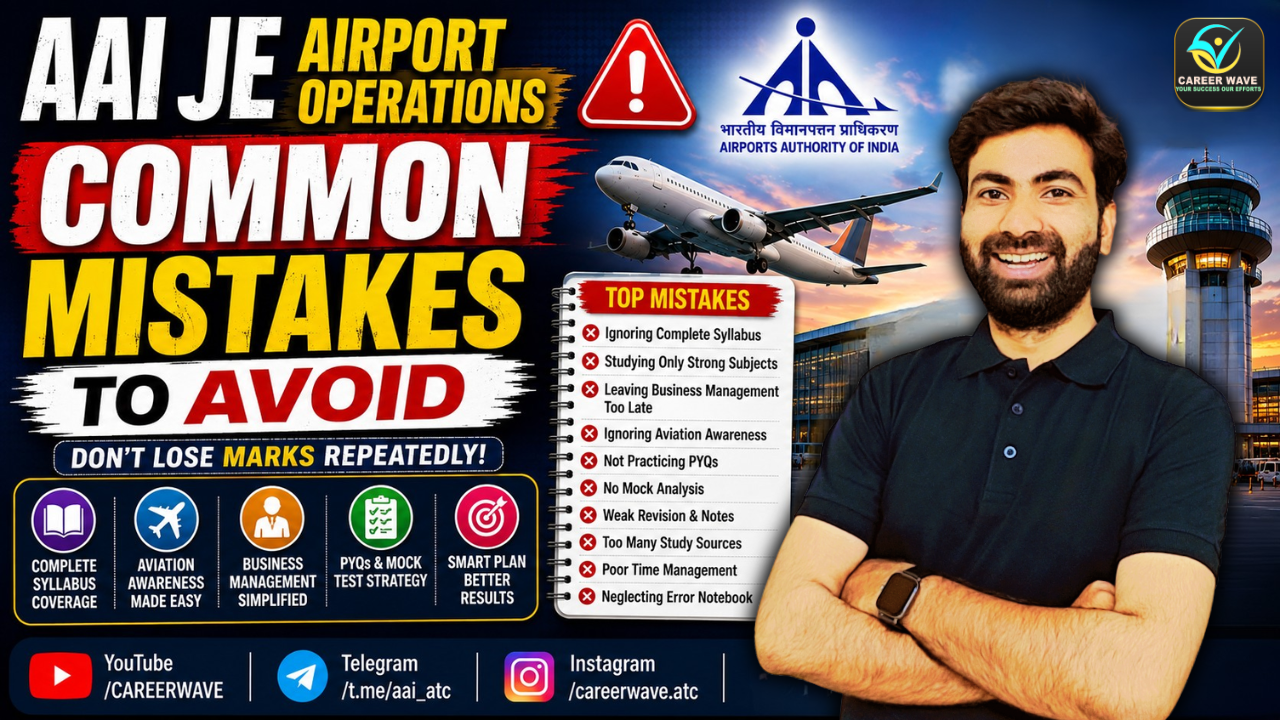
Preparing for AAI JE Airport
Operations 2026? Learn the most common preparation mistakes aspirants make,
from studying only strong subjects and ignoring Business Management or Aviation
Awareness to poor PYQ practice, weak revision and improper mock analysis.
Follow a smarter exam-oriented strategy with Career Wave and Satyendra Sir.
AAI JE Airport Operations Common Mistakes to
Avoid: Complete Preparation Guide
AAI Junior
Executive (Airport Operations) is an attractive opportunity for candidates who
want to build a career in the aviation sector. But a good opportunity also
attracts serious competition.
Most
aspirants do not fail because they are incapable of understanding the syllabus.
They lose
marks because of smaller mistakes repeated throughout their preparation:
Wrong
subject priority.
Too many study sources.
Weak revision.
Ignoring Aviation Awareness or Business Management.
Giving mocks without analysis.
Depending on familiarity instead of actual preparation.
At Career
Wave, Satyendra Sir emphasizes a simple principle:
Selection
preparation is not only about what you study. It is also about eliminating the
mistakes that repeatedly reduce your score.
Here are the most common mistakes
AAI JE Airport Operations aspirants should avoid.
1. Preparing Without Understanding the
Official Syllabus
The first
mistake can happen before serious preparation even begins.
Students
start studying from YouTube playlists, PDFs, books or old notes without first
understanding the complete syllabus.
This creates
two problems:
·
Important
topics may remain uncovered.
·
Too much
time may be spent on low-priority or irrelevant material.
Before
making your timetable, divide the applicable syllabus subject-wise and
topic-wise.
Use this
sequence:
Official
Syllabus → Subject List → Topic List → Study Plan → Tests
Your preparation plan should come
from the exam—not from whichever study material you find first.
2. Treating AAI AO Like AAI ATC
This mistake
is especially common among existing ATC aspirants.
Both
opportunities are associated with AAI, but that does not make their preparation
identical.
An ATC
aspirant may already have strengths in:
·
Physics
·
Mathematics
·
Reasoning
·
Aptitude
·
English
·
General
Awareness
·
Competitive-exam
practice
That
preparation can provide a useful foundation.
But AAI
Airport Operations has to be prepared according to its own applicable syllabus
and examination requirements.
Use your ATC
preparation as an advantage.
Do not allow it to become a
limitation.
3. Studying Only Physics and Mathematics
This is one
of the biggest traps for technical-background candidates.
Physics and
Maths feel comfortable because students may already have:
·
Notes
·
Formula
sheets
·
PYQs
·
Practice
questions
·
Previous
preparation
So they
continue spending most of their time there.
Meanwhile,
areas such as:
Business
Management, Aviation Awareness, Reasoning, Aptitude, English and General
Awareness
may receive
insufficient attention.
A strong
subject should become your score foundation, not your comfort zone.
If Physics and Mathematics are
already strong, maintain them through revision and tests while using more
learning time on weaker or newer subjects.
4. Starting Business Management Too Late
Candidates
from Engineering, Physics or Mathematics backgrounds may underestimate Business
Management because it appears theoretical.
But
objective questions can test very precise differences between concepts.
You may need
clarity regarding:
·
Definitions
·
Features
·
Functions
·
Principles
·
Management
concepts
·
Business
organization
·
Applications
·
Similar
terminology
·
Statement-based
concepts
Reading a
chapter once is not enough.
Use:
Concept →
Short Notes → MCQs → Error Analysis → Revision
Starting early gives you enough
time to revise theoretical concepts repeatedly.
5. Treating Aviation Awareness Like Random GK
Aviation
Awareness should not become a collection of random aviation facts.
Your
preparation should be structured.
Depending on
the applicable syllabus, important areas may include:
·
AAI
·
DGCA
·
BCAS
·
ICAO
·
IATA
·
Aviation
abbreviations
·
Airport
terminology
·
Airport
infrastructure
·
Airport
codes
·
Runway and
taxiway basics
·
Indian
aviation ecosystem
·
Relevant
aviation current affairs
Study these
areas systematically.
Aviation Awareness becomes much
easier when facts are connected to concepts.
6. Leaving Aviation Awareness for the Last
Few Days
Students
often think:
“Aviation is
factual. I will memorize it near the exam.”
That
strategy can create serious revision pressure.
Factual
information requires repeated recall.
If you
study:
ICAO → IATA
→ DGCA → BCAS → AAI → Airport Codes → Terminology → Current Aviation
only once,
much of it may disappear from memory.
Instead, use
a revision cycle:
Learn →
Revise → MCQs → Revisit Mistakes → Revise Again
Small daily revision is usually
more effective than one huge final session.
7. Ignoring Aptitude Because You Have Studied
It Before
Knowing
aptitude concepts and solving aptitude questions quickly are different skills.
You may
already know:
·
Percentage
·
Ratio
·
Average
·
Profit and
loss
·
Time and
work
·
Time, speed
and distance
But
competitive exams require:
Concept +
Calculation Speed + Accuracy + Question Selection
If aptitude
is already strong, you do not need to restart everything.
Maintain it through timed
practice and sectional tests.
8. Assuming Reasoning Is Automatically Easy
Reasoning
often looks simple when there is no time pressure.
During an
actual exam, however, a lengthy puzzle or unfamiliar pattern can consume
valuable minutes.
Reasoning
preparation should develop:
·
Pattern
recognition
·
Speed
·
Accuracy
·
Question
selection
·
Logical
clarity
·
Exit
strategy
Do not judge
your Reasoning ability by whether you can solve a question.
Judge it by whether you can solve
it correctly within a reasonable time.
9. Ignoring English Preparation
Aspirants
sometimes say:
“My English
is okay, so I don't need to prepare it.”
But
conversational English and competitive-exam English are not the same.
Questions
can test:
·
Grammar
·
Vocabulary
·
Usage
·
Reading
comprehension
·
Sentence
correction
·
Error
detection
·
Contextual
understanding
Treat English as a scoring
opportunity wherever it forms part of the applicable exam.
10. Preparing General Awareness Without
Revision
GA
preparation often becomes endless because students continuously collect new
information.
They follow:
·
Daily
current affairs
·
PDFs
·
Videos
·
Telegram
notes
·
Monthly
magazines
·
One-liners
But they
rarely revise them properly.
The result?
They
recognize a fact in the exam but cannot confidently identify the correct
option.
Use fewer
sources and revise them more often.
Collection is not preparation.
Recall is preparation.
11. Using Too Many Study Sources
One teacher
for concepts.
Another PDF
for revision.
A third book
for MCQs.
Five
Telegram channels for current affairs.
Multiple
YouTube playlists for the same topic.
This creates
the illusion of comprehensive preparation but often produces confusion.
A better
system is:
One Reliable
Concept Source + One Practice Source + PYQs + Tests + Revision Notes
Change a
source only when there is a genuine gap.
Do not change because another PDF
looks more attractive.
12. Making Very Long Notes
Notes should
reduce revision time.
If your
notes become almost as long as the original chapter, they are not serving that
purpose.
For subjects
such as Business Management and Aviation Awareness, use:
·
Keywords
·
Tables
·
Comparisons
·
One-line
definitions
·
Important
facts
·
Abbreviations
·
Commonly
confused concepts
Your notes should become shorter
as the examination approaches.
13. Watching Lectures Without Practising
Questions
Completing a
lecture creates familiarity.
It does not
guarantee exam performance.
After every
important topic:
Study →
Close Notes → Recall → Solve MCQs → Check Mistakes
If you
cannot answer questions independently, the topic is not yet exam-ready.
This applies to technical and
non-technical subjects alike.
14. Ignoring PYQs
Previous
Year Questions are not merely another practice set.
They help
you understand:
·
Question
framing
·
Difficulty
level
·
Important
concepts
·
Frequently
tested areas
·
Required
depth
·
Examiner
mindset
Without PYQ
analysis, students often spend too much time studying things that are unlikely
to improve their score.
At Career
Wave, Satyendra Sir recommends using PYQs as a benchmark for
exam-oriented preparation.
AAI
resources are available here:
Career
Wave AAI PYQs & E-Books
15. Solving PYQs Only Once
Another
mistake is solving a PYQ, checking the answer and moving on permanently.
Instead,
classify PYQs:
Correct
& Confident
Correct but Doubtful
Wrong
Not Attempted
Revisit the
last three categories.
A wrong PYQ can reveal a weakness
that may affect many similar questions.
16. Giving Mock Tests Too Late
Some
students wait until the entire syllabus is complete before starting mocks.
The problem
is that mock tests develop skills that lectures cannot teach:
·
Time
management
·
Question
selection
·
Section
switching
·
Concentration
·
Accuracy
under pressure
·
Decision-making
Start
sectional tests during preparation and gradually move toward full mocks.
Do not wait for a mythical point
where you feel “100% ready.”
17. Giving Mocks Without Analysis
A mock score
tells you what happened.
Mock
analysis tells you why it happened.
After every
mock, check:
·
Easy
questions missed
·
Conceptual
errors
·
Calculation
mistakes
·
Guessing
mistakes
·
Time-consuming
questions
·
Weak
subjects
·
Repeated
errors
·
Questions
left due to poor time management
A 60-minute mock followed by
serious analysis can be more useful than attempting multiple mocks without
review.
18. Chasing Attempts Instead of Accuracy
Attempt
count alone is not a meaningful performance indicator.
Aspirants
often compare:
“How many
questions did you attempt?”
A better
question is:
“How many
did you solve correctly, and how efficiently?”
Even where
there is no negative marking, random attempts do not improve your underlying
preparation or help you distinguish knowledge from guessing during practice.
Track:
Attempts |
Correct | Wrong | Accuracy | Time
This gives you a clearer picture
of readiness.
19. Not Tracking Time Per Question
A question
can be solved correctly and still be strategically expensive.
Suppose a
candidate spends four minutes solving one difficult question while several
easier questions remain.
That is a
question-selection problem.
During timed
practice, identify:
Quick
Questions → Attempt First
Moderate
Questions → Attempt Next
Time-Consuming
Questions → Return Later
Speed is not
only about calculating faster.
It is also about deciding where
your time deserves to go.
20. Not Maintaining an Error Notebook
An error
notebook is one of the simplest tools for improving mock scores.
Create
sections for every subject:
Physics
Formula or conceptual error
Mathematics
Calculation or method error
Aptitude
Formula, calculation, shortcut or time-management error
Business
Management
Confused definition, principle or application
Aviation
Awareness
Incorrect organization, airport code, abbreviation or terminology
Reasoning
Pattern-recognition or logical error
English
Grammar, vocabulary or usage error
General
Awareness
Incorrect or outdated fact
Before your
next test, revise recurring errors.
The
objective is simple:
Do not make the same mistake
twice.
21. Revising Everything Equally
Revision
should not be democratic.
Every topic
does not deserve equal time.
Give more
revision to:
·
Weak
concepts
·
Frequently
forgotten facts
·
Previous
mistakes
·
Important
formulas
·
Confusing
management concepts
·
Aviation
abbreviations
·
Current
affairs
·
High-value
topics
Give less
time to concepts you consistently answer correctly.
Use performance to decide
revision priority.
22. Studying According to Mood
Today
Physics because you enjoy it.
Tomorrow
Reasoning because it feels easy.
Then two
days of Aviation because a new video appeared.
Then no
Business Management for a week.
This creates
fragmented preparation.
Use a weekly
plan.
Your timetable should ensure that
every important subject receives the attention it requires regardless of your
mood.
23. Comparing Your Preparation With Other
Students
Someone has
completed the syllabus.
Someone has
attempted 20 mocks.
Someone
studies 10 hours daily.
Someone
scored higher than you in a sectional test.
None of
these facts automatically tell you what you need to study tomorrow.
Your useful
comparison is:
Your
Previous Performance vs Your Current Performance
Track:
·
Accuracy
·
Mock score
·
Weak topics
·
Revision
completion
·
Time
management
·
Error
repetition
Competition
matters on exam day.
During preparation, improvement
matters more.
24. Ignoring Eligibility and Document
Requirements
Preparation
is only useful if you satisfy the recruitment requirements.
Candidates
should carefully verify the applicable official notification for:
·
Educational
qualification
·
Degree mode
and duration
·
Age criteria
·
Category
conditions
·
Licence
requirements, where applicable
·
Required
certificates
·
Cut-off
dates
·
Document
verification requirements
Do not rely
solely on screenshots, reels or forwarded messages for eligibility.
The applicable official AAI
notification should remain your final reference.
25. Depending on Guesswork Because There Is
No Negative Marking
“No negative
marking” can create the wrong mindset.
Students may
think:
“I can mark
everything, so preparation accuracy is less important.”
But during
preparation, random guessing hides weaknesses.
Suppose you
answer a question correctly only because you guessed.
If you count
it as a fully mastered concept, your analysis becomes misleading.
During
mocks, separate:
Known
Correct Answer
from
Lucky Guess
Your objective is to increase the
first category.
26. Changing Strategy After Every Bad Mock
One poor
mock does not mean your complete preparation system has failed.
Mock scores
naturally fluctuate.
Before
changing your entire timetable, ask:
Was the
problem conceptual?
Was the paper difficult?
Was accuracy poor?
Did I manage time badly?
Was one subject responsible for most mistakes?
Change strategy based on patterns
across tests—not emotion after one score.
27. Ignoring Weak Subjects Until the End
This is one
of the most damaging habits.
Students
keep saying:
“I will do
this subject after completing my strong subjects.”
But strong
subjects never feel completely finished.
There is
always another question set, another revision and another mock.
Start weak
subjects early.
Even 45–60 focused minutes
daily can create significant improvement over several weeks.
28. Studying More but Revising Less
Adding new
material feels productive.
Revision
feels repetitive.
But
competitive examinations reward recall.
A useful
preparation cycle is:
Learn →
Practise → Revise → Test → Analyse → Revise Again
Without
revision, previously studied material gradually becomes unfamiliar.
Your timetable should therefore
include revision as a fixed activity—not something you do only when extra time
remains.
29. Ignoring Your Health and Sleep Before the
Exam
Long study
hours are useful only when the study quality remains high.
Repeatedly
sacrificing sleep can affect:
·
Concentration
·
Calculation
accuracy
·
Memory
·
Reading
speed
·
Decision-making
·
Mock
performance
Especially
during the final phase, maintain a routine that allows you to perform mentally
at the expected exam time.
Preparation should make your
brain more reliable—not simply more tired.
30. Waiting for Motivation Instead of
Building a System
Motivation
changes.
Your
timetable should not.
On some
days, you will feel highly focused.
On others,
preparation will feel repetitive.
A simple
minimum daily system helps maintain continuity:
Concept
Study + Practice + Revision + Error Analysis
Even an average study day becomes
useful when the system is consistent.
The 5 Mistakes That Can Hurt AAI AO
Preparation Most
If you
remember nothing else from this article, avoid these five:
1.
Preparing
without understanding the complete syllabus
2.
Studying
only your strongest subjects
3.
Postponing
Business Management and Aviation Awareness
4.
Ignoring
PYQs and proper mock analysis
5.
Failing to
revise your mistakes repeatedly
Correcting these five areas alone
can make your preparation significantly more structured.
Career Wave Strategy for Avoiding Preparation
Mistakes
At Career
Wave, Satyendra Sir recommends a simple preparation loop:
Syllabus →
Concepts → Topic MCQs → PYQs → Revision → Sectional Tests → Full Mocks → Error
Analysis → Re-Revision
After every
week, ask yourself three questions:
What
improved?
Where am I still losing marks?
What should receive more time next week?
That makes your preparation
performance-driven rather than habit-driven.
Final Takeaway
AAI JE
Airport Operations preparation does not require you to study everything
available on the internet.
It requires
you to study the right material, in the right proportion, with repeated
revision and testing.
Your biggest
risks are often not difficult chapters.
They are
repeated preparation mistakes:
Overconfidence.
Comfort-zone study.
Weak revision.
Poor mock analysis.
Ignoring weaker subjects.
As Satyendra
Sir at Career Wave emphasizes:
Do not only
ask, “What should I study?”
Also ask:
“What
mistakes should I stop repeating?”
Correcting that second part can
make the first part far more effective.
Frequently Asked Questions (FAQs)
1. What is
the biggest mistake in AAI JE Airport Operations preparation?
One of the biggest mistakes is
preparing only comfortable subjects while postponing new or weaker areas.
Preparation should cover the complete applicable syllabus strategically.
2. Should
ATC aspirants follow the same strategy for AAI AO?
Not completely. Existing ATC
preparation can provide a useful foundation, but AO should be prepared
according to its own syllabus, pattern and subject requirements.
3. Can I
leave Aviation Awareness for the last month?
It is better to start earlier
because factual topics benefit from repeated revision, recall and MCQ practice.
4. How
should I prepare Business Management?
Use a structured cycle: Concept
→ Short Notes → Topic MCQs → Error Analysis → Revision → Tests.
5. Are PYQs
important for AAI AO preparation?
Yes. PYQs and relevant previous
questions help you understand question framing, level, recurring concepts and
the depth of preparation required.
6. When
should I start mock tests?
Begin with topic tests and
sectional tests during syllabus preparation. Gradually introduce full-length
mocks rather than waiting until every chapter feels completely finished.
7. What
should I analyse after a mock?
Analyse wrong answers, doubtful
answers, lucky guesses, time-consuming questions, weak topics, calculation
errors and repeated mistakes.
8. Should I
maintain an error notebook?
Yes. Maintain subject-wise
records of recurring mistakes and revise them before subsequent tests.
9. How many
study sources should I use?
Prefer a limited set of reliable
sources covering concepts, practice, PYQs and revision. Too many overlapping
resources can reduce revision efficiency.
10. Is no
negative marking an advantage?
It can affect attempt strategy,
but it should not encourage careless preparation. During practice, distinguish
between answers you genuinely knew and answers obtained through guessing.
Connect with
Career Wave
YouTube: Career Wave YouTube
Telegram: Career Wave AAI Telegram
Instagram: Career Wave Instagram
Facebook: Career Wave Facebook
PYQs & E-Books: Career Wave AAI Resources
Career Wave — AAI Exam Preparation with Satyendra Sir
Leave a Comment
22-Aug-2026 01:25 PM
Preparing for AAI JE Airport Operations 2026? Learn the most common preparation mistakes aspirants make, from studying only strong subjects and ignoring Business Management or...
21-Aug-2026 03:49 PM
Are you preparing for AAI JE Airport Operations by focusing only on Physics and Maths? Understand why ignoring Business Management, Aviation Awareness, Reasoning, English, Aptitude...
20-Aug-2026 04:36 PM
Will AAI ATC preparation give you an advantage in AAI JE Airport Operations? Understand the syllabus overlap, benefits in Reasoning, Aptitude, English and Aviation, challenges...
19-Aug-2026 12:04 PM
Is MBA compulsory for AAI JE Airport Operations? Understand the eligibility criteria for B.Sc. + MBA and Engineering candidates, MBA mode requirements, qualification routes and...
18-Aug-2026 06:21 PM
Can B.Sc + MBA candidates apply for AAI JE Airport Operations 2026? Understand eligibility, qualification requirements, career opportunities, Aviation Awareness, Business Management, PYQs and smart...
17-Aug-2026 02:39 PM
Preparing Aviation Awareness for AAI AO 2026? Learn the complete smart strategy for AAI, DGCA, ICAO, IATA, airport codes, aviation terminology, aircraft basics, current affairs,...
