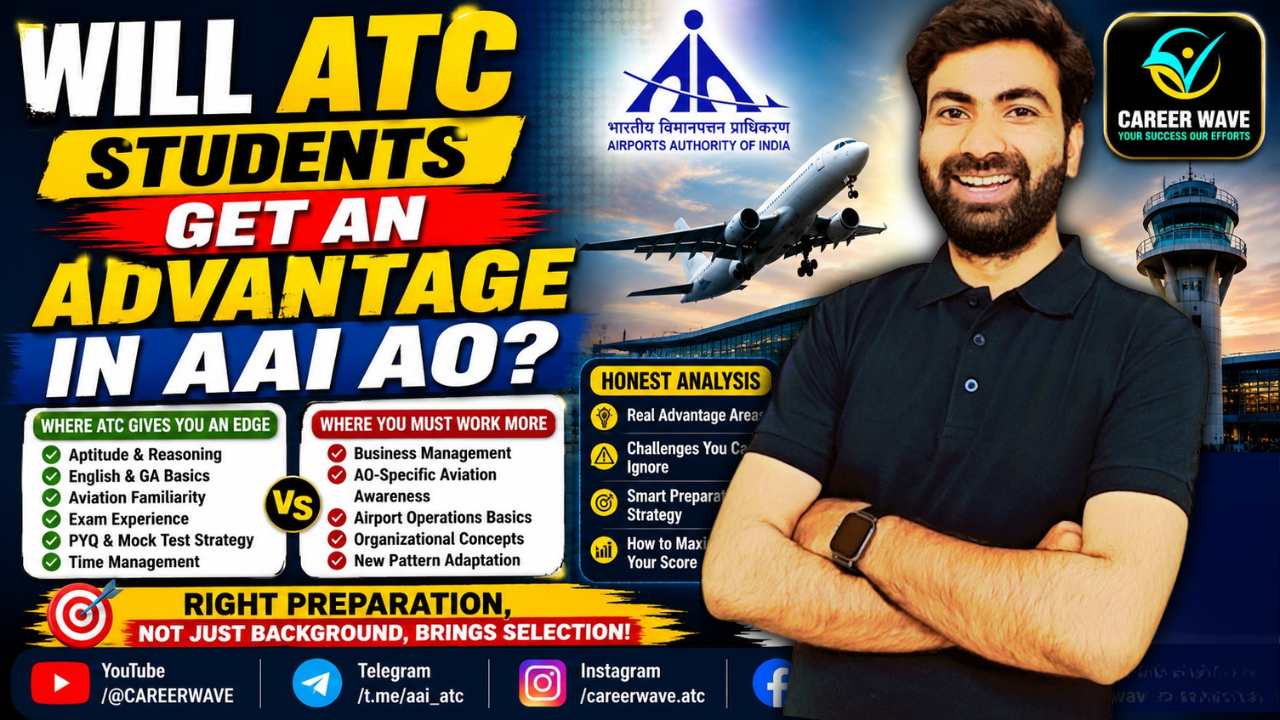
Will AAI ATC preparation give you
an advantage in AAI JE Airport Operations? Understand the syllabus overlap,
benefits in Reasoning, Aptitude, English and Aviation, challenges in Business
Management, and the right AO preparation strategy with Career Wave and
Satyendra Sir.
Will ATC Students Get an Advantage in AAI AO?
Honest Analysis
If you are
already preparing for AAI Junior Executive Air Traffic Control (ATC) and
are now considering AAI Junior Executive Airport Operations (AO), one
question naturally comes to mind:
“Will my ATC
preparation give me an advantage in AAI AO?”
The answer
is:
Yes, ATC
aspirants can have a useful head start—but it is not an automatic selection
advantage.
Your
existing preparation may help in overlapping areas such as aptitude, reasoning,
English, general awareness, exam temperament and familiarity with the aviation
environment. But AAI AO is a separate recruitment with its own syllabus
priorities and preparation requirements.
At Career
Wave, Satyendra Sir recommends that ATC students use their existing
preparation as a foundation, but not make the mistake of treating AO as simply
another ATC paper.
Let us understand where ATC
preparation helps, where it does not, and how an ATC aspirant should modify the
strategy for AAI AO.
ATC vs AO: First Understand the Difference
Both
recruitments are associated with the Airports Authority of India, but
the nature of the posts is different.
ATC is centered on air traffic control and safe, orderly management
of aircraft movements within the applicable operational framework.
Airport
Operations is associated with the broader
operational functioning and coordination of an airport.
Therefore:
Same
Organization ≠ Same Job
and
Some
Preparation Overlap ≠ Same Exam Preparation
This distinction should remain
clear from Day 1.
Where ATC Students Can Have an Advantage
1. You
Already Understand the AAI Exam Environment
An ATC
aspirant who has been preparing seriously is already familiar with AAI as an
organization and with competitive examination preparation.
You may
already understand:
·
How AAI
recruitments work
·
Importance
of official notifications
·
Computer-based
examination practice
·
PYQ analysis
·
Sectional
preparation
·
Mock-test
strategy
·
Time
management
A completely
new aspirant has to develop these habits from scratch.
An
experienced ATC aspirant may already have them.
That is a genuine advantage.
2. Your
Aptitude Preparation Can Help
ATC
preparation generally requires considerable quantitative and analytical
practice.
If you have
already developed good command over relevant aptitude concepts, you may not
need to begin those areas from zero for AO.
Your
existing skills in:
·
Basic
calculations
·
Percentages
·
Ratio and
proportion
·
Average
·
Profit and
loss
·
Time and
work
·
Time, speed
and distance
·
Numerical
interpretation
can help
wherever these concepts overlap with the applicable AO syllabus.
However, do not assume complete
overlap. Compare the current AO syllabus topic by topic.
3. Reasoning
Can Become a Strong Area
ATC students
who have already practised Reasoning regularly may have an advantage in:
·
Coding-decoding
·
Series
·
Analogy
·
Classification
·
Direction
sense
·
Blood
relations
·
Ranking
·
Syllogism
·
Logical
reasoning
·
Puzzles and
arrangements
The biggest
advantage is not merely knowing these topics.
It is pattern
recognition.
A beginner
may need one or two minutes to understand what a question is asking. An
experienced candidate may recognize the pattern almost immediately.
That saves time.
4. English
Preparation Can Carry Forward
If your ATC
preparation has already strengthened:
·
Grammar
·
Vocabulary
·
Reading
comprehension
·
Sentence
correction
·
Usage
·
Verbal
ability
then this
foundation can support your AO preparation wherever the syllabus overlaps.
Do not
unnecessarily restart basic English from Chapter 1 if your fundamentals are
already strong.
Instead:
Test
Yourself → Identify Weak Areas → Revise Selectively → Practise Exam-Level
Questions
This saves preparation time.
5. General
Awareness Preparation May Help
An ATC
aspirant may already follow:
·
Current
affairs
·
Static GK
·
AAI-related
developments
·
Aviation
news
·
Government
developments
This creates
useful continuity.
However, AO
preparation may require you to reorganize your General Awareness according to
its own examination requirements.
Do not
continue studying GA only because it was part of your ATC routine.
Make sure your preparation
matches the AO syllabus and question pattern.
6. Aviation
Familiarity Can Be a Major Head Start
This can be
one of the most useful advantages.
A serious
ATC aspirant is unlikely to find terms such as these completely unfamiliar:
·
AAI
·
DGCA
·
ICAO
·
IATA
·
Airports
·
Runways
·
Air traffic
·
Aviation
regulations
·
Air
navigation
·
Indian
aviation sector
A candidate
entering aviation preparation for the first time may initially spend
significant time simply becoming comfortable with this terminology.
ATC students
may already have the context.
But this
creates an important warning:
Familiarity
is not the same as exam-ready Aviation Awareness.
You still need AO-specific
preparation.
7. ATC
Students Already Understand the Value of PYQs
Experienced
AAI aspirants usually understand that random practice is not enough.
PYQs tell
you:
·
Actual
question level
·
Important
concepts
·
Question
framing
·
Repeated
areas
·
Required
depth
·
Examination
mindset
This habit
can be carried directly into AO preparation.
At Career
Wave, Satyendra Sir strongly emphasizes PYQ-based preparation
because it prevents students from studying unlimited material without knowing
whether it is relevant.
AAI PYQs & E-Books:
Career
Wave AAI PYQs
But Here Is the Problem: ATC Preparation Is
Not Enough
This is
where some ATC students can actually lose their advantage.
They think:
“I have
already prepared for AAI ATC. AO should be manageable automatically.”
That mindset
can create overconfidence.
Your
existing preparation helps only in areas that genuinely overlap.
For everything else, you are
still a learner.
Business Management Can Be a New Challenge
For many ATC
aspirants—especially those from Physics, Mathematics or Engineering-oriented
preparation—Business Management concepts may be relatively unfamiliar.
Depending on
the applicable AO syllabus, preparation may require understanding areas such
as:
·
Business
concepts
·
Management
principles
·
Forms of
business organization
·
Planning
·
Organizing
·
Staffing
·
Directing
·
Controlling
·
Business
environment
·
Management
functions
·
Organizational
concepts
An MBA or
management-background candidate may already recognize many of these concepts.
An ATC
candidate may need to learn them systematically.
This is one area where your
previous ATC preparation may offer little direct advantage.
Aviation Awareness Is Not the Same as ATC
Technical Knowledge
This
distinction is important.
ATC
preparation can expose you to aviation concepts, but AO Aviation Awareness can
involve a broader airport-oriented perspective.
You may need
to cover:
·
Airport
infrastructure
·
Airport
terminology
·
Aviation
organizations
·
Airport
codes
·
Civil
aviation ecosystem
·
Airport
operations basics
·
AAI-related
information
·
Aviation
current affairs
·
Regulatory
organizations
Therefore,
do not say:
“I know ATC,
so Aviation Awareness is already complete.”
Check the AO syllabus separately.
Physics and Mathematics May Not Give the Same
Advantage
For ATC
preparation, Physics and Mathematics can require significant attention.
An ATC
aspirant may have invested hundreds of hours in technical preparation.
That
knowledge is valuable, but you should not assume every technical area will
carry equal weight or relevance in Airport Operations preparation.
This creates
an important strategic change.
For ATC:
Technical
Strength can be central.
For AO:
Your
preparation must follow the AO-specific subject distribution and syllabus.
Do not continue spending most of
your time on your strongest ATC subjects simply because they are comfortable.
ATC Students Can Suffer from “Old Preparation
Bias”
This happens
when a candidate keeps studying what they already know.
For example:
You are
strong in Reasoning.
So you keep
practising Reasoning.
You are
comfortable with Aptitude.
So you keep
solving Aptitude.
But Business
Management and Aviation Awareness remain weak.
After a few
weeks, you feel productive because you have solved hundreds of questions.
Yet your
actual AO readiness has barely improved.
This is comfort-zone
preparation.
A better
approach is:
Maintain Strong Subjects + Invest
Heavily in AO-Specific Weak Areas
ATC Aspirant vs Fresh AO Aspirant
Consider two
candidates.
Candidate A:
ATC Aspirant
Already
strong in:
·
Aptitude
·
Reasoning
·
English
·
Test-taking
·
Some
aviation familiarity
But weak in:
·
Business
Management
·
AO-specific
Aviation Awareness
Candidate B:
New AO Aspirant with Management Background
May already
be comfortable with:
·
Business
Management
·
Organizational
concepts
But may need
more work in:
·
Aptitude
·
Reasoning
·
Aviation
·
Competitive-exam
speed
Who has the
advantage?
Neither
automatically.
The candidate who identifies gaps
faster and prepares according to the actual AO examination will ultimately have
the stronger position.
The Real Advantage of ATC Students:
Preparation Maturity
The biggest
advantage may not be any individual subject.
It may be exam
maturity.
A serious
ATC aspirant has probably already experienced:
·
Syllabus
pressure
·
Mock-score
fluctuations
·
Time-management
problems
·
Revision
cycles
·
PYQ practice
·
Accuracy
issues
·
Exam anxiety
·
Mistake
analysis
You already
know that completing lectures does not guarantee selection.
You
understand the importance of converting preparation into marks.
That experience can make your AO
preparation more efficient.
How Should ATC Students Prepare for AAI AO?
Do not
restart everything.
Use a Gap-Based
Strategy.
Step 1:
Compare Both Syllabi
Take the ATC
preparation you have already completed and compare it with the AO syllabus.
Mark every
topic as:
Strong |
Needs Revision | New
Step 2: Test
Your Overlapping Subjects
Give a
sectional test in Reasoning, English, Aptitude and other overlapping areas.
Do not
assume you are strong.
Verify it
through scores.
Step 3:
Prioritize New AO Areas
Give
significant attention to areas that were not part of your ATC preparation.
Step 4:
Build Aviation Awareness Separately
Use your
existing aviation familiarity as a foundation, but prepare AO-specific topics
systematically.
Step 5:
Start AO PYQs
Do not
depend only on ATC PYQs.
Understand
the question level relevant to Airport Operations.
Step 6: Move
to AO-Specific Mocks
Eventually, your preparation must
be measured through the actual AO paper structure rather than your ATC
performance.
A Smart Time Allocation Model
Suppose an
ATC student already has strong Reasoning, English and Aptitude.
Then
spending equal time on every subject may be inefficient.
A better
approach is to allocate more time to:
New Topics +
Weak Topics
and less—but
regular—time to:
Already
Strong Topics
For example:
Strong
Subject → Revision + Tests
Average
Subject → Practice + Revision
New Subject
→ Concept + Notes + MCQs + Revision
This is more efficient than
starting every subject from zero.
Don't Stop ATC Preparation Blindly
If you are
preparing for both ATC and Airport Operations, avoid making sudden decisions
without considering:
·
Recruitment
timelines
·
Your
eligibility
·
Your current
ATC preparation level
·
AO syllabus
requirements
·
Available
preparation time
·
Your career
preference
There can be
useful overlap between preparations, but each exam needs its own priority plan.
Create a combined timetable
rather than switching randomly between subjects.
Can ATC Students Prepare for AO in Less Time?
Potentially,
yes—if their overlapping subjects are genuinely strong.
An ATC
aspirant may save time because some fundamentals, practice habits and
examination skills are already developed.
But there is
no universal shortcut.
If your ATC
preparation itself is weak, simply calling yourself an “ATC aspirant” does not
create an advantage.
The real advantage comes from work
already completed, not from the exam name you previously prepared for.
Don't Underestimate AO Because You Prepared
ATC
This is
perhaps the most important warning.
Students
sometimes rank examinations mentally:
“ATC is
technical, so AO must be easier.”
That is not
a useful way to think about competitive recruitment.
An
examination can have simpler individual questions and still have difficult
selection because of:
·
High
competition
·
Limited
vacancies
·
High
attempts
·
Strong
candidates
·
Tight score
differences
Your
objective is not to decide which exam “looks easier.”
Your objective is to score high
enough for selection.
Career Wave Strategy for ATC Students
Targeting AAI AO
At Career
Wave, Satyendra Sir recommends a simple transition model:
Reuse →
Revise → Add → Test
Reuse
Carry
forward strong overlapping concepts.
Revise
Refresh
subjects you have already prepared.
Add
Learn
AO-specific topics such as Business Management and dedicated Aviation Awareness
areas.
Test
Measure
everything through AO-specific sectional and full-length tests.
This prevents unnecessary
repetition while ensuring that new AO requirements are not ignored.
Final Verdict: Will ATC Students Have an
Advantage?
Yes—but only
a conditional advantage.
ATC students
can have a head start because they may already possess:
·
Competitive-exam
experience
·
Reasoning
practice
·
Aptitude
preparation
·
English
preparation
·
General
Awareness habits
·
Aviation
familiarity
·
PYQ
experience
·
Mock-test
discipline
But that
advantage disappears if they:
·
Ignore
Business Management
·
Underprepare
Aviation Awareness
·
Assume ATC
and AO have the same syllabus
·
Keep
studying only comfortable subjects
·
Avoid
AO-specific PYQs
·
Become
overconfident
So the
correct equation is:
ATC
Preparation + AO-Specific Preparation = Real Advantage
Not:
ATC
Preparation = Automatic AO Selection
As Satyendra Sir at Career
Wave emphasizes, use your previous preparation as a foundation—but respect
the new examination enough to prepare for its unique demands.
Frequently Asked Questions
1. Will ATC
preparation help in AAI JE Airport Operations?
Yes, it can help in overlapping
subjects, competitive-exam skills and general aviation familiarity. However,
AO-specific topics still require separate preparation.
2. Can an
ATC aspirant crack AAI AO easily?
Previous preparation can provide
a head start, but selection is not automatic. Your AO-specific syllabus
coverage, accuracy, mocks and competitive score remain important.
3. Do I need
to study Reasoning again if I prepared it for ATC?
If your concepts and scores are
already strong, focus more on revision, timed practice and AO-level questions
rather than restarting the subject completely.
4. Is
Aviation Awareness already covered through ATC preparation?
Not necessarily. ATC familiarity
can help, but AO Aviation Awareness should be prepared according to its own
syllabus and exam requirements.
5. Is
Business Management important for ATC students preparing for AO?
If Business Management is part of
the applicable AO syllabus, ATC students without a management background should
treat it as a new subject and prepare it systematically.
6. Should
ATC students solve AO-specific PYQs?
Yes. ATC PYQs cannot fully
substitute for questions relevant to Airport Operations. AO-focused question
analysis helps you understand the required level and pattern.
7. Can I
prepare for AAI ATC and AO together?
There can be useful overlap, but
you need a structured plan that separates common subjects from exam-specific
subjects.
8. Do ATC
students have an advantage over MBA candidates?
Not automatically. ATC aspirants
may be stronger in some competitive-exam areas, while MBA candidates may have
greater familiarity with management concepts. Final performance depends on
complete preparation.
9. What is
the biggest advantage ATC students have?
For serious ATC aspirants, the
biggest advantage can be preparation maturity—experience with PYQs, mocks,
revision, time management and competitive examination pressure.
10. What
should an ATC student study first for AAI AO?
First compare the two syllabi.
Test your overlapping subjects and then prioritize AO-specific gaps rather than
restarting everything.
11. Where
can I get AAI PYQs?
You can access AAI-oriented
resources through:
Career Wave PYQs & E-Books
12. Where
can I follow AAI AO preparation?
Follow Career
Wave and Satyendra Sir for AAI-focused preparation, PYQs, Aviation
Awareness, exam strategy and updates.
Connect with Career Wave
YouTube: Career Wave YouTube
Channel
Telegram: Career Wave AAI Telegram
Instagram: Career
Wave Instagram
Facebook: Career Wave
Facebook
AAI PYQs: Career Wave PYQs &
E-Books
Career Wave — AAI Exam Preparation with Satyendra Sir
Leave a Comment
20-Aug-2026 04:36 PM
Will AAI ATC preparation give you an advantage in AAI JE Airport Operations? Understand the syllabus overlap, benefits in Reasoning, Aptitude, English and Aviation, challenges...
19-Aug-2026 12:04 PM
Is MBA compulsory for AAI JE Airport Operations? Understand the eligibility criteria for B.Sc. + MBA and Engineering candidates, MBA mode requirements, qualification routes and...
18-Aug-2026 06:21 PM
Can B.Sc + MBA candidates apply for AAI JE Airport Operations 2026? Understand eligibility, qualification requirements, career opportunities, Aviation Awareness, Business Management, PYQs and smart...
17-Aug-2026 02:39 PM
Preparing Aviation Awareness for AAI AO 2026? Learn the complete smart strategy for AAI, DGCA, ICAO, IATA, airport codes, aviation terminology, aircraft basics, current affairs,...
15-Aug-2026 01:18 PM
Confused between AAI Airport Operations and private airport jobs? Compare job security, salary, career growth, work pressure, shifts, recruitment, benefits and long-term opportunities. Career Wave...
14-Aug-2026 01:31 PM
AAI AO has no negative marking, but your score may still remain stuck. Understand why high attempts do not guarantee high marks and how accuracy,...
