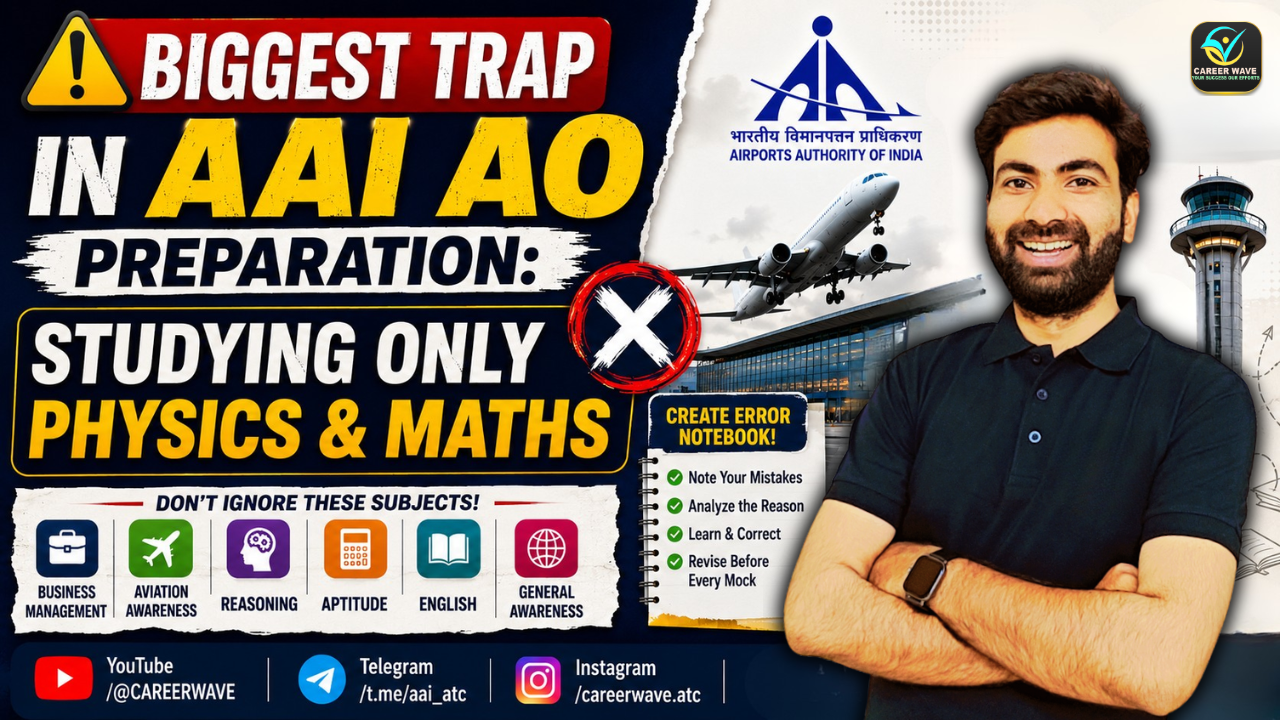
Are you preparing for AAI JE Airport Operations by focusing only on Physics and Maths? Understand why ignoring Business Management, Aviation Awareness, Reasoning, English, Aptitude and GA can hurt your overall score. Learn a
balanced AAI AO 2026 preparation strategy with Career Wave and Satyendra Sir.
Biggest Trap in
AAI AO Preparation: Studying Only Physics and Maths
AAI aspirants often make one preparation mistake without realizing how
costly it can become:
They continue preparing for AAI JE Airport Operations (AO) with the
mindset of an ATC aspirant.
Because many students come from Physics, Mathematics, Engineering or
AAI ATC preparation backgrounds, they naturally spend most of their study time
on Physics and Maths.
These subjects may feel familiar. Solving numerical questions creates a
sense of progress. You may already have notes, formulas and practice material.
But there is a problem:
AAI AO is not an exam where you should build your entire preparation
around only Physics and Maths.
If your preparation ignores or underestimates Business Management,
Aviation Awareness, General Awareness, Reasoning, Aptitude and English, you
can create serious gaps in your overall score.
At Career Wave, Satyendra Sir repeatedly emphasizes one
principle:
Prepare according to the exam you are going to appear for—not according
to the subjects you enjoy studying most.
This
article explains why studying only Physics and Maths can become one of the
biggest traps in AAI AO preparation and how to build a more balanced strategy.
Why Do Students
Fall Into the Physics-Maths Trap?
The reason is simple: comfort zone.
Many AAI aspirants have already spent months preparing technical
subjects. They know how to:
·
Revise formulas
·
Solve numerical problems
·
Practise chapter-wise MCQs
·
Attempt Physics and Maths PYQs
·
Analyse calculation mistakes
When they start AAI AO preparation, continuing the same routine feels
easy.
Meanwhile, subjects such as Business Management and Aviation
Awareness may be completely new.
The natural reaction is:
“I will complete Physics and Maths properly first. I will study the
other subjects later.”
That
“later” is where the problem begins.
1. AAI AO
Requires a Different Preparation Mindset
The first thing every candidate should understand is:
AAI ATC preparation and AAI Airport Operations preparation are not
identical.
Even where subjects or concepts overlap, the complete preparation
requirements are different.
Therefore, your first task should not be opening your old Physics
notebook.
Your first task should be:
Official Syllabus → Exam
Pattern → Subject Analysis → Preparation Plan
Only
then should you decide how much time each subject deserves.
2. Your Favourite
Subject Is Not Automatically Your Most Important Subject
Suppose you are excellent in Physics.
You study it for three hours every day because you enjoy solving
numerical problems.
But your Aviation Awareness remains weak.
Your Business Management preparation has barely started.
Your General Awareness revision is irregular.
Are those three hours giving you the maximum possible improvement in
your overall AO score?
Probably not.
Once you are already strong in a subject, additional study often
produces smaller improvements.
Meanwhile, improving a weak subject from poor to moderate can produce a
much bigger gain.
Your preparation should therefore follow:
Score Potential + Weakness + Exam Requirement
not simply:
Favourite
Subject + Comfort Zone
3. Physics and
Maths Can Create a False Sense of Preparation
Technical subjects give visible progress.
You complete:
Chapter 1 →
Chapter 2 → Formula Sheet → 100 MCQs → PYQs
It feels measurable.
Subjects such as Aviation Awareness or General Awareness may feel less
structured because they involve factual knowledge, terminology and revision.
Business Management may initially seem theoretical.
As a result, students keep returning to Physics and Maths because those
subjects make them feel productive.
But the real question is not:
“How many hours did I study today?”
It is:
“Did
today's study improve my total AAI AO score?”
4. Business
Management Can Become a Major Weakness
For candidates coming from Physics, Mathematics or Engineering
backgrounds, Business Management may initially look easy because the concepts
appear theoretical.
That assumption can be dangerous.
Objective questions can test:
·
Definitions
·
Principles
·
Features
·
Functions
·
Differences
·
Applications
·
Business situations
·
Statement-based concepts
·
Similar terminology
Knowing a definition approximately is often not enough.
You need enough conceptual clarity to distinguish between closely
related options.
At Career Wave, Satyendra Sir recommends studying Business
Management in the same systematic manner as a technical subject:
Concept
→ Short Notes → MCQs →
Revision → Tests
5. Aviation
Awareness Should Not Be Left for the Final Week
Another common statement is:
“Aviation is GK. I will memorize it near the exam.”
This is poor planning.
Aviation Awareness can include multiple layers of preparation, such as:
·
AAI
·
Indian civil aviation ecosystem
·
DGCA
·
BCAS
·
ICAO
·
IATA
·
Airports
·
Airport terminology
·
Runway and taxiway basics
·
Aviation abbreviations
·
Airport codes
·
Aviation-related current affairs
·
Important aviation organizations
Trying to absorb all of this at the end creates information overload.
A better approach is:
Study
Small → Revise Frequently → Practise MCQs → Repeat
6. Being an ATC
Aspirant Can Actually Increase This Risk
Students who have already prepared for AAI ATC can have a useful
advantage in AO.
They may already be strong in:
·
Physics
·
Mathematics
·
Reasoning
·
Aptitude
·
English
·
General competitive-exam skills
·
Some aviation-related awareness
But that previous preparation can also create old preparation bias.
The student continues doing what worked for ATC instead of identifying
what is new for AO.
The correct strategy is:
Carry Forward Strong Areas + Add AO-Specific Areas
not:
Repeat
Complete ATC Preparation and Hope It Covers AO
7. Business
Management Needs Early Preparation
If Business Management is new for you, start it early.
Do not wait until Physics and Maths are “completely finished.”
Competitive-exam preparation is rarely completed subject by subject in
a perfectly linear manner.
Use parallel preparation.
For example:
Physics/Maths Revision + Business Management Learning + Aviation
Awareness Revision + Non-Technical Practice
This
keeps your preparation balanced.
8. Aviation
Awareness Requires Repeated Revision
Suppose you learn 50 aviation facts today.
After three weeks without revision, how many will you remember
accurately?
Probably much fewer.
This is why factual subjects require spaced revision.
A useful cycle can be:
Day 1 →
Learn
Day 3 or 4 →
Quick Revision
Day 7 → MCQ
Revision
Later →
Mixed Test
The exact interval can vary, but the principle is important:
Aviation
Awareness cannot be prepared effectively through one-time reading.
9. Don't Ignore
Reasoning Because It Looks Easy
Many students think:
“Reasoning is easy. I will manage it in the exam.”
But there is a difference between:
Being able to solve a question
and
Being able to solve it quickly and accurately.
Reasoning requires practice for:
·
Pattern recognition
·
Question selection
·
Speed
·
Accuracy
·
Avoiding traps
·
Managing lengthy puzzles
If you have already prepared Reasoning well, maintain it through
sectional tests and mixed practice.
If
not, start now.
10. Aptitude
Needs Speed, Not Just Knowledge
The same applies to aptitude.
You may know percentage, ratio or average.
But can you solve an exam-level question efficiently?
Competitive exams test your ability to apply concepts under time
pressure.
Therefore:
Concept Knowledge + Calculation Speed + Question Selection = Exam
Performance
Do
not completely stop aptitude practice simply because you have completed its
lectures.
11. English Is
Often Underestimated
English can become another neglected area.
Students frequently assume that because they can read English, they do
not need structured preparation.
But objective English questions may test:
·
Grammar
·
Vocabulary
·
Usage
·
Sentence correction
·
Reading comprehension
·
Context
·
Error detection
·
Verbal ability
If
English is part of your applicable exam syllabus, prepare it as a scoring
subject rather than treating it casually.
12. General
Awareness Cannot Be Built Overnight
General Awareness has the same problem as Aviation Awareness.
It needs continuity.
Trying to cover months of relevant current affairs and static areas
immediately before the examination can become overwhelming.
A better system is:
Daily/Weekly Coverage →
Short Notes → Monthly Revision → MCQs
Keep the material filtered.
You do not need to memorize every news story.
You
need exam-relevant information.
13. Don't
Allocate Time Equally Either
Balanced preparation does not mean:
One hour for every subject regardless of your ability.
That is also inefficient.
Your time allocation should depend on three factors:
1. Exam Importance
How relevant is the subject according to the applicable pattern?
2. Current Strength
How well can you already perform?
3. Improvement Potential
How many additional marks can focused study realistically produce?
This
creates a much smarter timetable
14. Use the
Strong-Average-Weak Method
Classify every subject into three categories.
Strong
You consistently perform well in tests.
Strategy: Revision + PYQs + Tests
Average
You know concepts but make mistakes.
Strategy: Practice + Error Analysis + Revision
Weak/New
You lack conceptual clarity or have barely started.
Strategy: Concepts + Notes + Topic MCQs + Frequent Revision
For many ATC-background candidates, Physics and Maths may already be
strong.
If
so, they should not continue consuming the majority of preparation time.
15. Measure
Subjects Through Tests, Not Confidence
Students often say:
“My Maths is strong.”
How do you know?
Your confidence is not a reliable measurement.
Use:
Sectional Tests + PYQs + Timed Practice
If you consistently score well with good accuracy and time management,
then the subject is genuinely strong.
That
allows you to reduce study time and redirect it toward weaker areas.
16. PYQs Should
Guide Your Preparation
Previous Year Questions help you understand:
·
Question standard
·
Topic importance
·
Question framing
·
Conceptual depth
·
Repeated patterns
·
Areas requiring more practice
Without PYQ analysis, students often either over-study or under-study a
subject.
At Career Wave, PYQ analysis is treated as an important part of
AAI preparation because it helps candidates understand what exam-level
preparation actually looks like.
Access AAI resources here:
Career
Wave AAI PYQs & E-Books
17. Stop Counting
Only Study Hours
Imagine two students.
Student A
Studies Physics and Maths for 6 hours.
Both are already strong subjects.
Student B
Spends:
·
1.5 hours on a strong subject
·
2 hours on Business Management
·
1 hour on Aviation Awareness
·
1 hour on Reasoning/Aptitude
·
30 minutes analysing mistakes
Who used the preparation day more effectively?
The answer depends on their individual weaknesses, but Student B's
approach demonstrates an important principle:
Study
time should be allocated according to score improvement—not habit.
18. Build a Daily
Mixed Preparation System
Instead of studying only one subject for an entire day, create a
balanced system.
A sample structure could be:
Block 1 — New/Weak Subject
Business Management or Aviation Awareness
Block 2 — Technical/Strong Subject
Physics or Mathematics
Block 3 — Practice Subject
Reasoning or Aptitude
Block 4 — Revision
Aviation, GA, English or Business Management
Block 5 — MCQs/Test
Mixed or sectional practice
This
ensures that weak subjects receive regular attention without completely
abandoning your strengths.
19. Weekly Tests
Will Expose the Reality
Your weekly test should answer:
Which subject is actually reducing my score?
If Physics is consistently strong but Business Management is weak, your
next week's schedule should reflect that.
Preparation should be dynamic.
Use this cycle:
Test → Analyse → Reallocate Time → Study → Retest
This
is far more effective than following the same timetable for months.
20. Create an
Error Notebook for Every Subject
Do not maintain mistake records only for numerical subjects.
Your error notebook can contain:
Physics
Formula or conceptual mistake
Mathematics
Calculation or method error
Aptitude
Formula, calculation, shortcut or time-management error
Business Management
Confused definitions or principles
Aviation Awareness
Incorrect organization, code or terminology
Reasoning
Pattern-recognition error
English
Grammar or vocabulary error
GA
Incorrect fact or outdated information
Before
every mock, revise these recurring errors.
21. What Happens
If You Ignore Non-Technical Subjects?
You may reach the examination with excellent technical confidence but
incomplete overall preparation.
Then the paper starts.
You solve familiar questions comfortably.
But when Business Management, Aviation Awareness or other weaker areas
appear, your confidence falls.
You start guessing.
You spend unnecessary time.
Your accuracy becomes unstable.
This
is exactly why balanced preparation should begin before the
examination—not after your first disappointing mock.
22. The Real
Competition Is Total Score
AAI does not select candidates because they are excellent only in
Physics.
It does not select candidates because they solved the most difficult
Maths question.
Competitive selection ultimately depends on performance according to
the applicable recruitment process.
Therefore, your preparation objective should be:
Maximum Overall Competitive Score
not:
Maximum Mastery of My Favourite Subject
This
mindset changes everything.
23. A Better
Strategy for Physics and Maths Students
If Physics and Maths are already your strengths:
Don't abandon them. Maintain them.
Use:
·
Formula revision
·
Selected PYQs
·
Sectional tests
·
Error revision
·
Mixed MCQs
But use the time saved to strengthen:
Business Management + Aviation Awareness + Other Weak Sections
Your
strong subjects should become your score foundation, not your time-consuming
comfort zone.
24. 30-Day
Balanced Preparation Approach
As the examination approaches, your preparation should gradually become
more test-oriented.
Days 1–10
Complete major weak concepts and revise strong subjects.
Days 11–20
Increase sectional tests, PYQs and mixed practice.
Days 21–25
Increase full mocks and targeted revision.
Days 26–30
Focus heavily on:
·
Short notes
·
Error notebook
·
Important formulas
·
Business Management concepts
·
Aviation facts
·
Current revision
·
Mock mistakes
Avoid
continuously adding large new resources at the end.
Biggest Warning
for AAI AO Aspirants
If you are studying four hours of Physics and Maths every day but
continuously postponing Business Management and Aviation Awareness, ask
yourself:
“Am I preparing for AAI AO—or am I simply repeating the preparation I
already know?”
That
question can save weeks of ineffective study.
Career Wave
Strategy for AAI AO
At Career Wave, Satyendra Sir recommends this preparation
cycle:
Understand Pattern →
Identify Strengths →
Prioritize Weaknesses →
Study Concepts →
Solve PYQs → Take Tests → Analyse Errors → Revise
For candidates coming from ATC or technical backgrounds:
Physics & Maths Strength + AO-Specific Preparation = Better Overall
Readiness
Your existing preparation should save time.
It
should not prevent you from learning new subjects.
Final Takeaway
The biggest trap in AAI JE Airport Operations preparation is not
studying Physics and Maths.
The trap is studying only Physics and Maths because they are
comfortable while ignoring subjects that can decide your overall score.
Physics and Maths can remain valuable strengths.
But AAI AO preparation should be approached as a complete
examination, not as an extension of your favourite technical subjects.
Remember:
Strong Subjects Protect Your Score.
Weak Subjects Limit Your Score.
Your strategy should do both:
Maintain strengths and eliminate weaknesses.
That
is the balanced approach Career Wave and Satyendra Sir recommend for
serious AAI AO aspirants.
Frequently Asked
Questions (FAQs)
1. Is studying only Physics and Maths enough for AAI JE Airport
Operations?
No.
Candidates should prepare according to the complete official syllabus and exam
pattern applicable to the recruitment, including relevant non-technical and
AO-specific areas.
2. Should ATC students continue preparing Physics and Maths for AO?
They
should retain and revise relevant overlapping strengths, but should not allow
those subjects to consume preparation time needed for new or weaker AO areas.
3. Why is Business Management important for AAI AO preparation?
If it
forms part of the applicable syllabus, Business Management needs systematic
preparation because objective questions can test definitions, principles,
functions, applications and closely related concepts.
4. Can Aviation Awareness be completed in the last week?
That
is risky. Aviation Awareness contains factual and conceptual information that
benefits from repeated revision and MCQ practice.
5. Should I completely stop studying Physics and Maths if they are
already strong?
No.
Maintain strong subjects through revision, PYQs and tests. Reduce unnecessary
repetitive study and use the saved time for weaker areas.
6. Which subjects should I prioritize first?
Prioritize
according to the official syllabus, your current test performance and your
weaknesses. New and low-scoring areas generally need more learning time.
7. How do I know whether a subject is genuinely strong?
Use
timed sectional tests and PYQs. Consistently high accuracy and reasonable
solving time are better indicators than confidence alone.
8. Are PYQs necessary for AAI AO preparation?
Yes.
PYQs and relevant previous exam questions help you understand question level,
patterns, important concepts and the depth of preparation required.
9. What should ATC students focus on while shifting to AO preparation?
Identify
overlapping areas first, maintain them efficiently and devote substantial
attention to AO-specific or previously unprepared subjects.
10. What is the best overall AAI AO strategy?
Use a
balanced approach:
Syllabus
→ Concepts → PYQs →
Topic MCQs → Sectional Tests → Full Mocks → Error Analysis →
Revision
Connect with
Career Wave
YouTube: Career Wave YouTube
Telegram: Career Wave AAI Telegram
Instagram: Career Wave Instagram
Facebook: Career Wave Facebook
AAI PYQs & E-Books: Career Wave
PYQs
Career Wave — AAI Exam Preparation with Satyendra Sir
Leave a Comment
21-Aug-2026 03:49 PM
Are you preparing for AAI JE Airport Operations by focusing only on Physics and Maths? Understand why ignoring Business Management, Aviation Awareness, Reasoning, English, Aptitude...
20-Aug-2026 04:36 PM
Will AAI ATC preparation give you an advantage in AAI JE Airport Operations? Understand the syllabus overlap, benefits in Reasoning, Aptitude, English and Aviation, challenges...
19-Aug-2026 12:04 PM
Is MBA compulsory for AAI JE Airport Operations? Understand the eligibility criteria for B.Sc. + MBA and Engineering candidates, MBA mode requirements, qualification routes and...
18-Aug-2026 06:21 PM
Can B.Sc + MBA candidates apply for AAI JE Airport Operations 2026? Understand eligibility, qualification requirements, career opportunities, Aviation Awareness, Business Management, PYQs and smart...
17-Aug-2026 02:39 PM
Preparing Aviation Awareness for AAI AO 2026? Learn the complete smart strategy for AAI, DGCA, ICAO, IATA, airport codes, aviation terminology, aircraft basics, current affairs,...
15-Aug-2026 01:18 PM
Confused between AAI Airport Operations and private airport jobs? Compare job security, salary, career growth, work pressure, shifts, recruitment, benefits and long-term opportunities. Career Wave...
