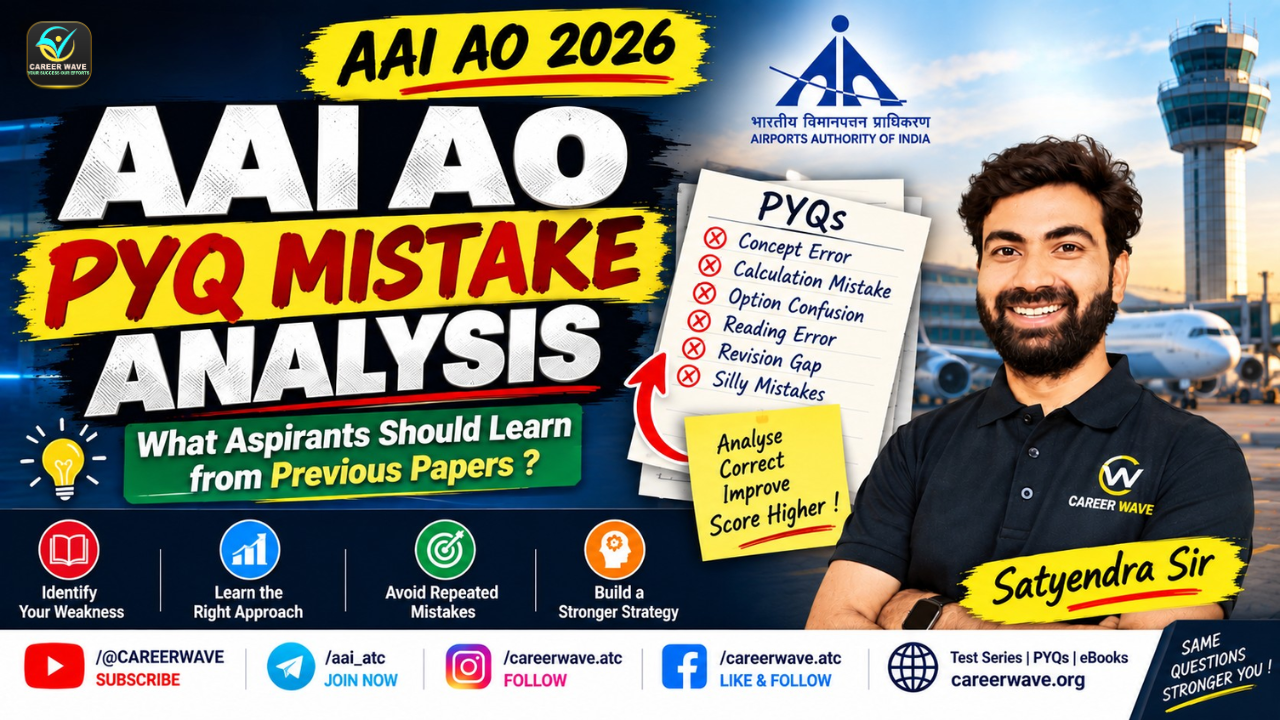
Learn how to analyse mistakes in
AAI AO PYQs and previous year papers. Identify concept errors, revision gaps,
calculation mistakes, option confusion and silly mistakes with Career Wave and
Satyendra Sir’s practical AAI AO 2026 preparation strategy.
AAI AO PYQ Mistake Analysis: What Aspirants
Should Learn from Previous Papers
Solving AAI
Junior Executive Airport Operations (AAI AO) Previous Year Questions is
important, but simply counting how many answers are correct is not enough.
The real
improvement starts when you analyse the questions you got wrong.
A wrong PYQ
can reveal a weak concept, poor revision, calculation problem, confusion
between similar terms, or even a habit of reading questions too quickly. If you
identify the actual reason behind the mistake, the same question can improve
several areas of your preparation.
At Career
Wave, Satyendra Sir recommends treating PYQs as a diagnostic tool:
Solve →
Check → Find the Mistake → Fix the Concept → Reattempt
For AAI AO aspirants, this
approach can turn previous papers into a highly effective preparation resource.
Why Is
Mistake Analysis Important in AAI AO PYQs?
Many
students follow this routine:
Solve
Question → Check Answer → Mark Wrong → Move to Next Question
This gives
you practice, but very little improvement.
A better
approach is:
Solve
Question → Check Answer → Understand Why You Were Wrong → Revise → Test
Yourself Again
The
difference is significant.
Your wrong
answers can reveal:
·
Concepts
that are still unclear
·
Facts that
require revision
·
Similar
terms that you confuse
·
Formulas you
forget
·
Calculation
mistakes
·
Poor
question-reading habits
·
Weak
elimination skills
·
Unnecessary
guessing
Instead of being disappointed by
mistakes, use them as data about your preparation.
What AAI AO
PYQs Can Teach You
1. Your Weak
Concepts
A question
may look difficult simply because the underlying concept is not clear.
Suppose you
repeatedly make mistakes from the same topic. The problem is probably not the
individual questions.
The topic
itself needs attention.
Do not solve
ten more questions immediately.
Go back to
the concept, understand it properly, and then return to the questions.
This is one
of the most important lessons students can learn from PYQ analysis.
2. Whether
You Actually Understand or Only Remember
Sometimes
students recognise a PYQ because they have seen it before.
That creates
false confidence.
Ask
yourself:
Could I
solve this question if the wording, values or options were changed?
If the
answer is no, you probably remember the question rather than understand the
concept.
Satyendra
Sir's approach at Career Wave is to focus on the concept behind the PYQ,
not just its correct option.
3. Which
Topics Need More Revision
Not every
wrong answer means that you never studied the topic.
Sometimes
you knew the answer a week ago but cannot recall it now.
That is a revision
problem.
These
mistakes tell you which topics need shorter revision intervals.
For example:
Day 1: Study
Day 3: Quick revision
Day 7: Reattempt questions
Day 15: Revision + mixed practice
The exact schedule can vary, but
repeated recall is more effective than reading a topic once and assuming it is
complete.
The 6 Major
Types of PYQ Mistakes
Every wrong
question should be classified.
1. Concept
Error
You did not
understand the concept required to answer the question.
Example: You know the terminology but cannot distinguish between two
closely related concepts.
What to do:
Return to the theory. Understand the concept before solving more questions
2. Memory or
Revision Error
You had
studied the answer earlier but could not recall it during practice.
What to do:
Add the fact or concept to your revision notes and revisit it periodically.
This does
not necessarily require relearning the entire chapter.
It requires
better retention.
3.
Calculation Error
You knew the
formula and method but still reached the wrong answer.
Common
causes include:
·
Arithmetic
mistakes
·
Incorrect
substitution
·
Unit errors
·
Sign errors
·
Wrong
conversion
·
Skipping
intermediate steps
What to do:
Solve similar numerical questions and identify exactly where your calculation
failed.
4.
Question-Reading Error
This is one
of the most avoidable categories.
Students
often miss words such as:
NOT
Incorrect
Except
Correct
Maximum
Minimum
You may know
the concept perfectly and still lose the question.
What to do:
Develop a habit of consciously identifying the instruction word before looking
at the options.
5. Option
Confusion
Sometimes
you eliminate two options but remain confused between the final two.
This is
valuable information.
It means
your knowledge is close, but not precise enough.
What to do:
Write down the exact difference between the two concepts or facts represented
by those options.
This can
turn a weak area into a scoring area.
6. Guessing
Error
Sometimes a
student has no clear basis for an answer but selects an option anyway.
During PYQ
practice, mark these questions separately—even if your guess happens to be
correct.
A guessed
correct answer should not automatically be treated as a mastered question.
Ask:
“Could I
explain why this option is correct?”
If not, revise it.
Correct
Answers Also Need Analysis
This is
often ignored.
Not every
correct answer represents strong preparation.
A correct
answer can come from:
·
Complete
knowledge
·
Partial
knowledge
·
Elimination
·
Guessing
·
Memory of
seeing the question earlier
Therefore,
classify your correct questions too.
Confident
Correct
You knew the
concept and could explain the answer.
Doubtful
Correct
You selected
the correct option but were confused.
Lucky
Correct
You guessed
and happened to get it right.
Only the
first category should be considered fully prepared.
This gives you a much more
accurate picture than your raw score.
Create an
AAI AO PYQ Mistake Notebook
Satyendra
Sir recommends maintaining a simple mistake notebook or error log.
You do not
need to copy complete questions every time.
Use a compact format:
|
Question/Topic |
Mistake
Type |
Why I Got
It Wrong |
What to
Revise |
|
Topic 1 |
Concept |
Concept
unclear |
Theory +
examples |
|
Topic 2 |
Revision |
Fact
forgotten |
Short
notes |
|
Topic 3 |
Calculation |
Wrong
conversion |
Numerical
practice |
|
Topic 4 |
Reading |
Missed
“NOT” |
Reading
discipline |
After several PYQs and mocks, this notebook becomes a personalised revision guide. Instead of revising everything equally, you can focus on what is actually costing you marks.
How to
Analyse an AAI AO Previous Paper Properly
After
completing a PYQ paper, do not immediately move to another one.
Follow this
process.
Step 1:
Check All Answers
Separate
questions into:
Correct |
Incorrect | Unattempted | Doubtful
Step 2:
Analyse Incorrect Questions
Identify the
exact reason for every error.
Step 3:
Review Doubtful Correct Answers
These are
hidden weaknesses.
Step 4:
Analyse Important Options
Understand
why close distractors are incorrect.
Step 5:
Revise the Underlying Concepts
Do not
memorise only the answer.
Step 6:
Reattempt Wrong Questions
Return to
them after revision.
If you still cannot solve them,
the concept needs further work.
Turn Every
Wrong PYQ into a Revision Topic
Suppose you
attempt 100 questions and get 25 wrong.
Do not
think:
“I made 25
mistakes.”
Think:
“I have
identified 25 opportunities to strengthen my preparation.”
Now classify
them.
Suppose the
analysis shows:
·
8 concept
errors
·
6 revision
errors
·
4
calculation errors
·
3 reading
errors
·
3
option-confusion errors
·
1 guessing
error
Your next
study plan is now obvious.
You do not
need random revision.
You need to
fix these specific weaknesses.
That is why mistake analysis can
make preparation more efficient.
PYQ Mistakes
Can Reveal Your Preparation Pattern
One wrong
answer does not always mean much.
Repeated
errors do.
If you
repeatedly make concept errors, your fundamentals require work.
If you
repeatedly make revision errors, your retention system needs
improvement.
If you
repeatedly make calculation errors, you need more numerical practice.
If you
repeatedly make reading errors, your exam discipline needs improvement.
If you
repeatedly get confused between two options, you need more precise conceptual
differentiation.
Look for the pattern behind
the mistakes, not just individual wrong answers.
When Should
You Reattempt Wrong PYQs?
Do not
immediately memorise the answer and solve the question again.
That only
tests short-term memory.
A better
method is:
Attempt →
Analyse → Revise → Leave a Gap → Reattempt
When you
return to the question later, try solving it without checking your previous
solution.
If you can now explain the
concept independently, the correction has worked.
Connect PYQ
Mistakes with Mock Tests
PYQs tell
you what has been asked previously.
Mock tests
check whether you can apply your preparation to fresh questions.
This makes
them a powerful combination.
For example,
if your PYQ analysis shows weakness in a particular area:
Revise Topic
→ Solve Related PYQs → Attempt Sectional Test → Check Improvement
If the same
mistake appears in the sectional test or full mock, the weakness has not yet
been resolved.
Career Wave
provides an AAI AO Test Series 2026 with full-length and sectional
practice.
AAI AO Test Series 2026 – Full Mock Tests + Sectional Tests
Where to
Practice AAI AO PYQs
Students
preparing for the AAI Junior Executive Airport Operations exam can check the
available AAI AO PYQs and eBooks on Career Wave.
AAI
AO PYQs and eBooks – Career Wave
While
practising, remember:
The
objective is not to finish PYQs quickly.
The objective is to understand
what every important question reveals about the exam and your preparation.
Common
Mistakes Students Make While Analysing PYQs
Avoid these
habits:
·
Checking
only the final answer
·
Memorising
option numbers
·
Ignoring
questions answered correctly through guessing
·
Not
analysing incorrect options
·
Solving the
same question immediately after seeing its solution
·
Repeating
papers without revising weak concepts
·
Not
recording repeated mistakes
·
Focusing
only on score
·
Attempting
more questions instead of correcting existing weaknesses
Practice creates data. Analysis
converts that data into improvement.
Satyendra
Sir’s AAI AO PYQ Mistake Strategy
At Career
Wave, the recommended approach can be summarised as:
Solve →
Classify → Analyse → Revise → Practice → Reattempt
After every
PYQ session, ask yourself three questions:
1. What did
I get wrong?
2. Why did I get it wrong?
3. What will I change so that it does not happen again?
The third
question is the most important.
Because
simply knowing your mistake does not improve your score.
Correcting the cause of the
mistake does.
FAQs –
1. Why
should I analyse wrong AAI AO PYQs?
Wrong PYQs identify weaknesses in
concepts, revision, calculations, reading and option selection. Analysing the
cause helps prevent similar mistakes in future questions.
2. Should I
maintain an error notebook for AAI AO?
Yes. A compact error notebook
helps track repeated weaknesses and creates a personalised revision list.
3. Should I
analyse questions that I answered correctly?
Yes, especially if you guessed or
were confused between options. A lucky correct answer can hide a weak concept.
4. What
should I do after getting a PYQ wrong?
Identify the reason, revise the
underlying concept, solve a few related questions and reattempt the PYQ after a
reasonable gap.
5. Where can
I get AAI AO previous year questions?
Available
AAI AO PYQs and eBook resources can be checked through Career Wave.
AAI
AO Previous Year Questions and eBooks
6. Is
solving more PYQs better than analysing mistakes?
Both matter, but simply
increasing question count without correcting repeated mistakes has limited
value. Quality of analysis is critical.
7. How can I
reduce silly mistakes in AAI AO?
Track reading, calculation and
option-selection errors separately. Once you know which type occurs repeatedly,
you can build a specific correction habit.
8. How are
mock tests useful after PYQ analysis?
Mock tests
introduce fresh questions and show whether the weaknesses identified through
PYQs have actually been corrected.
Practice with Career Wave AAI AO Test Series 2026
9. Should I
reattempt incorrect PYQs?
Yes. Reattempting them after
revision helps determine whether you have actually understood the concept or
merely remembered the solution.
10. What is
the best PYQ mistake-analysis method?
Use this
cycle:
Attempt → Check → Classify Error
→ Understand Cause → Revise → Practice → Reattempt
Prepare for
AAI AO with Career Wave
For AAI
AO PYQs, preparation strategies, mock tests, sectional tests, classes and exam
updates, students can stay connected with Career Wave and Satyendra Sir.
Career Wave
AAI Telegram Channel
Final
Takeaway
Your wrong
answers are not just lost marks during practice. They are indicators of exactly
what needs improvement.
Do not aim
only to solve more AAI AO PYQs.
Aim to repeat
fewer mistakes with every new paper.
Solve the PYQ. Find the reason. Fix the weakness. Test it again.
That is how previous year papers can become a powerful preparation tool for AAI AO aspirants with Career Wave and Satyendra Sir.
Leave a Comment
15-Sep-2026 05:42 PM
Prepare for IMD Scientific Assistant Physics 2026 with the Career Wave Complete Part-F Physics Test Series. Practice chapter-wise tests, mixed tests and full mock tests...
15-Sep-2026 12:29 PM
Learn how to analyse mistakes in AAI AO PYQs and previous year papers. Identify concept errors, revision gaps, calculation mistakes, option confusion and silly mistakes...
14-Sep-2026 01:55 PM
Confused between AAI AO PYQs and mock tests? Learn what to practice first, when to start full mocks, how to analyse mistakes, and the best...
12-Sep-2026 12:25 PM
Analyse AAI AO previous year papers to understand question patterns, difficulty level, important concepts, common mistakes, and the examiner’s approach. Learn the right PYQ preparation...
11-Sep-2026 03:21 PM
Prepare for AAI Junior Executive Airport Operations 2026 with AAI AO PYQs. Understand previous year question trends, important concepts, examiner approach, common mistakes, and the...
09-Sep-2026 12:05 PM
Learn the best AAI AO Full Mock Test Strategy 2026 to manage exam time effectively. Career Wave and Satyendra Sir explain section order, two-round attempt...
