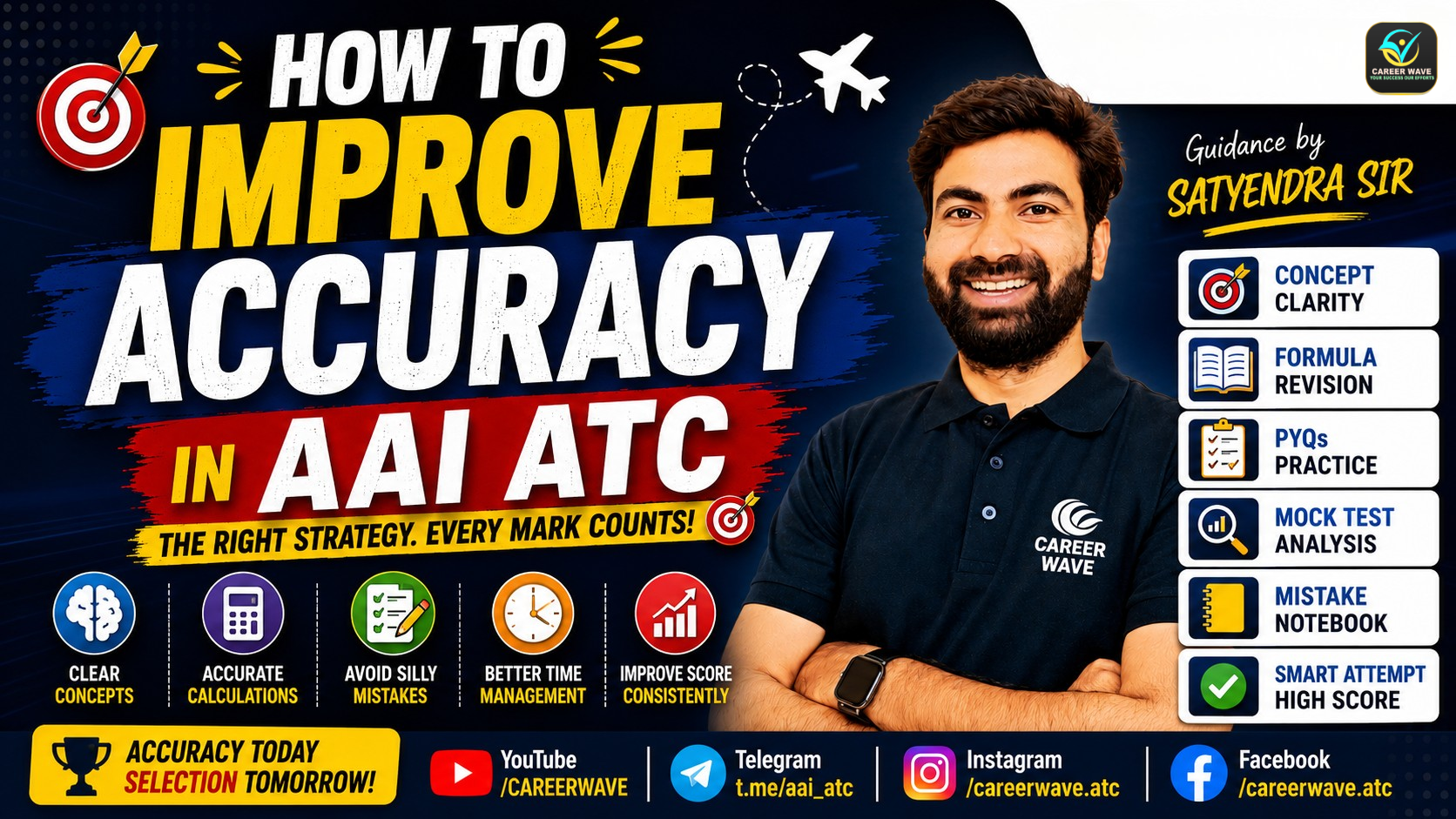
Learn
how to improve accuracy in the AAI ATC exam with concept clarity, formula
revision, PYQ practice, mock test analysis, mistake notebook strategy, and
guidance from Career Wave by Satyendra Sir.
How to Improve
Accuracy in AAI ATC
Accuracy is one of the most important factors in the AAI ATC exam. Many
students study well, attend classes, revise formulas, and attempt mocks, but
their score does not improve because they lose marks in avoidable mistakes.
In AAI ATC, selection is not only about how many questions you attempt.
It is about how many questions you solve correctly within the given time. A
student with better accuracy can often score higher than a student who attempts
more questions without control.
At Career
Wave, Satyendra Sir always guides students with one clear message: accuracy
is built through concept clarity, disciplined practice, mock analysis, and
mistake control.
Why Accuracy
Matters in AAI ATC
AAI ATC is a performance-based exam. You need knowledge, but you also
need the ability to apply that knowledge correctly under time pressure.
Good accuracy helps you:
• Save marks
• Reduce silly mistakes
• Improve confidence during the exam
• Attempt questions with better decision-making
• Avoid panic in difficult sections
• Increase final score without studying extra topics
Many
students think speed is everything. But speed without accuracy can damage your
result. First build accuracy, then increase speed.
Understand the
Difference Between Speed and Accuracy
Speed means solving questions quickly.
Accuracy means solving questions correctly.
Both are important, but accuracy should come first.
A common mistake students make is trying to solve every question fast
from the beginning. This leads to calculation errors, wrong option marking, and
poor reading of questions.
Better approach:
• First solve slowly but correctly
• Then reduce time gradually
• Then practice under mock test conditions
This
is the correct way to improve performance.
Common Reasons
for Low Accuracy in AAI ATC
Low accuracy usually happens because of these reasons:
• Weak concept clarity
• Poor formula revision
• Not reading the question properly
• Calculation mistakes
• Unit conversion errors
• Over-attempting doubtful questions
• Lack of mock test analysis
• Repeating the same mistakes
• Weak time management
• Panic during exam-like situations
If
you want to improve accuracy, first identify why your answers are going wrong.
Step 1: Analyze
Your Mistakes Properly
The first step to improving accuracy is mistake analysis. Do not just
check how many questions were wrong. Check why they were wrong.
Divide mistakes into categories:
• Concept mistake
• Formula mistake
• Calculation mistake
• Unit mistake
• Question reading mistake
• Wrong option marking
• Time pressure mistake
• Guessing mistake
Once you know the type of mistake, you can correct it easily.
At
Career Wave, Satyendra Sir always advises students to maintain a dedicated
mistake notebook. This notebook helps students track repeated mistakes and
avoid them in future tests.
Step 2: Build
Strong Concept Clarity
Accuracy cannot improve if concepts are weak. In Physics and
Mathematics, many students memorize formulas but do not understand where to
apply them.
For every topic, ask yourself:
• What is the concept?
• Which formula applies here?
• What are the conditions?
• What are the common traps?
• What type of PYQs come from this topic?
Do
not rush through chapters. Build clarity first, then practice questions.
Step 3: Revise Formulas Daily
Formula recall is very important for AAI ATC, especially in Physics and
Mathematics. If you remember formulas but confuse their application, accuracy
will drop.
Your formula revision should include:
• Formula
• Unit
• Condition of use
• Special case
• Related concept
• Common mistake
• One example question
Revise
formulas daily for 15–20 minutes. This small habit can improve both speed and
accuracy.
Step 4: Read the
Question Carefully
Many wrong answers happen because students do not read the question
properly. Words like “not correct,” “except,” “minimum,” “maximum,” “nearest,”
and “incorrect” can change the entire answer.
Before solving, identify:
• What is given?
• What is asked?
• Which unit is used?
• Is there any tricky word?
• Is the question asking for exact or approximate value?
A
5-second careful reading can save one full question.
Step 5: Improve
Calculation Discipline
Calculation errors are one of the biggest reasons for low accuracy.
These mistakes happen more when students try to solve too fast.
To reduce calculation mistakes:
• Write clean rough work
• Do not skip important steps
• Check signs and decimal points
• Avoid unnecessary mental calculation
• Circle the final value
• Match the answer with options carefully
Easy
questions should never be lost due to careless calculation.
Step 6: Practice
Topic-Wise Before Full Mocks
Many students directly jump to full-length mock tests without
topic-wise accuracy. This is not the right method.
Follow this sequence:
1.
Concept study
2.
Basic questions
3.
Topic-wise practice
4.
PYQ practice
5.
Sectional test
6.
Full mock test
This
step-by-step method improves accuracy naturally.
Step 7: Use PYQs
to Understand Exam Demand
Previous year questions are very important for AAI ATC preparation.
PYQs help you understand what type of questions are actually asked.
While solving PYQs, observe:
• Repeated topics
• Common formulas
• Difficulty level
• Question framing
• Time-consuming areas
• Easy scoring areas
PYQs
make your preparation exam-oriented and help you avoid unnecessary study
pressure.
Step 8: Do Not
Over-Attempt Blindly
Attempting more questions looks good only when accuracy is high. If you
attempt doubtful questions without logic, your accuracy will fall.
Before attempting a doubtful question, ask:
• Can I eliminate two options?
• Do I know the concept partially?
• Is the question worth the time?
• Am I guessing randomly?
Smart
selection of questions is a major part of accuracy.
Step 9: Revise
Your Mistake Notebook Before Every Mock
Before every mock test, revise your previous mistakes. This helps you
avoid repeating the same errors.
Your mistake notebook should include:
• Question type
• Wrong approach
• Correct method
• Reason for mistake
• Final learning point
For example:
Mistake: Used km/h value directly in formula.
Correction: Convert km/h into m/s first.
Learning: Always check units before applying formula.
This
habit slowly builds exam discipline.
Step 10: Attempt
Mock Tests in Exam-Like Conditions
Mock tests are useful only when attempted seriously. Do not take mocks
casually.
During mock tests:
• Sit in a quiet place
• Use a timer
• Avoid breaks
• Do not check solutions in between
• Follow proper question selection
• Analyze after completion
Mock
tests help you build accuracy under pressure.
Subject-Wise
Accuracy Tips for AAI ATC
Physics
• Read the question carefully before applying formula
• Check units and dimensions
• Revise formulas daily
• Do not mix similar formulas
• Practice numerical questions step by step
• Revise common PYQ patterns
Mathematics
• Write formulas clearly
• Avoid skipping calculation steps
• Check signs, powers, and decimals
• Practice standard question types
• Use shortcuts only when you understand the concept
• Recheck final answer before marking
Reasoning
• Read all conditions carefully
• Do not assume extra information
• Draw diagrams where needed
• Check sequence, position, and direction twice
• Avoid rushing in arrangement questions
• Practice regularly to improve logical accuracy
Aptitude
• Identify what the question is asking
• Check values and units before solving
• Use short methods only after concept clarity
• Practice percentage, ratio, average, time and work, and speed questions
• Recheck calculations carefully
• Analyze repeated mistakes from mocks
English
• Read the full sentence before choosing the option
• Check subject-verb agreement
• Revise grammar rules regularly
• Do not depend only on instinct
• Practice error detection and sentence improvement
• Build vocabulary through daily revision
General Awareness
•
Revise facts repeatedly
• Use trusted sources only
• Avoid random last-minute information
• Make short notes for static GK
• Revise current affairs in small parts
• Do not guess blindly in factual questions
Best Accuracy
Strategy by Career Wave
At Career Wave, Satyendra Sir recommends a simple accuracy
improvement cycle:
1.
Study the concept properly.
2.
Practice basic questions.
3.
Solve PYQs.
4.
Attempt sectional tests.
5.
Analyze every mistake.
6.
Revise formulas and short notes.
7.
Repeat the process weekly.
This
cycle helps students improve score steadily without panic.
7-Day Accuracy
Improvement Plan
Day 1: Analyze Previous Mocks
Check all wrong questions and classify mistakes.
Day 2: Formula Revision
Revise Physics and Maths formulas with units and conditions.
Day 3: PYQ Practice
Solve selected PYQs from weak topics.
Day 4: Sectional Test
Attempt one sectional test and analyze it deeply.
Day 5: Mistake Notebook Revision
Revise all repeated mistakes and correction points.
Day 6: Full Mock Test
Attempt one full mock in exam-like conditions.
Day 7: Review and Light Revision
Revise
short notes, formulas, English rules, GA facts, and mock mistakes.
Important Career
Wave Links
YouTube Channel: https://www.youtube.com/@CAREERWAVE
Telegram Channel: https://t.me/aai_atc
Instagram: https://www.instagram.com/careerwave.atc
Facebook:
https://www.facebook.com/careerwave.atc
Conclusion
Improving accuracy in AAI ATC is not a one-day task. It requires clear
concepts, regular formula revision, clean calculation, proper mock analysis,
and a strong mistake notebook.
At Career Wave, Satyendra Sir always guides students to focus on smart
preparation, not random preparation. If you want to improve your score, start
tracking your mistakes today. Accuracy improves when you stop repeating the
same errors.
Study
with clarity. Practice with discipline. Attempt with confidence.
FAQs:
1. Why is my accuracy low in AAI ATC mocks?
Accuracy
is usually low because of weak concepts, formula confusion, calculation errors,
poor question reading, or lack of mock analysis.
2. How can I improve accuracy in Physics?
Revise
formulas daily, check units, understand concepts, solve PYQs, and maintain a
mistake notebook for repeated errors.
3. How can I reduce calculation mistakes in Maths and Aptitude?
Write
clean rough work, avoid skipping steps, check decimals and signs, and practice
calculations regularly.
4. Should I attempt more questions to improve score?
Attempting
more questions helps only when accuracy is good. Do not over-attempt doubtful
questions blindly.
5. Is mock test analysis important for accuracy?
Yes.
Mock analysis is essential because it shows why you are losing marks and what
mistakes need correction.
6. How often should I revise my mistake notebook?
Revise
your mistake notebook before every mock test and during final revision.
7. How can I avoid silly mistakes in AAI ATC?
Read
questions carefully, check units, avoid rushing, revise formulas, and recheck
final answers before marking.
8. Are PYQs useful for improving accuracy?
Yes.
PYQs help you understand real exam patterns, repeated concepts, and common
question types.
Leave a Comment
09-Sep-2026 12:05 PM
Learn the best AAI AO Full Mock Test Strategy 2026 to manage exam time effectively. Career Wave and Satyendra Sir explain section order, two-round attempt...
08-Sep-2026 02:40 PM
Learn how to improve accuracy in AAI JE Airport Operations 2026 mock tests and reduce silly mistakes. Career Wave and Satyendra Sir explain practical strategies...
08-Sep-2026 10:51 AM
Discover why mock tests are essential for AAI JE Airport Operations 2026 preparation. Learn how Full Mock Tests and Sectional Tests help improve speed, accuracy,...
07-Sep-2026 03:52 PM
Prepare for AAI JE Airport Operations 2026 with Career Wave’s exam-focused Test Series. Get Full-Length Mock Tests, Sectional Tests, latest pattern-based questions, detailed solutions, performance...
07-Sep-2026 11:27 AM
Check the complete IMD Scientific Assistant Physics Syllabus 2026 for Part-F as per the official SSC JE 2026 notification. Get chapter-wise topics including Mathematical Methods,...
05-Sep-2026 12:01 PM
Get the complete IMD Scientific Assistant Exam Pattern 2026 explained by Career Wave. Check Paper 1 and Paper 2 pattern, total questions, marks, duration, negative...
