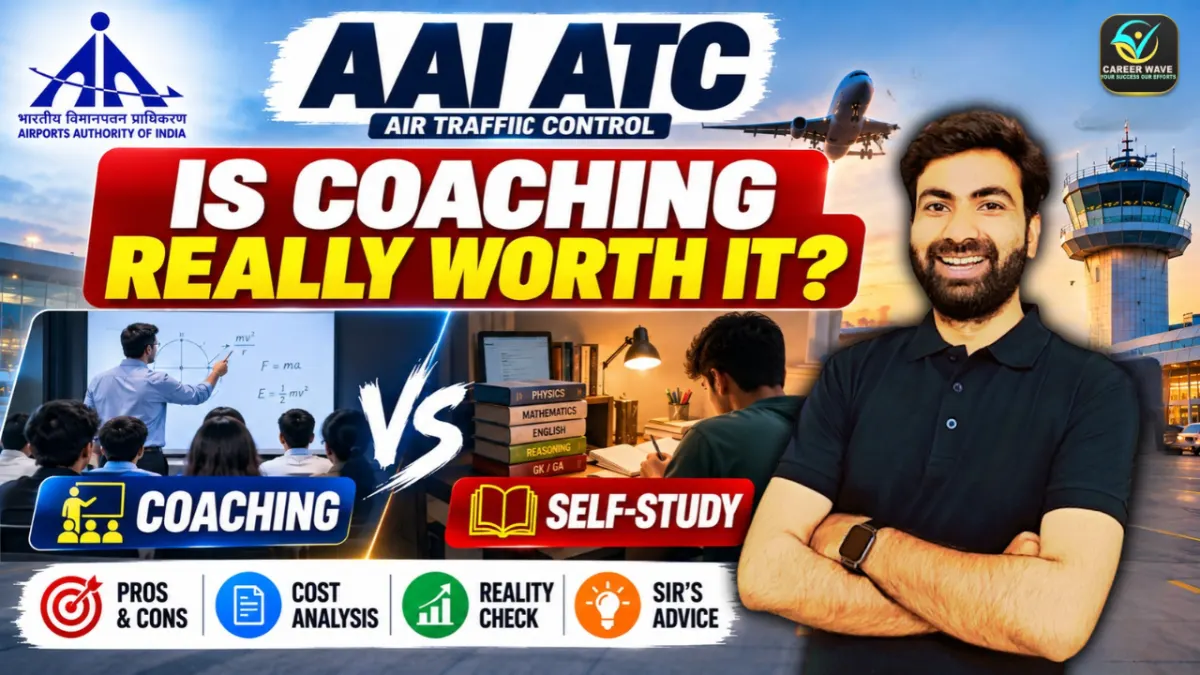
Is coaching really necessary to
crack AAI ATC 2026, or can you succeed through self-study? Discover an honest
comparison of AAI ATC online coaching, offline coaching, and self-study with
Career Wave and Satyendra Sir. Learn when coaching is worth the investment, who
needs structured guidance, how to prepare without coaching, and why Physics,
Mathematics, PYQs, mock tests, and regular revision are essential. Explore
practical tips for beginners, repeat aspirants, and working professionals to
choose the right AAI ATC preparation strategy.
AAI ATC 2026 Preparation | Is Coaching Necessary? | Self-Study vs Online Coaching | PYQs, Mock Tests & Smart Preparation Strategy
Every year, thousands of students begin preparing for the AAI Junior Executive (Air Traffic Control) examination with the dream of building a career in India's aviation sector.
But before starting their preparation, many aspirants face one important question:
"Is coaching really necessary to crack AAI ATC, or can I prepare through self-study?"
Some students believe that joining coaching guarantees selection. Others think that watching free YouTube lectures and solving previous year questions is enough.
The reality lies somewhere in between.
Coaching can provide structure, guidance, and accountability, but it cannot replace a student's individual effort. Similarly, self-study can be effective, but it requires discipline, reliable resources, and a clear preparation strategy.
At Career Wave, Satyendra Sir believes that students should choose their preparation method according to their current knowledge, available time, learning style, and financial situation.
In this article, we will discuss whether coaching is worth it for AAI ATC 2026, compare coaching with self-study, explain who actually needs coaching, and share practical preparation strategies for both types of aspirants.
Before deciding whether coaching is necessary, understand the examination itself.
AAI ATC is a competitive examination that requires preparation across technical and non-technical subjects.
The recent AAI ATC CBT pattern has included the following distribution:
|
Subject |
Questions |
Marks |
|
Physics |
30 |
30 |
|
Mathematics |
30 |
30 |
|
English Language |
20 |
20 |
|
General Intelligence / Reasoning |
15 |
15 |
|
General Aptitude |
15 |
15 |
|
General Knowledge / Awareness |
10 |
10 |
|
Total |
120 |
120 |
This reflects the recent 120-question examination pattern. Candidates should verify the syllabus, marking scheme, and examination requirements in the official notification for their recruitment cycle.
Physics and Mathematics together contribute 60 marks, while non-technical subjects contribute another 60 marks.
This means that successful preparation requires more than simply solving technical numerical questions.
Students need conceptual understanding, consistent revision, PYQ practice, time management, and mock-test analysis.
The real question is not whether coaching is compulsory.
The real question is whether coaching will help you prepare more effectively than your current self-study approach.
No. Coaching is not compulsory for AAI ATC preparation or eligibility.
There is no requirement that a candidate must join a coaching institute to appear for the examination.
Students can prepare through:
However, every preparation method has advantages and limitations.
A student with strong Physics and Mathematics fundamentals may need only targeted practice and mock tests.
A beginner who struggles with technical concepts may benefit from systematic classroom guidance.
Satyendra Sir's Advice: Do not join coaching simply because everyone else is joining. First identify what support your preparation actually needs.
Both methods can be effective when followed consistently.
The difference lies in how students receive guidance, organize their preparation, and measure their progress.
|
Factor |
Coaching |
Self-Study |
|
Study Structure |
Usually provides a planned schedule |
Student creates the schedule |
|
Concept Learning |
Teacher-guided explanations |
Independent learning |
|
Doubt Resolution |
Depends on available faculty support |
Requires independent research |
|
Study Material |
Often organized by syllabus |
Must be selected independently |
|
Discipline |
Classes provide external structure |
Requires self-discipline |
|
Flexibility |
Depends on class format |
Highly flexible |
|
Cost |
Usually involves course fees |
Can be relatively affordable |
|
Mock Tests |
May be included in the course |
Can be purchased separately |
|
Personalization |
Depends on course and faculty |
Fully controlled by the student |
|
Accountability |
External support may be available |
Primarily self-managed |
Neither approach guarantees selection.
The better option depends on the student's preparation needs.
Coaching can be particularly useful when students face difficulties that are hard to resolve through independent preparation.
Physics and Mathematics are important parts of the AAI ATC examination.
Students who struggle with fundamental concepts may find it difficult to solve exam-level numerical questions independently.
For example, a student may remember an electrostatics formula but fail to understand when it should be applied.
Similarly, a student may memorize integration formulas without understanding the method required for a particular question.
In such cases, structured teaching can help build conceptual clarity.
Coaching is worth considering when you need systematic explanations rather than only more practice questions.
Beginners often feel confused about:
A structured course can reduce this confusion by providing a defined learning sequence.
However, students should still understand the syllabus themselves instead of depending completely on the course schedule.
Some students create excellent timetables but struggle to follow them.
They study seriously for a few days and then lose momentum.
Scheduled classes, assignments, and regular tests can provide accountability.
However, simply attending classes does not guarantee discipline.
Students must still revise and practise independently.
When the examination is approaching, students may not have enough time to experiment with multiple resources.
A well-organized course can help them identify important concepts and structure their revision.
But joining a lengthy course close to the examination may also create unnecessary backlog.
Students should evaluate whether a course matches their available time.
Unresolved doubts can weaken conceptual understanding.
For example, students may repeatedly make mistakes in:
Access to knowledgeable teachers can help resolve these difficulties.
Career Wave Tip: Before joining any course, check whether its teaching approach, syllabus coverage, and doubt-support system match your needs.
Self-study can be an effective option for students who already have a reasonable academic foundation.
You may not need a complete coaching course if:
For example, a student who consistently performs well in Physics and Mathematics sectional tests may benefit more from targeted revision and full mocks than from repeating complete foundational lectures.
Satyendra Sir's Advice: Choose preparation support according to your weaknesses. Do not spend time studying concepts you have already mastered unless revision is necessary.
One of the most dangerous assumptions is that paying for coaching automatically improves the chances of selection.
Coaching provides resources and guidance.
But students must convert those resources into knowledge and examination performance.
Two students attending the same classes may achieve very different results because of differences in:
A coaching institute cannot take the examination on your behalf.
Coaching can guide your preparation, but your performance depends on how effectively you use that guidance.
Free YouTube lectures can be extremely useful, especially for students who cannot afford paid coaching.
They can help with:
However, free content may not always follow a complete, organized learning sequence.
Students sometimes waste time switching between unrelated videos.
Step 1: Follow the official syllabus.
Step 2: Choose reliable educators.
Step 3: Organize lectures chapter-wise.
Step 4: Prepare concise notes.
Step 5: Solve practice questions after each lecture.
Step 6: Use PYQs and mock tests to evaluate understanding.
For AAI ATC preparation guidance, Physics discussions, PYQs, and examination strategies, students can follow the Career Wave YouTube channel.
Not every coaching course offers the same level of support.
Before enrolling, evaluate the following factors.
Check whether the course covers both technical and non-technical subjects.
Teachers should explain concepts clearly and demonstrate how to apply them to exam-level questions.
A useful course should help students understand PYQ concepts and previous examination trends.
Check whether students receive opportunities for timed practice and performance analysis.
Understand how students can ask questions and receive clarification.
Look for formula revision, short notes, practice sessions, or other suitable revision resources.
Make sure the course schedule fits your preparation timeline.
Review the course description, included resources, access conditions, and fees before purchasing.
Satyendra Sir's Advice: Choose coaching based on educational value, not advertisements, unrealistic promises, or fear of missing out.
Whether you join coaching or prepare independently, AAI ATC previous year questions should be part of your preparation.
PYQs help students understand:
However, memorizing PYQ answers is not enough.
Students should understand why an answer is correct and practise similar questions.
Concept Study → Chapter-Wise PYQs → Error Analysis → Similar Questions → Revision
At Career Wave, aspirants can explore AAI ATC previous year questions and e-books here:
A common misconception is that coaching students automatically perform better in mock tests.
Actual performance depends on preparation quality.
Whether you study independently or through coaching, full mock tests are essential for assessing examination readiness.
|
Subject |
What to Analyse |
|
Physics |
Conceptual and formula mistakes |
|
Mathematics |
Calculation errors and lengthy methods |
|
English |
Grammar and vocabulary mistakes |
|
Reasoning |
Logical errors and solving time |
|
Aptitude |
Calculation speed and accuracy |
|
General Awareness |
Incorrect or forgotten facts |
Important: Attempting a mock without analysing mistakes provides limited improvement.
Students looking for structured full-length practice can explore:
If I were preparing entirely through self-study, I would follow a systematic plan.
Download and analyse the relevant AAI ATC notification.
Identify the technical and non-technical subjects.
Allocate sufficient time to Physics, Mathematics, English, Reasoning, Aptitude, and General Awareness.
Use reliable textbooks and educational lectures.
Avoid memorizing formulas without understanding their applications.
Solve basic questions first, followed by moderate and exam-level problems.
Practise previous year questions chapter-wise.
Evaluate individual subjects before moving to full mocks.
Practise under timed, examination-like conditions.
Record recurring mistakes and revise them regularly.
Measure improvement through accuracy, completed topics, and mock-test performance.
Reserve dedicated time for formulas, weak chapters, and previously incorrect questions.
If you decide to join coaching, the next challenge is using it effectively.
Simply attending lectures is not enough.
Review the topic briefly and identify any existing doubts.
Focus on understanding concepts and important problem-solving methods.
Revise the notes and solve relevant questions independently.
Attempt practice tests and revise completed chapters.
Review your progress and identify subjects requiring additional attention.
Career Wave Tip: A coaching course becomes more valuable when classroom learning is supported by independent practice and revision.
Students also need to decide between online and offline learning.
Advantages:
Neither method is universally better.
Choose the format that supports your learning style and available time.
Repeat aspirants should evaluate their previous preparation before purchasing another complete course.
Ask yourself:
If your primary problem was weak fundamentals, structured teaching may help.
If your primary problem was poor mock-test performance, targeted practice and analysis may be more useful.
If your primary problem was lack of revision, repeating every lecture may not be the most efficient solution.
Satyendra Sir's Advice: Repeat aspirants should correct the reasons behind their previous performance rather than automatically repeating the same preparation process.
Whether you join coaching or prepare independently, a balanced routine is important.
|
Activity |
Duration |
|
Physics |
90 Minutes |
|
Mathematics |
90 Minutes |
|
English and Reasoning |
60 Minutes |
|
Aptitude and General Awareness |
60 Minutes |
|
PYQs and Formula Revision |
60 Minutes |
|
Total |
6 Hours |
This is an illustrative self-study schedule.
Students attending live classes should adjust these hours according to lecture duration and revision requirements.
On full mock-test days, replace part of the regular study schedule with the mock and its analysis.
A hybrid preparation model can be useful for students who do not need complete coaching but require guidance in selected subjects.
For example:
A student with strong Mathematics but weak Physics may use teacher-guided Physics lectures while preparing Mathematics independently.
Another student may complete the syllabus through self-study but purchase a structured test series.
|
Student Profile |
Suitable Approach |
|
Complete Beginner |
Structured coaching or guided study plan |
|
Strong Technical Fundamentals |
Self-study with PYQs and mocks |
|
Weak Physics Concepts |
Targeted Physics guidance |
|
Weak Mathematics Concepts |
Targeted Mathematics guidance |
|
Working Professional |
Flexible online or hybrid preparation |
|
Repeat Aspirant |
Weak-area-focused preparation |
|
Syllabus Already Completed |
Revision, sectional tests, and full mocks |
|
Limited Budget |
Free lectures, reliable notes, PYQs, and selected tests |
These are practical recommendations, not fixed rules.
The final decision should depend on individual circumstances.
Joining coaching does not automatically eliminate preparation mistakes.
Avoid these common problems.
Concepts are easily forgotten when students do not revise them.
Students must develop independent problem-solving ability.
Understanding a lecture does not guarantee that you can solve exam-level questions.
Without timed practice, students may struggle during the actual examination.
Unfinished lectures can reduce revision time.
Physics and Mathematics alone cannot cover the complete examination.
Unresolved confusion can lead to repeated mistakes.
Exam readiness must be evaluated through practice and performance.
At Career Wave, Satyendra Sir emphasizes conceptual understanding, structured preparation, PYQ analysis, and regular practice.
The objective is to help students make better preparation decisions, whether they are beginners, repeat aspirants, or students already preparing independently.
Students can access educational discussions, subject guidance, PYQ explanations, and preparation strategies through the Career Wave YouTube channel.
Previous year questions help aspirants understand important concepts and earlier examination trends.
Full mock tests help students practise under examination conditions and evaluate their preparation.
Students should select resources based on their actual requirements rather than purchasing materials they cannot use effectively.
The answer depends on what coaching adds to your preparation.
If you struggle with concepts, lack a clear study plan, or need regular academic guidance, a suitable coaching program may provide meaningful value.
If you already have strong fundamentals, a disciplined routine, and reliable resources, self-study supported by PYQs and mock tests may be sufficient.
Coaching is worth considering when it helps you:
But no coaching institute can guarantee selection.
The value of coaching should be measured by how much it improves your learning and preparation—not simply by the number of classes offered.
Stay connected with Career Wave and Satyendra Sir for AAI ATC preparation strategies, Physics and Mathematics guidance, PYQs, mock tests, and examination updates.
AAI ATC PYQs and E-Books
Career Wave — Your Success, Our
Efforts
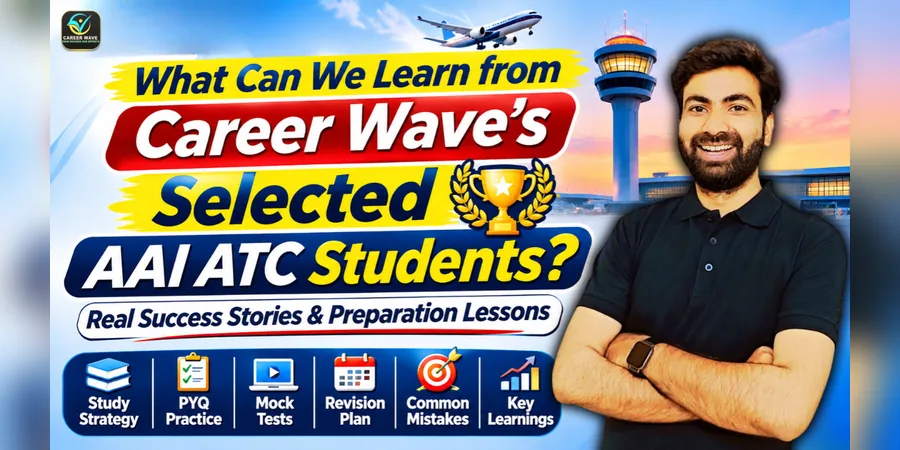 What Can We Learn from Career Wave's Selected AAI ATC Students? Success Stories...
23 Nov 2026
 AAI ATC 2027: Notification, Eligibility, Syllabus, Exam Pattern, Salary, Cut-Off...
23 Nov 2026
 RRB Group D Score Card 2026 and ALP CBT-1 Answer Key: Score, Cut-off and Next St...
22 Nov 2026
 AAI JE AO 2026 Answer Key: Status, Score Calculation, Paper Analysis and Expecte...
22 Nov 2026
 SSC JE 2026 IMD Scientific Assistant Answer Key: Score Calculation, Objections a...
22 Nov 2026
 B.Sc vs B.Tech for AAI ATC 2027: Best Preparation Strategy for Each
19 Nov 2026
Leave a Comment
23-Nov-2026 02:05 PM
What Career Wave's selected AAI ATC students did differently: real testimonials, PYQ and mock-test methods, a 6-month plan and mistakes to avoid in 2027.
23-Nov-2026 01:23 PM
AAI ATC 2027 guide: notification status, eligibility, age limit, exam pattern, syllabus, salary, 2025 cut-offs and Career Wave’s 3 live batches compared.
22-Nov-2026 03:58 PM
RRB Group D score card is out till 1 Dec and ALP CBT-1 objections are closed. Check your score, qualifying marks, PET standards and next...
22-Nov-2026 11:51 AM
AAI JE Operations 2026 answer key status, how to calculate your score out of 120, the 26 Oct paper analysis and the expected cut-off of...
22-Nov-2026 11:23 AM
SSC JE 2026 Paper-I answer key for IMD Scientific Assistant is out. Learn how to calculate your score, raise objections before 22 Nov 6 PM...
19-Nov-2026 03:50 PM
B.Sc vs B.Tech: Who has an advantage in AAI ATC 2027? Discover the right preparation strategy for B.Sc Physics, B.Sc Mathematics and Engineering graduates. Compare...
 Career WaveOn WhatsApp
36,000+ learners · 4.8★ on Google