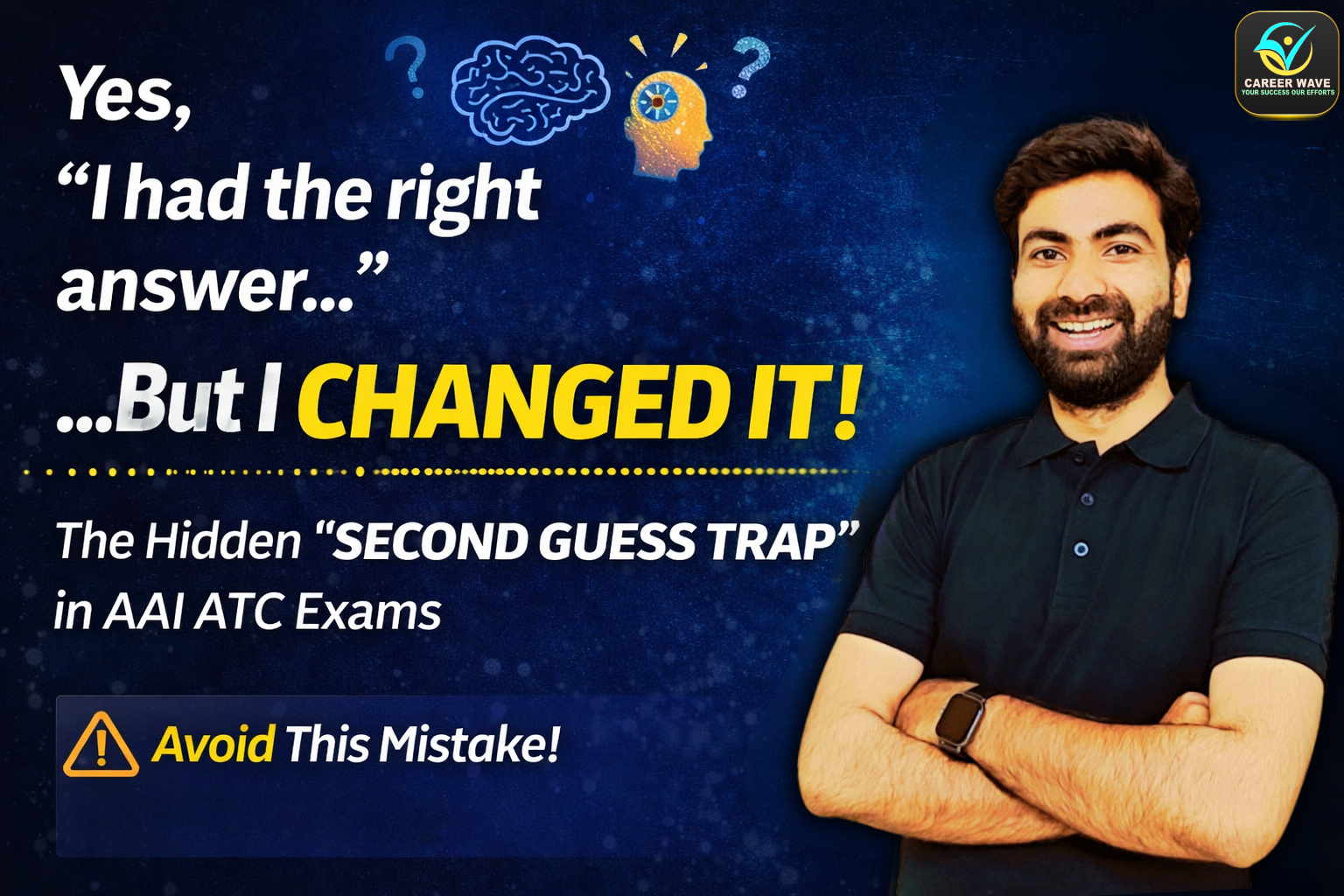
Many AAI ATC aspirants lose
crucial marks by changing correct answers during the exam due to overthinking
and pressure. This psychological mistake is known as the “Second Guess Trap.”
In this detailed guide by Career Wave, learn why it happens, how it affects
performance, and how toppers avoid it.
The “Second Guess Trap” in AAI ATC Exams
(Why Many
Correct Answers Turn Into Wrong Ones)
Every year
after the AAI ATC exam, many aspirants realize something frustrating:
“My first
answer was correct… I changed it later and lost marks.”
This is one
of the most common psychological mistakes in competitive exams. At Career
Wave, mentors refer to it as the “Second Guess Trap.”
The trap
happens when a candidate initially solves a question correctly but later changes
the answer because of doubt, pressure, or overthinking. In a high-pressure
exam like AAI ATC, this mistake can easily cost 5–10 marks, which
is often the difference between selection and missing the cutoff.
Understanding this trap is
extremely important because it affects even well-prepared and intelligent
students.
1) What Exactly Is the Second Guess Trap?
The Second
Guess Trap follows a simple but damaging pattern:
1.
A student
reads the question and solves it correctly.
2.
The correct
option is selected with confidence.
3.
After moving
ahead, doubt starts appearing.
4.
The student
revisits the question.
5.
Overthinking
begins.
6.
The answer
is changed.
7.
The new
answer turns out to be incorrect.
This usually
happens not because the student lacked knowledge, but because they lost
trust in their first logical decision.
In time-bound CBT exams like AAI
ATC, confidence in decision-making is just as important as conceptual
knowledge.
2) Why the Second Guess Trap Happens in AAI
ATC
2.1 Exam
Pressure Creates Self-Doubt
The AAI ATC
exam carries huge expectations. Many students see it as a career-defining
opportunity, which increases psychological pressure.
During the
exam, students often think:
·
“This
question looks too easy.”
·
“What if
this is a trick question?”
·
“Maybe I
missed something.”
This type of
thinking slowly replaces confidence with suspicion.
At Career
Wave, mentors explain a simple reality:
Not every
question in the paper is tricky.
Sometimes the correct answer is exactly what it looks like.
When
students start doubting everything, they fall into the Second Guess Trap.
2.2
Overthinking Because of Strong Preparation
Interestingly,
students who are well prepared fall into this trap more often.
Why?
Because they
know multiple methods to solve a problem. For example:
·
Solving a
numerical using two different formulas
·
Rechecking
calculations again and again
·
Deriving the
concept from the beginning
While this
approach works during practice, it becomes dangerous in a 2-hour CBT exam.
Instead of
saving time, it creates confusion and unnecessary mental fatigue.
Toppers
understand that in AAI ATC:
The goal is
not perfect verification — the goal is fast and correct decision-making.
2.3 Time
Pressure and Late-Exam Panic
Another
common reason for second guessing happens during the final 20–30 minutes of
the exam.
At this
stage:
·
The brain is
already tired.
·
Time is
running out.
·
Anxiety
increases.
Students
often go back to earlier questions and quickly review them.
During this
rushed review:
·
They forget
their earlier reasoning.
·
They misread
the question again.
·
They change
answers impulsively.
This is when
many correct answers are accidentally converted into wrong ones.
2.4 Pattern
Disruption in the Exam
Many
aspirants practice using similar patterns in mock tests.
However, the
actual AAI ATC paper may:
·
Change the
wording of questions
·
Mix easy and
tricky questions randomly
·
Break
expected patterns
When
students encounter unfamiliar patterns, they assume something is wrong and
begin to doubt their answers, even when they solved them correctly.
This
confusion often leads to second guessing.
2.5
Cognitive Fatigue During Long Exams
AAI ATC is a
mentally demanding exam.
For two
hours, students continuously:
·
Read complex
questions
·
Perform
calculations
·
Make
decisions quickly
As the exam
progresses, mental fatigue builds up.
Fatigue
reduces:
·
Focus
·
Patience
·
Confidence
When the brain becomes tired, it
is more likely to doubt earlier decisions, increasing the chances of
second guessing.
3) How AAI ATC Toppers Avoid the Second Guess
Trap
Successful
candidates follow clear mental rules during the exam.
3.1 Trust
the First Logical Answer
If a
question was solved clearly and the logic was correct, toppers do not change
the answer.
They
reconsider only if they find:
·
A clear
calculation error
·
A misread
condition in the question
·
A missing
value or incorrect formula
Otherwise,
they move ahead.
3.2 Avoid
Unnecessary Re-Solving
Toppers
understand that re-solving every question wastes time.
Instead,
they focus on maximizing attempts with good accuracy.
Every minute
saved can help solve another question.
3.3 Smart
Use of the Review Feature
Most CBT
exams allow questions to be flagged for review.
Toppers
typically review:
·
Doubtful
questions
·
Questions
skipped earlier
They avoid
revisiting questions they already solved confidently.
3.4
Emotional Discipline
The biggest
strength of AAI ATC toppers is emotional control.
They avoid
thoughts like:
·
“I must
recheck everything.”
·
“Maybe I
made a mistake.”
Instead, they follow a structured
exam strategy and trust their preparation.
4) How Career Wave Helps Students Avoid the
Second Guess Trap
At Career
Wave, preparation goes beyond just teaching concepts.
The
institute focuses on exam psychology and decision-making skills, which
are essential for clearing AAI ATC.
Career Wave
preparation includes:
• CBT-based
mock simulations
• Strategy training for exam decision-making
• Practice sessions focused on speed and accuracy
• Guidance on when to skip or attempt questions
• Mentorship sessions on managing exam pressure
This
approach helps students develop confidence and discipline inside the exam
hall, reducing mistakes like second guessing.
Because in AAI ATC, success
depends not only on knowledge but also on how effectively you apply it under
pressure.
5) Final Insight
The Second
Guess Trap is not a knowledge problem.
It is a confidence
problem.
When
students stop trusting their preparation, they start doubting even correct
answers.
In a
fast-paced exam like AAI ATC, the ability to make clear decisions and
move forward confidently is a major advantage.
If your
reasoning is correct and your calculation is accurate:
Trust your
answer and move ahead.
Sometimes, the smartest exam
strategy is simply believing in your first correct decision.
6) FAQs –
Q1. Should I
never change my answer in the exam?
You can
change your answer only if you identify a clear mistake, such as a
calculation error or misreading the question. Avoid changing answers just
because of doubt.
Q2. How many
marks can students lose due to second guessing?
Many
aspirants lose 5–10 marks in AAI ATC simply by changing correct answers
during review.
Q3. Why do
intelligent students fall into this trap more often?
Because they
tend to analyze deeply and recheck excessively, which increases the
chances of confusion and overthinking.
Q4. How can
I train myself to avoid second guessing?
Practice timed
CBT mock tests, develop decision discipline, and learn to trust your first
logical solution—an approach strongly emphasized in Career Wave’s
preparation system.
Q5. Is
reviewing answers at the end of the exam useful?
Yes, but only for flagged or
doubtful questions. Rechecking already confident answers often leads to
unnecessary mistakes.
Related blogs-
Why Good Mock Scores Collapse in the Real AAIATC Exam
Question Scanning vs Question Solving: What Toppers Actually Do
Leave a Comment
13-Aug-2026 02:19 PM
Understand the real work profile of AAI AO, including airport operations, terminal management, passenger facilitation, airside support, coordination duties, shift work, salary, and Career Wave...
13-Aug-2026 01:46 PM
Learn why Business Management and Aviation Awareness are hidden scoring sections in AAI AO, including important topics, preparation strategy, PYQ approach, revision plan, and Career...
11-Aug-2026 02:39 PM
Learn which topics to prioritize and which topics to keep for later in AAI AO preparation, including Physics, Maths, Business Management, Reasoning, English, Quant, Aviation...
10-Aug-2026 01:05 PM
AAI AO has no negative marking, but does that make selection easy? Understand why high attempts, rising competition, limited vacancies, accuracy, PYQs and smart exam...
08-Aug-2026 12:27 PM
Learn why AAI AO is a golden opportunity for freshers, including no work experience requirement, ₹14 lakh approximate CTC, aviation-sector exposure, exam pattern, eligibility, preparation...
07-Aug-2026 04:05 PM
Understand the real job profile of AAI AO, including salary, actual airport operations work, shift duty, passenger facilitation, coordination responsibilities, work pressure, and Career Wave...
