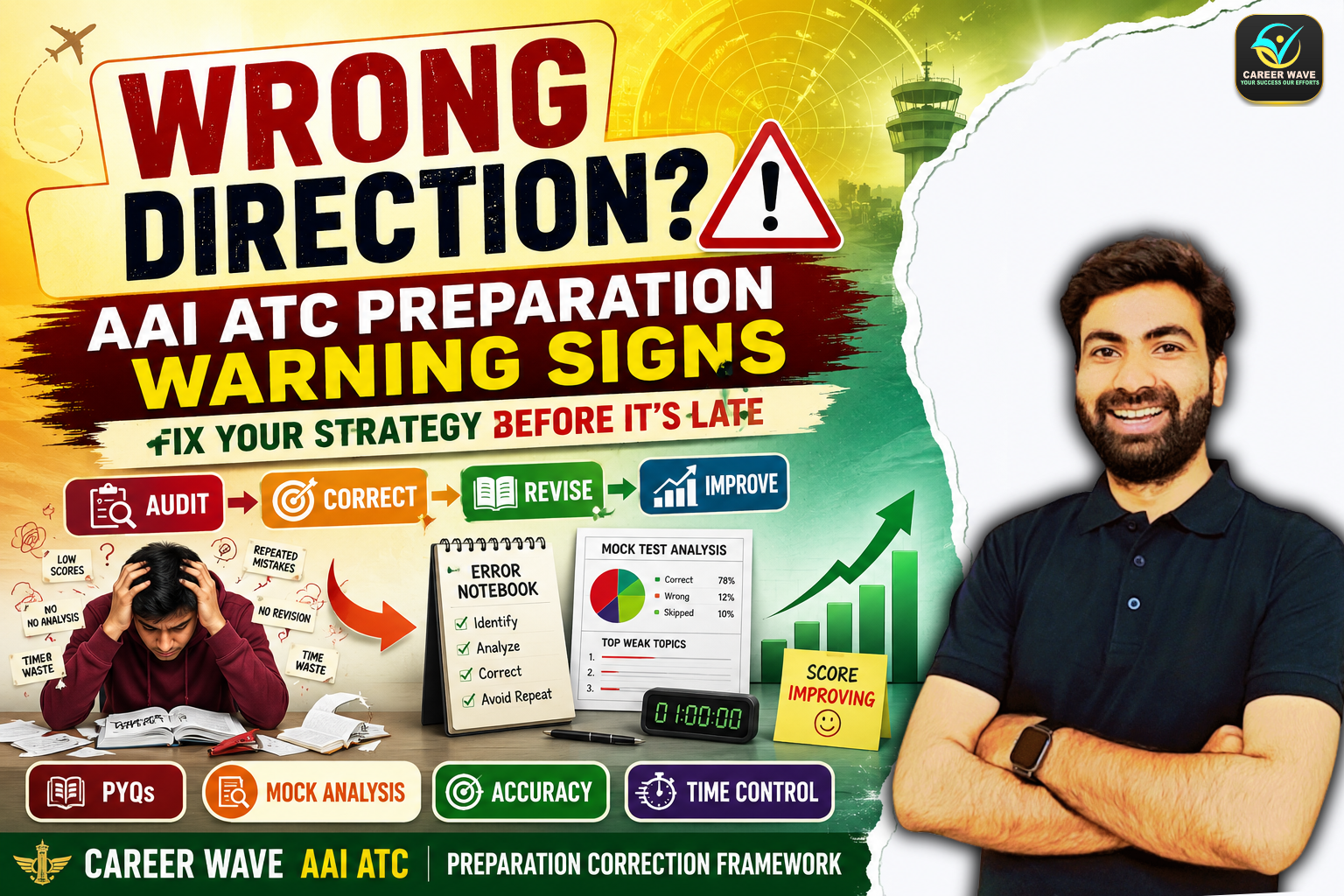
Many AAI ATC aspirants study
daily but fail to improve their mock scores because their preparation is moving
in the wrong direction. This blog explains warning signs like ignoring PYQs,
poor mock analysis, falling accuracy, weak revision, too many resources,
advanced-topic confusion, time mismanagement, and how Career Wave helps
students bring preparation back on track.
How to Know Your AAI ATC Preparation Is Going
in the Wrong Direction
Many AAI ATC
aspirants study daily, attend classes, make notes, solve questions, and give
mocks. Still, their score does not improve as expected.
The problem
is not always lack of hard work.
The real problem is often wrong preparation direction.
AAI ATC is
not just about completing the syllabus. It requires PYQ-based preparation,
accuracy, revision, mock analysis, time management, and smart attempt strategy.
If these elements are missing, even serious preparation may not convert into
marks.
At Career Wave, we guide
students to identify wrong preparation patterns early so they can correct them
before the exam and move toward selection with a clear strategy.
1. Your Mock Score Is Not Improving
If you are
studying daily but your mock score remains stuck for weeks, it is a clear
warning sign.
This usually
happens because:
·
You are
studying without analysis
·
You are
repeating the same mistakes
·
You are not
revising weak areas
·
You are
solving random questions
·
You are not
tracking accuracy
·
You are not
improving time management
At Career Wave, students
are trained to track mock scores, accuracy, wrong questions, time spent, and
repeated mistakes instead of only counting study hours.
2. You Are Completing Syllabus but Ignoring
PYQs
Syllabus
completion does not mean exam readiness.
AAI ATC
preparation becomes meaningful only when concepts are connected with Previous
Year Questions.
PYQs help
you understand:
·
Actual exam
level
·
Important
topics
·
Repeated
concepts
·
Formula
usage
·
Question
pattern
·
Common traps
If you are
completing chapters but not solving PYQs, your preparation is going in the
wrong direction.
Career Wave Method:
Concept → Formula → PYQ → Practice → Mock → Analysis
3. You Are Using Too Many Resources
Too many
resources create confusion.
Students
often use:
·
Multiple
books
·
YouTube
playlists
·
Telegram
PDFs
·
Different
teachers’ notes
·
Random
formula sheets
·
Mixed exam
material
This creates
scattered preparation and weak revision.
A better
approach is:
·
One main
source
·
One formula
sheet
·
One PYQ
source
·
One mock
platform
·
One error
notebook
Career Wave keeps preparation structured, limited, and exam-focused so students do not waste time on irrelevant material.

4. You Are Giving Mocks Without Analysis
Mock tests
are useful only when they are analyzed properly.
After every
mock, check:
·
Which
questions were wrong?
·
Which
section reduced the score?
·
Which topic
caused repeated mistakes?
·
Which
question took too much time?
·
Which
formula was forgotten?
·
Which easy
question was missed?
·
Which
question should have been skipped?
A mock
without analysis is only a score check.
A mock with analysis is a score improvement tool.
Career Wave focuses strongly on
mock analysis because this is where real improvement begins.
5. Your Accuracy Is Falling
If attempts
are increasing but accuracy is falling, preparation is unstable.
Low accuracy
usually happens due to:
·
Guesswork
·
Over-attempting
·
Formula
confusion
·
Weak
revision
·
Calculation
mistakes
·
Misreading
questions
·
Panic during
mocks
Target
accuracy should be:
|
Section |
Target Accuracy |
|
Physics |
85–90% |
|
Mathematics |
85–90% |
|
Reasoning |
90%+ |
|
English |
85%+ |
|
Aptitude |
95%+ |
|
Overall |
85–90%+ |
Career Wave teaches students to
improve accuracy first, then increase attempts.
6. You Are Studying Advanced Topics Too Early
AAI ATC
mostly tests basic to moderate-level concepts with speed and accuracy.
Studying
unnecessary advanced topics too early can create:
·
Concept
confusion
·
Overthinking
·
Slow solving
speed
·
Weak focus
on basics
·
Reduced
revision time
·
Low
confidence
Your target
is not to study everything.
Your target is to score maximum marks in the AAI ATC exam.
Career Wave keeps preparation
aligned with the official syllabus, PYQs, mock level, and actual exam demand.
7. You Are Avoiding Weak Topics
If you keep
delaying weak topics, your preparation is not moving in the right direction.
Common
signs:
·
“I will do
this later.”
·
“This
chapter is too difficult.”
·
“I will
revise it after syllabus completion.”
·
“I will
focus only on strong areas.”
Weak topics
should be corrected early, especially if they are high-weightage areas.
Use this
method:
1.
Revise basic
concept
2.
Learn
formulas
3.
Solve PYQs
4.
Attempt
sectional test
5.
Add mistakes
to error notebook
6.
Revise again
after a few days
Career Wave helps students
identify weak areas and convert them into scoring areas through structured
practice.
8. You Are Not Revising Regularly
If you keep
studying new topics but do not revise old ones, your preparation will collapse
during mocks.
Without
revision, students forget:
·
Formulas
·
Short tricks
·
PYQ patterns
·
Concept
conditions
·
Common
mistakes
Career Wave
revision model:
·
Concept
revision
·
Formula
revision
·
PYQ revision
·
Mock mistake
revision
·
Final
short-note revision
Revision is not optional. It is
the backbone of AAI ATC preparation.
9. You Are Not Tracking Mistakes
If you are
not maintaining an error notebook, you may be repeating the same mistakes again
and again.
Use this
format:
|
Date |
Subject |
Chapter |
Mistake Type |
Reason |
Correction |
|
10 May |
Physics |
Current Electricity |
Formula error |
Wrong power formula |
Revise P = VI, P = I²R, P = V²/R |
|
12 May |
Maths |
Probability |
Concept error |
Confused events |
Revise probability rules |
|
15 May |
English |
RC |
Reading error |
Missed “not” |
Mark keywords carefully |
Career Wave encourages students
to convert mistakes into revision targets.
10. You Are Spending Too Much Time on One
Question
AAI ATC is a
time-controlled CBT.
If you spend
2–3 minutes on one question, you may lose multiple easy questions.
Time rule:
·
Easy
question: 20–30 seconds
·
Moderate
question: 45–60 seconds
·
Tough
question: mark and revisit
·
No clear
approach after 60–90 seconds: leave
Career Wave trains students to
protect time and avoid emotional attachment to difficult questions.
11. You Are Preparing Without a Weekly Plan
Random daily
preparation creates random results.
A proper
weekly plan should include:
|
Day |
Focus |
|
Monday |
Physics weak topic + PYQs |
|
Tuesday |
Maths practice + formulas |
|
Wednesday |
Part A + revision |
|
Thursday |
Physics sectional test |
|
Friday |
Maths sectional test |
|
Saturday |
Full mock |
|
Sunday |
Mock analysis + error notebook revision |
Career Wave helps students follow
a measurable weekly structure instead of random preparation.
12. Your Mock Scores Are Highly Fluctuating
Score
fluctuation is a warning sign.
Example:
92 → 75 → 88
→ 70 → 86
This shows
unstable preparation.
Reasons may
include:
·
Weak
revision
·
Panic in
tough papers
·
Poor time
management
·
Low accuracy
·
Wrong
attempt strategy
·
Dependence
on familiar questions
Career Wave focuses on score
stability, not one random high score.
13. You Are Ignoring Part A
Physics and
Maths are important, but Part A should not be ignored.
Part A can
give stable marks through:
·
English
accuracy
·
Reasoning
speed
·
Basic
aptitude
·
GK awareness
Career Wave recommends giving
Part A 30–40 minutes daily in a controlled way.
14. You Are Studying but Not Performing Under
Timer
If you solve
questions at home but fail in mocks, your preparation is not exam-ready.
The actual
exam tests:
·
Time
pressure
·
Section
switching
·
Question
selection
·
Accuracy
under stress
·
Fast recall
Career Wave includes timed
practice, sectional tests, and CBT-style mocks so students can convert
knowledge into performance.
Career Wave Correction Framework
If your
preparation is going in the wrong direction, follow this system:
Step 1: Stop
Random Study
Pause and
identify what is not working.
Step 2:
Audit Your Preparation
Check
syllabus, PYQs, mocks, accuracy, and revision.
Step 3:
Identify Score Leakage
Find where
marks are being lost.
Step 4: Fix
Weak Topics
Use concept
+ PYQ + test method.
Step 5:
Analyze Mocks Deeply
Do not move
to the next mock without analysis.
Step 6:
Revise Smartly
Revise
formulas, PYQs, short notes, and errors.
Step 7:
Improve Attempt Strategy
Learn what
to attempt, skip, and revisit.
Step 8:
Track Progress Weekly
Measure improvement, not just
effort.
Final Takeaway
Your AAI ATC
preparation may be going in the wrong direction if:
·
Mock score
is not improving
·
PYQs are
ignored
·
Accuracy is
falling
·
Too many
resources are used
·
Weak topics
are postponed
·
Revision is
irregular
·
Mistakes are
repeated
·
Time
management is poor
·
Mock
analysis is missing
AAI ATC
selection needs correct direction, not only hard work.
Career Wave
helps students prepare with a structured system:
Concept →
PYQs → Practice → Mock → Analysis → Revision → Selection
The goal is simple:
Study less randomly. Perform more accurately.
FAQs
Q1. How do I
know my AAI ATC preparation is going in the wrong direction?
If your mock scores are stuck,
accuracy is falling, PYQs are ignored, mistakes are repeated, and revision is
irregular, your preparation needs correction.
Q2. Is
syllabus completion enough for AAI ATC?
No. Syllabus completion is only
the first step. PYQs, mocks, revision, accuracy, and time management decide
final performance.
Q3. Why is
my mock score not improving despite studying daily?
Your mock score may be stuck
because of poor analysis, repeated mistakes, weak revision, wrong attempt
strategy, or weak topic correction.
Q4. Should I
use multiple resources for AAI ATC?
No. Too many resources create
confusion. Use limited, reliable, exam-oriented resources and revise them
multiple times.
Q5. Why are
PYQs important in AAI ATC preparation?
PYQs reveal actual exam level,
repeated concepts, high-frequency topics, and question patterns. Without PYQs,
preparation remains incomplete.
Q6. What
should I do if my accuracy is low?
Analyze mistake types, reduce
guesswork, revise weak formulas, practice PYQs, and avoid over-attempting.
Q7. Is
advanced study required for AAI ATC?
Advanced study is not the main
requirement. AAI ATC mostly needs strong basics, PYQs, speed, accuracy, and
revision.
Q8. How does
Career Wave help correct wrong preparation?
Career Wave
helps through PYQ-based classes, mock analysis, weak-topic correction, formula
revision, error tracking, mentorship, and exam strategy.
Q9. How
often should I analyze my preparation?
You should analyze your
preparation weekly using mock scores, accuracy, weak topics, revision status,
and error notebook.
Q10. What is
the best way to bring AAI ATC preparation back on track?
Stop random study, audit your
preparation, solve PYQs, analyze mocks, revise errors, fix weak topics, and
follow a structured plan with Career Wave.
Related Blogs -
Are You Really Ready for AAI ATC? Take This Self-Check
How Career Wave Tracks Student Performance for AAI ATC
Why Most Students Fail Without Proper Guidance in ATC
Leave a Comment
25-Aug-2026 06:05 PM
Can B.Tech candidates apply for AAI JE Airport Operations 2026? Understand eligibility, MBA requirements, advantages for engineering graduates, Business Management, Aviation Awareness, PYQs and the...
22-Aug-2026 01:25 PM
Preparing for AAI JE Airport Operations 2026? Learn the most common preparation mistakes aspirants make, from studying only strong subjects and ignoring Business Management or...
21-Aug-2026 03:49 PM
Are you preparing for AAI JE Airport Operations by focusing only on Physics and Maths? Understand why ignoring Business Management, Aviation Awareness, Reasoning, English, Aptitude...
20-Aug-2026 04:36 PM
Will AAI ATC preparation give you an advantage in AAI JE Airport Operations? Understand the syllabus overlap, benefits in Reasoning, Aptitude, English and Aviation, challenges...
19-Aug-2026 12:04 PM
Is MBA compulsory for AAI JE Airport Operations? Understand the eligibility criteria for B.Sc. + MBA and Engineering candidates, MBA mode requirements, qualification routes and...
18-Aug-2026 06:21 PM
Can B.Sc + MBA candidates apply for AAI JE Airport Operations 2026? Understand eligibility, qualification requirements, career opportunities, Aviation Awareness, Business Management, PYQs and smart...
