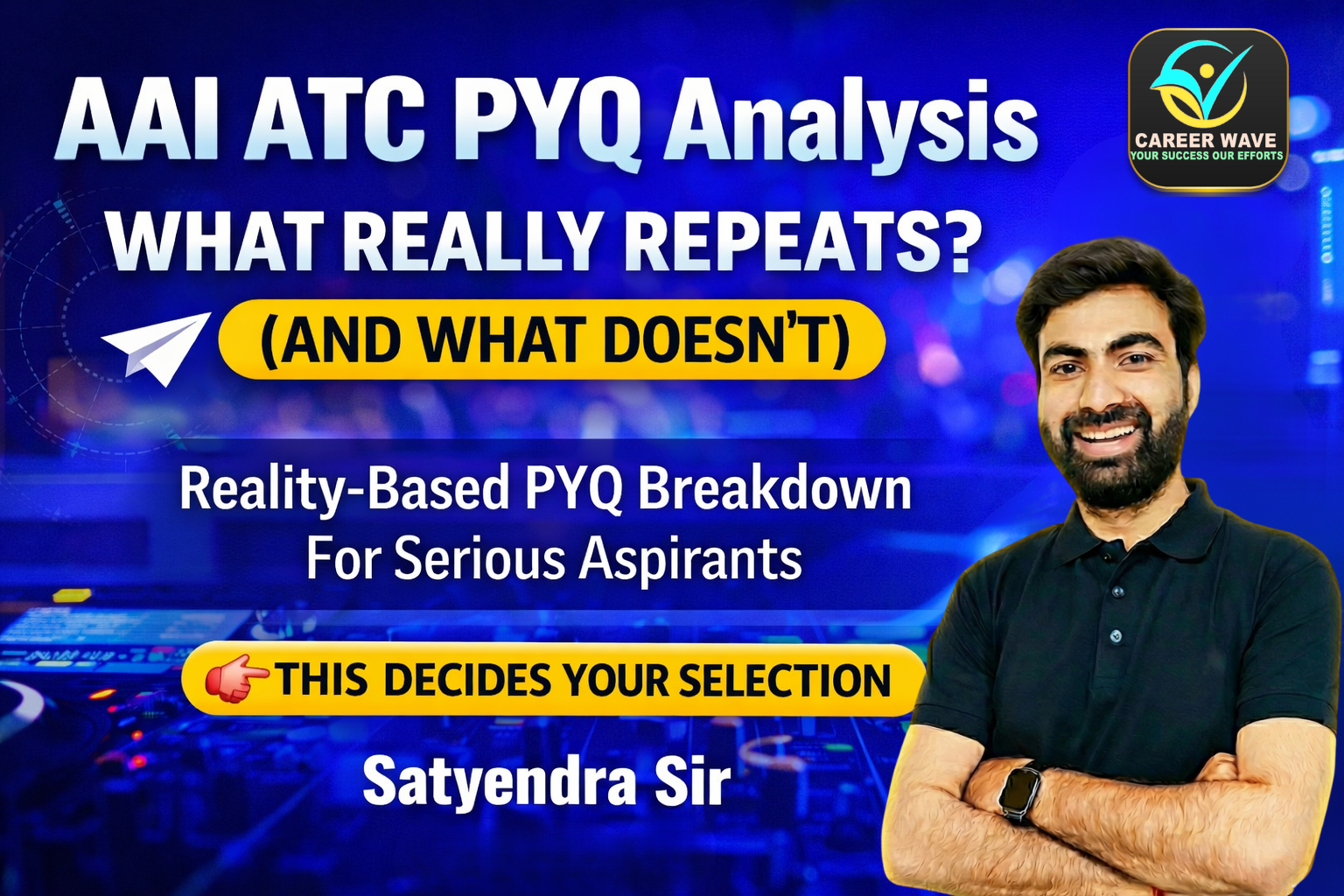
Most AAI ATC aspirants fail not
because of lack of effort, but because they study everything equally. This blog
by Career Wave breaks down AAI ATC Previous Year Question (PYQ) trends to show
what actually repeats, what doesn’t, and how serious aspirants should align
their preparation for selection.
AAI ATC PYQ Analysis: What Really Repeats
(And What Doesn’t)
A
Reality-Based Guide for Serious Aspirants
By Career Wave
Most AAI ATC
aspirants make one critical mistake.
They study the entire syllabus
equally.
But the
truth is simple:
AAI
ATC does not test everything.
It tests the same things, again and again — in different forms.
This blog is
written to help you understand what actually repeats in AAI ATC PYQs,
what only looks important but rarely comes, and how to align your preparation
accordingly.
At Career
Wave, every ATC strategy starts with PYQ analysis, not book completion.
1) Why PYQ
Analysis Is the Backbone of AAI ATC Preparation
AAI ATC is:
·
❌ Not
memory-based
·
❌ Not random
·
✅
Pattern-driven
·
✅
Concept-repetitive
Previous
Year Questions (PYQs) tell you:
·
Which
chapters decide cut-off
·
Which
concepts are favourite of examiners
·
How questions
are twisted, not changed
Books teach theory.
PYQs teach selection.
2) Subject-Wise
PYQ Reality Check
🔥 Physics – The Real Game Changer
From
year-wise PYQ analysis (2021–2023 memory-based papers), Physics dominates
selection.
High-Repeating
Physics Chapters (Must-Do)
These
chapters repeat directly or indirectly every cycle:

1. Electromagnetic Waves
o
Wave
properties
o Speed–frequency relations
o
Conceptual
one-liners
2. Laws of Motion
o Free body diagrams
o Pseudo force logic
o
Constraint-based
numerical
3. Ray Optics & Optical Instruments
o Lens formula
o Magnification
o
Ray tracing
logic
4. Electrostatics & Gauss’s Law
o Electric field patterns
o Flux-based questions
o
Symmetry
logic
5. Moving Charges & Magnetism
o Force on charge
o Direction-based questions
o
Simple
numerical traps
6.
Current
Electricity
o Series–parallel circuits
o Drift velocity concepts
o
Graph-based
reasoning
7. Semiconductor Electronics
o PN junction logic
o Diode characteristics
o
Digital
basics
8. Atoms
o Energy levels
o
Simple
formula-based numerical
👉
Career Wave observation:
Students who master these 8 chapters almost always stay above cut-off,
even with average non-tech performance
⚠️
Medium-Repeating Physics Chapters
Important
but not selection-deciders alone:
·
Thermodynamics
·
Wave
Optics
Study them after
high-weight chapters, not before.
📐 Mathematics – Accuracy & Stability Section
Mathematics
questions repeat in pattern, not in values.

High-Return
Maths Topics
1. Calculus
2. Vectors & 3D Geometry
3. Matrices & Determinants
4. Probability
5. Trigonometry
6. Algebra (basic identities)
What Repeats
in Maths PYQs
·
Same
formula usage
·
Same
logic
·
Slightly
changed numbers
👉
Key mistake beginners make:
Studying theory without timed practice.
At Career
Wave, maths is trained for:
·
Speed
·
Error
control
·
Instant
formula recall
3)
⚡ Non-Technical
Section – Score Booster, Not Selector
Reasoning

Repeats in:
·
Series
·
Coding-decoding
·
Direction
sense
·
Analogy
English

Repeats in:
·
Error
spotting
·
Vocabulary
·
Simple
comprehension
General
Awareness

·
Recent current affairs (6–8 months)
·
Aviation-related
basics
General Aptitude

❗ Reality:
Non-tech can support selection, but cannot replace weak Physics–Maths.
4) What Does
NOT Repeat (Stop Wasting Time Here)
Based on PYQ
trends:
·
Deep theory
reading without numerical
·
Rare derivations
·
Over-advanced maths
·
Random GK
facts
If a topic hasn’t appeared in 3
cycles, it is not priority.
5)
Correct PYQ-Based Study Sequence (Used at Career Wave)
1.
Study
concept from NCERT / core notes
2.
Solve PYQs
immediately
3.
Identify
repeat logic
4.
Create short
formula & mistake notes
5.
Test + analysis
This cycle is repeated for every
chapter.
6) Why
PYQ-Based Students Beat Syllabus-Finishers
PYQ-trained
students:
·
Recognize questions
faster
·
Avoid silly mistakes
·
Manage time better
·
Stay calm under pressure
That is why:
AAI ATC is
cracked by pattern recognition, not syllabus completion.
Career
Wave’s PYQ Philosophy
At Career
Wave:
·
PYQs are not
“revision material”
·
PYQs are the primary syllabus
·
Teaching is aligned with:
o Year-wise trend
o Topic-wise weightage
o Cut-off reality
Because:
Exams repeat patterns.
Only unprepared students repeat mistakes.
7) FAQs – PYQ
Doubts Answered
Q1.
Are PYQs enough for AAI ATC?
PYQs + NCERT fundamentals = strong foundation.
Q2.
Should I finish syllabus before PYQs?
No. PYQs should run parallel with study.
Q3.
How many years of PYQs are sufficient?
Last 5–7 years (including memory-based papers).
Q4. Can beginners use PYQs from
day one?
Yes. In fact, beginners need PYQs the most.
8) 🔑 Final
Takeaway
AAI ATC does
not reward:
·
Random study
·
Blind hard work
·
Book hoarding
It rewards:
·
Pattern awareness
·
Concept clarity
·
PYQ-driven preparation
If you want
to prepare smart, not scattered,
Career Wave exists to convert PYQ insight into selection reality.
Study less.
Revise smarter.
Follow patterns.
Crack ATC.
Leave a Comment
09-Sep-2026 12:05 PM
Learn the best AAI AO Full Mock Test Strategy 2026 to manage exam time effectively. Career Wave and Satyendra Sir explain section order, two-round attempt...
08-Sep-2026 02:40 PM
Learn how to improve accuracy in AAI JE Airport Operations 2026 mock tests and reduce silly mistakes. Career Wave and Satyendra Sir explain practical strategies...
08-Sep-2026 10:51 AM
Discover why mock tests are essential for AAI JE Airport Operations 2026 preparation. Learn how Full Mock Tests and Sectional Tests help improve speed, accuracy,...
07-Sep-2026 03:52 PM
Prepare for AAI JE Airport Operations 2026 with Career Wave’s exam-focused Test Series. Get Full-Length Mock Tests, Sectional Tests, latest pattern-based questions, detailed solutions, performance...
07-Sep-2026 11:27 AM
Check the complete IMD Scientific Assistant Physics Syllabus 2026 for Part-F as per the official SSC JE 2026 notification. Get chapter-wise topics including Mathematical Methods,...
05-Sep-2026 12:01 PM
Get the complete IMD Scientific Assistant Exam Pattern 2026 explained by Career Wave. Check Paper 1 and Paper 2 pattern, total questions, marks, duration, negative...
