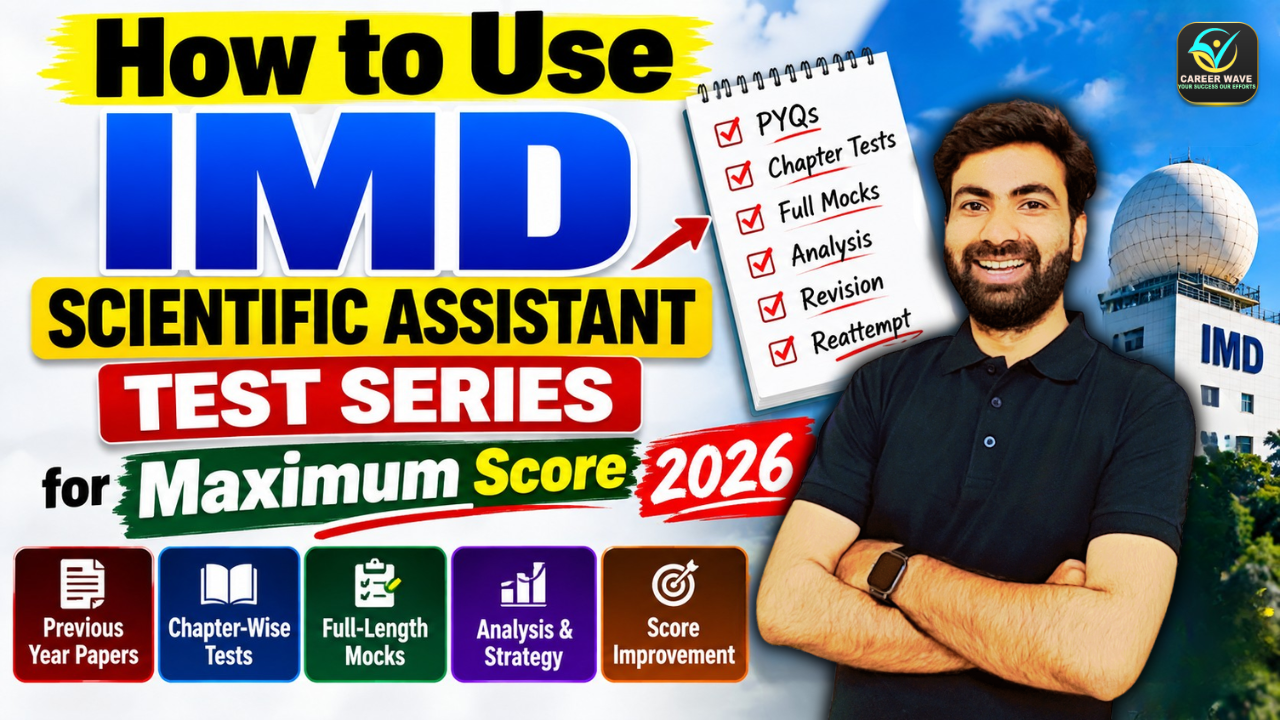
Learn how to use the IMD
Scientific Assistant Physics Test Series 2026 effectively with PYQs,
chapter-wise tests, mixed practice, full mocks, mistake analysis, revision and
reattempt strategy. Follow the structured preparation approach of Career
Wave and Satyendra Sir to improve accuracy, speed, time management and
overall score.
How to Use IMD Scientific Assistant Test
Series for Maximum Score
Preparing
for SSC IMD Scientific Assistant 2026 is not just about completing the
syllabus. The real improvement starts when you begin using mock tests and
sectional tests in a planned way.
A test
series should not be treated as a collection of questions. It should be used as
a complete preparation system to improve:
·
Concept
clarity
·
Accuracy
·
Speed
·
Time
management
·
Question
selection
·
Weak-area
identification
·
Exam
confidence
At Career
Wave, Satyendra Sir recommends using the IMD Scientific Assistant
test series in a structured cycle:
Study → Test
→ Analyse → Revise → Reattempt → Improve
This article explains how to use
the Career Wave IMD Scientific Assistant Physics Test Series 2026
effectively to maximize your score.
Career Wave IMD Scientific Assistant Physics
Test Series 2026
The Career
Wave test series is designed for Physics aspirants preparing for SSC IMD
Scientific Assistant 2026.
Test Series
Link
https://careerwave.org/test-series/33-ssc-imd-scientific-assistant-physics-test-series-2026
Complete
Preparation Batch
1. Start with Previous Year Papers
Before
attempting too many predicted mocks, begin with PYQs.
Previous
year papers help you understand:
·
Actual
question level
·
Repeated
concepts
·
Numerical
depth
·
Common
theoretical areas
·
Question
framing
·
Time
requirement
The current
practice material includes questions from topics such as blackbody radiation,
ideal gas behaviour, determinants, Brewster’s angle, and beam mechanics, which
shows the range and depth of technical questions students may encounter.
Extract MCQs Exactly Extract MCQs Exactly Extract MCQs Exactly Extract MCQs
Exactly
According to
Satyendra Sir, PYQs should be your benchmark.
Do not start by guessing what the
paper may ask. First understand what has already been asked.
2. Use Chapter-Wise Tests After Every Unit
Do not wait
until the full syllabus is completed.
After
finishing a chapter, attempt a chapter-wise test.
For example:
·
Mechanics
·
Optics
·
Thermodynamics
·
Electricity
·
Magnetism
·
Modern
Physics
·
Solid State
Physics
·
Semiconductor
Devices
Why This
Works
You
immediately discover:
·
whether the
concept is actually clear
·
whether
formulas are retained
·
whether
calculations are slow
·
whether
similar concepts are getting mixed up
This is much more effective than
revising passively.
3. Analyse Accuracy, Not Just Score
Many
students only check the final score.
That is not
enough.
After every
test, calculate:
Accuracy =
Correct Answers ÷ Attempted Questions × 100
Then analyse
whether your problem is:
·
low accuracy
·
low attempts
·
slow speed
·
weak
concepts
·
poor
question selection
At Career Wave, Satyendra Sir
recommends improving accuracy before aggressively increasing attempts.
4. Classify Every Mistake
Every wrong
question should be placed into one category.
Concept
Error
You did not
understand the topic properly.
Formula
Error
You knew the
concept but forgot or used the wrong relation.
Calculation
Error
The approach
was right but arithmetic went wrong.
Reading
Error
You missed
words like:
·
maximum
·
minimum
·
incorrect
·
not correct
·
except
Guessing
Error
You
attempted without sufficient confidence.
Once mistakes are classified,
revision becomes much more efficient.
5. Maintain a Mistake Notebook
This is one
of the most effective habits.
After every
mock, note only:
·
Important
wrong questions
·
Frequently
forgotten formulas
·
Repeated
conceptual mistakes
·
Tricky facts
·
Common
calculation errors
Do not
rewrite the entire solution.
Keep it
short.
Before the
next mock, revise this notebook.
Over time, the number of repeated
mistakes should reduce.
6. Move from Chapter Tests to Mixed Tests
After
completing several chapters, start mixed-topic tests.
Mixed tests
are important because the real exam does not tell you:
“This
question is from Optics.”
You must
identify the topic yourself.
Mixed
practice improves:
·
Concept
recognition
·
Formula
recall
·
Topic
switching
·
Decision-making
speed
This stage bridges the gap
between chapter practice and full mocks.
7. Attempt Full-Length Mocks Under Real
Conditions
When you
begin full mocks, simulate the actual exam as closely as possible.
Use:
·
Fixed time
·
No notes
·
No
unnecessary breaks
·
Proper
sitting position
·
No mobile
distractions
This trains
your brain for complete-paper concentration.
A mock test attempted casually
does not give the same benefit as one attempted under exam-like conditions.
8. Use a Three-Round Mock Strategy
Satyendra
Sir recommends using a simple three-round approach.
Round 1:
Direct Questions
Solve the
questions you can answer quickly and confidently.
Round 2:
Moderate Questions
Attempt
questions that require calculation or deeper thinking.
Round 3:
Review
Return to
marked questions if time remains.
This prevents you from wasting
too much time on one difficult numerical.
9. Improve Question Selection
One of the
biggest differences between average and strong mock performance is question
selection.
You should
learn to identify:
·
Direct
questions
·
Moderate
questions
·
Time-consuming
questions
·
High-risk
guesses
The goal is
not to attempt everything.
The goal is to maximize your
final score.
10. Use Performance Analytics Properly
If your test
series provides analytics, use them.
Track:
·
Overall
score
·
Accuracy
·
Time taken
·
Correct
questions
·
Incorrect
questions
·
Unattempted
questions
·
Chapter-wise
performance
·
Rank
·
Progress
over time
Do not use
analytics only to compare yourself with others.
Use them to compare your current
performance with your previous performance.
11. Focus on Weak Chapters
Suppose your
test analysis shows:
·
Modern
Physics: strong
·
Mechanics:
moderate
·
Thermodynamics:
weak
·
Optics: weak
Do not
revise all chapters equally.
Spend more
time on weak areas.
This is the main benefit of
data-based preparation.
12. Reattempt Important Tests
Many
students attempt a test once and never return to it.
That is a
mistake.
After
revising weak areas, reattempt selected tests.
This tells
you whether you actually improved.
A test becomes valuable when it
shows progress.
13. Track Score Improvement
Maintain a simple score tracker.
|
Test |
Score |
Accuracy |
Weak Area |
|
Mock 1 |
— |
— |
— |
|
Mock 2 |
— |
— |
— |
|
Mock 3 |
— |
— |
— |
Your aim
should be:
·
fewer
repeated mistakes
·
higher
accuracy
·
better
timing
·
more stable
scores
One unusually high score is less
important than consistent performance.
14. Do Not Attempt Too Many Mocks Without
Analysis
Giving one
mock properly and analysing it deeply is often more useful than giving three
mocks back-to-back without review.
Satyendra
Sir recommends:
Mock →
Analysis → Revision → Next Mock
not
Mock → Mock → Mock → No Analysis
15. Revise Formulas Before Full Mocks
Physics
requires fast recall.
Before full
mocks, revise:
·
Important
formulas
·
Standard
constants
·
Key
relations
·
Common
approximations
·
Graph trends
Keep a short
formula sheet.
Do not revise full notes before
every test.
16. Use PYQs to Build Priority
PYQs help
you understand where concepts are repeatedly tested.
If certain
topics appear repeatedly, those areas deserve more practice.
But avoid
completely ignoring other syllabus topics.
A strong
strategy is:
PYQ Priority + Full Syllabus
Coverage
17. Prepare for Conceptual + Numerical
Questions
A good IMD
Physics strategy should include both.
Conceptual
Practice
Useful for:
·
Laws
·
Definitions
·
Physical
interpretation
·
Graphs
·
Statement-based
questions
Numerical
Practice
Useful for:
·
Formula
application
·
Unit
conversion
·
Calculation
speed
·
Approximation
·
Option
elimination
Both are necessary.
18. Use Full Mocks for Exam Temperament
A full mock
also trains mental endurance.
You learn:
·
how to stay
focused
·
how to
recover after a difficult question
·
how to avoid
panic
·
how to
maintain accuracy in the second half
These skills develop only through
repeated timed practice.
19. Use Rank as Feedback, Not Pressure
If
leaderboard or All-India Rank is available, use it intelligently.
Rank can
show:
·
whether your
score is competitive
·
whether
improvement is happening
·
how others
are performing
But do not
panic after one poor rank.
Focus on
trend.
Consistency matters more.
20. Final 30-Day Test Strategy
A practical
final-stage approach can be:
Week 1
·
PYQs
·
Weak chapter
tests
·
Formula
revision
Week 2
·
Mixed tests
·
2–3 full
mocks
·
Error
analysis
Week 3
·
More full
mocks
·
Weak-topic
revision
·
Reattempt
important tests
Week 4
·
Final mock
practice
·
Short
revision
·
Error
notebook
·
Formula
revision
Do not
overload yourself with too many new topics in the final days.
Career Wave
Recommended Test Cycle
The complete
approach is:
Previous
Year Papers → Chapter-Wise Tests → Mixed Tests → Full Mocks → Analytics →
Revision → Reattempt
This is the most efficient way to
convert preparation into score improvement.
Why the Career Wave Test Series Helps
The Career
Wave IMD Scientific Assistant Physics Test Series 2026 is designed to
support structured practice through:
·
PYQs
·
Sectional
tests
·
Full-length
mocks
·
Detailed
solutions
·
Performance
analysis
·
Ranking
·
Exam-oriented
practice
Students can
combine it with concept classes from the complete preparation batch.
Test Series
https://careerwave.org/test-series/33-ssc-imd-scientific-assistant-physics-test-series-2026
Complete
Batch
Final Advice from Satyendra Sir
Do not judge
preparation by how many lectures you completed.
Do not judge
preparation by how many mocks you attempted.
Judge it by:
·
how many
mistakes stopped repeating
·
how much
accuracy improved
·
how much
time reduced
·
how stable
your scores became
That is real
improvement.
At Career
Wave, the focus is simple:
Practice Smart → Analyse Deeply →
Revise Precisely → Score Better
FAQs –
1. When
should I start the IMD test series?
Start chapter-wise tests during
syllabus completion. Do not wait until the entire syllabus is finished.
2. Should I
attempt PYQs first?
Yes. PYQs should be used early to
understand actual exam level and question patterns.
3. How many
mocks should I attempt?
There is no fixed perfect number.
Focus on proper analysis after every mock.
4. What is
more important: score or accuracy?
Both matter, but improving
accuracy is especially important because repeated wrong attempts reduce net
performance.
5. Should I
reattempt old mocks?
Yes. Reattempt selected tests
after revision to check whether weaknesses have improved.
6. How
should I analyse mistakes?
Classify them into concept,
formula, calculation, reading, and guessing errors.
7. Is a
mistake notebook useful?
Yes. It helps track repeated
errors and supports fast revision before future mocks.
8. Should I
attempt chapter tests or full mocks first?
Start with chapter tests, then
mixed tests, and finally full mocks.
9. How do
full mocks help?
They improve time management,
question selection, concentration, and exam temperament.
10. Should I
attempt every question?
No. Smart skipping and question
selection are important.
11. Where
can I join the Career Wave IMD Physics Test Series?
https://careerwave.org/test-series/33-ssc-imd-scientific-assistant-physics-test-series-2026
12. Where
can I join the complete preparation batch?
13. Who
provides Physics guidance at Career Wave?
Students can follow Satyendra
Sir for Physics concepts, PYQs, test strategy, mock analysis, and
exam-oriented preparation.
Connect With Career Wave
YouTube:
https://www.youtube.com/@CAREERWAVE
Telegram:
https://t.me/aai_atc
Instagram:
https://www.instagram.com/careerwave.atc
Facebook:
https://www.facebook.com/careerwave.atc
Physics Test
Series:
https://careerwave.org/test-series/33-ssc-imd-scientific-assistant-physics-test-series-2026
Complete
Preparation Batch:
https://careerwave.org/new-courses/71-ssc-imd-scientific-assistant-2026-complete-preparation-batch-career-wave
Career Wave — Use every test to find your next improvement.
Leave a Comment
01-Oct-2026 01:05 PM
Learn how to use the IMD Scientific Assistant Physics Test Series 2026 effectively with PYQs, chapter-wise tests, mixed practice, full mocks, mistake analysis, revision and...
30-Sep-2026 04:45 PM
Prepare smarter for AAI AO 2026 with previous year questionsand complete PYQ an and complete PYQ analysis. Understand question patterns, conceptual depth, common mistakes, option traps...
29-Sep-2026 03:03 PM
Discover the most common mistakes students make while solving AAI AO PYQs, including memorising answers, ignoring options, skipping mistake analysis and poor revision. Learn the...
22-Sep-2026 12:26 PM
Prepare for SSC IMD Scientific Assistant 2026 Physics Part-F with a structured strategy based on chapter-wise tests, PYQs, mixed practice, full-length mock tests, detailed solutions...
16-Sep-2026 01:04 PM
Explore the complete Career Wave IMD Scientific Assistant Physics Test Series 2026 with Previous Year Papers, sectional tests, full-length mock tests, detailed solutions, performance analytics,...
16-Sep-2026 11:55 AM
Understand why regular mock-test practice is essential for IMD Scientific Assistant 2026. Learn how mock tests improve speed, accuracy, time management, question selection, negative-marking control,...
