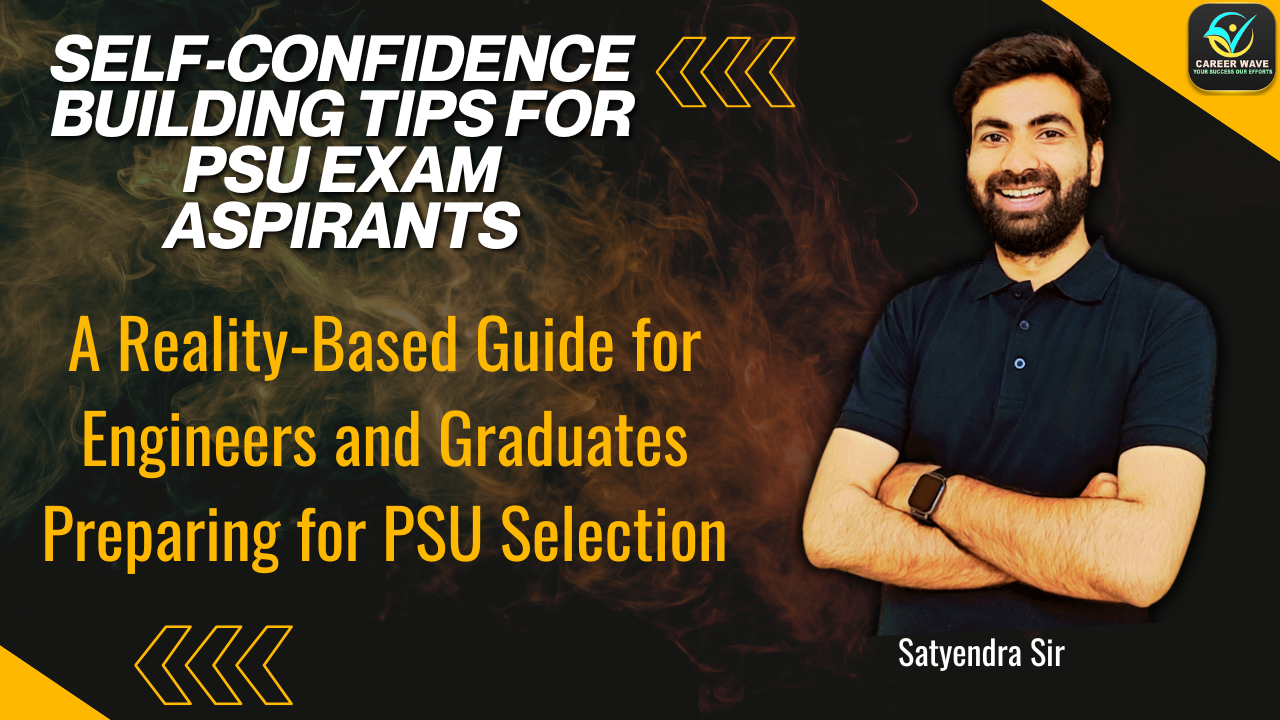
A reality-based, practical guide
by Career Wave to help PSU exam aspirants build, protect, and sustain
self-confidence throughout their preparation journey. Learn why confidence
breaks, how to rebuild it systematically, and how to stay mentally strong until
final selection.
Self-Confidence Building Tips for PSU ExamAspirants
A
Reality-Based Guide for Engineers and Graduates Preparing for PSU Selection
By
Career Wave
Preparing
for PSU exams is not just a test of knowledge—it is a long psychological
journey.
At Career Wave, we have observed one clear truth over years of mentoring PSU
aspirants:
Most
students do not fail because they are weak in subjects.
They fail because they lose confidence midway.
This blog is
written to help PSU aspirants understand why confidence breaks, how
to rebuild it, and how to sustain it until selection.
1. Understanding the Real Confidence Problem
in PSU Preparation
PSU
aspirants usually start with motivation.
Confidence issues begin later.
Ø
Common
situations where confidence drops:
·
Low marks in
initial mock tests
·
Comparing
yourself with toppers
·
Long gaps
between notifications
·
Repeated
exam postponements
·
Studying
seriously but seeing no immediate results
At Career Wave, we call this
phase “the silent danger zone”—where capable students quietly give up.
2. Separate Self-Worth from Mock Scores (Most
Important Rule)
One of the
biggest confidence killers is this thought:
“If I’m
scoring low in mocks, I’m not made for PSU exams.”
This is
false.
Ø
Reality:
·
Mocks are training
tools, not verdicts
·
Low scores
show what to fix, not who you are
·
Almost every
selected PSU officer once scored below cut-off in mocks
Career
Wave Rule:
Mock
marks are feedback, not identity.
Ø
Confidence
improves when you:
·
Track
improvement topic-wise
·
Focus on
error reduction, not rank obsession
·
Compare your
current self with your past self—not others
3. Confidence Comes from Clarity, Not
Motivation
Motivation
fades.
Clarity stays.
Ø
At Career
Wave, confident students always have:
·
Clear exam
priority (not 5 exams together)
·
Clear
subject order
·
Clear daily
targets
·
Clear
revision strategy
Confusion
creates anxiety.
Anxiety kills confidence.
Action Tip:
Ø
Write
answers to these:
·
Which PSU
exam is my priority?
·
Which
subjects carry maximum weight?
·
What exactly
am I studying this week?
Confidence grows when your brain
knows what to do next.
4. Build Confidence Through PYQs, Not Random
Study
Nothing
builds confidence faster than solving Previous Year Questions correctly.
Ø
Why PYQs
matter psychologically:
·
They make
the exam feel familiar
·
They reduce
fear of unknown questions
·
They prove
that questions are solvable
Ø
At Career
Wave:
·
PYQs are
treated as primary syllabus
·
Students are
trained to identify repeat patterns
·
Confidence
rises naturally when patterns become predictable
Confidence
Exercise:
Ø
After every
PYQ session, note:
·
“This
concept repeats”
·
“I can
handle this level”
·
“I’ve seen
this logic before”
Confidence is born from
familiarity.
5. Small Daily Wins Matter More Than Big
Study Plans
Ø
Many
aspirants lose confidence because they plan unrealistically:
·
“I’ll finish
the whole subject this week”
·
“I’ll study
10 hours daily”
Ø
When plans
fail, confidence drops.
Career Wave Method:
·
Small,
achievable daily targets
·
Fixed study
blocks
·
Defined
completion points
Example:
·
“20 PYQs of
Current Electricity today”
·
“One mock +
analysis today”
Every
completed task tells your brain:
“I am
progressing.”
That is how confidence compounds.
6. Control Comparison—The Silent Confidence
Killer
Ø
PSU
preparation environments are filled with:
·
Telegram
scores
·
YouTube
toppers
·
Social media
success stories
Ø
What you
don’t see:
·
Their
failures
·
Their years
of struggle
·
Their
starting point
Career Wave
Mindset:
Comparison
does not improve rank. Consistency does.
Ø
Limit:
·
Score-sharing
groups
·
Negative
discussion circles
·
Overconsumption
of topper stories
Confidence grows in focused
isolation, not noisy comparison.
7. Confidence Improves with Testing—If
Analysis Is Honest
Many
students avoid tests because:
“What if my
score is bad?”
But avoiding
tests creates deeper fear.
Ø
At Career
Wave:
·
Tests are
compulsory
·
Analysis is
more important than marks
·
Improvement
is tracked, not perfection
Ø
Ask after
every test:
·
Why did I
lose marks?
·
Concept
issue or time issue?
·
Repeated
mistake or new mistake?
When mistakes reduce, confidence
rises automatically.
8. Body, Routine, and Confidence Are
Connected
This is
often ignored.
Ø
Low
confidence is amplified by:
·
Irregular
sleep
·
Poor diet
·
No physical
movement
·
Constant
screen exposure
Ø
Career Wave
always advises:
·
Fixed
sleep-wake cycle
·
Light
physical activity
·
Short breaks
between study blocks
A regulated body creates a stable
mind.
A stable mind supports confidence.
9. Replace “Selection Pressure” with “Process
Trust”
PSU
aspirants often carry this thought daily:
“What if I
don’t get selected?”
This thought
destroys confidence.
Instead,
shift to:
“If I follow
the process daily, selection probability increases.”
Ø
Career Wave
philosophy:
·
Focus on
daily execution
·
Ignore
outcome anxiety
·
Trust the
system you’re following
Confidence comes from process
faith, not result obsession.
10. Final Message from Career Wave
Self-confidence
in PSU preparation is not a personality trait.
It is a skill built through structure, repetition, and discipline.
Ø
Most PSU
officers were once:
·
Confused
·
Underconfident
·
Doubtful
Ø
What
changed?
·
They stayed
longer than doubt
·
They trusted
a system
·
They kept
preparing even when confidence was low
At Career
Wave, we don’t create motivation spikes.
We build exam-ready confidence—slowly, steadily, and honestly.
If you are consistent,
confidence will follow.
And when confidence stabilizes,
selection becomes realistic.
Leave a Comment
14-Apr-2026 10:05 AM
Confused about what to study in Maths for AAI ATC? This detailed guide by Career Wave explains high-weight topics, what to skip, PYQ strategy, accuracy...
13-Apr-2026 03:35 PM
Explore Career Wave’s outstanding performance in AAI ATC 2025 with 125 selections. Discover selected students, their strategies, preparation approach, and how structured learning helped them...
13-Apr-2026 09:40 AM
Starting AAI ATC preparation as a beginner? This complete guide by Career Wave covers exam pattern, subject priority, study plan, PYQs, mock strategy, and beginner...
11-Apr-2026 05:25 PM
Learn the complete category-wise strategy to clear the AAI ATC exam with a safe score approach. This detailed guide by Career Wave explains cutoff trends,...
10-Apr-2026 11:06 AM
Understand the real reason why AAI ATC aspirants often score less in mock tests but perform better in the actual exam. This detailed analysis by...
09-Apr-2026 04:03 PM
Explore detailed AAI ATC cutoff trends from 2018 to 2025 with category-wise analysis, safe score targets, and expert insights from Career Wave. Understand how cutoff...
