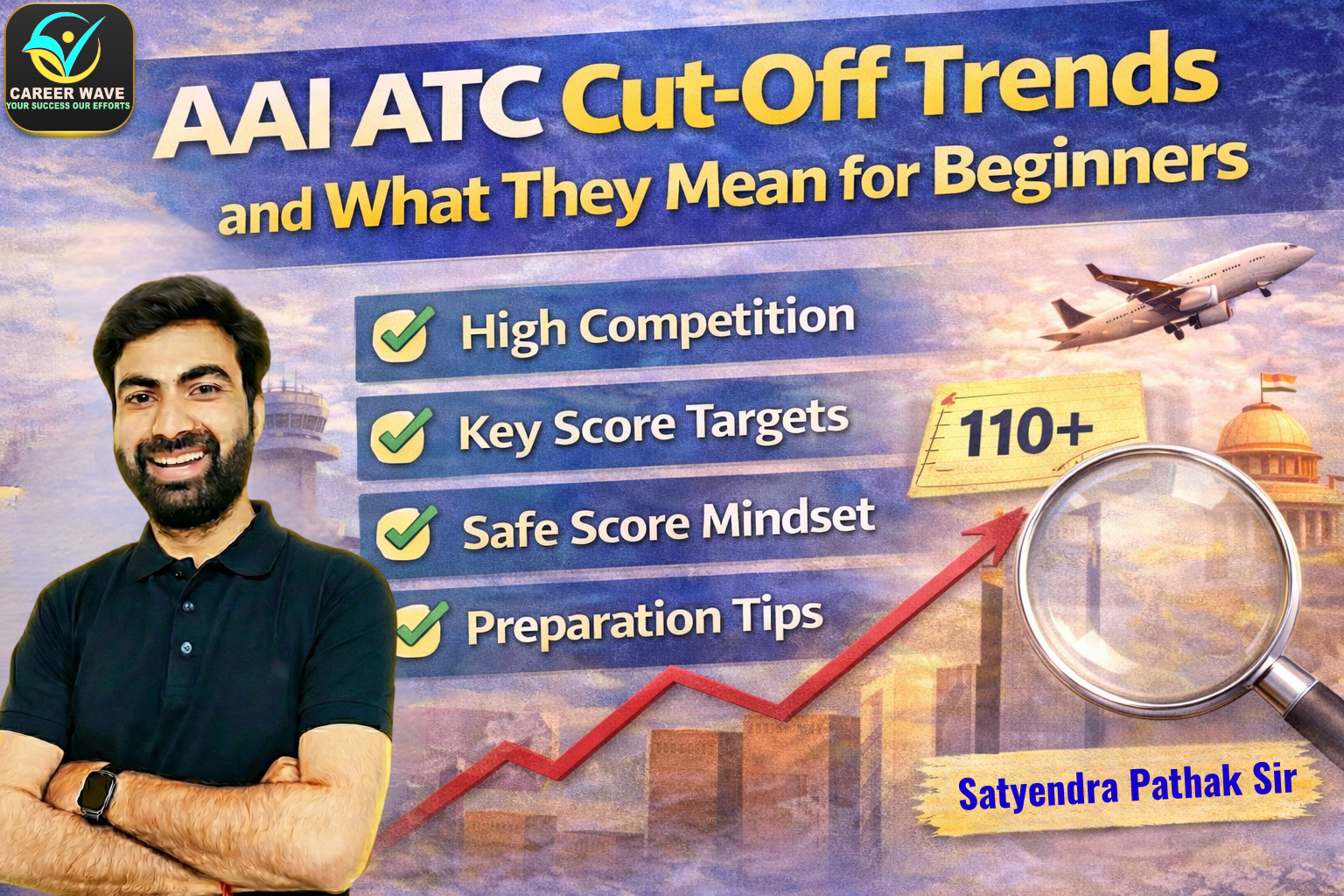
AAI ATC cut-off trends often
confuse beginners and create unnecessary fear. This blog explains why AAI ATC
cut-offs are high, how they have evolved over the years, what a safe score
means, and how beginners should plan their preparation smartly. A must-read
clarity guide for serious ATC aspirants by Career Wave.
AAI
ATC Cut-Off Trends and What They Mean for Beginners
1.
Why
Understanding the Cut-Off Is Crucial Before You Start
Most
beginners make one common mistake: they start studying books first and try to
understand the cut-off later.
In reality, the cut-off decides:
·
How much
accuracy you need
·
How fast you
must solve questions
·
Which topics
are compulsory
·
What score
you should realistically target
At Career Wave, preparation
always begins with clarity, not confusion.
Syllabus->Tech
+non-tech
2.
What Is the
AAI ATC Cut-Off?
(Simple Explanation)
The AAI ATC
cut-off is the minimum score required to move ahead in the selection
process, which includes:
·
Medical
examination (as per ATC medical standards)
·
Document
verification
·
Final merit
consideration
If your score is below the
cut-off, the selection process ends there—regardless of effort.
3.
Why the AAI
ATC Cut-Off Is Always High
The AAI ATC
cut-off remains high due to multiple strong reasons:
A) No
Negative Marking = Score Inflation
·
Candidates
attempt more questions
·
Even average
aspirants attempt 110–120 questions
·
More
attempts lead to higher scores
This is the biggest
reason behind high cut-offs in AAI ATC.
Click here-previous year questions
B) Limited
Vacancies = Tough Competition
·
Vacancies
are limited in each cycle
·
Even a
difference of .5-1 marks can change selection
·
Competition
is intense due to fewer seats
C)
Academically Strong Competition
AAI ATC is
attempted by:
·
Engineering
graduates (all branches)
·
Science
graduates with Physics and Mathematics
This creates
a strong academic crowd, naturally pushing the cut-off higher.
D) Irregular
Exam Frequency
·
AAI ATC is
not conducted every year
·
Aspirants
prepare for long periods
·
When the
exam is announced, many candidates are already exam-ready
Result: the cut-off becomes
unpredictable for beginners.
4.
What These
Cut-Off Trends Mean for Beginners
Every
beginner must understand these realities:
Truth 1: You
Are Competing With Prepared Aspirants
You are not
competing only with fresh beginners, but also with:
·
Repeat
candidates
·
Long-term
aspirants
·
Students
practicing PYQs for months or years
Late
starters automatically face higher pressure.
Truth 2:
Physics and Mathematics Decide Selection
In AAI ATC:
·
The
technical section dominates merit
·
Physics and
Mathematics are the real selection makers
·
Non-technical
subjects only help boost scores
Weak
technical preparation almost guarantees rejection.
Truth 3:
High Cut-Off Is Not Luck—It Is Preparation
A high
cut-off means:
·
Higher
attempt rates
·
Better
accuracy
·
PYQ-based
strategies were followed
Selection is systematic, not
accidental.
5.
Safe Score
Mindset for Beginners
For a general
category aspirant, a practical understanding:
·
Below 95
marks → Unsafe
·
95–105 marks
→ Borderline
·
110+ marks →
Safer competitive zone
The goal should be not just to
clear the cut-off, but to stay comfortably above it.
6.
What You
Must Do Because the Cut-Off Is High
Step 1: Stop
Waiting for the Notification
AAI ATC
rewards preparedness, not reaction.
Step 2:
Treat PYQs as Your Core Study Material
Correct
sequence:
Topic → PYQs → Revision → Test → Analysis
PYQs reveal:
·
Repeated
topics
·
Ignored
areas
·
Common
question patterns
Step 3:
Improve Accuracy Before Increasing Attempts
No negative
marking does not mean blind guessing.
It demands:
·
Smart
attempts
·
Controlled
mistakes
·
High
accuracy
Step 4:
Master High-Weight Technical Chapters First
Follow a priority-based
strategy, not random syllabus
coverage.
Step 5:
Focus on Test Analysis, Not
Just Tests
After every
test, identify:
·
Why a
question was wrong
·
Concept gap
or silly mistake
·
Time
management issues
7.
Common
Beginner Mistakes About Cut-Off
·
Panicking
after seeing last year’s cut-off
·
Changing
strategy repeatedly
·
Avoiding
technical subjects
·
Leaving PYQs
for the end
·
Starting
tests too late
Cut-off fear grows when the
preparation system is weak.
8.
Career
Wave’s Cut-Off–Proof Preparation Approach
Career Wave
focuses on:
·
Technical
dominance (Physics + Mathematics)
·
Topic-wise
priority planning
·
PYQ-linked
learning
·
Regular mock
tests with deep analysis
·
Strong
revision systems (formula and error tracking)
A strong system reduces cut-off
pressure.
9.
FAQs –
Beginner Doubts Answered
Q1.
Why is the AAI ATC cut-off so high?
Because of no negative marking, limited vacancies, and a prepared candidate
pool.
Q2.
Can a beginner clear AAI ATC?
Yes, with early start and PYQ-based preparation.
Q3.
How important is the non-technical section?
It is a score booster, not a selection decider.
Q4.
What should be the safe score target?
Aim for a 110+ mindset, especially for General category.
Q5. How can I handle high cut-off
pressure?
Focus on accuracy, PYQs, revision, and test analysis.
10. Final Message for Beginners
The AAI ATC
cut-off is high because the job is premium.
Selection is achievable if you:
·
Start early
·
Take Physics
and Mathematics seriously
·
Follow
PYQ-based preparation
·
Build a
strong test-and-analysis system
Career Wave exists to remove
confusion, build clarity, and convert clarity into selection.
Leave a Comment
10-Apr-2026 11:06 AM
Understand the real reason why AAI ATC aspirants often score less in mock tests but perform better in the actual exam. This detailed analysis by...
09-Apr-2026 04:03 PM
Explore detailed AAI ATC cutoff trends from 2018 to 2025 with category-wise analysis, safe score targets, and expert insights from Career Wave. Understand how cutoff...
09-Apr-2026 12:54 PM
Confused between score and rank in AAI ATC exam? Learn how to predict your selection using mock scores, accuracy, and real competition trends. A practical...
08-Apr-2026 11:53 AM
Most AAI ATC aspirants fail not because of lack of effort, but due to lack of proper guidance and strategy. In this detailed guide, understand...
07-Apr-2026 12:56 PM
Confused between test series and self-study for AAI ATC preparation? This detailed guide explains what actually works, how toppers prepare, and why combining both is...
07-Apr-2026 11:17 AM
Discover the exact daily study routine followed by AAI ATC top rankers. Learn how to plan your day, improve accuracy, manage time, and boost your...
