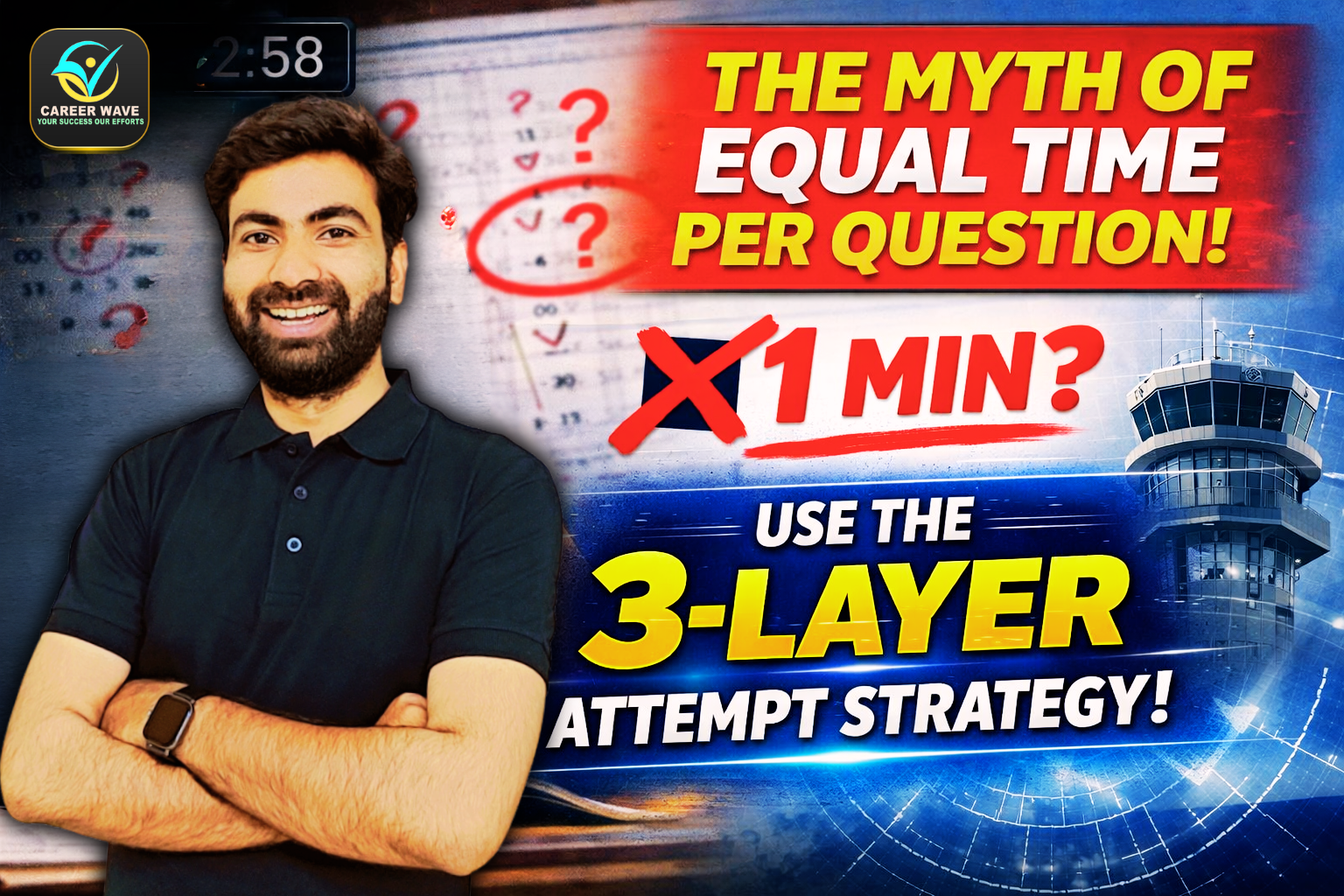
Discover why giving equal time to
every question in AAI ATC CBT is a dangerous myth. Learn the proven 3-Layer
Attempt Strategy used by serious aspirants to maximize accuracy and score
smartly.
The Myth of Equal Time Per Question in AAI ATC
The 3-Layer Attempt Strategy for
AAI ATC CBT
By Career Wave
One of the biggest myths in AAI ATC preparation is this:
“Give equal time to every question.”
It sounds fair.
It sounds logical.
But in AAI ATC CBT, it is dangerous.
At Career Wave, after analyzing hundreds of mock performances and
selected candidates’ strategies, one truth is clear:
👉 AAI ATC is
not about equal time.
👉 It is about
intelligent time distribution.
This blog breaks the myth and introduces the 3-Layer Attempt Strategy
that serious aspirants use to maximize score with stability.
1) Why Equal Time Per Question Is a Myth
Let’s think
practically.
In AAI ATC
CBT:
·
Some
questions take 20–30 seconds.
·
Some take
2–3 minutes.
·
Some are
traps.
·
Some are
direct formula-based.
If you force
equal time on all, two problems occur:
1. Easy
Questions Get Over-Analyzed
You waste
precious seconds double-checking what you already know.
2. Tough
Questions Get Emotional Time
You fight
with them longer than necessary.
Result?
·
Time
pressure increases.
·
Accuracy
drops in the final section.
·
Confidence
shakes.
At Career Wave, we call this:
“Time Equality Trap.”
2) The Reality of AAI ATC CBT
AAI ATC is
not designed to test whether you can spend 1 minute per question.
It tests:
·
Decision-making
speed
·
Concept
clarity
·
Question
selection intelligence
·
Emotional
control under time pressure
Time management is not
mathematical.
It is strategic.
3) The 3-Layer Attempt Strategy for AAI ATC
CBT
This is the
strategy we teach at Career Wave to shift aspirants from confusion to
clarity during exams.
Instead of
equal time, divide the paper into three logical layers.
Layer 1:
Direct & High-Confidence Questions (First Sweep)
These are:
·
Formula-based
numericals
·
Conceptually
clear questions
·
Questions
you instantly recognize
Time
Strategy:
Spend minimal time. Move fast.
Target:
Solve 50–60% of the paper in this layer.
Golden Rule:
If you understand the question in one reading, attempt immediately.
This builds:
·
Momentum
·
Confidence
·
Early score
security
Layer 2:
Moderate & Thinking Questions (Second Sweep)
These are:
·
Multi-step
numericals
·
Slightly
twisted conceptual questions
·
Questions
requiring structured thinking
Time
Strategy:
Return after completing Layer 1.
Here, your
confidence is already high.
Now you invest controlled thinking time.
Target:
Convert another 20–25% of questions.
Golden Rule:
If stuck for too long, mark and move. Don’t emotionally attach.
Layer 3:
Risky & Trap Questions (Final Sweep)
These are:
·
Time-consuming
numericals
·
Unfamiliar
patterns
·
Confusing
language-based questions
Time
Strategy:
Attempt only if:
·
Time allows
·
Elimination
technique works
·
Accuracy
probability is high
Target:
Selective attempts only.
Golden Rule:
Not every question deserves your time.
4) Why This Strategy Works in AAI ATC
At Career
Wave, we’ve observed this pattern:
Students
who:
·
Try to solve
in order
·
Spend equal
time
·
Fight tough
questions early
→ Experience
time pressure in the last 30 minutes.
Students
who:
·
Sweep easy
questions first
·
Build score
cushion
·
Allocate
time dynamically
→ Maintain
calm thinking till the end.
The exam rewards smart
allocation, not equal distribution.
5) Psychological Advantage of 3-Layer
Strategy
This method
also stabilizes emotions.
Instead of
thinking:
“The paper is tough.”
You think:
“Layer 1 complete. Good start.”
Small wins
reduce pressure.
By the time
you reach Layer 3, you already have a safe score base.
That changes your risk-taking
decisions.
6) What Happens If You Follow Equal Time?
Let’s
compare:
Equal Time
Strategy:
·
Start
solving in order
·
Spend 2
minutes on Q1
·
3 minutes on
Q2
·
Panic by
mid-exam
·
Rush final
20 questions
3-Layer
Strategy:
·
Clear easy
zone fast
·
Secure marks
early
·
Invest time
where needed
·
Attempt
risky questions calmly
Which one sounds like a selection
mindset?
7) Career Wave’s Ground Insight
From
analyzing selected candidates:
👉
Toppers don’t attempt linearly.
👉 They
attempt strategically.
👉 They don’t
distribute time equally.
👉 They
distribute attention intelligently.
AAI ATC is
not about solving every question.
It’s about maximizing correct
attempts within limited time.
8) Practical Implementation Plan
During
mocks:
1.
First 30–40
minutes → Only Layer 1.
2.
Next 30–35
minutes → Layer 2.
3.
Final 15–20
minutes → Layer 3 + review.
Practice
this pattern consistently.
By exam day, it becomes
automatic.
9) Final Words from Career Wave
Stop
believing the myth of fairness in time.
The exam is
not fair in question difficulty.
So, your
time should not be equal either.
Smart
aspirants don’t manage time.
They manage priorities.
Equal time
creates pressure.
Layered strategy creates control.
— Career Wave
10) FAQs – Time Strategy in AAI ATC CBT
Q1. Should I
solve questions in sequence?
Not
necessarily. If the platform allows navigation, use layered strategy instead of
strict order.
Q2. What if
I misjudge a question’s difficulty?
It’s okay.
With practice, recognition improves. Mock analysis is key.
Q3. How much
time should I spend on one question ideally?
There is no
fixed number. Instead:
·
Easy → Quick
execution
·
Moderate →
Structured thinking
·
Tough →
Selective investment
Q4. When
should I start practicing this strategy?
Immediately
during mock tests. Never experiment with a new strategy on exam day.
Q5. Does
this strategy improve accuracy?
Yes.
Because:
·
You reduce
emotional solving.
·
You avoid
rushed final attempts.
· You attempt risky questions only when safe.
Why Over-Analyzing Easy Questions Is More Dangerous Than Tough Ones
The Confidence Crash Point in AAI ATC CBT (And How to Cross It)
What Happens in the Brain When You See an Unfamiliar Question?
Leave a Comment
14-Apr-2026 10:05 AM
Confused about what to study in Maths for AAI ATC? This detailed guide by Career Wave explains high-weight topics, what to skip, PYQ strategy, accuracy...
13-Apr-2026 03:35 PM
Explore Career Wave’s outstanding performance in AAI ATC 2025 with 125 selections. Discover selected students, their strategies, preparation approach, and how structured learning helped them...
13-Apr-2026 09:40 AM
Starting AAI ATC preparation as a beginner? This complete guide by Career Wave covers exam pattern, subject priority, study plan, PYQs, mock strategy, and beginner...
11-Apr-2026 05:25 PM
Learn the complete category-wise strategy to clear the AAI ATC exam with a safe score approach. This detailed guide by Career Wave explains cutoff trends,...
10-Apr-2026 11:06 AM
Understand the real reason why AAI ATC aspirants often score less in mock tests but perform better in the actual exam. This detailed analysis by...
09-Apr-2026 04:03 PM
Explore detailed AAI ATC cutoff trends from 2018 to 2025 with category-wise analysis, safe score targets, and expert insights from Career Wave. Understand how cutoff...
