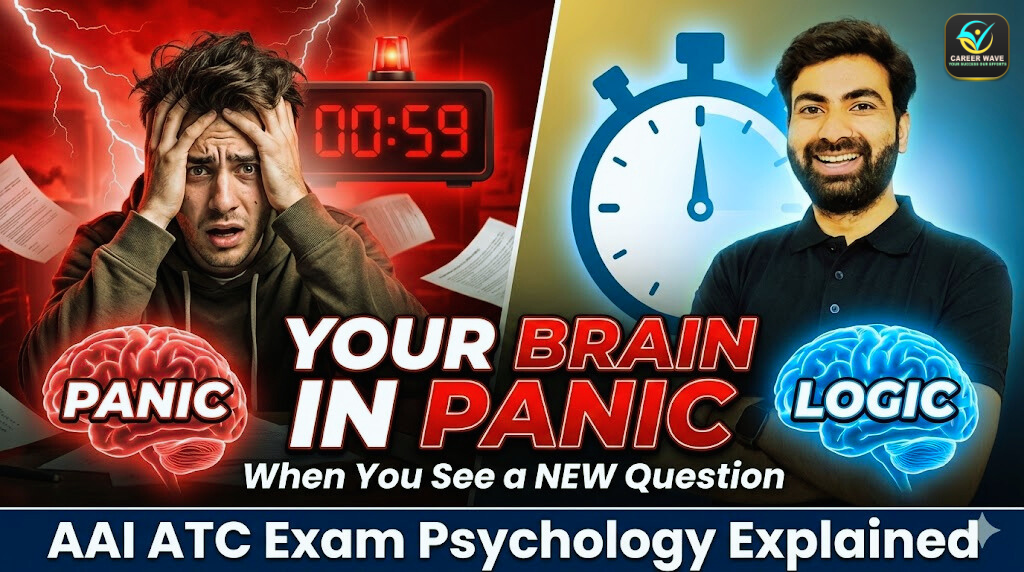
Discover the science behind exam
panic and how your brain reacts when you see an unfamiliar question. Learn how
stress affects memory, decision-making, and performance in competitive exams
like AAI ATC — and how to train your brain to stay calm and think clearly.
What Happens in the Brain When You See an Unfamiliar Question?
You’re in the exam hall.
The timer is running.
Your heartbeat increases slightly.
You read a question… and suddenly realize:
“I’ve never seen this before.”
In that exact moment, something powerful happens inside your brain.
Understanding this process can completely change how you perform in competitive
exams like the AAI ATC Exam conducted by the Airports Authority of
India.
Let’s break it down scientifically — and strategically.
1) The First Reaction: The Amygdala Activates
(Threat Detection)
When you see
an unfamiliar question, your brain quickly scans:
·
Is this
dangerous?
·
Will this
reduce my score?
·
Am I falling
behind?
The amygdala
(your emotional alarm system) activates.
This can
cause:
·
Sudden
anxiety
·
Increased
heart rate
·
Shallow
breathing
·
Panic
thoughts like “I’m not prepared”
This is not
weakness.
It’s biology.
Your brain interprets uncertainty
as a potential threat.
2) The Prefrontal Cortex vs Panic
Your prefrontal
cortex (the logical thinking part of the brain) now tries to take control.
If trained
properly, it will:
·
Break the
question into parts
·
Search for
related concepts
·
Apply
elimination logic
·
Make a
calculated decision
If not
trained, panic dominates.
And when
panic dominates:
·
Working
memory shrinks
·
Silly
mistakes increase
·
Time wastage
begins
·
Decision
quality drops
This is why two students with
equal knowledge perform very differently.
3) Working Memory Overload
When you see
something unfamiliar, your brain tries to:
·
Recall
similar patterns
·
Connect
formulas
·
Estimate
possibilities
·
Process
options simultaneously
This
overload working memory.
Under
stress, working memory capacity reduces by up to 30–40%.
That’s why:
·
You forget
simple formulas
·
You misread
options
·
You doubt
correct answers
It’s not lack of preparation.
It’s cognitive overload.
4) The Role of Pattern Recognition
High
performers don’t panic because their brain has built strong pattern
libraries.
Even if a
question looks new, they subconsciously recognize:
·
Structure
similarity
·
Conceptual
category
·
Question
type pattern
·
Hidden
shortcut possibility
This happens
through repeated exposure and decision-training.
The brain becomes efficient at
recognizing structures instead of memorizing questions.
5) Fight, Freeze, or Focus
When faced
with unfamiliar content, the brain can react in three ways:
❌
Fight (Force Solve)
You spend
too much time trying to crack it.
❌
Freeze
You stare
blankly and waste 60–90 seconds.
✅
Focus & Move
You quickly
evaluate:
·
Is this
worth solving now?
·
Can I
eliminate options?
·
Should I
skip and return?
This third response is trained —
not natural.
6) Why Mock Practice Changes Brain Wiring
Repeated
exposure to unfamiliar questions during mock tests does something powerful:
It reduces
the amygdala’s overreaction.
The brain
learns:
“This is uncomfortable, but not dangerous.”
Over time:
·
Anxiety
drops
·
Logical
thinking activates faster
·
Decision
speed improves
·
Emotional
stability increases
This is why structured mock
analysis matters more than just syllabus revision.
7) In Exams Like AAI ATC (No Negative
Marking)
Since the
AAI ATC exam currently has no negative marking:
The brain
must shift from:
“Should I attempt?”
To:
“How intelligently can I attempt?”
That
requires:
·
Calm
evaluation
·
Fast
elimination
·
Time
awareness
·
Controlled
guessing
All of this depends on neural
training, not just knowledge.
8) What Top Performers Do Differently
When toppers
see an unfamiliar question, their internal dialogue is different:
Instead of:
“I don’t know this.”
They think:
“Let’s break this down.”
Instead of
panic, they switch to analysis mode.
That switch is the real
difference.
9) How to Train Your Brain for Unfamiliar
Questions
Here are
actionable strategies:
Ø
Practice
Timed Exposure
Regularly
solve new pattern questions under strict time.
Ø
Analyze
Emotional Reaction
After mocks,
note:
·
Did you
panic?
·
Did you
overspend time?
·
Did you skip
too quickly?
Ø
Train
Elimination Logic
Even if you
don’t know the answer, remove 2 wrong options.
Ø
Simulate
Pressure
Practice
with countdown timers.
Ø
Build
Conceptual Clarity
Deep understanding reduces
uncertainty shock.
10) Final Thought
An
unfamiliar question doesn’t test your memory.
It tests
your brain’s ability to:
·
Stay calm
·
Process
efficiently
·
Make
strategic decisions
Selection
doesn’t go to the most knowledgeable mind.
It goes to
the most stable one under uncertainty.
Train your brain — not just your
syllabus.
11) FAQs – What Happens in the Brain When You
See an Unfamiliar Question?
1. Why do I
panic when I see an unfamiliar question in the exam?
When you
encounter something unfamiliar, your brain’s threat detection system (amygdala)
activates. It interprets uncertainty as risk, which can trigger anxiety, faster
heartbeat, and self-doubt. This reaction is biological — not a sign of weak
preparation.
2. Does
panic mean I am not well prepared?
Not
necessarily. Even well-prepared students experience stress. The difference lies
in how quickly the logical part of the brain (prefrontal cortex) regains
control. Training through mock tests improves this recovery speed.
3. Why do I
forget simple concepts under pressure?
Stress
reduces working memory capacity. When anxiety increases, your brain temporarily
limits how much information it can process. That’s why formulas you know well
may feel “blank” in the moment.
4. How can I reduce panic during competitive exams like AAI ATC?
You can
reduce panic by:
·
Practicing
timed mock tests regularly
·
Exposing
yourself to unfamiliar question patterns
·
Learning
elimination techniques
·
Improving
conceptual clarity
·
Practicing
breathing control before and during the exam
Repeated
exposure trains your brain to treat uncertainty as normal rather than
threatening.
5. Should I
skip unfamiliar questions immediately?
Not always.
First:
·
Scan the
question calmly
·
Check if you
recognize any related concept
·
Try
eliminating clearly wrong options
If it still feels time-consuming,
move forward and return later. Smart time management is key.
Related blogs-
Why Career Wave Focuses More on Decision-Training Than Syllabus
What Career Wave Means by ‘Exam-Ready Mindset’
Leave a Comment
13-Aug-2026 02:19 PM
Understand the real work profile of AAI AO, including airport operations, terminal management, passenger facilitation, airside support, coordination duties, shift work, salary, and Career Wave...
13-Aug-2026 01:46 PM
Learn why Business Management and Aviation Awareness are hidden scoring sections in AAI AO, including important topics, preparation strategy, PYQ approach, revision plan, and Career...
11-Aug-2026 02:39 PM
Learn which topics to prioritize and which topics to keep for later in AAI AO preparation, including Physics, Maths, Business Management, Reasoning, English, Quant, Aviation...
10-Aug-2026 01:05 PM
AAI AO has no negative marking, but does that make selection easy? Understand why high attempts, rising competition, limited vacancies, accuracy, PYQs and smart exam...
08-Aug-2026 12:27 PM
Learn why AAI AO is a golden opportunity for freshers, including no work experience requirement, ₹14 lakh approximate CTC, aviation-sector exposure, exam pattern, eligibility, preparation...
07-Aug-2026 04:05 PM
Understand the real job profile of AAI AO, including salary, actual airport operations work, shift duty, passenger facilitation, coordination responsibilities, work pressure, and Career Wave...
