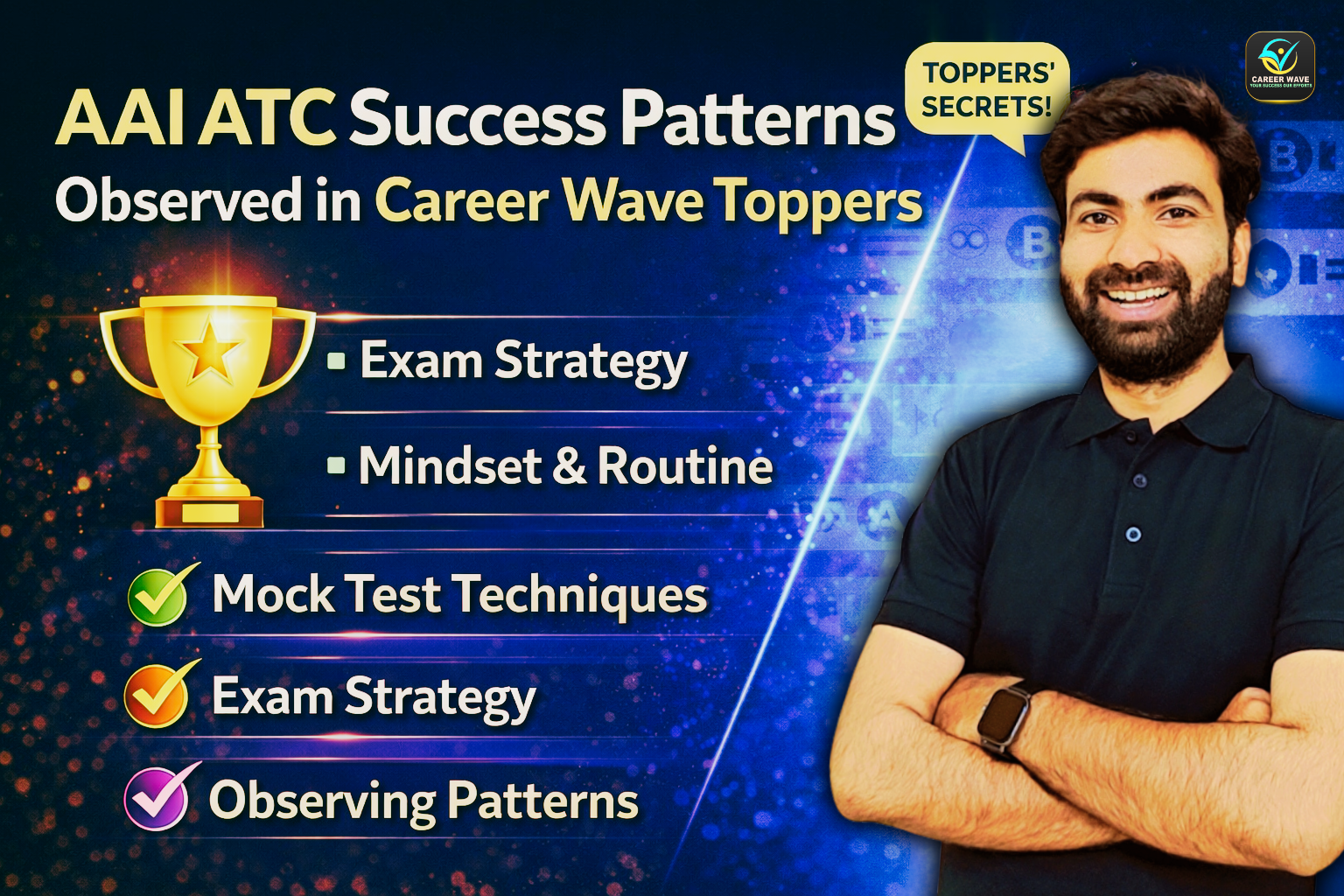
Discover the proven preparation
strategies, study patterns, mindset techniques, and daily routines followed by
Career Wave toppers to crack the AAI ATC exam. Learn how successful candidates
structured their preparation and how you can replicate their winning approach.
AAI ATC Success Patterns Observed in Career Wave Toppers
(What Actually Separates Rankers
from the Rest)
Every year, thousands of aspirants prepare seriously for AAI ATC.
Many complete the syllabus.
Many solve hundreds of questions.
Many take multiple mock tests.
Yet only a small percentage
convert preparation into selection.
After closely observing Career Wave toppers over multiple batches, one thing
becomes clear:
Selection is not random. It follows patterns.
This blog breaks down the real success patterns consistently seen in AAI ATC
toppers.
1) They Prioritize Accuracy Over Attempts
One of the
strongest patterns:
Toppers do
not chase high attempts blindly.
They focus
on:
·
Controlled
attempts
·
High
accuracy (75–85%+)
·
Smart
skipping
While
average aspirants try to attempt everything, toppers understand:
In AAI ATC,
careless mistakes cost more than missed questions.
They protect their score before
trying to increase it.
2) They Treat Mock Tests as Performance Labs
Non-selected
aspirants:
·
Take mocks
for marks
·
Feel happy
or demotivated
·
Move on
Career Wave
toppers:
·
Take mocks
for data
·
Analyze
section-wise timing
·
Track
recurring errors
·
Adjust
strategy
They
maintain:
·
Error
notebooks
·
Weak-topic
lists
·
Time
analysis sheets
Mocks are not ego checks.
Mocks are performance laboratories.
3) They Improve Daily — Even if by 1%
Toppers
don’t look for dramatic jumps.
Instead,
they:
·
Eliminate
1–2 silly mistakes daily
·
Improve time
control gradually
·
Strengthen
one weak area weekly
Over 3–4
months, this compounds into:
·
10–20-mark
improvement
·
Stable
performance
·
Higher
confidence
They understand the compound
effect of small corrections.
4) They Master PYQs Deeply
Another
common pattern:
Toppers
don’t just solve Previous Year Questions —
They decode them.
They
analyze:
·
Repeated
concepts
·
Question
framing style
·
Typical
traps
·
Difficulty
patterns
PYQs become
their benchmark.
By the time they enter the exam
hall, very little feels “new.”
5) They Develop a Fixed Attempt Strategy
Before the
exam, toppers know:
·
How many
questions they will attempt
·
Which
section they will start with
·
Maximum time
per section
·
When to stop
attempting
They do not
improvise inside the exam hall.
Their
strategy is rehearsed through multiple mocks.
This reduces panic dramatically.
6) They Separate Emotions from Performance
One key
difference:
Average
aspirant:
·
Low mock →
demotivated
·
High mock →
overconfident
Topper:
·
Low mock →
analyze
·
High mock →
analyze
Emotion does
not dictate preparation.
Data does.
They treat preparation like
structured training, not a mood-based journey.
7) They Know Their Weaknesses Precisely
Toppers
never say:
·
“Everything
is weak.”
·
“Paper was
unexpected.”
Instead,
they know:
·
Which
chapters cost them marks
·
Which
question types slow them down
·
Which
formulas they forget under pressure
Clarity
leads to targeted correction.
Vagueness leads to stagnation.
8) They Practice Under Real Conditions
AAI ATC is a
120-minute performance exam.
Toppers
simulate:
·
Full-length
timed mocks
·
Exam-like
sitting conditions
·
Distraction-free
attempts
They train
mental stamina — not just subject knowledge.
By exam day, pressure feels
familiar.
9) They Avoid Last-Minute Panic Studying
A strong
pattern observed:
Toppers
rarely restart the full syllabus near the exam.
Instead,
they:
·
Revise
formulas
·
Reattempt
wrong questions
·
Focus on
accuracy polish
Last-minute
syllabus overload is a common trait among non-selected aspirants.
Toppers trust their preparation.
10) They Build an Exam-Ready Identity
Beyond
strategy and practice, there is a mindset shift.
Non-selected
aspirants think:
“I hope I clear.”
Toppers
think:
“I am preparing to perform.”
They see
themselves as:
·
Controlled
performers
·
Strategic
test-takers
·
Calm
decision-makers
Identity influences performance.
The Core Pattern Behind All Success
If we
summarize Career Wave topper behavior in one sentence:
They focus
more on correction than completion.
They don’t
just study.
They refine.
They don’t
just practice.
They analyze.
They don’t just work hard.
They work precisely.
What This Means for You
If you want
to replicate success patterns:
Start doing
the following immediately:
✔ Track
accuracy, not just attempts
✔ Maintain a mistake notebook
✔ Analyze every mock deeply
✔ Fix weaknesses quickly
✔ Develop a stable attempt
strategy
✔ Practice emotional control
Success
leaves clues.
Career Wave
toppers are not superhuman.
They simply
follow disciplined patterns consistently.
And patterns — when repeated long
enough — create selection.
Final Thought
AAI ATC is
not about who studies the most.
It’s about
who performs the best for 120 minutes.
If your
preparation builds:
·
Stability
·
Accuracy
·
Strategy
·
Mental
control
You are
building the same success patterns observed in Career Wave toppers.
And that is how preparation turns
into selection.
FAQs – AAI ATC Success Patterns Observed in
Career Wave Toppers
Q1. Are
Career Wave toppers naturally intelligent students?
Not
necessarily.
Most toppers are not “genius-level” students — they are disciplined and
strategic.
What
separates them is:
·
Consistency
·
Strong mock
analysis
·
Accuracy
focus
·
Emotional
control
Selection in AAI ATC is more
about performance discipline than brilliance.
Q2. How many
hours do toppers study daily?
There is no
fixed number.
Some study
5–6 focused hours.
Some study 8 hours.
The
difference is:
They measure output quality, not just hours.
A topper’s 5 focused hours often
outperform 10 distracted hours.
Q3. How many
mock tests do Career Wave toppers typically take?
On average:
·
15–30
quality full-length mocks
·
Each mock
followed by detailed analysis
The key is not mock count —
It’s the depth of analysis after each test.
Q4. Do
toppers attempt more questions than others?
Not always.
Many
toppers:
·
Attempt
slightly fewer questions
·
Maintain
higher accuracy
In AAI ATC, accuracy + controlled
attempts usually rank higher than aggressive attempts with errors.
Q5. How do
toppers handle low mock scores?
They treat
low scores as feedback.
Instead of:
“I am not good enough”
They think:
“What exactly caused the drop?”
They break
down:
·
Section
timing
·
Error type
·
Attempt
strategy
Low mocks become correction
points — not emotional breakdowns.
Helpful links-
What Happens in the Brain When You See an Unfamiliar Question?
Why Career Wave Focuses More on Decision-Training Than Syllabus
What Career Wave Means by ‘Exam-Ready Mindset’
Leave a Comment
09-Sep-2026 12:05 PM
Learn the best AAI AO Full Mock Test Strategy 2026 to manage exam time effectively. Career Wave and Satyendra Sir explain section order, two-round attempt...
08-Sep-2026 02:40 PM
Learn how to improve accuracy in AAI JE Airport Operations 2026 mock tests and reduce silly mistakes. Career Wave and Satyendra Sir explain practical strategies...
08-Sep-2026 10:51 AM
Discover why mock tests are essential for AAI JE Airport Operations 2026 preparation. Learn how Full Mock Tests and Sectional Tests help improve speed, accuracy,...
07-Sep-2026 03:52 PM
Prepare for AAI JE Airport Operations 2026 with Career Wave’s exam-focused Test Series. Get Full-Length Mock Tests, Sectional Tests, latest pattern-based questions, detailed solutions, performance...
07-Sep-2026 11:27 AM
Check the complete IMD Scientific Assistant Physics Syllabus 2026 for Part-F as per the official SSC JE 2026 notification. Get chapter-wise topics including Mathematical Methods,...
05-Sep-2026 12:01 PM
Get the complete IMD Scientific Assistant Exam Pattern 2026 explained by Career Wave. Check Paper 1 and Paper 2 pattern, total questions, marks, duration, negative...
