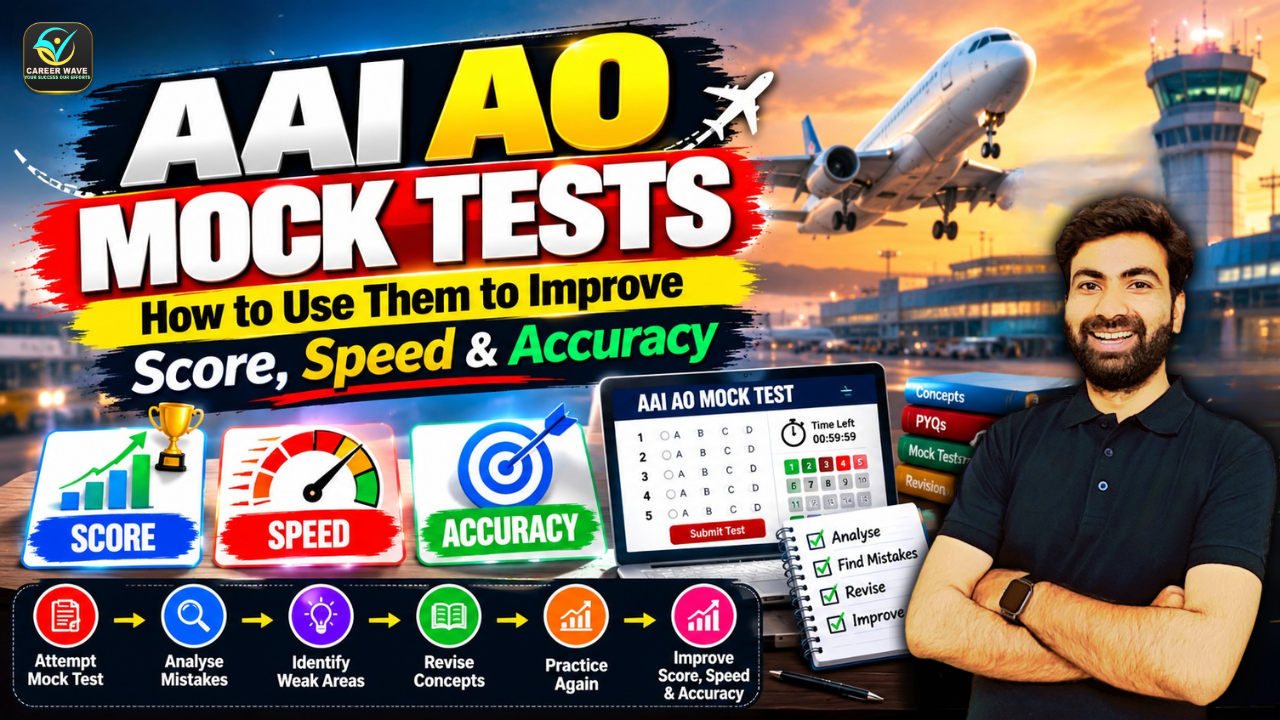
Learn how to
use AAI AO mock tests effectively to improve score, speed and accuracy.
Understand mock analysis, error tracking, time management, sectional practice,
PYQ revision and the right test strategy with Career Wave and Satyendra Sir.
Mock tests are one of the most important parts of AAI Junior Executive Airport Operations (AAI AO) preparation, but simply attempting more mocks does not automatically improve your performance.
Many students take a test, check the score, feel satisfied or disappointed, and then move directly to the next mock. The real improvement, however, happens after the test.
At Career Wave, Satyendra Sir recommends using every AAI AO mock as a performance-analysis tool:
A well-analysed mock can help you improve three critical areas:
This guide explains how to use AAI AO mock tests effectively and turn every test into measurable improvement.
Concept classes and notes help you learn.
PYQs help you understand previously asked questions.
Mock tests help you determine whether you can apply your preparation to fresh questions under test conditions.
Regular mock practice can help you evaluate:
But these benefits depend heavily on how seriously you analyse each test.
A common routine looks like this:
This gives you practice, but limited improvement.
Instead, use:
Attempt Mock → Analyse Every Error → Find the Cause → Revise → Solve Related Questions → Apply Correction in Next Mock
Your mock score is an output.
Your analysis tells you what needs to change to improve that output.
A full mock should not feel like casual question practice.
Create realistic test conditions as far as possible.
During the test:
If you repeatedly pause a mock or check concepts during the test, the resulting score will not accurately reflect your current preparation.
Career Wave provides an AAI AO Test Series with full mocks and sectional tests for structured practice.
Suppose you score higher in one mock and lower in another.
That does not automatically mean your preparation improved and then declined.
The papers may differ in difficulty or topic distribution.
Instead of tracking only the final score, track:
This provides a much clearer picture of performance.
Accuracy is one of the simplest indicators of question-solving quality.
Use:
For example:
If you attempt 100 questions and 85 are correct:
Now suppose you increase your attempts but your accuracy falls sharply.
That tells you that increased speed or aggression is producing unnecessary errors.
The objective is not simply:
It is:
After every mock, classify your questions.
You knew the concept and solved it correctly.
You selected the correct answer but were uncertain.
You attempted the question but got it wrong.
You could not confidently solve it.
The last three categories require analysis.
Do not treat a lucky guess as complete mastery simply because the final answer was correct.
This is where real mock analysis begins.
Use an error classification system:
|
Error Type |
What Happened |
Action |
|
Concept Error |
Concept not clear |
Revise theory |
|
Revision Error |
Studied but forgot |
Revise notes |
|
Calculation Error |
Method right, execution wrong |
Practise |
|
Reading Error |
Misread question |
Improve reading |
|
Option Confusion |
Stuck between choices |
Compare concepts |
|
Time Error |
Took too long |
Improve selection |
|
Guessing Error |
No clear reasoning |
Strengthen basics |
After several mocks, patterns will start appearing.
Those patterns tell you what is actually limiting your score.
Your score improves when the causes of lost marks are reduced.
After each mock, identify:
These should receive immediate attention because they represent avoidable losses.
These indicate revision gaps.
These require concept revision.
These require better reading and test discipline.
These require better selection or faster methods.
Do not simply ask:
Ask:
That question gives you something actionable.
Speed does not mean solving every question as quickly as possible.
Good speed means using your time efficiently.
After a mock, identify questions where you spent too much time.
Then ask:
or
The solution depends on the cause.
Not every question deserves equal time on the first pass.
A useful approach is:
Easy and Direct → Moderate → Time-Consuming
Do not allow one difficult question to consume time that could have been used on several manageable questions.
If one topic consistently consumes too much time, use sectional or topic-wise practice.
Follow:
Identify Slow Topic → Revise Method → Timed Practice → Sectional Test → Recheck Speed
Full mocks reveal the problem.
Focused practice fixes it.
Accuracy often falls because students rush.
The solution is not always to slow down dramatically.
Instead, identify the source of incorrect answers.
You may miss words such as:
Train yourself to identify the instruction word before selecting an answer.
If you know the formula but repeatedly make arithmetic or substitution errors, practise short timed sets.
Do not relearn the entire chapter if the concept itself is already clear.
If you regularly narrow questions down to two options but select the wrong one, your knowledge may lack precision.
Revise the exact difference between those two concepts.
During analysis, separately mark questions answered through guessing.
A guessed correct answer should still be reviewed.
If not, the concept requires revision.
Satyendra Sir recommends maintaining a simple Mock Error Log.
You can use:
|
Mock |
Topic |
Error Type |
Reason |
Action |
|
Mock 1 |
Topic A |
Concept |
Concept unclear |
Revise |
|
Mock 1 |
Topic B |
Reading |
Missed NOT |
Read carefully |
|
Mock 2 |
Topic C |
Calculation |
Wrong substitution |
Practice |
|
Mock 2 |
Topic D |
Revision |
Fact forgotten |
Revise notes |
After several tests, this becomes one of your most useful revision resources.
You will begin to see whether your mistakes are random or repetitive.
Mock tests and PYQs should not be treated separately.
Suppose a mock reveals weakness in a particular concept.
Use:
Mock Mistake → Revise Topic → Solve Related PYQs → Solve Fresh Questions → Recheck in Sectional Test
This connects exam history with current performance.
Career Wave provides available AAI AO PYQ and eBook resources for additional practice.
Both have different purposes.
Use them to evaluate:
Use them to improve:
The ideal cycle is:
Full Mock → Find Weak Section → Revise → Sectional Test → Full Mock Again
Do not judge improvement from a single test.
Track performance across multiple mocks.
A simple tracker can include:
|
Mock |
Score |
Attempts |
Accuracy |
Main Weakness |
|
Mock 1 |
— |
— |
— |
Concept |
|
Mock 2 |
— |
— |
— |
Reading |
|
Mock 3 |
— |
— |
— |
Speed |
|
Mock 4 |
— |
— |
— |
Revision |
You are moving in the right direction if, over time:
Score improvement should emerge from these changes.
There is no universal number.
Your objective should not be:
Instead ask:
A mock without analysis provides limited feedback.
If you are attempting tests so frequently that you have no time to revise your mistakes, reduce the frequency and improve the analysis.
You do not necessarily need to wait for 100% syllabus completion.
A progressive approach works better.
Testing should become more comprehensive as your syllabus coverage improves.
Follow this sequence:
1. Record your score, attempts and accuracy.
2. Identify incorrect questions.
3. Review doubtful correct questions.
4. Analyse unattempted questions.
5. Classify each important mistake.
6. Identify repeated errors.
7. Revise the required concepts.
8. Solve related PYQs or fresh questions.
9. Reattempt selected difficult questions later.
10. Carry one specific improvement target into the next mock.
or
This gives every test a clear purpose.
Avoid:
The number of mocks matters less than what you learn from them.
At Career Wave, the recommended process is:
Attempt → Analyse → Classify Errors → Revise → PYQ Practice → Sectional Practice → Next Mock
After every test, ask:
For AAI AO mock tests, PYQs, sectional tests, preparation strategies and exam guidance, stay connected with Career Wave and Satyendra Sir.
Do not use AAI AO mock tests only to measure your preparation.
Use them to improve your preparation.
A mock should tell you:
Where you
lose marks.
Where you lose time.
Why your answers go wrong.
What you need to revise next.
The most effective cycle is:
Mock → Analysis → Correction → Practice → Next Mock
That is how Career Wave and Satyendra Sir recommend using mock tests to steadily improve score, speed and accuracy for AAI AO.
Leave a Comment
23-Nov-2026 02:05 PM
What Career Wave's selected AAI ATC students did differently: real testimonials, PYQ and mock-test methods, a 6-month plan and mistakes to avoid in 2027.
23-Nov-2026 01:23 PM
AAI ATC 2027 guide: notification status, eligibility, age limit, exam pattern, syllabus, salary, 2025 cut-offs and Career Wave’s 3 live batches compared.
22-Nov-2026 03:58 PM
RRB Group D score card is out till 1 Dec and ALP CBT-1 objections are closed. Check your score, qualifying marks, PET standards and next...
22-Nov-2026 11:51 AM
AAI JE Operations 2026 answer key status, how to calculate your score out of 120, the 26 Oct paper analysis and the expected cut-off of...
22-Nov-2026 11:23 AM
SSC JE 2026 Paper-I answer key for IMD Scientific Assistant is out. Learn how to calculate your score, raise objections before 22 Nov 6 PM...
19-Nov-2026 03:50 PM
B.Sc vs B.Tech: Who has an advantage in AAI ATC 2027? Discover the right preparation strategy for B.Sc Physics, B.Sc Mathematics and Engineering graduates. Compare...
 Career WaveOn WhatsApp
36,000+ learners · 4.8★ on Google