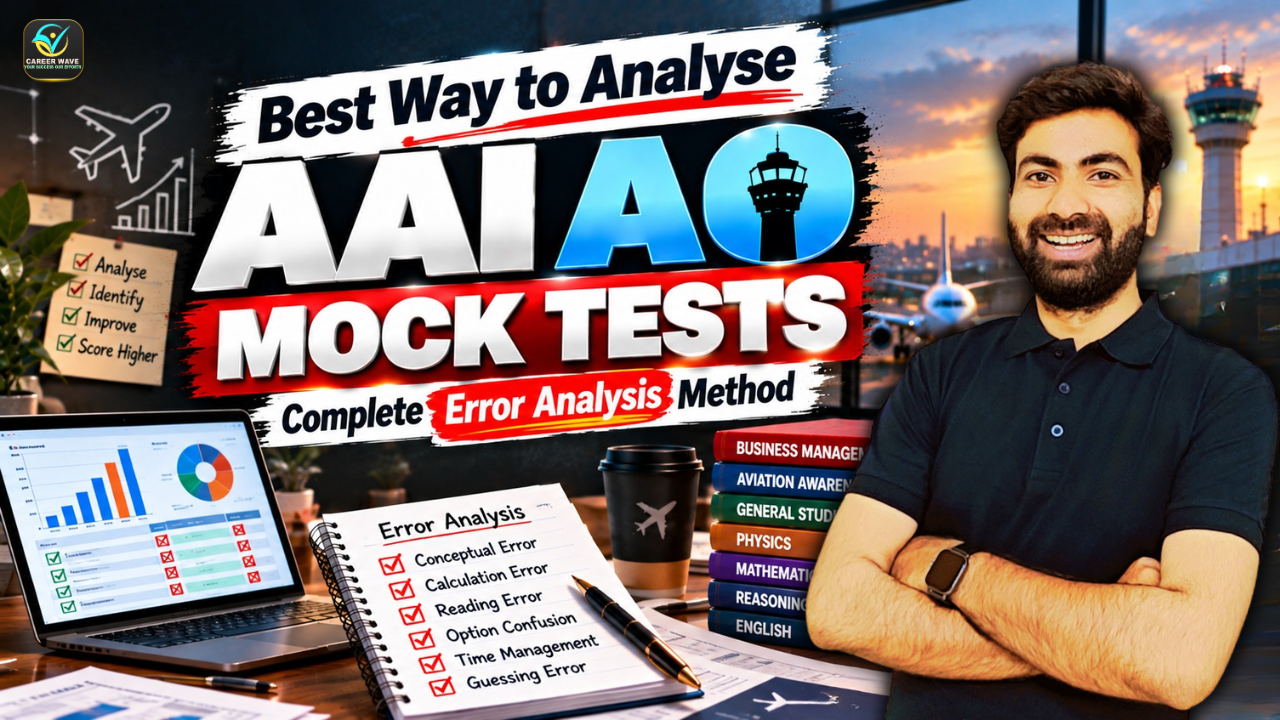
Learn the best way to analyse AAI
AO Mock Tests 2026 with Career Wave and Satyendra Sir. Discover a complete
step-by-step error analysis method to identify conceptual mistakes, improve
accuracy, increase question-solving speed, manage time effectively, and boost
your mock test scores. Understand subject-wise performance tracking, mistake
notebooks, PYQ revision, sectional tests, and full mock test strategies for AAI
Junior Executive Airport Operations 2026.
Best Way to Analyse AAI AO Mock Tests 2026:
Complete Error Analysis Method
Preparing
for the AAI Junior Executive Airport Operations (AAI AO) 2026
examination requires more than completing the syllabus and attempting mock
tests. You also need to understand your mistakes, identify weak areas, and
improve your performance with every test.
Many
aspirants attempt several mock tests but notice that their scores remain almost
the same. Some students even experience a sudden drop in marks despite studying
regularly.
The reason
is often simple: they are attempting mock tests but not analysing them
properly.
At Career
Wave, Satyendra Sir emphasises that a mock test is not just a way to check
your score. It is a tool to understand your preparation and identify exactly
where improvement is required.
A productive
mock-test strategy follows this cycle:
Attempt Mock
→ Analyse Mistakes → Identify Weak Concepts → Revise → Practise → Improve
In this guide, we will discuss
the best way to analyse AAI AO mock tests, classify different types of errors,
maintain a mock-test analysis notebook, improve accuracy, and develop an
effective revision strategy before the examination.
Why Is Mock Test Analysis Important for AAI
AO 2026?
Imagine two
students preparing for the same examination.
Student A
attempts 15 mock tests but checks only the final score and rank.
Student B
attempts 10 mock tests, carefully analyses incorrect answers, revises weak
concepts, and practises similar questions before the next test.
Although
Student A has attempted more tests, Student B may improve faster because the
mistakes identified during practice are being corrected.
This is why mock-test
analysis is just as important as attempting the test itself.
A proper
analysis helps you:
·
Identify
subjects where marks are being lost.
·
Understand
repeated conceptual mistakes.
·
Improve
question-solving accuracy.
·
Recognise
careless errors.
·
Improve time
management.
·
Identify
questions that consume unnecessary time.
·
Strengthen
weak chapters.
·
Reduce
confusion between similar options.
·
Plan
revision according to actual performance.
Remember: A mock test tells you
how you performed. Mock analysis tells you how to improve.
Step 1: Record Your AAI AO Mock Test
Performance
The first
step after completing a mock test is to record your performance.
Do not
immediately move to the next test.
Maintain a simple mock-test
performance tracker.
|
Performance
Parameter |
Example |
|
Total
Questions |
120 |
|
Attempted Questions |
110 |
|
Correct
Answers |
92 |
|
Incorrect Answers |
18 |
|
Unattempted
Questions |
10 |
|
Accuracy |
83.64% |
|
Main
Weak Area |
Business
Management |
|
Major Error Type |
Conceptual Errors |
The values
above are illustrative, not results from an actual AAI AO paper.
How to
Calculate Mock Test Accuracy
Accuracy =
(Correct Answers ÷ Attempted Questions) × 100
For example:
Correct
Answers = 92
Attempted
Questions = 110
Accuracy =
(92 ÷ 110) × 100
Accuracy =
83.64%
This means
approximately 84 out of every 100 attempted questions were answered correctly.
For any mock
test, calculate the score separately according to its applicable marking
scheme.
Satyendra Sir's Advice: Do not evaluate your preparation using only the total score.
Track accuracy, attempts, incorrect answers, and repeated mistakes together.
Step 2: Divide Questions into Four Categories
After
recording your performance, classify the questions.
This is one
of the most useful techniques for detailed AAI AO mock-test analysis.
Category 1:
Confident Correct Questions
These are
questions you answered correctly because you understood the concept.
You were
confident about the answer and could explain why the other options were
incorrect.
Action: These questions generally require only quick revision.
Category 2:
Doubtful Correct Questions
These are
questions where your answer was correct, but you were uncertain.
For example,
you were confused between options B and C and selected B.
Even if B
was correct, your conceptual understanding may still be incomplete.
Action: Revise the concept and understand why the selected option is
correct.
Category 3:
Incorrect Questions
These are
questions where you selected the wrong answer.
However,
simply marking them incorrect is not enough.
You must
identify the reason behind the mistake.
Action: Classify the error and revise the relevant topic.
Category 4:
Unattempted Questions
These are
questions you skipped or could not solve within the available time.
Some may
have been difficult, while others may have been left because of poor time
management.
Action: Determine whether the question was unattempted because of
insufficient knowledge, confusion, calculation difficulty, or lack of time.
Recommended
Priority for Analysis
Focus on:
Incorrect
Questions + Doubtful Correct Questions + Unattempted Questions
These categories usually provide
the most useful information about your weaknesses.
Step 3: Identify the Seven Major Types of
Mock Test Errors
Not every
wrong answer occurs because you lack knowledge.
Different
mistakes require different solutions.
At Career Wave, students are
encouraged to identify the exact reason behind each important error.
|
Error
Type |
Reason |
Improvement
Method |
|
Conceptual
Error |
Concept
not understood |
Revise
theory |
|
Revision Error |
Studied but forgotten |
Revise short notes |
|
Calculation
Error |
Arithmetic
or formula mistake |
Practise
numericals |
|
Reading Error |
Misread the question |
Improve reading discipline |
|
Option
Confusion |
Confused
between similar answers |
Compare
concepts |
|
Time Management Error |
Spent excessive time |
Improve question selection |
|
Guessing
Error |
Selected
without sufficient reasoning |
Strengthen
knowledge |
Let's
understand these errors in detail.
1.
Conceptual Errors
A conceptual
error occurs when you do not understand the topic properly.
For example,
you may confuse delegation with decentralisation in Business Management.
How to
improve:
·
Revisit the
original concept.
·
Understand
important definitions.
·
Study
differences between related terms.
·
Solve
topic-wise questions.
·
Reattempt
the incorrect question later.
Do not
simply memorise the correct option.
2. Revision
Errors
Sometimes
you know a concept but cannot recall it during the test.
This usually
indicates a revision gap.
How to
improve:
Maintain
short notes containing important formulas, definitions, facts, and frequently
forgotten concepts.
Revise these
notes regularly.
3.
Calculation Errors
Calculation
mistakes may occur in numerical questions even when you know the correct
method.
Common
causes include:
·
Incorrect
substitution.
·
Arithmetic
mistakes.
·
Unit
conversion errors.
·
Wrong signs.
·
Formula
application errors.
How to
improve:
Practise
similar numerical questions and identify the exact calculation step where the
mistake occurred.
4. Reading
Errors
Students
sometimes lose marks because they fail to read the question carefully.
Words such
as:
NOT,
Incorrect, Except, Maximum, Minimum, Most Appropriate
can
completely change the meaning of a question.
How to
improve:
Identify the
instruction word before evaluating the options.
Avoid
selecting an answer based only on the first few words of the question.
5. Option
Confusion
This occurs
when two or more options appear similar.
For example,
a Business Management question may contain closely related management
functions.
How to
improve:
Study the
exact differences between the concepts.
Prepare
comparison tables wherever necessary.
6. Time
Management Errors
Some
students spend too much time on difficult questions and later struggle to
attempt easier ones.
How to
improve:
Practise
identifying questions that can be solved quickly.
Use a
multi-round attempt strategy and return to time-consuming questions later.
7. Guessing
Errors
A guessed
answer may sometimes be correct, but that does not mean the concept is clear.
How to
improve:
Review
questions answered through guessing, especially when you cannot explain the
correct option.
Avoid depending on random
guessing as a preparation strategy.
Step 4: Perform Subject-Wise AAI AO Mock Test
Analysis
Overall mock
scores do not reveal which subjects need the most attention.
Subject-wise
analysis is therefore essential.
For AAI AO
preparation, organise your analysis according to the subjects included in the
applicable examination syllabus.
A sample analysis format is given
below.
|
Subject |
Accuracy |
Main
Problem |
Action |
|
Physics |
80% |
Formula
recall |
Revise
formulas |
|
Mathematics |
75% |
Calculation speed |
Timed practice |
|
Reasoning |
90% |
Few
reading errors |
Maintain
accuracy |
|
English |
85% |
Grammar confusion |
Revise rules |
|
Business
Management |
70% |
Concept
confusion |
Topic-wise
revision |
|
General Studies |
75% |
Memory gaps |
Rapid revision |
|
Aviation
Awareness |
80% |
Factual
recall |
Revise
notes |
These are
illustrative performance values, not actual subject-wise exam results.
How to
Identify Your Weakest Subject
Do not
identify weakness only through low marks.
Consider:
Accuracy +
Time Taken + Repeated Errors + Topic Coverage
For example,
if Business Management has low accuracy because of conceptual confusion,
additional mock tests alone may not solve the problem.
You need to revise the concepts
before attempting another sectional test.
Step 5: Analyse the Time Spent on Questions
Time
management is an important part of mock-test performance.
Some
students know the answers but cannot attempt enough questions because they
spend excessive time on difficult problems.
After every
mock, ask:
·
Which
questions took the most time?
·
Were those
questions genuinely difficult?
·
Did I spend
too much time on calculations?
·
Did I
repeatedly reread questions?
·
Did I leave
manageable questions because of poor time allocation?
Use a
Three-Round Question Attempt Strategy
Round 1:
Easy and Direct Questions
Attempt
questions that can be solved confidently without excessive time.
Round 2:
Moderate Questions
Return to
questions requiring calculations or additional thinking.
Round 3:
Difficult or Time-Consuming Questions
Use the
remaining time to reconsider difficult questions and review marked answers.
The exact
time allocation should depend on your strengths and the examination
instructions.
Important: Do not allow one difficult question to consume the time needed
for several manageable questions.
Step 6: Maintain an AAI AO Mock Test Error
Notebook
An error
notebook is one of the most practical tools for improving performance.
Instead of
rewriting complete solutions, record the reason behind each important mistake.
Sample Mock Test Error Notebook
|
Mock |
Subject |
Mistake |
Reason |
Corrective
Action |
|
Mock 1 |
Physics |
Wrong
formula |
Revision
gap |
Revise
formula sheet |
|
Mock 1 |
English |
Grammar error |
Rule confusion |
Practise grammar MCQs |
|
Mock 2 |
Mathematics |
Calculation
mistake |
Rushed
solution |
Timed
practice |
|
Mock 2 |
Business Management |
Wrong principle |
Concept unclear |
Revise theory |
|
Mock 3 |
Reasoning |
Incorrect
option |
Reading
error |
Read
instructions carefully |
After
attempting several mock tests, review the notebook.
If the same
error appears repeatedly, prioritise that weakness.
Your error notebook should become
a personalised revision guide.
Step 7: Connect Mock Test Mistakes with AAI
AO PYQs
Mock tests
and Previous Year Questions should support each other.
Suppose you
make repeated mistakes in a particular topic during full mock tests.
Instead of
attempting another mock immediately, follow this process:
Mock Mistake
→ Identify Topic → Revise Concept → Solve Related PYQs → Practise Fresh
Questions → Recheck
This helps
you understand both the concept and how it has been tested previously.
Career Wave
provides available AAI AO PYQ and eBook resources for exam-oriented practice.
AAI AO PYQs
and eBooks:
https://careerwave.org/ebooks
Remember that solving the same
PYQ repeatedly is not enough. You should also practise fresh questions to
verify your conceptual understanding.
Step 8: Use Sectional Tests to Correct Weak
Subjects
Full mock
tests reveal overall performance.
Sectional
tests help you improve specific areas.
For example,
if your mock analysis shows repeated mistakes in Business Management, revise
the relevant chapters and attempt a focused sectional test.
Similarly,
if your Mathematics performance is affected by slow calculations, practise
timed numerical sets.
Recommended
Improvement Cycle
Full Mock →
Identify Weak Subject → Revise → Sectional Test → Analyse → Full Mock Again
This
approach is more effective than repeatedly attempting full mocks without
addressing the underlying weaknesses.
Students can
explore the AAI AO Test Series 2026 by Career Wave, which includes full
mock tests and sectional tests.
AAI AO Test Series 2026:
https://careerwave.org/test-series/32-aai-ao-test-series-2026-full-mock-tests-sectional-tests
Step 9: Compare Your Performance Across
Multiple Mock Tests
A single
mock score does not provide a complete picture of your preparation.
Mock tests
may differ in difficulty and topic distribution.
Therefore,
track performance across several tests.
Sample AAI AO Mock Test Progress
Tracker
|
Mock
Test |
Score |
Accuracy |
Major
Weakness |
|
Mock 1 |
78 |
75% |
Conceptual
errors |
|
Mock 2 |
84 |
80% |
Calculation errors |
|
Mock 3 |
89 |
84% |
Reading
mistakes |
|
Mock 4 |
94 |
88% |
Time management |
|
Mock 5 |
98 |
90% |
Minor
revision gaps |
The scores
and percentages above are hypothetical examples.
A positive
trend may indicate improvement, but you should also consider differences in
mock difficulty.
Look for
changes such as:
·
Fewer
repeated mistakes.
·
Better
accuracy.
·
Improved
time management.
·
Reduced
option confusion.
·
Stronger
performance in weak subjects.
·
Better
application of concepts in fresh questions.
Step 10: Follow a 30-Minute Quick Mock
Analysis Method
When time is
limited, use a short analysis session to identify your most important
weaknesses.
This is a suggested quick-review
method, not a replacement for detailed analysis when needed.
|
Time |
Task |
|
First
5 Minutes |
Record
score, attempts and accuracy |
|
Next 10 Minutes |
Review incorrect questions |
|
Next 5
Minutes |
Review
doubtful correct answers |
|
Next 5 Minutes |
Identify repeated errors |
|
Final
5 Minutes |
Prepare
the next revision target |
Total: 30 Minutes
For a
full-length mock, detailed analysis may require considerably more time,
particularly when many questions involve unfamiliar concepts.
The goal is to complete
meaningful analysis rather than follow a fixed time limit.
How to Improve AAI AO Mock Test Scores
Through Error Analysis
The most
effective way to improve your score is to reduce avoidable mistakes.
Suppose your
mock analysis reveals that you frequently lose marks because of reading errors.
Your next
target should be to reduce those errors.
If your main
problem is formula recall, revise your formula sheets.
If your main
problem is conceptual confusion, revisit the relevant chapters.
Different
weaknesses require different solutions.
Do not use the same revision
strategy for every mistake.
Satyendra Sir's Three-Point Improvement
Method
At Career
Wave, Satyendra Sir recommends focusing on three performance indicators.
1. Accuracy
Reduce
incorrect answers caused by confusion, calculation mistakes and careless
reading.
2. Speed
Improve
question selection and reduce unnecessary time spent on difficult problems.
3.
Conceptual Clarity
Revise the
topics responsible for repeated errors and practise related questions.
When these three areas improve
together, mock-test performance can become more consistent.
Common Mistakes Students Make During Mock
Test Analysis
Even serious
aspirants sometimes analyse mock tests incorrectly.
Avoid these
common mistakes:
1.
Checking
only the final score.
2.
Ignoring
doubtful correct answers.
3.
Not
reviewing unattempted questions.
4.
Memorising
correct options without understanding concepts.
5.
Attempting
another mock immediately without revision.
6.
Comparing
scores without considering difficulty.
7.
Not
maintaining an error notebook.
8.
Repeating
the same mistakes across multiple tests.
9.
Ignoring
weak subjects.
10. Focusing only on the number of mocks attempted.
Remember: More mock tests do not
automatically mean better preparation. Better analysis creates opportunities
for improvement.
Satyendra Sir's Recommended AAI AO Mock
Analysis Strategy
At Career
Wave, Satyendra Sir recommends a systematic approach to mock-test
improvement.
After every
test:
Step 1: Record your score and accuracy.
Step 2: Review incorrect, doubtful and unattempted questions.
Step 3: Classify the mistakes.
Step 4: Identify weak subjects and topics.
Step 5: Revise the relevant concepts.
Step 6: Solve related PYQs and fresh questions.
Step 7: Attempt targeted sectional tests.
Step 8: Evaluate your improvement in the next full mock.
The
objective is not to achieve a perfect score in every mock.
It is to make sure that the
mistakes identified today are less likely to be repeated tomorrow.
FAQs –
1. What is
the best way to analyse AAI AO mock tests?
Record your performance, classify
questions, identify error types, revise weak topics, and practise similar
questions before attempting the next mock.
2. How much
time should I spend analysing an AAI AO mock test?
It depends on the number and
complexity of mistakes. A quick review may take around 30 minutes, but detailed
full-mock analysis can require substantially more time.
3. Should I
analyse correctly answered questions?
Yes, particularly questions
answered through guessing or uncertainty. Confidently correct questions
generally require less attention.
4. How can I
improve my AAI AO mock test score?
Identify where you are losing
marks, correct repeated errors, strengthen weak concepts, and track performance
across multiple tests.
5. How can I
improve accuracy in AAI AO mock tests?
Analyse incorrect answers, reduce
reading and calculation errors, improve conceptual clarity, and avoid
unnecessary guessing.
6. What
should I do if my AAI AO mock score decreases?
Review the paper's difficulty,
topic distribution, accuracy, and error patterns. A lower score in one mock
does not necessarily indicate weaker preparation.
7. Should I
attempt another mock immediately after completing one?
Not always. First analyse the
test and correct important weaknesses. Then attempt another mock when you can
meaningfully evaluate improvement.
8. Are
sectional tests useful for AAI AO preparation?
Yes. Sectional tests help
students practise weak subjects and improve accuracy in specific areas.
9. Where can
I find AAI AO PYQs?
You can
explore available previous year questions and eBook resources through Career
Wave.
AAI AO PYQs:
https://careerwave.org/ebooks
10. Where
can I attempt AAI AO mock tests?
Career Wave
provides an AAI AO Test Series with full mock tests and sectional tests.
AAI AO Test Series 2026:
https://careerwave.org/test-series/32-aai-ao-test-series-2026-full-mock-tests-sectional-tests
11. Is
accuracy more important than the number of attempts?
Both matter. High attempts with
poor accuracy can reduce performance, while very few attempts may limit your
score. The objective is to maximise correct answers within the available time.
12. What is
Satyendra Sir's recommended mock-test analysis method?
Follow:
Attempt →
Analyse → Classify Errors → Revise → Practise → Reattempt → Improve
This creates a continuous
improvement process.
Prepare for AAI AO 2026 with Career Wave
Preparing
for the AAI Junior Executive Airport Operations examination requires a
combination of conceptual understanding, PYQ practice, mock tests and regular
revision.
At Career
Wave, Satyendra Sir focuses on helping aspirants identify weaknesses,
strengthen concepts and develop exam-oriented preparation strategies.
Students can
explore the following resources.
AAI AO Test
Series 2026
Practise
full mock tests and sectional tests to evaluate your preparation.
https://careerwave.org/test-series/32-aai-ao-test-series-2026-full-mock-tests-sectional-tests
AAI AO
Previous Year Questions and eBooks
Explore
available AAI AO previous year question resources for revision and practice.
Connect with Career Wave
YouTube –
Career Wave
https://www.youtube.com/@CAREERWAVE
Telegram –
AAI ATC & AO Preparation
https://t.me/aai_atc
Instagram –
Career Wave
https://www.instagram.com/careerwave.atc
Facebook – Career Wave
https://www.facebook.com/careerwave.atc
Final Takeaway
The best way
to improve your AAI AO mock test performance is not simply to attempt
more tests.
It is to
understand why you are losing marks and systematically correct those mistakes.
Every mock
should answer three important questions:
Where am I
losing marks?
Why am I
making these mistakes?
What should
I improve before my next test?
Follow the
cycle:
Mock Test →
Error Analysis → Concept Revision → Targeted Practice → Next Mock
With
consistent practice, detailed analysis and structured revision, Career Wave
and Satyendra Sir aim to help AAI AO aspirants improve their accuracy,
speed and overall exam readiness.
Career Wave | Your Success, Our Efforts
Leave a Comment
13-Oct-2026 02:13 PM
Learn the best way to analyse AAI AO Mock Tests 2026 with Career Wave and Satyendra Sir. Discover a complete step-by-step error analysis method to...
12-Oct-2026 02:58 PM
How many AAI AO PYQs should you solve before the 2026 exam? Learn the ideal daily PYQ practice targets, subject-wise preparation strategy, revision techniques, mistake...
08-Oct-2026 03:20 PM
Prepare for AAI AO Business Management 2026 with Career Wave and Satyendra Sir. Learn how to improve your score through Business Management mock tests, important...
07-Oct-2026 04:44 PM
Learn how to use AAI AO mock tests effectively to improve score, speed and accuracy. Understand mock analysis, error tracking, time management, sectional practice, PYQ...
06-Oct-2026 01:54 PM
Learn the most common mistakes students make while solving AAI AO PYQs, from memorising answers and ignoring options to skipping mistake analysis and revision. Follow...
05-Oct-2026 04:40 PM
Confused between AAI AO PYQs and mock tests? Learn what to practice first, when to start sectional and full mocks, how to analyse mistakes, and...
