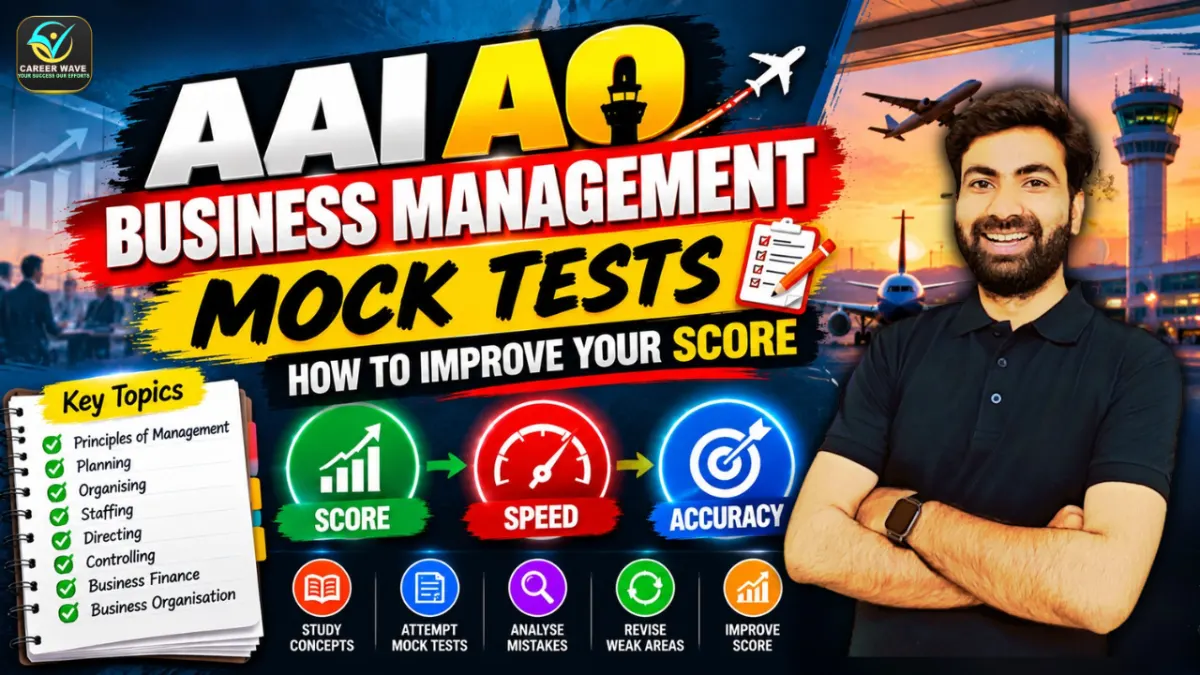
Prepare for AAI AO Business
Management 2026 with Career Wave and Satyendra Sir. Learn how to improve your
score through Business Management mock tests, important topics, NCERT concepts,
PYQs, sectional practice, error analysis, time management and effective
revision strategies.
Preparing for the AAI Junior Executive Airport Operations (AAI AO) 2026 exam requires more than completing the syllabus. You need to understand concepts, recognise how questions are framed, and apply your knowledge accurately during the examination.
For students preparing for the Business Management section, mock tests can play an important role in improving performance.
Business Management is a subject where students often feel confident after reading a chapter but struggle when similar terms, management principles, or application-based questions appear in MCQs.
At Career Wave, Satyendra Sir recommends combining conceptual preparation with regular question practice, previous year questions, and detailed mock-test analysis.
The strategy is simple:
Learn Concepts → Revise → Solve PYQs → Attempt Mock Tests → Analyse Mistakes → Improve Accuracy
In this guide, we will discuss how to use AAI AO Business Management mock tests effectively, which topics deserve attention, how to avoid common mistakes, and how to improve your score through structured preparation.
Business Management is not just about remembering definitions. Students also need to understand how management concepts work in practical situations.
For example, a question may test the meaning of planning, but another question may describe a workplace situation and ask which management function is being performed.
Both questions involve the same subject, but the approach required is different.
Mock tests help students practise these variations.
Regular Business Management practice can help you:
The purpose of a mock test is not only to measure your score. It is to identify what is preventing you from scoring better.
Students should use the applicable AAI AO syllabus as their primary reference. For Business Management preparation, the following areas are useful for organising conceptual revision and MCQ practice.
|
Topic |
What to Focus On |
|
Nature and Significance of Management |
Meaning, objectives, levels and functions |
|
Principles of Management |
Fayol's principles and Taylor's scientific management |
|
Business Environment |
Dimensions, features and business impact |
|
Planning |
Meaning, importance, limitations and planning process |
|
Organising |
Organisational structure, delegation and decentralisation |
|
Staffing |
Recruitment, selection, training and development |
|
Directing |
Motivation, leadership, communication and supervision |
|
Controlling |
Steps, importance and relationship with planning |
|
Business Finance |
Sources of finance, financial decisions and working capital |
|
Business Organisation |
Forms of business ownership and their characteristics |
These are suggested revision areas, not a verified prediction of the 2026 paper's topic-wise distribution.
One common mistake students make is starting mock tests before understanding the basic concepts.
For Business Management, this approach can create unnecessary confusion.
Suppose you are studying the management function of organising.
You should first understand:
After understanding these concepts, attempt relevant MCQs.
Satyendra Sir's recommendation: Do not memorise a management definition without understanding its practical meaning.
A clear concept helps you answer direct questions as well as questions based on situations.
If you have recently completed a chapter, begin with topic-wise questions.
For example, after studying Principles of Management, practise questions involving Fayol's principles, Taylor's techniques, and differences between related concepts.
This helps you identify whether the chapter is genuinely clear.
A useful preparation sequence is:
Repeat this cycle for each topic before moving to mixed-topic tests.
Once several chapters are completed, move to sectional tests and then full mock tests.
Business Management contains several concepts that students frequently confuse.
Examples include:
Consider this question:
Question: Which management function involves comparing actual performance with predetermined standards?
(a) Planning (b) Organising (c) Controlling (d) Staffing
Correct Answer: (c) Controlling
Explanation: Controlling involves measuring actual performance, comparing it with established standards, identifying deviations and taking corrective action when required.
Planning establishes objectives and standards, while controlling checks whether performance aligns with them.
Understanding this distinction makes similar questions easier to solve.
Many students attempt a mock test, check their marks and immediately start another test.
This is not the most effective approach.
After completing a Business Management mock, classify your questions into four categories.
|
Category |
Meaning |
Action |
|
Confident Correct |
Concept clearly understood |
Quick revision |
|
Doubtful Correct |
Correct answer with uncertainty |
Review concept |
|
Incorrect |
Wrong answer selected |
Analyse mistake |
|
Unattempted |
Could not determine the answer |
Study relevant topic |
Pay particular attention to doubtful correct answers.
A question answered correctly through guessing should not be considered fully mastered.
Your score alone cannot explain the reason behind your mistakes.
For example, two students may receive the same score but have completely different weaknesses.
One may struggle with management principles, while another may understand the concepts but misread questions.
Use an error-analysis table.
|
Error Type |
Example |
Improvement Strategy |
|
Conceptual Error |
Confusing delegation with decentralisation |
Revise differences |
|
Memory Error |
Forgetting a management principle |
Use short notes |
|
Reading Error |
Missing the word "incorrect" |
Read instructions carefully |
|
Application Error |
Unable to identify a principle in a situation |
Practise case-based MCQs |
|
Option Confusion |
Two similar answers |
Compare definitions |
|
Guessing Error |
Selecting without sufficient knowledge |
Strengthen concepts |
At Career Wave, the recommended approach is to correct these weaknesses before attempting the next mock.
Business Management questions may appear easy because many options contain familiar terminology.
However, familiar terminology does not always mean the option is correct.
Read the complete question before selecting an answer.
Pay attention to words such as:
Incorrect, NOT, Except, Most Appropriate, Primary and Main Objective.
These words can change the required answer.
For example, a question asking for a feature of planning is different from one asking which statement is not a feature of planning.
Previous Year Questions and mock tests serve different purposes.
PYQs help you understand how concepts have been tested in previous examinations.
Mock tests help you practise fresh questions and evaluate your current performance.
For Business Management, use PYQs to identify important conceptual differences and question formats, then practise those concepts through fresh MCQs.
Students can explore available AAI AO previous year question resources and eBooks on Career Wave.
Access AAI AO PYQs and eBooks
You do not need to rewrite complete chapters after every mock.
Instead, maintain short revision notes containing:
For example:
Delegation: Transfer of authority to a subordinate to perform assigned tasks; the manager remains accountable.
Decentralisation: Systematic distribution of decision-making authority across different levels of an organisation.
Short comparison notes make revision faster and more effective.
Business Management is largely concept-oriented, so speed often improves when students can recognise concepts without repeatedly analysing every option from the beginning.
However, avoid rushing.
Use the following approach:
Read Question → Identify Concept → Evaluate Options → Select Answer → Move Ahead
For lengthy situation-based questions, identify the management action described before comparing the options.
If a question remains confusing, do not spend excessive time on it during a timed test. Move forward and return later if time permits.
This is a sample revision plan for students who have already covered the main concepts.
|
Day |
Preparation Task |
|
Day 1 |
Attempt a Business Management sectional test and analyse errors |
|
Day 2 |
Revise management principles, planning and organising |
|
Day 3 |
Practise directing, staffing and controlling MCQs |
|
Day 4 |
Solve relevant PYQs and review incorrect options |
|
Day 5 |
Attempt another sectional test and compare accuracy |
|
Day 6 |
Revise weak topics and the error notebook |
|
Day 7 |
Attempt mixed-topic practice and consolidate short notes |
The objective is not to study every chapter repeatedly. It is to strengthen the topics where your test performance indicates weaknesses.
A sectional test measures your performance in a particular subject.
A full mock measures how effectively you perform across the examination.
Both are important.
If your Business Management accuracy is low in a full mock, revise the weak topics and practise related questions before taking another full test.
The recommended cycle is:
Full Mock → Identify Business Management Errors → Revise → Sectional Practice → Full Mock Again
Career Wave provides an AAI AO Test Series with full mock tests and sectional tests.
Explore AAI AO Test Series 2026 – Full Mocks and Sectional Tests
Students should avoid the following habits:
1. Memorising definitions without understanding concepts.
2. Ignoring differences between similar management terms.
3. Attempting mocks without reviewing incorrect answers.
4. Treating guessed correct answers as mastered.
5. Skipping application-based questions.
6. Studying only important questions and ignoring syllabus coverage.
7. Solving repeated questions without fresh practice.
8. Not maintaining short revision notes.
9. Ignoring Business Management weaknesses identified in full mocks.
10. Attempting too many tests without sufficient revision.
The most important rule is to learn from every mistake rather than simply attempting more questions.
At Career Wave, Satyendra Sir recommends focusing on three important areas.
Concept Clarity: Understand the meaning, features, principles and applications of management topics.
Question Practice: Solve topic-wise MCQs, relevant PYQs, sectional tests and full mocks.
Performance Analysis: Identify mistakes, revise weak concepts and measure whether accuracy improves in subsequent tests.
A simple preparation formula is:
Concept + PYQ + Mock Test + Analysis + Revision = More Effective Preparation
Mock tests should be used as a learning tool, not just a scorecard.
At Career Wave, Satyendra Sir focuses on helping aspirants strengthen their concepts, practise examination-oriented questions and use mock-test analysis to improve performance.
For AAI AO Business Management preparation, students can access the following resources.
AAI AO Test Series 2026
Full mock tests and sectional practice
View Test Series
AAI AO Previous Year Questions
Available PYQ and eBook resources
Explore eBooks
Improving your AAI AO Business Management score is not about memorising hundreds of MCQs or attempting mock tests without a plan.
It requires understanding management concepts, identifying repeated mistakes, revising weak areas and applying what you have learned in fresh questions.
Remember:
Do not just complete mock tests. Use every mock test to become better prepared for the next one.
With structured concept revision, PYQ practice and mock-test analysis, Career Wave and Satyendra Sir aim to help AAI AO aspirants prepare more effectively for the Business Management section.
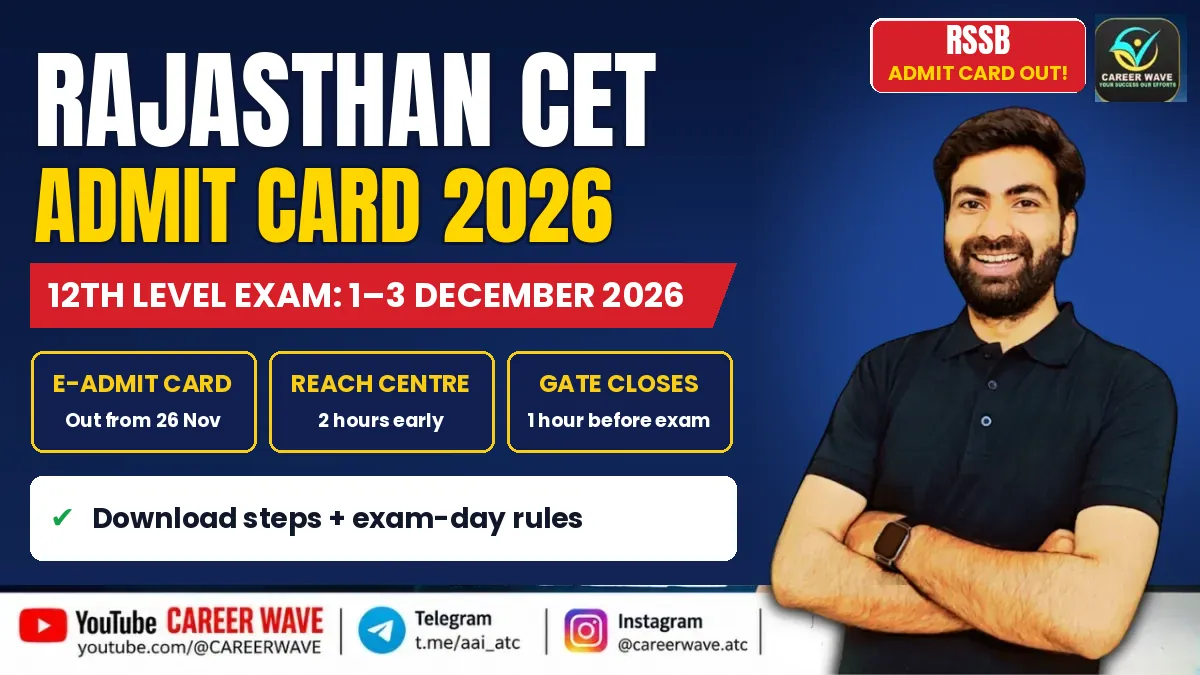 Rajasthan CET 12th Level Admit Card 2026 Out: Exam 1–3 December, Download Steps
26 Nov 2026
 UGC NET December 2026 City Slip Out: Exam 14–21 Dec, Subject-wise Schedule
26 Nov 2026
 AAI JE Electronics (CNS) Recruitment: CBT Instead of GATE Under Consideration
25 Nov 2026
 SSC GD PET/PST 2026 Date Clash with SI Exam: How to Ask for a New Date
25 Nov 2026
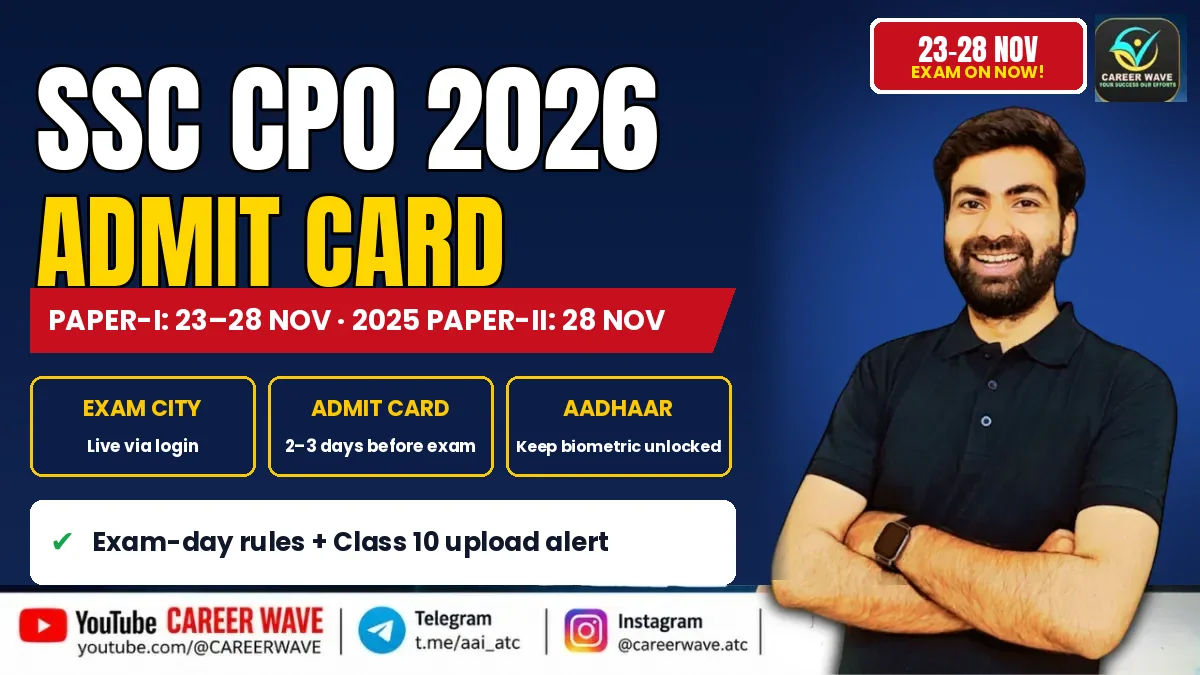 SSC CPO Admit Card 2026: Paper-I 23–28 Nov, 2025 Paper-II on 28 Nov
25 Nov 2026
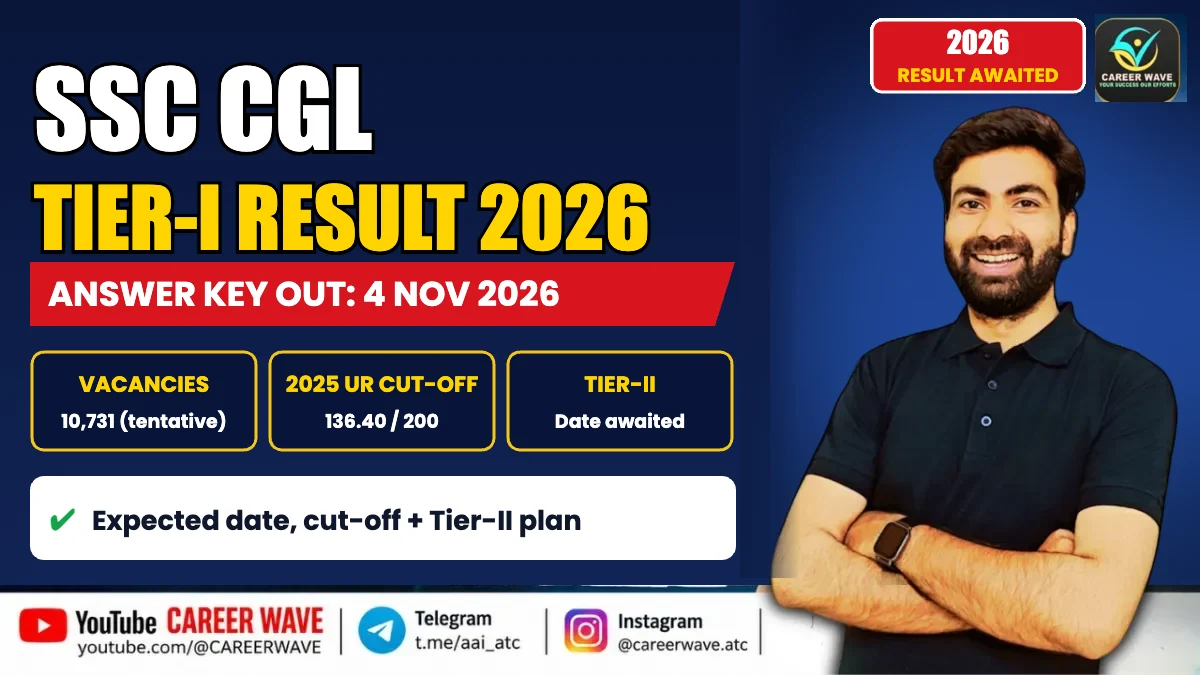 SSC CGL 2026 Tier-I Result: Expected Date, Cut-off and Next Steps
24 Nov 2026
Leave a Comment
Ask a doubt or share your view. Only your name is shown with the comment.
26-Nov-2026 01:23 PM
Rajasthan CET 12th Level (Senior Secondary) admit card 2026 is out from 26 November. Exam on 1, 2 and 3 December 2026 in two shifts;...
26-Nov-2026 10:23 AM
UGC NET December 2026 exam city intimation slip is out on ugcnet.nta.nic.in. Exam on 14–18 and 21 December 2026 in two shifts; admit card to...
25-Nov-2026 09:52 PM
AAI meeting minutes say JE (CNS) recruitment through its own CBT instead of GATE is under consideration with MoCA. What it means for 2026-27 aspirants.
25-Nov-2026 04:28 PM
SSC GD 2026 PET/PST clashing with the SI in Delhi Police & CAPF exam (23–28 Nov)? Email the CRPF with your roll number and proof....
25-Nov-2026 04:28 PM
SSC CPO 2026 Paper-I runs 23–28 Nov and 2025 Paper-II is on 28 Nov. Admit card comes 2–3 days before. Aadhaar rule, Class 10 alert...
24-Nov-2026 07:54 PM
SSC CGL 2026 Tier-I result is awaited; the answer key came on 4 Nov. Expected date, 10,731 vacancies, last year's official cut-off and Tier-II steps.
 Career WaveOn WhatsApp
37,000+ students · 455+ selected in AAI ATC · 4.8★ on Google
