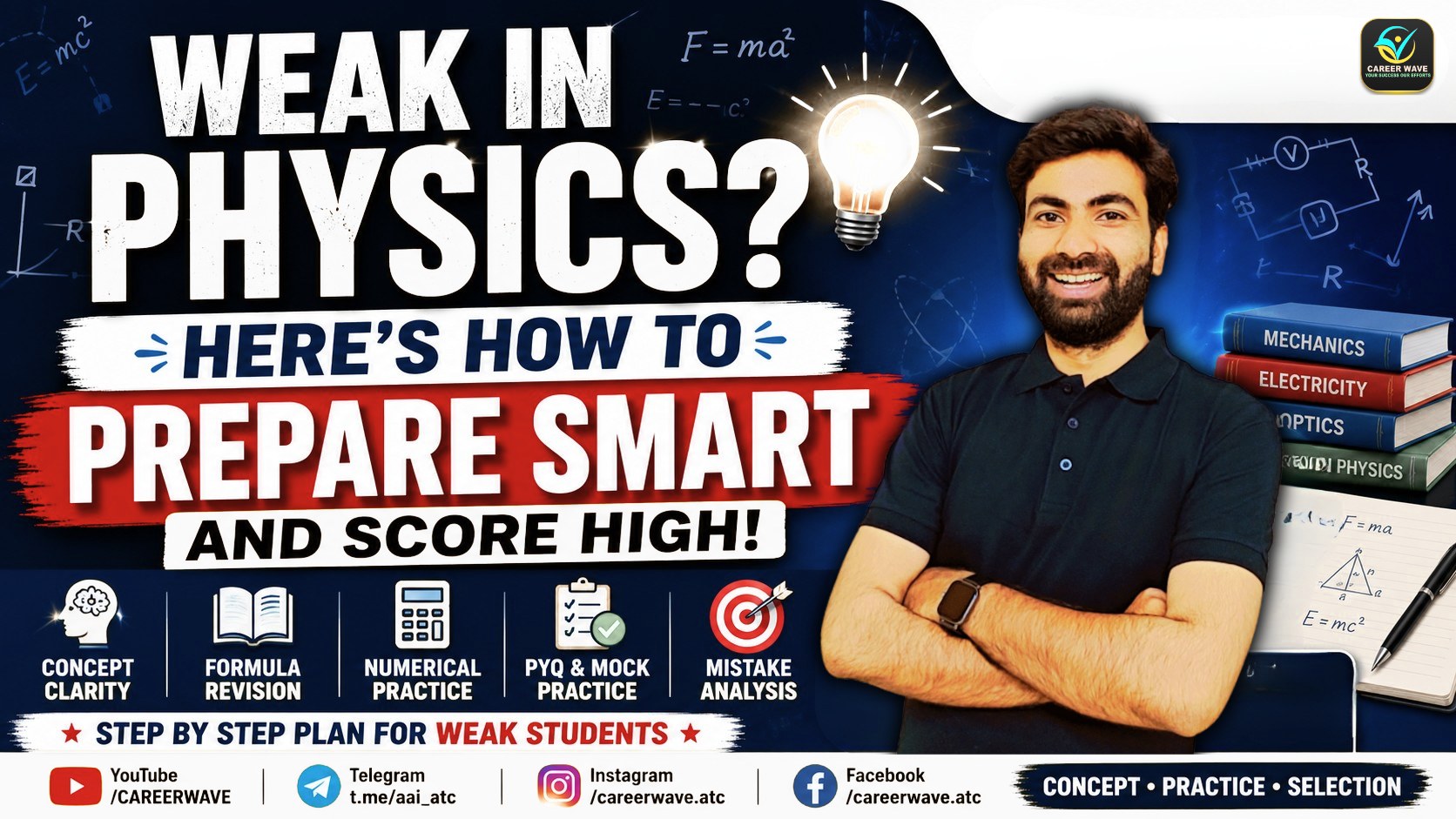
Learn how to improve Physics from
basic level with concept clarity, formula revision, numerical practice, PYQ
analysis, mistake notebook strategy, and guidance from Career Wave by Satyendra
Sir.
How to Prepare if You Are Weak in Physics
Physics is
one of the most important subjects for students preparing for competitive
exams, especially exams like AAI ATC where conceptual clarity and numerical
accuracy matter a lot. Many students feel weak in Physics because they try to
memorize formulas without understanding the basic concept behind them.
The truth is
simple: Physics is not difficult if you study it in the right order. You do not
need to become a research-level expert. You need exam-oriented clarity, formula
command, and regular question practice.
At Career Wave, Satyendra Sir
always guides students with one clear approach: first understand the concept,
then learn the formula, then practice questions, and finally revise mistakes.
This method helps even weak students improve step by step.
Why Students Feel Weak in Physics
Many
students struggle in Physics because of these common reasons:
·
Weak basic
concepts
·
Fear of
numerical questions
·
Poor formula
revision
·
Lack of
proper notes
·
Skipping
theory and jumping directly to questions
·
Not
analyzing mistakes
·
Confusion
between similar formulas
·
Poor
understanding of units and dimensions
·
Irregular
practice
Physics becomes difficult when
students study it randomly. A proper chapter-wise plan can make it much easier.
First Accept Your Current Level
If you are
weak in Physics, do not feel demotivated. The first step is to accept your
current level honestly.
Ask
yourself:
·
Which
chapters are completely weak?
·
Which
chapters are average?
·
Which
chapters are easy for me?
·
Do I forget
formulas?
·
Do I make
calculation mistakes?
·
Do I
understand theory but fail in numericals?
Once you know the exact problem,
improvement becomes easier.
Start with Basic Chapters First
Do not start
Physics from difficult or lengthy chapters. Begin with chapters that build your
foundation.
You can
start with:
·
Units and
Dimensions
·
Vectors
·
Motion in a
Straight Line
·
Laws of
Motion
·
Work, Power
and Energy
·
Current
Electricity
·
Basic Optics
·
Modern
Physics
These chapters help you build
confidence and prepare your base for advanced topics.
Understand Concepts Before Formulas
Many
students try to memorize formulas first. This is a mistake. A formula becomes
useful only when you know where and how to apply it.
For every
concept, ask:
·
What is the
meaning of this concept?
·
Where is it
used?
·
What are the
conditions?
·
Which
formula applies here?
·
What type of
questions are asked from this concept?
For example, do not only memorize
equations of motion. Understand when acceleration is constant and when those
formulas are applicable.
Make a Formula Notebook
Physics
needs regular formula revision. Create a separate formula notebook and write
formulas chapter-wise.
In your
formula notebook, include:
·
Important
formulas
·
Units
·
Dimensions
·
Conditions
of use
·
Special
cases
·
Common
mistakes
·
One solved
example for difficult formulas
Revise this notebook daily for at
least 15–20 minutes. This small habit can improve your Physics score
significantly.
Learn Units and Dimensions Properly
Units and
dimensions are very important in Physics. Many numerical mistakes happen
because students ignore units.
Always
check:
·
SI unit
·
Conversion
factor
·
Given unit
·
Required
unit
·
Final answer
unit
Examples:
·
km/h to m/s
·
cm to m
·
mm to m
·
kW to W
·
μF to F
·
minutes to
seconds
If your units are correct, your
chances of getting the correct answer improve.
Practice Numericals Step by Step
If you are
weak in Physics, do not directly attempt high-level questions. Follow a simple
3-level practice method.
Level 1:
Basic Questions
Start with
direct formula-based questions. These help you understand formula application.
Level 2:
Moderate Questions
Then solve
questions that require two concepts or small calculations.
Level 3:
Exam-Level Questions
Finally,
solve PYQs, mock test questions, and mixed chapter questions.
This step-by-step method prevents
confusion and builds confidence.
Do Not Ignore Theory
Physics is
not only numericals. Many exam questions are conceptual. If you ignore theory,
you may lose easy marks.
Focus on:
·
Definitions
·
Laws
·
Graphs
·
Units
·
Dimensions
·
Important
applications
·
Conceptual
statements
·
Basic
diagrams
Theory helps
you understand numericals better.
Use Short Notes for Revision
Short notes
are very useful for Physics. Do not write long theory again and again. Keep
your notes crisp and exam-oriented.
Your Physics
short notes should include:
·
Formula list
·
Key concepts
·
Important
graphs
·
Common
mistakes
·
PYQ-based
points
·
Unit
conversions
·
Important
tricks
Before every mock test, revise
your short notes once.
Analyze Your Mistakes
Mistake
analysis is the fastest way to improve Physics. After every test, do not just
check your marks. Check why you made mistakes.
Write
mistakes under these categories:
·
Concept
mistake
·
Formula
mistake
·
Unit mistake
·
Calculation
mistake
·
Question
reading mistake
·
Time
pressure mistake
At Career Wave, Satyendra Sir
strongly recommends maintaining a mistake notebook. It helps students avoid
repeated errors and improve accuracy.
Revise PYQs Regularly
Previous
year questions are very important for understanding the exam pattern. PYQs show
what type of questions are actually asked.
While
solving PYQs, note:
·
Repeated
topics
·
Frequently
used formulas
·
Common
question patterns
·
Difficulty
level
·
Time
required per question
·
Tricky
concepts
PYQs make your preparation more
practical and exam-focused.
Follow a Daily Physics Routine
If Physics
is weak, study it daily instead of doing it once or twice a week.
A simple
daily routine can be:
·
20 minutes
formula revision
·
30 minutes
concept study
·
40 minutes
numerical practice
·
20 minutes
mistake revision
·
10 minutes
quick recap
Even 1.5 to 2 hours of focused
Physics practice daily can bring strong improvement over time.
Do Not Compare Yourself with Others
Some
students are already strong in Physics, while some need more time. Do not
compare your speed with others. Your goal is steady improvement.
Focus on:
·
Your weak
chapters
·
Your
mistakes
·
Your mock
test progress
·
Your
revision consistency
·
Your
accuracy improvement
Physics improves through
discipline, not panic.
Best Strategy by Career Wave for Weak Physics
Students
Career
Wave’s practical strategy for weak Physics students is simple:
1.
Start from
basic chapters.
2.
Understand
concepts before formulas.
3.
Make a
formula notebook.
4.
Solve basic
to advanced questions gradually.
5.
Revise PYQs
regularly.
6.
Maintain a
mistake notebook.
7.
Practice
Physics daily.
8.
Take mock
tests and analyze properly.
Under the guidance of Satyendra
Sir, students learn Physics in a structured and exam-oriented way. The focus is
not on making the subject complicated, but on making concepts clear and
scoring.
Final 30-Day Physics Improvement Plan
Week 1:
Basic Foundation
Study Units,
Dimensions, Vectors, and Basic Mechanics. Focus on formulas and simple
questions.
Week 2: Core
Chapters
Cover
Motion, Laws of Motion, Work Power Energy, and Current Electricity. Practice
direct and moderate numericals.
Week 3:
Scoring Chapters
Revise
Optics, Modern Physics, Heat, Waves, and important formula-based chapters.
Week 4: PYQs
and Mock Practice
Solve PYQs,
attempt sectional tests, revise mistakes, and improve accuracy.
This 30-day plan can help weak
students build confidence and improve their Physics performance.
Important Career Wave Links
YouTube
Channel: https://www.youtube.com/@CAREERWAVE
Telegram
Channel: https://t.me/aai_atc
Instagram: https://www.instagram.com/careerwave.atc
Facebook: https://www.facebook.com/careerwave.atc
Conclusion
If you are
weak in Physics, do not avoid the subject. Start with basics, revise formulas
daily, practice numericals step by step, and analyze every mistake. Physics
becomes easier when you study it with the right method.
Career Wave
and Satyendra Sir guide students with a simple, structured, and exam-focused
approach. With consistency and proper revision, even a weak student can improve
Physics and score well in the exam.
Remember, Physics is not about
fear. It is about clarity, practice, and revision.
FAQs:
1. Can I
improve Physics if my basics are weak?
Yes, you can improve Physics by
starting from basic chapters, understanding concepts clearly, and practicing
regularly.
2. Which
chapters should I start with if I am weak in Physics?
Start with Units and Dimensions,
Vectors, Motion, Laws of Motion, Work Power Energy, Current Electricity, and
Modern Physics.
3. Should I
memorize formulas directly?
No. First understand the concept
and condition of the formula. Then memorize and practice questions based on it.
4. How many
hours should I study Physics daily?
If Physics is weak, study it for
at least 1.5 to 2 hours daily with formula revision, concept study, and
numerical practice.
5. How can I
improve Physics numericals?
Start with basic formula-based
questions, then move to moderate questions, and finally solve PYQs and mock
test questions.
6. Is a
formula notebook necessary for Physics?
Yes, a formula notebook is very
useful for quick revision and better formula recall during the exam.
7. Why do I
forget Physics formulas?
You forget formulas because of
irregular revision and lack of practice. Revise formulas daily and apply them
in questions.
Related Blogs -
Physics Numericals in AAI ATC: How to Solve Fast Without Panic
Career Growth in AAI ATC (Level-Wise Promotion Path)
How to Build a Revision System for AAI ATC (Complete Advanced Guide)
Leave a Comment
25-Aug-2026 06:05 PM
Can B.Tech candidates apply for AAI JE Airport Operations 2026? Understand eligibility, MBA requirements, advantages for engineering graduates, Business Management, Aviation Awareness, PYQs and the...
22-Aug-2026 01:25 PM
Preparing for AAI JE Airport Operations 2026? Learn the most common preparation mistakes aspirants make, from studying only strong subjects and ignoring Business Management or...
21-Aug-2026 03:49 PM
Are you preparing for AAI JE Airport Operations by focusing only on Physics and Maths? Understand why ignoring Business Management, Aviation Awareness, Reasoning, English, Aptitude...
20-Aug-2026 04:36 PM
Will AAI ATC preparation give you an advantage in AAI JE Airport Operations? Understand the syllabus overlap, benefits in Reasoning, Aptitude, English and Aviation, challenges...
19-Aug-2026 12:04 PM
Is MBA compulsory for AAI JE Airport Operations? Understand the eligibility criteria for B.Sc. + MBA and Engineering candidates, MBA mode requirements, qualification routes and...
18-Aug-2026 06:21 PM
Can B.Sc + MBA candidates apply for AAI JE Airport Operations 2026? Understand eligibility, qualification requirements, career opportunities, Aviation Awareness, Business Management, PYQs and smart...
