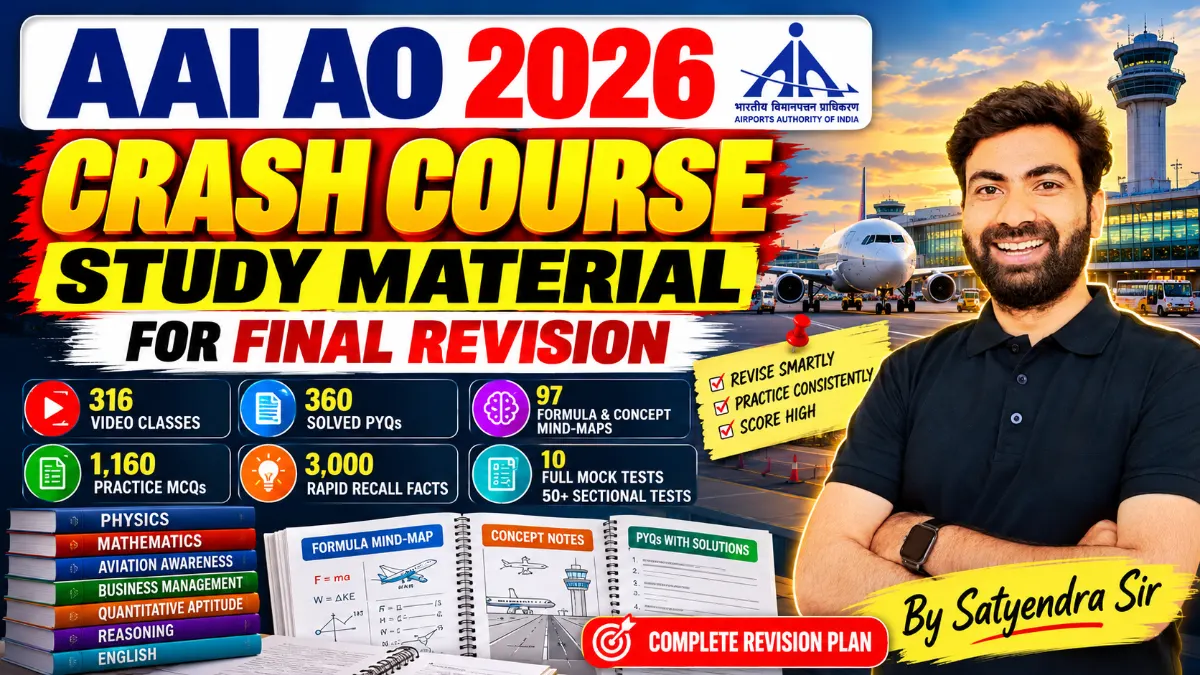
Prepare for AAI Junior Executive
Airport Operations 2026 with Career Wave's comprehensive crash course study
material under the guidance of Satyendra Sir. Get 316 recorded video classes,
360 solved PYQs, 97 formula and concept mind-maps, 1,160 practice MCQs, 3,000
rapid-recall facts, full-length mock tests, sectional tests and a 14-day
revision planner. Explore subject-wise preparation strategies for Physics, Mathematics,
Aviation Awareness, Business Management, Quantitative Aptitude, Reasoning and
English.
AAI JE Airport Operations 2026 | 316 Video Classes | 360 Solved PYQs | 1,160 Practice MCQs | 3,000 Rapid Recall Facts | Full Mock Tests
The AAI Junior Executive (Airport Operations) 2026 examination is scheduled for 26 October 2026, and the final phase of preparation has begun. With limited time remaining, many aspirants are searching for the best AAI AO crash course study material that can help them revise important concepts, practise previous year questions and improve their examination performance.
At this stage, one question matters more than anything else:
Are you revising the right material, or are you still collecting new books and notes?
Many students have already attended classes, completed important chapters and attempted practice questions. However, remembering formulas, recalling Aviation facts, distinguishing between Business Management theories and solving numerical questions within the available time can still be challenging.
This is why the final revision stage requires a different approach.
You need concise study material that helps you revise quickly, identify weak areas and practise examination-oriented questions.
At Career Wave, under the guidance of Satyendra Sir, the AAI AO Final Approach 2026 Crash Course has been designed around this requirement.
Instead of relying on disconnected notes, question banks and revision resources, students can follow a structured system combining concept classes, solved PYQs, formula mind-maps, concept boosters, rapid-recall notes and mock tests.
In this article, we will discuss:
Preparing for an examination and revising for an examination are two different processes.
During the initial preparation stage, students need detailed explanations, concept-building classes and sufficient time to understand every chapter.
However, during the final revision phase, the priorities change.
You need to recall formulas quickly, recognise concepts, revise important facts and improve your ability to solve questions under examination conditions.
For example, imagine you have already completed Electromagnetic Induction in Physics.
Reading the entire chapter again may take several hours. But a well-organised formula sheet, followed by selected previous year questions and a short practice test, can help you identify what you remember and what requires additional attention.
The same principle applies to other subjects.
Mathematics: Formula recall and timed problem-solving become important.
Aviation Awareness: Quick revision of terminology, organisations and operational concepts becomes essential.
Business Management: Comparison charts help distinguish between similar theories and principles.
Reasoning and Quantitative Aptitude: Shortcuts and repeated timed practice help improve speed.
English: Grammar rules, vocabulary and error-detection practice support accuracy.
The final days should not be spent collecting more resources. Students should focus on revising what they have already studied, solving relevant questions and correcting repeated mistakes.
The objective is to convert preparation into better examination performance.
Not every collection of notes or PDFs qualifies as an effective crash course.
A useful revision system should contain materials that serve different purposes.
|
Study Resource |
Purpose During Final Revision |
|
Recorded Concept Classes |
Revise weak and incomplete concepts |
|
Previous Year Questions |
Understand previously tested concepts |
|
Formula Mind-Maps |
Revise Physics and Mathematics quickly |
|
Concept Mind-Maps |
Organise theoretical and factual information |
|
Concept Boosters |
Strengthen concepts through MCQ practice |
|
Rapid Recall Notes |
Improve memory and factual retention |
|
Sectional Tests |
Practise specific subjects and chapters |
|
Full-Length Mock Tests |
Evaluate overall examination readiness |
|
Revision Planner |
Organise daily preparation |
|
Exam-Day Strategy |
Improve question selection and time management |
The important factor is not simply the quantity of material.
Every resource should have a clear purpose.
For example, formula sheets should be used for revision, PYQs for understanding previous examination questions and mock tests for evaluating performance.
At Career Wave, these resources are organised into a connected study system so that students can move from learning to practice, analysis and revision.
The AAI AO Final Approach 2026 is a structured crash course developed by Career Wave for aspirants preparing for the Airport Operations examination.
Under the guidance of Satyendra Sir, the course combines recorded classes, question discussions, test practice and revision resources.
|
Resource |
Available Coverage |
|
Recorded Video Classes |
316 |
|
Technical Video Classes |
170 |
|
Non-Technical Video Classes |
146 |
|
Full-Length Mock Tests |
10 |
|
Live Mock Tests |
3 |
|
Sectional Tests |
50+ |
|
Solved Previous Year Questions |
360 |
|
Formula Mind-Maps |
51 |
|
Concept Mind-Maps |
46 |
|
Total Mind-Maps |
97 |
|
Concept Booster Cards |
290 |
|
Practice MCQs |
1,160 |
|
Rapid Recall Facts |
3,000 |
|
Final Revision Workbook |
14-Day Sprint |
|
High-Score Concept Sheets |
Important Topics Across Four Subjects |
The study system includes resources for Physics, Mathematics, Aviation Awareness, Business Management, Quantitative Aptitude, Reasoning and English.
A student can follow a simple learning cycle:
Watch the Concept Class → Revise the Mind-Map → Practise Booster MCQs → Attempt PYQs → Take a Test → Analyse Mistakes → Revise Again
This method helps connect conceptual understanding with question-solving practice.
Explore the Complete Course:
Physics requires a strong understanding of concepts and their mathematical applications.
During the final revision stage, students often face two problems:
1. They forget important formulas.
2. They remember the formula but struggle to apply it correctly.
A good Physics revision resource should address both problems.
Career Wave's AAI AO study material includes 29 Physics formula mind-maps.
These maps organise important formulas and concepts chapter-wise.
A mind-map for Laws of Motion, for example, helps students revise Newton's laws, momentum, impulse, friction and circular-motion concepts together.
Similarly, formula revision for Alternating Current and Electromagnetic Induction becomes easier when important relationships and phasor diagrams are presented visually.
Step 1: Revise the chapter's important formulas.
Step 2: Understand the conditions under which each formula applies.
Step 3: Solve selected numerical questions.
Step 4: Practise relevant AAI AO PYQs.
Step 5: Record calculation and conceptual mistakes.
Step 6: Revise the same chapter again after a short interval.
Do not memorise formulas in isolation. Understand the concept behind each formula and practise its application through numerical questions.
A small mistake in units, signs or assumptions can change the final answer.
5. AAI AO Mathematics Study Material 2026: Important Formulas and Chapter-Wise Revision
Mathematics is another subject where organised formula revision can save valuable time.
Students may understand a topic during regular preparation but forget formulas when attempting timed questions.
This is why concise revision sheets become useful.
Career Wave provides 22 Mathematics formula mind-maps designed around chapter-wise revision.
These resources help students revisit formulas, identities, important methods and common mistakes without reading complete chapters repeatedly.
For example, Integration can involve multiple standard formulas, substitution methods and applications.
A structured formula map helps organise these concepts for rapid revision.
First, revise the formula sheet.
Next, practise previously asked questions and selected numerical problems.
Check whether your mistakes are caused by incorrect formula selection, calculation errors or an incomplete understanding of the question.
When you identify a repeated mistake, revise the corresponding concept immediately.
Important: Do not spend your remaining preparation time learning complicated shortcuts that you have never practised before.
Use methods that you understand and can apply accurately.
Aviation Awareness is a specialised component of the AAI Airport Operations preparation syllabus.
Unlike subjects that rely mainly on numerical calculations, Aviation Awareness requires an understanding of terminology, organisations, airport infrastructure and operational concepts.
Aspirants should prepare concise revision notes covering important aviation fundamentals.
Aviation contains several closely related terms.
For example:
Students may remember the full forms but struggle to distinguish their operational meanings.
A diagram showing the runway and associated declared distances makes these terms easier to understand.
Career Wave's Aviation revision resources include 10 concept mind-maps, 40 concept booster cards and 330 rapid-recall facts.
These resources help students connect definitions, diagrams and practice questions.
Revise a topic through the concept mind-map.
Read the important definitions carefully.
Practise relevant multiple-choice questions.
Then use rapid-recall questions to check whether you can remember important facts without looking at the notes.
This approach can be particularly useful for factual and terminology-based subjects.
7. AAI AO Business Management Study Material: NCERT Concepts, Theories and Thinkers
Business Management preparation requires clarity in definitions, principles, functions and management theories.
Students frequently confuse similar concepts, especially when questions contain closely related answer options.
|
Thinker |
Important Contribution |
|
F. W. Taylor |
Scientific Management |
|
Henri Fayol |
General Principles of Management |
|
Max Weber |
Bureaucratic Theory |
|
Elton Mayo |
Human Relations and Hawthorne Studies |
|
Abraham Maslow |
Hierarchy of Needs |
|
Frederick Herzberg |
Two-Factor Theory |
|
Douglas McGregor |
Theory X and Theory Y |
The AAI AO study system includes:
Instead of memorising names randomly, prepare a comparison chart.
Include the thinker's name, theory, main contribution, important keywords and differences from similar theories.
For example, Taylor focused on improving efficiency through scientific methods, while Fayol developed general principles applicable to management.
Understanding these distinctions helps students respond to conceptual questions more confidently.
Satyendra Sir's Tip: When solving Business Management MCQs, study the incorrect options as carefully as the correct answer. This is especially useful for questions involving management thinkers and theories.
Quantitative Aptitude, Reasoning and English require a combination of conceptual clarity, practice and quick recall.
Important practice areas include:
Use formula notes and timed practice sets to improve calculation speed.
Important topics include:
Practise different question patterns rather than memorising individual answers.
Important revision topics include:
Career Wave's preparation resources include concept maps, booster questions and rapid-recall material for these subjects.
Regular short practice sessions can help students maintain accuracy without spending excessive time revisiting familiar chapters.
Previous Year Questions help students understand how examination concepts have been tested in earlier recruitment cycles.
For AAI AO aspirants, the 2016, 2018 and 2021 papers are important preparation resources.
Career Wave's solved PYQ book contains 360 questions from these three examinations, arranged subject-wise and chapter-wise.
Understand Question Formats: Become familiar with the types of questions asked previously.
Identify Tested Concepts: See which chapters and concepts appeared in earlier papers.
Improve Problem-Solving: Practise applying concepts to actual examination questions.
Recognise Common Errors: Identify mistakes involving formulas, definitions and question interpretation.
Support Final Revision: Use previously tested questions to revisit relevant concepts.
1. Select a chapter you have already studied.
2. Attempt the questions without checking answers.
3. Read the detailed explanations.
4. Identify incorrect and doubtful questions.
5. Revise the related concepts.
6. Practise similar fresh MCQs.
7. Reattempt incorrect questions after revision.
Satyendra Sir's Advice: Previous year questions should help you understand the examination, not encourage you to memorise old answers.
Exact repetition is never guaranteed. Prepare the concept so that you can solve a new question based on the same principle.
Explore AAI AO Previous Year Questions:
AAI AO PYQs and eBooks – Career Wave
Related: AAI AO PYQ Strategy 2026: How to Use Previous Year Questions EffectivelyOne of the biggest challenges during final preparation is deciding how much theory to revise and how many questions to practise.
Reading theory without practice can create a false sense of confidence.
Similarly, attempting large numbers of questions without understanding mistakes may not improve performance.
A balanced approach combines both.
Career Wave's Concept Booster resources contain 290 concept cards and 1,160 MCQs with solutions across seven subjects.
Each booster card focuses on a concept and includes related practice questions.
Learn: Read the core idea and important formulas.
Understand: Review the explanation and examples.
Practise: Solve the related MCQs independently.
Analyse: Check incorrect answers and identify mistakes.
Revise: Return to the concept after a short interval.
|
Subject |
Booster Cards |
Practice MCQs |
|
Physics |
60 |
240 |
|
Mathematics |
60 |
240 |
|
Aviation |
40 |
160 |
|
Business Management |
30 |
120 |
|
Quantitative Aptitude |
40 |
160 |
|
Reasoning |
30 |
120 |
|
English |
30 |
120 |
|
Total |
290 |
1,160 |
Concept-based practice is especially useful when students repeatedly make mistakes in familiar topics.
Instead of solving many unrelated questions, focus on the concept responsible for the mistake.
One common problem during final revision is forgetting information that was studied several weeks earlier.
This is particularly noticeable in factual subjects, grammar rules, definitions and formulas.
Repeated reading can help, but active recall provides a more direct way to check what you remember.
Active recall means trying to remember information without looking at the answer.
For example, instead of repeatedly reading the definition of TODA, ask yourself:
Attempt to answer from memory, then check whether your response is correct.
Career Wave's Rapid Recall resources include 3,000 one-line facts, organised for short revision sessions.
Fold: Hide the answer.
Fire: Recall the answer aloud or mentally.
Tick: Mark whether your answer was correct.
If you cannot remember an answer, mark it for another revision round.
Spend approximately 10 minutes reviewing a prepared set of facts.
Record the questions you could not recall.
Revisit those questions during the next revision session.
This method can help students identify information that requires additional attention.
Study material becomes more effective when supported by regular testing.
Mock tests help students check whether they can recall concepts and solve questions within the available time.
Career Wave's AAI AO Final Approach preparation system includes:
Full mocks help you practise the overall examination format.
They are useful for evaluating accuracy, time management and subject-wise performance.
Sectional tests help you focus on individual subjects or weak areas.
For example, if you are repeatedly making mistakes in Physics, a targeted Physics sectional test may be more useful than immediately attempting another full mock.
After attempting a test, check:
Classify mistakes into conceptual errors, calculation errors and careless mistakes.
Then revise the corresponding topics.
Attempting more mock tests does not automatically lead to better preparation.
A carefully analysed mock test can provide more useful information than several tests attempted without reviewing mistakes.
Start Practising:
AAI AO Test Series 2026 – Full Mock Tests and Sectional Tests
If you have already completed most of the syllabus, use the final 10 days for structured revision and examination practice.
The following timetable combines concept maps, PYQs, booster questions and mock-test analysis.
|
Day |
Main Focus |
Recommended Resources |
|
Day 1 |
Evaluate Preparation |
Full Mock + Error Analysis |
|
Day 2 |
Physics Revision |
Formula Mind-Maps + PYQs |
|
Day 3 |
Mathematics Revision |
Formula Sheets + Numerical Practice |
|
Day 4 |
Business Management |
Concept Maps + Booster MCQs |
|
Day 5 |
Aviation Awareness |
Concept Maps + Rapid Recall |
|
Day 6 |
Quantitative Aptitude & Reasoning |
Shortcuts + Timed Questions |
|
Day 7 |
English & Weak Topics |
Grammar Notes + Sectional Tests |
|
Day 8 |
Overall Performance |
Full Mock + Detailed Analysis |
|
Day 9 |
Complete Syllabus Revision |
Rapid Recall + Important PYQs |
|
Day 10 |
Final Preparation |
Formula Sheets + Short Notes |
Start each day with the most important revision topic.
Use short notes or concept maps before practising questions.
Attempt a manageable number of relevant MCQs.
Analyse mistakes and revise weak concepts before moving to the next topic.
Do not try to complete every available question simply to meet a numerical target.
The goal is better understanding, recall and examination readiness.
During the final preparation stage, students often waste time because they choose or use study materials inefficiently.
Downloading multiple books and notes does not guarantee better preparation.
Choose resources that cover the relevant syllabus and allow sufficient revision time.
If you already understand a topic, revising its formula sheet and practising questions may be more efficient than rewatching a complete lecture.
PYQs help you understand previously tested concepts and should be included in your preparation.
Always identify why an answer was correct or incorrect.
Do not concentrate exclusively on Physics and Mathematics.
Maintain revision of all applicable subjects.
A mock test should lead to specific improvements in your preparation plan.
Avoid frequently changing teachers, notes and problem-solving methods during the final days.
A sustainable revision routine is more useful than studying continuously without proper rest.
Students searching for the best AAI AO 2026 crash course study material should compare resources based on syllabus coverage, clarity, practice quality and revision support.
Career Wave's Final Approach system offers a structured combination of these resources.
Recorded concept classes, discussion sessions, solved PYQs, mock tests and revision material are organised together.
Formula and concept mind-maps support quick revision.
360 solved PYQs help students understand questions from the 2016, 2018 and 2021 examinations.
1,160 booster questions provide additional practice across seven subjects.
3,000 facts support short, repeated recall sessions.
The 14-Day Sprint Workbook provides a structured approach to daily revision and practice.
Career Wave focuses on connecting conceptual understanding with examination-oriented question practice.
The course may be useful for:
Students starting preparation from the beginning should consider whether the remaining time is sufficient for their individual needs.
For AAI AO preparation strategies, previous year questions, revision notes, mock-test discussions and examination updates, follow Career Wave on its official platforms.
Watch preparation strategies, Physics and Mathematics classes, PYQ discussions and examination guidance by Satyendra Sir and the Career Wave faculty.
Get important examination updates, preparation guidance and useful study information.
Follow important exam updates, short revision tips and preparation-related content.
Stay connected for educational content and announcements.
Practise full-length mock tests and sectional questions.
Explore available AAI AO question papers and preparation eBooks.
Explore the complete revision system, recorded classes, solved PYQs, mind-maps, concept boosters and mock tests.
The best AAI AO 2026 crash course study material is not necessarily the resource with the most pages or the greatest number of lectures.
It is the material that helps you revise efficiently, understand concepts, practise relevant questions and identify mistakes before the examination.
Your final preparation should focus on:
At Career Wave, under the guidance of Satyendra Sir, the AAI AO Final Approach 2026 brings these elements together through a structured preparation system.
The final days should be used to strengthen what you already know and correct mistakes that may affect your examination performance.
Revise Smartly. Practise Consistently. Analyse Every Mistake.
Career Wave | Your Success, Our Efforts
 What Can We Learn from Career Wave's Selected AAI ATC Students? Success Stories...
23 Nov 2026
 AAI ATC 2027: Notification, Eligibility, Syllabus, Exam Pattern, Salary, Cut-Off...
23 Nov 2026
 RRB Group D Score Card 2026 and ALP CBT-1 Answer Key: Score, Cut-off and Next St...
22 Nov 2026
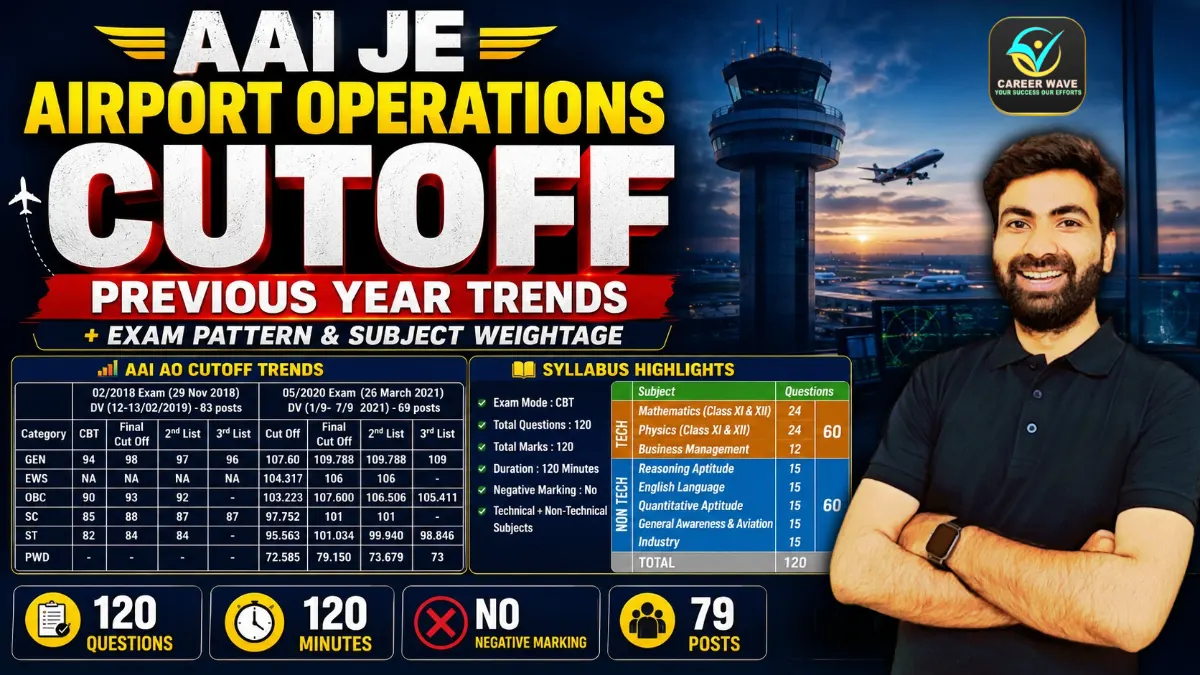 AAI JE AO 2026 Answer Key: Status, Score Calculation, Paper Analysis and Expecte...
22 Nov 2026
 SSC JE 2026 IMD Scientific Assistant Answer Key: Score Calculation, Objections a...
22 Nov 2026
 B.Sc vs B.Tech for AAI ATC 2027: Best Preparation Strategy for Each
19 Nov 2026
Leave a Comment
23-Nov-2026 02:05 PM
What Career Wave's selected AAI ATC students did differently: real testimonials, PYQ and mock-test methods, a 6-month plan and mistakes to avoid in 2027.
23-Nov-2026 01:23 PM
AAI ATC 2027 guide: notification status, eligibility, age limit, exam pattern, syllabus, salary, 2025 cut-offs and Career Wave’s 3 live batches compared.
22-Nov-2026 03:58 PM
RRB Group D score card is out till 1 Dec and ALP CBT-1 objections are closed. Check your score, qualifying marks, PET standards and next...
22-Nov-2026 11:51 AM
AAI JE Operations 2026 answer key status, how to calculate your score out of 120, the 26 Oct paper analysis and the expected cut-off of...
22-Nov-2026 11:23 AM
SSC JE 2026 Paper-I answer key for IMD Scientific Assistant is out. Learn how to calculate your score, raise objections before 22 Nov 6 PM...
19-Nov-2026 03:50 PM
B.Sc vs B.Tech: Who has an advantage in AAI ATC 2027? Discover the right preparation strategy for B.Sc Physics, B.Sc Mathematics and Engineering graduates. Compare...
 Career WaveOn WhatsApp
36,000+ learners · 4.8★ on Google