×
Burnout during AAI ATC preparation signs and recovery

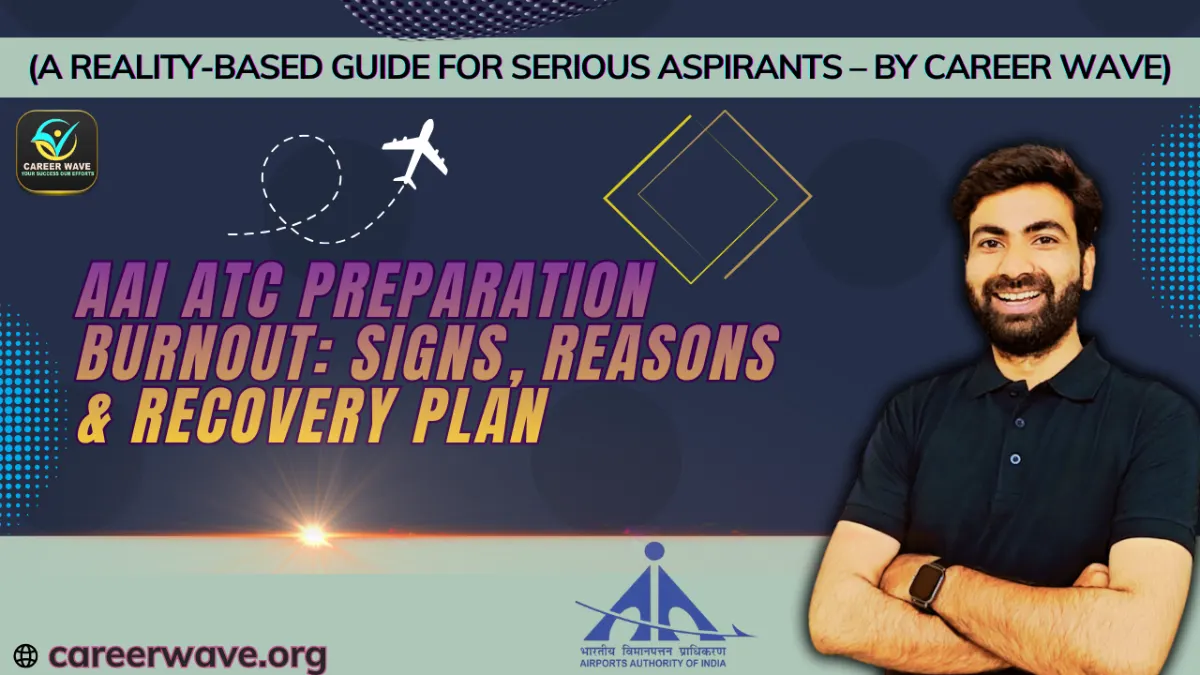
AAI ATC Preparation Burnout: Signs, Reasons & Recovery Plan | Career Wave

03-Feb-2026 04:08 PM

AAI ATC preparation burnout is a silent reason why many capable aspirants underperform. In this Career Wave guide, learn how to identify burnout early, understand its root causes, and follow a practical recovery plan to regain focus, confidence, and exam accuracy.

AAI ATC Guide · Career Wave
Preparation Burnout
(A Reality-Based Guide for Serious Aspirants – By Career Wave)
4 minread time
7 partsstep-by-step
11 FAQsquick answers
LiveATC 2027 batches

Preparing for AAI ATC (Junior Executive – Air Traffic Control) is a long, demanding journey. Months of Physics, Mathematics, mock tests, revision, and constant comparison can slowly drain even the most motivated aspirant.

At Career Wave, we have observed a critical pattern:
Many aspirants don’t fail due to lack of intelligence or effort — they fail due to preparation burnout.
This blog helps you identify burnout early, understand why it happens, and follow a practical recovery plan to get back on track without wasting months.

What Is AAI ATC Preparation Burnout?
Burnout is not laziness.
Burnout is mental exhaustion caused by prolonged, unstructured pressure.
In AAI ATC preparation, burnout usually shows up as:

  • ✓Loss of focus
  • ✓Reduced accuracy
  • ✓Emotional fatigue
  • ✓Lack of motivation despite long study hours
    Important:
    Burnout often appears right when your preparation should peak.

Takeaway notes

  • 1Stop pushing blindly
  • 2Start preparing smartly
  • 3After finishing syllabus
  • 4During mock test phase
  • 51–2 months before exam This is when guidance matters the most.
01

Early Warning Signs of AAI ATC Burnout

Career Wave students commonly report these signs:

Studying More but Scoring Less

  • Increased study hours
  • Declining mock test scores
  • Frequent silly mistakes
    Clear burnout indicator.

Constant Topic-Hopping

  • Switching topics daily
  • Starting new chapters repeatedly
  • Never feeling “done”
    This overload confuses the brain.

Revision Avoidance

  • Avoiding revision sessions
  • Feeling overwhelmed by notes
  • Fear of mock tests

Mental & Physical Fatigue

  • Headaches
  • Poor sleep
  • Irritability
  • Lack of concentration

Emotional Symptoms

  • Self-doubt
  • Comparison with others
  • Feeling “I’ll never clear this”
    These are not weakness signs — they are burnout symptoms.
02

Why AAI ATC Aspirants Burn Out (Root Causes)

No Clear Study Boundaries

Most aspirants:

Over-Preparing Extra Topics

As Career Wave repeatedly emphasizes:

Studying extra topics increases pressure but not marks.

More content = more confusion = faster burnout.

Delayed Mock Tests

Avoiding mocks:

  • Creates exam fear
  • Disconnects preparation from reality
  • Increases mental pressure

Unrealistic Daily Targets

Planning:

  • 6–8 hours daily (unsustainable)
  • Zero buffer days
    Consistency breaks when targets are unrealistic.

Comparing With Others

Social media, Telegram groups, and peer pressure:

  • Distort progress perception
  • Create anxiety
  • Kill confidence
03

Career Wave’s Recovery Plan (Step-by-Step)

Step 1: Pause Without Guilt (2–3 Days)

  • Stop heavy studying
  • Sleep properly
  • Light revision only
    Rest is part of preparation, not time waste.

Step 2: Reset Your Syllabus Scope

Career Wave rule:

Limit your syllabus to PYQ-dominated topics only.

  • Drop low-frequency chapters
  • Focus on high-weightage areas

Step 3: Switch to Revision-First Mode

Instead of learning new topics:

  • Revise formulas
  • Solve PYQs again
  • Strengthen weak concepts
    Revision restores confidence quickly.

Step 4: Restart Mock Tests (Low Pressure)

  • Start with sectional mocks
  • Focus on accuracy, not score
  • Analyze calmly

Step 5: Reduce Study Hours, Increase Quality

Career Wave recommends:

  • 3–5 focused hours/day
  • Fixed study slots
  • Short breaks
    Quality beats quantity during burnout recovery.
04

How Career Wave Prevents Burnout in Students

Career Wave’s preparation system is designed to avoid burnout:

  • Fixed syllabus boundaries
  • PYQ-driven teaching
  • Weekly revision cycles
  • Balanced mock scheduling
  • Mentorship support
  • Honest guidance (no fear marketing)
Students know where to stop — and that reduces pressure.
05

When Burnout Usually Happens (Critical Phases)

Career Wave data shows burnout peaks:

  • After finishing syllabus
  • During mock test phase
  • 1–2 months before exam
    This is when guidance matters the most.
06

Final Words from Career Wave

AAI ATC is not a sprint.
It is a controlled, focused journey.

Burnout does not mean you are weak.
It means you are working without direction.

If you feel stuck, tired, or confused:
  • Stop pushing blindly
  • Start preparing smartly
  • Seek clarity, not motivation
    Recover, reset, and rise — with Career Wave.
07

Frequently Asked Questions (FAQs)

Yes, very common.
According to Career Wave observations, burnout affects:

  • First-time aspirants
  • Repeaters
  • Working professionals
    Burnout usually appears when aspirants study without clear limits, especially during the mock-test or revision phase.

This is an important distinction.

  • Laziness = unwillingness to study
  • Burnout = mental exhaustion despite wanting to study
    Career Wave mentors often see highly sincere students experiencing burnout because of over-preparation and pressure, not lack of effort.

Yes. Burnout can:

  • Lower accuracy
  • Increase silly mistakes
  • Reduce speed
  • Affect decision-making in the exam hall
    Many capable students underperform due to burnout, not knowledge gaps.

Career Wave analysis shows burnout commonly occurs:

  • After syllabus completion
  • During continuous mock testing
  • 1–2 months before the exam
    This phase needs strategy correction, not more study hours.

Not completely—but you must pause heavy learning.

Career Wave recommends:

  • 2–3 days of light revision
  • No new topics
  • Proper sleep and mental reset
    Rest is part of smart preparation.

No.
In fact, selected students guided by Career Wave report that short, planned breaks:

  • Improve clarity
  • Restore confidence
  • Increase mock scores
    Unplanned exhaustion is harmful; planned recovery is powerful.

Career Wave’s fastest recovery method:

  • Stop adding new topics
  • Revise core formulas
  • Solve PYQs again
  • Restart sectional mocks
  • Reduce study hours, increase focus

Recovery is about simplification, not expansion.

Yes. Career Wave prevents burnout by:

  • Limiting syllabus scope
  • PYQ-first teaching
  • Fixed revision cycles
  • Balanced mock frequency
  • Mentorship and guidance
    Students who follow a structured plan rarely burn out.

Not necessarily.

Career Wave advises:

  • First try recovery and restructuring
  • Focus on accuracy and revision
  • Evaluate mock performance after reset
    Many aspirants clear AAI ATC after recovering from burnout, not by postponing.

Career Wave provides:

  • Mentorship support
  • Study plan restructuring
  • Confidence rebuilding
  • Mock analysis guidance
  • Emotional and strategic clarity

You’re not alone in this journey.

Yes. Repeaters often:

  • Carry past failure pressure
  • Over-prepare to compensate
  • Study without breaks
    Career Wave specifically helps repeaters unlearn wrong habits and regain confidence.
Found this useful? Share it with a friend preparing for AAI ATC.
Not sure which batch fits you?
Talk to our team for a free study-plan suggestion.
CAREER WAVE Learn with clarity Practise with PYQs Crack with strategy

Tags:

AAI ATC, AAI ATC preparation burnout, AAI ATC burnout recovery, AAI ATC exam stress, AAI ATC preparation mistakes, AAI ATC study fatigue, Career Wave AAI ATC guidance, AAI ATC exam strategy, AAI ATC mental preparation

Leave a Comment

Recent Blogs


What Can We Learn from Career Wave's Selected AAI ATC Students? Success Stories & Preparation Lessons for 2027

23-Nov-2026 02:05 PM

What Career Wave's selected AAI ATC students did differently: real testimonials, PYQ and mock-test methods, a 6-month plan and mistakes to avoid in 2027.

AAI ATC 2027: Notification, Eligibility, Syllabus, Exam Pattern, Salary, Cut-Off & Complete Preparation Guide

23-Nov-2026 01:23 PM

AAI ATC 2027 guide: notification status, eligibility, age limit, exam pattern, syllabus, salary, 2025 cut-offs and Career Wave’s 3 live batches compared.

RRB Group D Score Card 2026 and ALP CBT-1 Answer Key: Score, Cut-off and Next Steps

22-Nov-2026 03:58 PM

RRB Group D score card is out till 1 Dec and ALP CBT-1 objections are closed. Check your score, qualifying marks, PET standards and next...

AAI JE AO 2026 Answer Key: Status, Score Calculation, Paper Analysis and Expected Cut-off

22-Nov-2026 11:51 AM

AAI JE Operations 2026 answer key status, how to calculate your score out of 120, the 26 Oct paper analysis and the expected cut-off of...

SSC JE 2026 IMD Scientific Assistant Answer Key: Score Calculation, Objections and Expected Cut-off

22-Nov-2026 11:23 AM

SSC JE 2026 Paper-I answer key for IMD Scientific Assistant is out. Learn how to calculate your score, raise objections before 22 Nov 6 PM...

B.Sc vs B.Tech for AAI ATC 2027: Best Preparation Strategy for Each

19-Nov-2026 03:50 PM

B.Sc vs B.Tech: Who has an advantage in AAI ATC 2027? Discover the right preparation strategy for B.Sc Physics, B.Sc Mathematics and Engineering graduates. Compare...

On this page