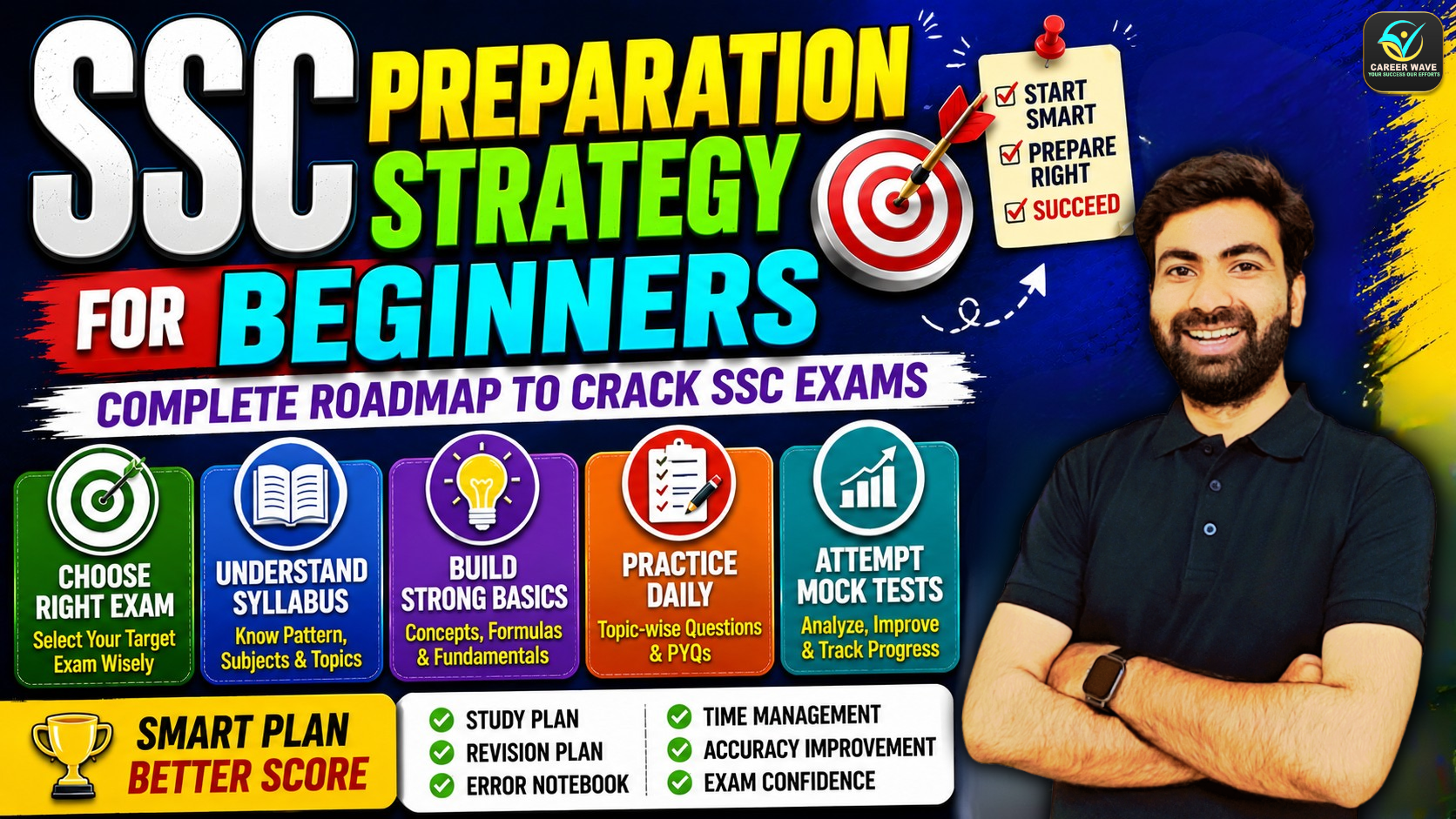
Read the complete SSC preparation
strategy for beginners with exam selection, syllabus planning, subject-wise
preparation, PYQ practice, mock test strategy, revision plan, error notebook
and Career Wave guidance.
SSC Preparation Strategy for Beginners:
Complete Roadmap to Start from Zero
SSC
preparation is one of the most popular choices among students who want a stable
government job in India. Every year, lakhs of candidates prepare for different
SSC exams such as SSC CGL, CHSL, MTS, GD, CPO, JE, Stenographer and Selection
Post.
For
beginners, the biggest problem is not hard work. The biggest problem is lack of
direction.
Many
students start preparation with excitement but without a clear plan. They watch
random videos, buy multiple books, join test series, download PDFs and start
solving questions without understanding the exam properly. After a few weeks,
they feel confused because they do not know what to study, how much to study,
which exam to target and when to start mock tests.
SSC
preparation becomes easier when it is done in a structured way.
At Career
Wave, we guide beginners with a simple approach:
First
understand the exam.
Then build basics.
Then practice topic-wise questions.
Then solve previous year papers.
Then attempt mock tests.
Then revise and improve accuracy.
This blog gives a complete SSC
preparation strategy for beginners in detail.
What is SSC?
SSC stands
for Staff Selection Commission. It conducts various exams for
recruitment in central government ministries, departments, offices and
organizations.
SSC exams
are popular because they provide:
·
Government
job security
·
Fixed salary
·
Allowances
·
Career
growth
·
Promotion
opportunities
·
Respectable
job profile
·
Opportunities
for 10th, 12th and graduate candidates
Popular SSC
exams include:
·
SSC CGL
·
SSC CHSL
·
SSC MTS
·
SSC GD
Constable
·
SSC CPO
·
SSC JE
·
SSC
Stenographer
·
SSC
Translator
·
SSC
Selection Post
Each exam has a different
eligibility, pattern, syllabus and selection process. Therefore, beginners
should not start preparation blindly.
Why Beginners Need a Proper SSC Strategy
A beginner
usually faces these problems:
·
No clarity
about the right SSC exam
·
Confusion
between CGL, CHSL, MTS, GD and CPO
·
Weak Maths
basics
·
Poor English
confidence
·
Fear of
General Awareness
·
No habit of
mock tests
·
No revision
plan
·
Too many
books and sources
·
Low
confidence after mock tests
·
No idea
about cut-off and competition
A proper
strategy helps solve these problems step by step.
Without strategy, preparation
becomes random. With strategy, preparation becomes focused.
Step 1: Choose the Right SSC Exam
The first
step is to choose the correct SSC exam according to your qualification, age,
interest and career goal.
Many
beginners make the mistake of preparing for all SSC exams at the same time.
This creates confusion. SSC CGL, CHSL, MTS, GD, CPO, JE and Stenographer are
not exactly the same. Their difficulty level, selection process and job profile
are different.
SSC Exams
Based on Qualification
|
Qualification |
Suitable SSC Exams |
|
10th Pass |
SSC MTS, SSC GD, Havaldar, Selection Post
Matric Level |
|
12th Pass |
SSC CHSL, SSC Stenographer, Selection Post
Higher Secondary Level |
|
Graduation |
SSC CGL, SSC CPO, Selection Post Graduation
Level |
|
Engineering Diploma/Degree |
SSC JE |
|
Hindi-English Language Background |
SSC Translator |
How to
Choose Your Target Exam
Choose SSC
CGL if:
·
You are a
graduate.
·
You want
Group B or Group C posts.
·
You want
better salary and promotion scope.
·
You are
ready for higher competition.
·
You can
prepare Quant, English, Reasoning and General Awareness deeply.
Choose SSC
CHSL if:
·
You are 12th
pass.
·
You want an
office-based government job.
·
You are
comfortable with typing or computer work.
·
You want to
start a government career early.
Choose SSC
MTS if:
·
You are 10th
pass.
·
You want
early entry into government service.
·
You are
comfortable with basic-level exam preparation.
·
You want a
support-level government post.
Choose SSC
GD if:
·
You are 10th
pass.
·
You are
physically fit.
·
You want a
uniformed job.
·
You are
ready for running, physical test and medical standards.
Choose SSC
CPO if:
·
You are a
graduate.
·
You want
Sub-Inspector-level uniformed service.
·
You are
physically fit.
·
You are
ready for written exam, PET/PST and medical examination.
Choose SSC
JE if:
·
You have
Civil, Mechanical or Electrical Engineering background.
·
You want a
technical government job.
·
You are
ready to prepare engineering subjects seriously.
Choose SSC
Stenographer if:
·
You are 12th
pass.
·
You have or
can develop shorthand skill.
·
You want an
office-based skill-oriented job.
Career Wave
Advice
Choose one
main exam and one backup exam.
For example:
|
Main Exam |
Backup Exam |
|
SSC CGL |
Selection Post |
|
SSC CHSL |
MTS / Selection Post |
|
SSC GD |
MTS / Havaldar |
|
SSC CPO |
CGL / GD |
|
SSC JE |
Selection Post / CGL |
|
SSC Stenographer |
CHSL / Selection Post |
Do not prepare randomly for five
exams at once. Focus gives better results.
Step 2: Understand the Exam Pattern
After
choosing the exam, understand the exam pattern properly. Many students start
studying without knowing the number of questions, marks, time limit and
negative marking.
This is a
serious mistake.
Why Exam
Pattern is Important
Exam pattern
tells you:
·
How many
stages are there?
·
How many
questions are asked?
·
What is the
total marks?
·
How much
time is given?
·
Is there
negative marking?
·
Which
subject has more weightage?
·
Is there a
typing test?
·
Is there a
physical test?
·
Is there a
technical paper?
·
How is final
merit prepared?
A student
preparing for SSC CHSL should know Tier-I, Tier-II and typing/skill test
requirements.
A student preparing for SSC GD should know CBT, PET, PST, medical and document
verification.
A student preparing for SSC JE should know Paper-I, Paper-II and technical
subject weightage.
What
Beginners Should Do
Write these
details in your notebook:
·
Exam name
·
Eligibility
·
Exam stages
·
Subjects
·
Total marks
·
Time
duration
·
Negative
marking
·
Skill/physical
requirement
·
Final
selection process
At Career Wave, we
recommend every beginner to keep the exam pattern visible on the study table.
It keeps preparation focused.
Step 3: Understand the Syllabus
Syllabus is
the boundary of preparation. Without syllabus clarity, students waste time on
unnecessary topics.
Most SSC
exams include these subjects:
·
Quantitative
Aptitude
·
Reasoning
·
English
·
General
Awareness
Some exams
also include:
·
Computer
Knowledge
·
Typing Test
·
Data Entry
Skill Test
·
Stenography
·
Physical
Test
·
Technical
Subject
·
Translation
and Essay
Why Syllabus
Clarity Matters
If you do
not understand the syllabus:
·
You may
study irrelevant topics.
·
You may miss
important chapters.
·
Your
revision will be unorganized.
·
Mock test
performance will remain unstable.
·
You will
waste time on low-value areas.
Beginner
Rule
Before
starting preparation, make a subject-wise syllabus checklist.
Example:
Quant
Checklist
·
Number
System
·
Simplification
·
Percentage
·
Ratio and
Proportion
·
Average
·
Profit and
Loss
·
SI and CI
·
Time and
Work
·
Speed and
Distance
·
Mensuration
·
Geometry
·
Data
Interpretation
Reasoning
Checklist
·
Analogy
·
Classification
·
Series
·
Coding-Decoding
·
Blood
Relation
·
Direction
·
Ranking
·
Syllogism
·
Venn Diagram
·
Non-Verbal
Reasoning
English
Checklist
·
Grammar
·
Vocabulary
·
Error
Detection
·
Sentence
Improvement
·
Reading
Comprehension
·
Cloze Test
·
Synonyms and
Antonyms
·
Idioms and
Phrases
·
One Word
Substitution
General
Awareness Checklist
·
History
·
Geography
·
Polity
·
Economy
·
General
Science
·
Current
Affairs
·
Static GK
Step 4: Build Strong Basics First
Beginners
should not start preparation with full mock tests or advanced-level questions.
The first target should be concept clarity.
A weak
foundation creates problems later.
Quantitative
Aptitude Basics
Quant is one
of the most important subjects in SSC exams. Many beginners fear Maths, but SSC
Maths can be improved with regular practice.
Start with:
·
Tables
·
Squares
·
Cubes
·
Percentage
·
Ratio
·
Average
·
Profit and
Loss
·
Simple
Interest
·
Compound
Interest
·
Time and
Work
·
Speed and
Distance
Quant
Preparation Method
Follow this
order:
1.
Understand
concept
2.
Learn
formula
3.
Solve basic
examples
4.
Practice
30–50 questions
5.
Solve
previous year questions
6.
Give topic
test
7.
Revise
mistakes
Do not run
behind shortcuts from day one. Shortcuts are useful only after concept clarity.
Reasoning
Basics
Reasoning is
one of the most scoring subjects in SSC exams. A beginner can improve reasoning
quickly with daily practice.
Start with:
·
Analogy
·
Series
·
Coding-Decoding
·
Direction
·
Blood
Relation
·
Ranking
·
Syllogism
·
Venn Diagram
Reasoning
Preparation Method
·
Learn one
topic at a time.
·
Understand
common patterns.
·
Solve easy
questions first.
·
Move to
moderate questions.
·
Practice
mixed sets.
·
Give timed
quizzes.
Reasoning
needs practice, not memorization.
English
Basics
English is
very important in SSC exams, especially CGL, CHSL, CPO and Stenographer. Many
Hindi-medium students ignore English due to fear, but this is a mistake.
Start with:
·
Parts of
Speech
·
Tense
·
Subject-Verb
Agreement
·
Articles
·
Prepositions
·
Error
Detection
·
Sentence
Improvement
·
Vocabulary
·
Reading
Comprehension
English
Preparation Method
Daily
practice is compulsory.
A good
beginner plan:
·
10
vocabulary words daily
·
10 grammar
questions daily
·
5 error
detection questions daily
·
5 sentence
improvement questions daily
·
1 small
reading passage daily
English
improves slowly, but with consistency it becomes scoring.
General
Awareness Basics
General
Awareness feels difficult because the syllabus is wide. But for SSC, GK should
be prepared smartly.
Focus on:
·
Indian
History
·
Indian
Polity
·
Geography
·
Economy
basics
·
General
Science
·
Static GK
·
Current
Affairs
GK
Preparation Method
·
Use short
notes.
·
Revise
repeatedly.
·
Practice
MCQs.
·
Do not
collect too much material.
·
Focus on
repeated SSC topics.
·
Revise wrong
answers from mocks.
At Career Wave, we advise
students to study limited GK material but revise it multiple times.
Step 5: Make a Realistic Daily Study Plan
A beginner
should not make an unrealistic timetable. Studying 10–12 hours from the first
day is not practical for most students.
Start with a
simple plan and follow it daily.
Daily Study
Plan for Beginners
|
Time |
Subject |
|
1 hour |
Quantitative Aptitude |
|
1 hour |
Reasoning |
|
1 hour |
English |
|
45 minutes |
General Awareness |
|
30 minutes |
Revision |
|
30 minutes |
Practice Questions |
This is a 4
to 5-hour daily plan. It is suitable for beginners.
Study Plan
for College or Working Students
|
Time |
Subject |
|
45 minutes |
Quant |
|
45 minutes |
Reasoning |
|
45 minutes |
English |
|
30 minutes |
GK / Current Affairs |
|
Weekend |
Mock Test + Analysis |
The goal is
not to study all day. The goal is to study consistently.
Weekly Study
Structure
|
Day |
Main Focus |
|
Monday |
Quant + English |
|
Tuesday |
Reasoning + GK |
|
Wednesday |
Quant + Vocabulary |
|
Thursday |
English + Reasoning |
|
Friday |
GK + Quant |
|
Saturday |
Sectional Test |
|
Sunday |
Mock Analysis + Revision |
Step 6: Solve Previous Year Questions
Previous
year questions are the backbone of SSC preparation. Beginners should never
ignore PYQs.
Why PYQs Are
Important
Previous
year questions help you understand:
·
Real exam
level
·
Repeated
topics
·
Important
chapters
·
Question
framing
·
Difficulty
level
·
Time
requirement
·
Common traps
·
Actual SSC
pattern
How to Use
PYQs Correctly
Do not solve
PYQs randomly. Use them in two stages.
Stage 1:
Topic-Wise PYQs
After
completing a topic, solve PYQs from that topic.
Example:
·
Percentage
PYQs
·
Ratio PYQs
·
Coding-Decoding
PYQs
·
Error
Detection PYQs
·
Polity PYQs
Stage 2:
Year-Wise PYQs
After
completing major syllabus, solve full previous year papers.
This helps
in understanding complete exam structure and time management.
Career Wave
Advice
Every topic should end with PYQ
practice. If you study a topic but do not solve PYQs, your preparation is
incomplete.
Step 7: Start Mock Tests at the Right Time
Mock tests
are important, but beginners should not start full mocks from the first day.
If basics
are weak, full mock tests may reduce confidence. Start step by step.
Correct Mock
Test Sequence
|
Preparation Stage |
Test Type |
|
First 20–30 days |
Topic-wise tests |
|
After basic preparation |
Sectional tests |
|
After 50–60% syllabus completion |
Full mock tests |
|
Final stage |
Full mocks + PYQ mocks |
Why Mock
Tests Are Important
Mock tests
help improve:
·
Speed
·
Accuracy
·
Time
management
·
Question
selection
·
Exam
temperament
·
Confidence
·
Weak topic
identification
How to
Attempt Mock Tests
·
Sit in a
quiet place.
·
Use real
exam timing.
·
Do not pause
the test.
·
Do not use
notes.
·
Follow
negative marking.
·
Attempt
seriously.
·
Analyze
after completion.
Mock tests are not only for
checking marks. They are for improving marks.
Step 8: Analyze Mock Tests Properly
Many
students give mock tests but do not analyze them. This is one of the biggest
mistakes.
Mock score
tells where you are. Mock analysis tells how to improve.
How to
Analyze a Mock
After every
mock, check your mistakes.
|
Mistake Type |
Meaning |
Solution |
|
Concept Mistake |
Topic not clear |
Revise the concept |
|
Calculation Mistake |
Method correct, calculation wrong |
Practice calculation |
|
Silly Mistake |
Question read incorrectly |
Improve attention |
|
Time Mistake |
Too much time spent |
Practice timed sets |
|
Guesswork Mistake |
Random attempt |
Control attempts |
Questions to
Ask After Every Mock
·
Which
section was weakest?
·
Which topic
caused maximum mistakes?
·
Did I
attempt too many doubtful questions?
·
Did I waste
time on difficult questions?
·
Did I miss
easy questions?
·
What should
I revise before the next mock?
At Career Wave, we
recommend spending 2–3 hours on analysis after every full mock.
Step 9: Maintain an Error Notebook
An error
notebook is a powerful tool for SSC preparation. It helps you avoid repeating
the same mistakes.
What to
Write in Error Notebook
·
Wrong
formulas
·
Calculation
mistakes
·
Grammar
rules
·
Vocabulary
errors
·
GK facts you
forgot
·
Reasoning
patterns
·
Difficult
questions
·
Mock test
mistakes
·
PYQ
observations
How to Use
Error Notebook
·
Update it
after every mock.
·
Revise it
every Sunday.
·
Read it
before sectional tests.
·
Revise it
heavily in the final month.
Many students improve their score
simply by reducing repeated mistakes.
Step 10: Build Speed and Accuracy Together
SSC exams
are time-bound. You need speed, but speed without accuracy is dangerous.
How to
Improve Speed
·
Practice
timed quizzes.
·
Learn
calculation techniques.
·
Revise
formulas.
·
Solve PYQs.
·
Improve
reading speed.
·
Attempt easy
questions first.
·
Avoid
lengthy questions in the first round.
How to
Improve Accuracy
·
Avoid blind
guessing.
·
Read
questions carefully.
·
Revise weak
topics.
·
Analyze
wrong questions.
·
Attempt only
confident questions.
·
Do not
over-attempt.
·
Control exam
pressure.
Best Rule
Accuracy
first, speed second.
Once accuracy improves, speed can
be increased through timed practice.
Step 11: Prepare General Awareness Smartly
General
Awareness is a scoring section if prepared with revision. It saves time in the
exam because it does not require calculation.
What to
Study in GK
·
History
·
Polity
·
Geography
·
Economy
·
General
Science
·
Current
Affairs
·
Static GK
·
Sports
·
Awards
·
Books and
Authors
·
Important
Days
·
Government
Schemes
GK Strategy
for Beginners
·
Study one
topic daily.
·
Make short
notes.
·
Practice
MCQs.
·
Revise
weekly.
·
Do not
change sources again and again.
·
Focus on
repeated SSC topics.
What Not to
Do
·
Do not
collect unlimited PDFs.
·
Do not study
GK without revision.
·
Do not rely
only on current affairs.
·
Do not
ignore static GK.
·
Do not
memorize without MCQ practice.
Step 12: Prepare English Daily
English
needs regular practice. Beginners should not leave English for the last month.
Daily
English Routine
·
10
vocabulary words
·
10 grammar
questions
·
5 error
detection questions
·
5 sentence
improvement questions
·
1 reading
comprehension passage
·
Revision of
old vocabulary
Important
English Areas
·
Tense
·
Subject-Verb
Agreement
·
Articles
·
Prepositions
·
Active and
Passive Voice
·
Direct and
Indirect Speech
·
Error
Detection
·
Sentence
Improvement
·
Cloze Test
·
Comprehension
·
One Word
Substitution
·
Idioms and
Phrases
Career Wave
Advice
English cannot be improved by
only watching classes. Practice is necessary. Read, solve, revise and repeat.
Step 13: Prepare for Extra Stages
Some SSC
exams require more than written preparation.
Extra Stages
in SSC Exams
|
Exam |
Extra Requirement |
|
SSC CHSL |
Typing / Data Entry Skill Test |
|
SSC Stenographer |
Shorthand and Transcription |
|
SSC GD |
PET/PST and Medical |
|
SSC CPO |
PET/PST and Medical |
|
SSC JE |
Technical Subject |
|
SSC Translator |
Translation and Essay |
Important
Advice
Do not wait
for written result to start extra stage preparation.
·
CHSL
students should practice typing early.
·
GD/CPO
students should start running early.
·
Stenographer
students should practice shorthand daily.
·
JE students
should prepare technical subjects from the beginning.
·
Translator
aspirants should practice translation regularly.
90-Day SSC Preparation Strategy for Beginners
First 30
Days: Foundation Phase
Focus on:
·
Understanding
exam pattern
·
Reading
syllabus
·
Starting
Quant basics
·
Starting
Reasoning basics
·
Learning
English grammar
·
Building GK
notes
·
Starting
vocabulary
·
Solving easy
questions
Target by
Day 30
·
Basic
clarity of all subjects
·
Formula
notebook started
·
Vocabulary
notebook started
·
Topic-wise
practice started
·
Revision
habit developed
Next 30
Days: Practice Phase
Focus on:
·
Topic-wise
questions
·
Previous
year questions
·
Sectional
tests
·
GK MCQs
·
English
practice
·
Formula
revision
·
Error
notebook
Target by
Day 60
·
Major topics
covered
·
PYQ practice
started
·
Sectional
tests started
·
Weak topics
identified
·
Accuracy
improvement visible
Final 30
Days: Mock and Revision Phase
Focus on:
·
Full mock
tests
·
Mock
analysis
·
Previous
year papers
·
Formula
revision
·
GK revision
·
Error
notebook
·
Weak topic
correction
·
Speed and
accuracy
Target by
Day 90
·
Exam-like
practice
·
Improved
time management
·
Better
accuracy
·
Strong
revision base
·
Clear
attempt strategy
6-Month SSC Preparation Strategy for
Beginners
Month 1:
Basic Foundation
·
Understand
exam and syllabus.
·
Start Quant
basics.
·
Start
Reasoning topics.
·
Begin
English grammar.
·
Start GK
notes.
·
Develop
study habit.
Month 2:
Topic Building
·
Complete
arithmetic basics.
·
Complete
major reasoning topics.
·
Practice
English grammar.
·
Study static
GK.
·
Solve
basic-level questions.
Month 3: PYQ
Phase
·
Start
topic-wise PYQs.
·
Begin
sectional tests.
·
Revise
formulas.
·
Revise
grammar rules.
·
Maintain
error notebook.
Month 4:
Practice Phase
·
Solve mixed
questions.
·
Attempt
timed quizzes.
·
Improve weak
topics.
·
Practice GK
MCQs.
·
Start full
mocks if syllabus is 50–60% complete.
Month 5:
Mock Test Phase
·
Attempt full
mocks.
·
Analyze
deeply.
·
Solve
previous year papers.
·
Track
accuracy.
·
Reduce silly
mistakes.
Month 6:
Final Revision Phase
·
Revise error
notebook.
·
Revise
formula notebook.
·
Revise GK
notes.
·
Attempt
exam-like mocks.
·
Finalize
attempt strategy.
·
Avoid new
sources.
Best Study Material Strategy for Beginners
Beginners
often collect too many books and PDFs. This creates confusion.
Best
Approach
Use limited
sources.
|
Subject |
Source Type |
|
Quant |
One concept source + PYQs |
|
Reasoning |
One practice source + PYQs |
|
English |
Grammar + vocabulary + PYQs |
|
GK |
Static notes + current affairs |
|
Mock Tests |
One standard test series |
|
Revision |
Self-made notes |
At Career Wave, we advise:
Do not study from too many sources. Study from limited sources multiple times.
Common Mistakes Beginners Should Avoid
·
Preparing
without choosing exam
·
Ignoring
syllabus
·
Ignoring
exam pattern
·
Studying too
many books
·
Running
behind shortcuts from day one
·
Not solving
PYQs
·
Giving mocks
without analysis
·
Not revising
regularly
·
Ignoring
English
·
Studying GK
without notes
·
Ignoring
typing or physical test
·
Comparing
with others
·
Changing
strategy every week
·
Not
maintaining consistency
Career Wave Guidance for SSC Beginners
At Career
Wave, we believe beginners need a practical and structured plan. SSC
preparation should not be based on fear or confusion. It should be based on
clarity, practice and consistency.
A beginner
should follow this cycle:
1.
Choose the
right exam.
2.
Understand
eligibility.
3.
Study the
syllabus.
4.
Build
basics.
5.
Practice
topic-wise questions.
6.
Solve PYQs.
7.
Attempt
mocks.
8.
Analyze
mistakes.
9.
Revise
regularly.
10. Stay consistent.
Career Wave helps students
understand the right exam, follow a clear preparation plan, avoid common
mistakes and improve through structured practice.
FAQs
Q1. How
should a beginner start SSC preparation?
A beginner should start by
choosing the right SSC exam, understanding the syllabus and exam pattern,
building basic concepts, solving previous year questions and then attempting
mock tests.
Q2. Which
SSC exam is best for beginners?
It depends on qualification. SSC
MTS and SSC GD are good for 10th pass candidates, SSC CHSL is good for 12th
pass candidates, and SSC CGL is a strong option for graduates.
Q3. How many
hours should a beginner study daily for SSC?
A beginner can start with 4 to 5
focused hours daily. Consistency is more important than long study hours.
Q4. Can I
prepare for SSC without coaching?
Yes. SSC preparation is possible
without coaching if you have the right books, PYQs, mock tests, revision plan
and discipline. Guidance can help avoid mistakes.
Q5. Which
subject should I start first for SSC?
Start with Quant basics,
Reasoning, English grammar and General Awareness together. Do not study only
one subject for many weeks.
Q6. Is Maths
compulsory for SSC exams?
Maths is important in most SSC
exams such as CGL, CHSL, MTS, GD and CPO. Beginners should start with
arithmetic basics.
Conclusion
SSC
preparation for beginners should start with clarity and discipline. Do not
begin randomly. First choose the right exam, understand the pattern and
syllabus, build basic concepts, practice previous year questions, attempt mock
tests and revise regularly.
A beginner
should focus on basics first, then speed, then accuracy. Mock tests should be
used for improvement, not fear. Revision should be part of daily preparation.
At Career Wave, we advise
every beginner to prepare with a structured roadmap. With the right strategy,
regular practice and honest analysis, SSC selection becomes a realistic goal.
Leave a Comment
25-Aug-2026 06:05 PM
Can B.Tech candidates apply for AAI JE Airport Operations 2026? Understand eligibility, MBA requirements, advantages for engineering graduates, Business Management, Aviation Awareness, PYQs and the...
22-Aug-2026 01:25 PM
Preparing for AAI JE Airport Operations 2026? Learn the most common preparation mistakes aspirants make, from studying only strong subjects and ignoring Business Management or...
21-Aug-2026 03:49 PM
Are you preparing for AAI JE Airport Operations by focusing only on Physics and Maths? Understand why ignoring Business Management, Aviation Awareness, Reasoning, English, Aptitude...
20-Aug-2026 04:36 PM
Will AAI ATC preparation give you an advantage in AAI JE Airport Operations? Understand the syllabus overlap, benefits in Reasoning, Aptitude, English and Aviation, challenges...
19-Aug-2026 12:04 PM
Is MBA compulsory for AAI JE Airport Operations? Understand the eligibility criteria for B.Sc. + MBA and Engineering candidates, MBA mode requirements, qualification routes and...
18-Aug-2026 06:21 PM
Can B.Sc + MBA candidates apply for AAI JE Airport Operations 2026? Understand eligibility, qualification requirements, career opportunities, Aviation Awareness, Business Management, PYQs and smart...
