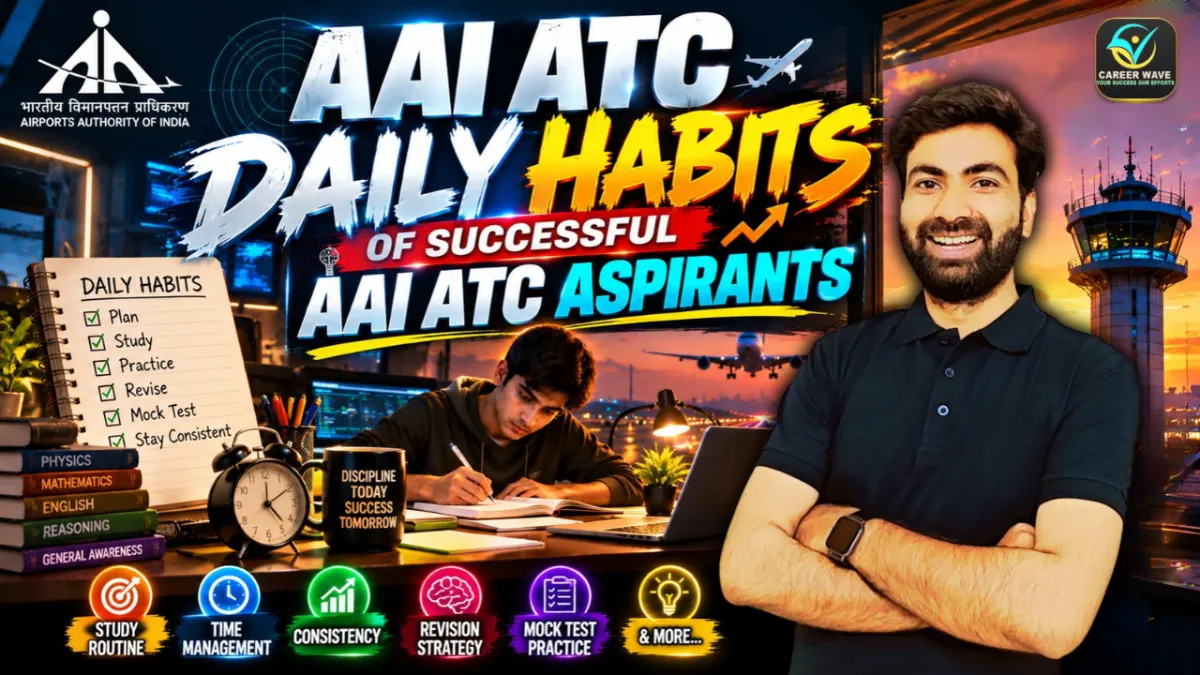
Want to crack AAI ATC 2026 with a
smart and disciplined preparation strategy? Discover 25 daily habits of
successful AAI ATC aspirants with Career Wave and Satyendra Sir. Learn how to
create an effective daily study timetable, revise Physics and Mathematics
formulas, practise English, Reasoning, Aptitude, and General Awareness, solve
previous year questions, and improve mock test scores. Explore proven revision
techniques, time management tips, error notebook strategies, and daily routines
to improve accuracy, consistency, and exam confidence.
AAI ATC 2026 Preparation Strategy | Daily Study Routine | Physics & Mathematics Practice | PYQs | Mock Tests | Revision | Expert Guidance by Satyendra Sir
Every year, thousands of students prepare for the AAI Junior Executive (Air Traffic Control) examination, but not every aspirant achieves the desired result.
What makes the difference?
Is it studying for 10–12 hours every day? Joining expensive coaching? Solving hundreds of questions without taking breaks?
Not necessarily.
The difference often comes down to daily habits, consistency, smart preparation, and the ability to learn from mistakes.
Some students study for long hours but struggle to remember formulas. Others complete the syllabus but cannot perform well in mock tests. Many aspirants know the concepts but lose marks because of poor time management or insufficient revision.
At Career Wave, Satyendra Sir emphasizes that successful preparation is not about studying randomly for more hours. It is about building a routine that helps students understand concepts, retain information, practise questions, and improve examination performance.
In this article, we will discuss 25 daily habits that can help AAI ATC aspirants prepare more effectively, along with a practical study timetable, subject-wise strategies, revision techniques, and frequently asked questions.
One of the most useful habits is deciding what you need to accomplish before starting your study session.
Many students open their books without a clear target and waste time deciding what to study.
Instead of writing "Study Physics," create specific goals.
For example:
Satyendra Sir's Advice: A daily timetable should contain measurable targets, not just subject names.
The recent AAI ATC examination pattern has included 120 questions divided between technical and non-technical subjects.
|
Subject |
Questions |
Marks |
|
Physics |
30 |
30 |
|
Mathematics |
30 |
30 |
|
English Language |
20 |
20 |
|
Reasoning |
15 |
15 |
|
General Aptitude |
15 |
15 |
|
General Awareness |
10 |
10 |
|
Total |
120 |
120 |
This reflects the recent examination pattern. Always check the applicable official AAI recruitment notification for the latest examination details.
Physics and Mathematics together contribute 60 marks, while the non-technical subjects contribute another 60 marks.
Aspirants should avoid preparing only Physics and Mathematics while postponing the remaining subjects.
Daily Habit: Include at least one non-technical subject in your daily study routine.
Every student has a period during the day when concentration is relatively strong.
For some students, it is early morning. For others, it may be the afternoon or evening.
Use your most productive hours for challenging subjects.
For example:
Avoid spending your most productive hours on unnecessary scrolling or repeatedly organizing study material.
Career Wave Tip: Schedule difficult topics according to your concentration level rather than copying someone else's timetable.
Physics requires both conceptual understanding and formula application.
A common problem among aspirants is remembering formulas during lectures but forgetting them during mock tests.
Include:
For example, while revising Electrostatics, do not simply memorize Coulomb's law. Understand the direction of force, vector nature, and conditions under which the formula applies.
Daily Habit: Spend 15–20 minutes revising Physics formulas and applying selected formulas to questions.
Watching Mathematics solutions is different from solving questions yourself.
Many students understand the teacher's explanation but struggle when they attempt a similar problem independently.
1. Understand the concept.
2. Review the standard method.
3. Solve questions without looking at the solution.
4. Identify calculation or method errors.
5. Practise variations of the same concept.
Focus on conceptual clarity rather than memorizing shortcuts without understanding them.
Daily Habit: Solve a manageable set of Mathematics questions independently and review every incorrect answer.
English is an important part of AAI ATC preparation.
Students who neglect it may lose marks in questions that could have been answered through regular practice.
Daily Habit: Practise 15–20 English questions and revise a few grammar rules or vocabulary items.
Reasoning requires logical thinking, accuracy, and speed.
Students should not depend only on understanding the solutions.
Focus on topics such as:
Daily Habit: Attempt a short Reasoning set under a time limit and analyse mistakes.
General Aptitude becomes easier to manage when students develop reliable calculation methods.
Daily Habit: Practise a few calculation-based questions and review the methods that consume excessive time.
General Awareness is often postponed because students consider it less important than technical subjects.
However, leaving the entire subject for the final weeks creates unnecessary pressure.
Divide General Awareness into manageable areas:
Daily Habit: Spend 15–20 minutes studying or revising General Awareness.
Focus on reliable information and concise notes.
Previous year questions help aspirants understand the concepts and question types tested in earlier AAI ATC examinations.
However, memorizing PYQ answers is not enough.
After solving each question, ask:
1. Which concept is being tested?
2. Why is the correct option right?
3. Why are the remaining options incorrect?
4. Can the question be solved faster?
5. How might the examiner modify the question?
Daily Habit: Solve PYQs from the chapters you have already studied.
An error notebook helps students identify recurring mistakes.
Do not maintain mistake records only for Physics and Mathematics.
|
Subject |
Mistakes to Record |
|
Physics |
Formula, unit, conceptual and sign errors |
|
Mathematics |
Calculation mistakes and incorrect methods |
|
English |
Grammar and vocabulary errors |
|
Reasoning |
Logical and pattern-recognition mistakes |
|
Aptitude |
Calculation, percentage, ratio and shortcut errors |
|
General Awareness |
Incorrect facts and outdated information |
Daily Habit: Record important mistakes and revise recurring errors before mock tests.
Repeatedly reading notes may create familiarity without ensuring retention.
Active recall helps students test whether they can remember concepts independently.
After studying a chapter:
Daily Habit: Spend a few minutes recalling previously studied concepts without looking at your notes.
Revision should not begin only after completing the syllabus.
Without regular revision, students may forget earlier chapters.
Same Day: Review important concepts.
After a Few Days: Solve related questions.
Weekly: Revise completed topics.
Monthly: Revisit older chapters and weak areas.
The frequency should depend on your retention and performance.
Career Wave Tip: Revision becomes more effective when combined with active recall and question practice.
One common habit among aspirants is collecting multiple PDFs, books, notes, and video playlists.
Students keep switching between resources instead of completing one properly.
Use a simple resource system:
Satyendra Sir's Advice: Completing and revising reliable resources is more useful than collecting material you never study.
Successful preparation requires measurable improvement.
At the end of each day, review your work.
Daily Habit: Spend five minutes reviewing your progress and planning the next day.
Time management should be developed gradually.
Students who practise without time limits may struggle during the actual examination.
Start with small timed question sets.
Gradually move to:
Daily Habit: Include at least one short timed practice session when appropriate for your preparation stage.
Mock tests help students evaluate examination readiness.
But simply attempting more mocks does not guarantee improvement.
Analyse:
Then revise the concepts responsible for your mistakes.
For structured full-length mock-test practice
Satyendra Sir's Advice: A mock test becomes useful when you convert its mistakes into improvements.
Some students attempt to solve questions faster without developing reliable methods.
This can increase careless mistakes.
Practise solving questions correctly before introducing strict time limits.
As accuracy improves, gradually reduce the time available for similar question sets.
One difficult numerical question should not consume the time needed for several easier questions.
During timed practice:
Experiment with question-selection strategies during mocks.
Students often compare their study hours, mock scores, and syllabus progress with other aspirants.
This can create unnecessary pressure.
A student scoring 80 marks may feel discouraged after seeing someone else score 105.
Compare your current performance with your previous performance.
Track improvements in:
Daily Habit: Focus on your preparation data rather than constantly comparing yourself with others.
Mobile phones can be useful for lectures, notes, and mock tests.
However, unnecessary notifications and social media scrolling can interrupt concentration.
Daily Habit: Protect your focused study time from unnecessary interruptions.
Sleep is important for attention, learning, and memory.
Students sometimes sacrifice sleep to increase study hours.
However, excessive fatigue can reduce concentration and increase careless mistakes.
Satyendra Sir's Advice: Your study schedule should be sustainable. Preparation quality matters more than simply extending study hours.
Students often focus only on their weakest subjects.
While improving weaknesses is important, strong subjects also require revision.
Divide your preparation into:
Weak Areas: Concept improvement and additional practice.
Average Areas: Regular practice and accuracy improvement.
Strong Areas: Revision and timed practice to maintain performance.
Daily Habit: Give extra attention to weak subjects while periodically revising strong subjects.
Daily planning helps maintain consistency.
Weekly reviews help determine whether the overall strategy is working.
1. Which chapters did I complete?
2. Which chapters require revision?
3. Did my accuracy improve?
4. Which subject needs additional attention?
5. What mistakes occurred repeatedly?
6. Did I complete my planned tests?
7. What should change next week?
Do not change your entire timetable after one difficult day.
Make adjustments based on repeated performance patterns.
A simple but useful habit is preparing the next day's study targets before finishing the current day.
This reduces decision-making time when you begin studying the next day.
Career Wave Tip: A clear plan makes it easier to start studying consistently.
There is no single timetable suitable for every student.
However, a balanced schedule can help aspirants organize their preparation.
|
Study Activity |
Duration |
|
Physics Concepts and Numerical Practice |
90 Minutes |
|
Mathematics Concepts and Questions |
90 Minutes |
|
English and Reasoning |
60 Minutes |
|
Aptitude and General Awareness |
60 Minutes |
|
PYQs, Formula Revision and Error Analysis |
60 Minutes |
|
Total |
6 Hours |
Students attending coaching classes should adjust the timetable according to lecture duration and available self-study time.
On full mock-test days, replace part of the regular schedule with mock practice and analysis.
Along with daily habits, students should maintain a structured weekly routine.
|
Day |
Main Preparation Focus |
|
Monday |
Physics + Mathematics + English |
|
Tuesday |
Physics + Aptitude + Reasoning |
|
Wednesday |
Mathematics + Physics + General Awareness |
|
Thursday |
Mathematics + English + Reasoning |
|
Friday |
Physics + Mathematics + Aptitude |
|
Saturday |
Formula Revision + PYQs + Sectional Tests |
|
Sunday |
Full Mock Test + Detailed Analysis |
This is a sample plan. Adjust it according to your strengths, weaknesses, and syllabus coverage.
At Career Wave, Satyendra Sir emphasizes building strong concepts, maintaining consistency, practising previous year questions, and regularly evaluating performance.
Students can use Career Wave's preparation resources to support their daily study routine.
Focus on understanding Physics and Mathematics concepts instead of memorizing solutions.
Use PYQs to understand important concepts and previous examination trends.
Attempt full-length tests to evaluate accuracy, speed, and examination readiness.
Follow Career Wave for educational lectures, revision strategies, and examination guidance.
Career Wave YouTube Channel:
The most effective AAI ATC preparation routine is not necessarily the one with the longest study hours.
It is the routine that helps you improve consistently.
A student who studies regularly, revises concepts, practises PYQs, and analyses mistakes can make meaningful progress without following an unrealistic schedule.
Satyendra Sir recommends focusing on five essential habits:
1. Study with clear daily targets.
2. Revise Physics and Mathematics regularly.
3. Practise both technical and non-technical subjects.
4. Analyse mistakes after tests.
5. Track progress and adjust preparation accordingly.
The objective is not to complete more activities every day.
The objective is to make every study session contribute to better understanding, accuracy, and examination performance.
Preparing for AAI ATC 2026 requires more than completing the syllabus.
Students must develop habits that support conceptual understanding, retention, problem-solving, and examination readiness.
Regular Physics and Mathematics practice, non-technical preparation, PYQ analysis, mock tests, and revision should become part of a structured routine.
Avoid unnecessary resource switching, unrealistic study schedules, and constant comparison with other aspirants.
Instead, focus on improving your performance gradually.
At Career Wave, Satyendra Sir encourages students to build a preparation system that is practical, consistent, and measurable.
Remember: Success in AAI ATC preparation is not built through one perfect study day. It is built through consistent, purposeful effort over time.
Stay connected with Career Wave and Satyendra Sir for AAI ATC preparation strategies, Physics and Mathematics guidance, PYQs, mock tests, and examination updates.
Career Wave — Your Success, Our Efforts
 What Can We Learn from Career Wave's Selected AAI ATC Students? Success Stories...
23 Nov 2026
 AAI ATC 2027: Notification, Eligibility, Syllabus, Exam Pattern, Salary, Cut-Off...
23 Nov 2026
 RRB Group D Score Card 2026 and ALP CBT-1 Answer Key: Score, Cut-off and Next St...
22 Nov 2026
 AAI JE AO 2026 Answer Key: Status, Score Calculation, Paper Analysis and Expecte...
22 Nov 2026
 SSC JE 2026 IMD Scientific Assistant Answer Key: Score Calculation, Objections a...
22 Nov 2026
 B.Sc vs B.Tech for AAI ATC 2027: Best Preparation Strategy for Each
19 Nov 2026
Leave a Comment
23-Nov-2026 02:05 PM
What Career Wave's selected AAI ATC students did differently: real testimonials, PYQ and mock-test methods, a 6-month plan and mistakes to avoid in 2027.
23-Nov-2026 01:23 PM
AAI ATC 2027 guide: notification status, eligibility, age limit, exam pattern, syllabus, salary, 2025 cut-offs and Career Wave’s 3 live batches compared.
22-Nov-2026 03:58 PM
RRB Group D score card is out till 1 Dec and ALP CBT-1 objections are closed. Check your score, qualifying marks, PET standards and next...
22-Nov-2026 11:51 AM
AAI JE Operations 2026 answer key status, how to calculate your score out of 120, the 26 Oct paper analysis and the expected cut-off of...
22-Nov-2026 11:23 AM
SSC JE 2026 Paper-I answer key for IMD Scientific Assistant is out. Learn how to calculate your score, raise objections before 22 Nov 6 PM...
19-Nov-2026 03:50 PM
B.Sc vs B.Tech: Who has an advantage in AAI ATC 2027? Discover the right preparation strategy for B.Sc Physics, B.Sc Mathematics and Engineering graduates. Compare...
 Career WaveOn WhatsApp
36,000+ learners · 4.8★ on Google