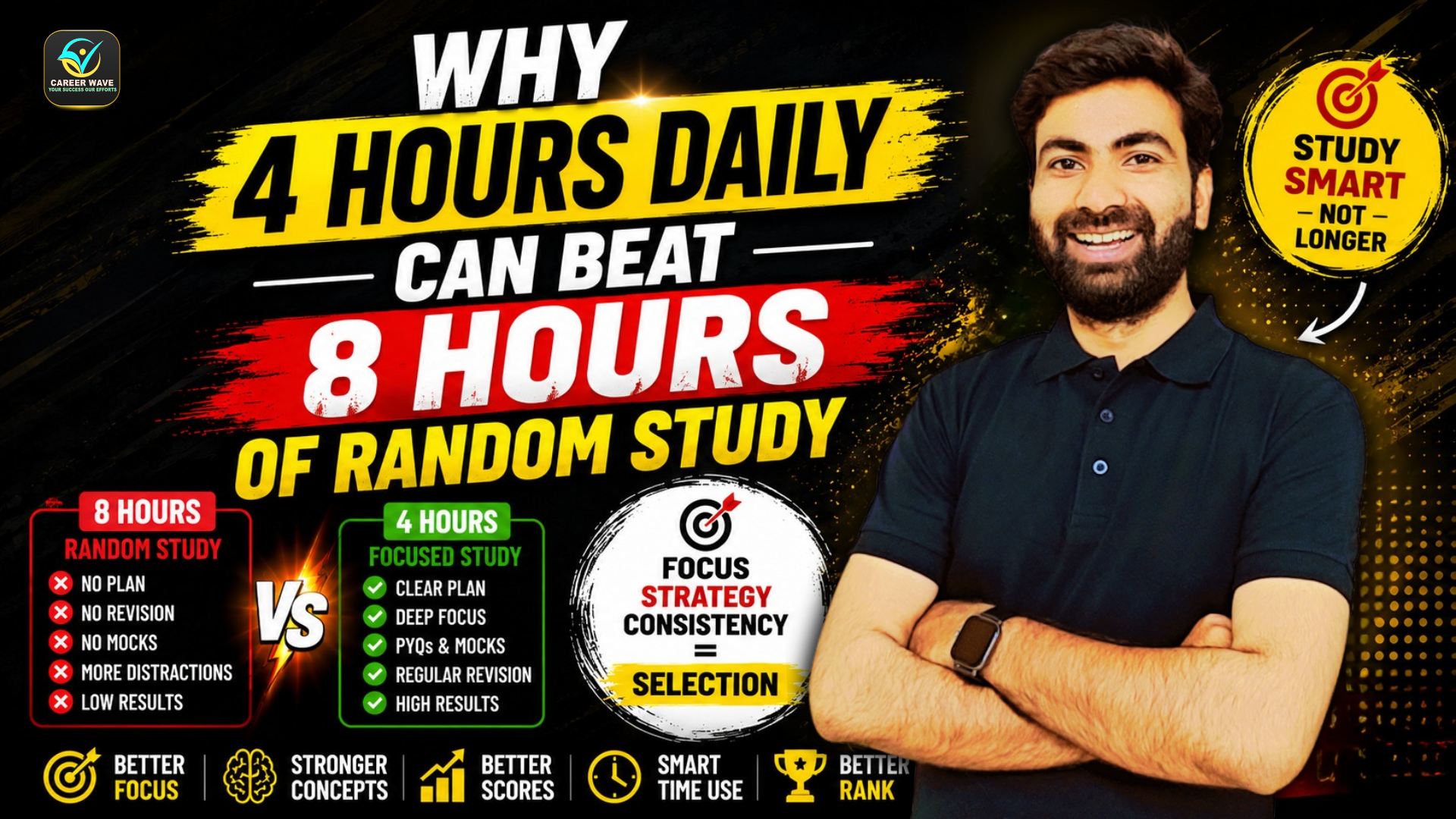
Many AAI ATC aspirants believe
long study hours guarantee selection, but random study often leads to burnout,
weak revision, and poor mock performance. This blog explains why 4 focused
hours with strategy, PYQs, revision, mock analysis, and deep work can
outperform 8 hours of unstructured study, along with Career Wave’s smart
preparation approach for AAI ATC.
Why 4 Hours Daily Can Beat 8 Hours of Random
Study
Many AAI ATC
aspirants believe that success depends mainly on study hours.
They think:
·
“I need to
study 10–12 hours daily.”
·
“More hours
automatically mean better rank.”
·
“If someone
studies longer than me, they are definitely ahead.”
But real
exam results often prove the opposite.
At Career
Wave, we have guided students who cleared AAI ATC with disciplined 4–5 hour
schedules, while some students studying 8–10 random hours struggled to improve
their mock scores.
Why does
this happen?
Because
competitive exams do not reward time spent.
They reward effective performance.
AAI ATC is
not a “long-study-hours” exam.
It is a speed + accuracy + strategy exam.
This blog explains in detail why
4 focused hours daily can outperform 8 hours of unstructured study and how
smart preparation creates better results than endless sitting.
1. AAI ATC Is a Performance Exam, Not a
Study-Hour Competition
The actual
AAI ATC CBT lasts only 120 minutes.
Within those
2 hours, students must:
·
solve
quickly
·
maintain
accuracy
·
manage time
smartly
·
avoid panic
·
handle
pressure
·
make fast
decisions
The exam
never asks:
·
How many
hours did you study?
·
How many
books did you complete?
·
How many
pages of notes did you make?
It only
measures one thing:
How
effectively can you perform under pressure?
This is why
smart preparation matters far more than long but ineffective study sessions.
Career Wave
Insight
Many students prepare
emotionally.
Toppers prepare strategically.
2. Random Study Creates the Illusion of Hard
Work
One of the
biggest problems in AAI ATC preparation is “fake productivity.”
Students
stay busy all day and assume they are progressing.
But being
busy and being productive are completely different things.
Examples of
Random Study
·
Watching
lectures continuously without practice
·
Reading
notes passively for hours
·
Switching
subjects every 20–30 minutes
·
Studying
while checking phone notifications
·
Solving
questions without timer pressure
·
Collecting
endless PDFs and resources
·
Watching
motivational videos more than solving PYQs
·
Highlighting
books instead of testing recall
·
Reading
solutions instead of solving independently
This type of
preparation feels tiring, but it produces weak results.
At Career
Wave, we call this:
Motion
without direction.
The student feels exhausted but
mock scores remain unchanged.
3. Focused Study Improves Retention
The human
brain cannot maintain deep concentration continuously for 8–10 hours.
After a
certain point:
·
concentration
drops
·
memory
weakens
·
reading
speed slows
·
accuracy
decreases
·
silly
mistakes increase
Long random
study sessions often become passive.
Students may
physically sit for many hours, but mentally they are no longer learning
efficiently.
Focused
4-Hour Study Looks Different
In a focused
study session:
✔
distractions are removed
✔ goals are clear
✔ active solving happens
✔ revision is included
✔ mistakes are analyzed
✔ recall is tested regularly
This creates
stronger memory retention and better exam performance.
Career Wave
Rule
Focused study builds memory.
Random study builds fatigue.
4. Deep Work Beats Long Sitting
Many
aspirants measure preparation using:
·
“How many
hours did I sit today?”
This is the
wrong metric.
The real
question should be:
·
“How deeply
did I focus?”
What Is Deep
Work?
Deep work
means:
·
complete
concentration
·
no social
media distractions
·
active
problem solving
·
full mental
involvement
·
timed
practice
·
serious
revision
·
focused mock
analysis
Even 2–3
hours of deep work can outperform an entire day of distracted study.
At Career Wave, students
are trained to improve study quality instead of blindly increasing study
quantity.
5. Long Random Study Reduces Revision Quality
One of the
biggest hidden problems with random long-hour study is weak revision.
Students
often spend all day:
·
learning new
topics
·
watching
fresh lectures
·
collecting
new material
But they
fail to revise older concepts properly.
Result:
·
formulas get
forgotten
·
concepts
weaken
·
PYQ patterns
disappear from memory
·
mock
performance becomes unstable
Focused
Students Usually:
·
revise
regularly
·
maintain
formula sheets
·
track
mistakes
·
revisit weak
topics
·
solve
repeated PYQs
Career Wave
strongly emphasizes revision because:
Revision converts effort into
marks.
6. Mock Performance Matters More Than Study
Hours
Imagine two
students.
Student A
·
studies 9–10
hours daily
·
watches many
lectures
·
solves
random questions
·
rarely
analyzes mocks
·
weak
revision
·
no error
tracking
Mock Score:
72–78
Student B
·
studies 4
focused hours daily
·
gives
regular mocks
·
analyzes
mistakes deeply
·
revises
formulas repeatedly
·
solves PYQs
strategically
·
tracks weak
areas
Mock Score:
90+
Who is
closer to selection?
Obviously
Student B.
At Career Wave, we
repeatedly observe that mock discipline matters more than raw study hours.
7. AAI ATC Requires Mental Freshness
AAI ATC
contains:
·
calculations
·
numerical
solving
·
interpretation-based
questions
·
reading-intensive
sections
·
fast
decision-making
Mental
freshness is extremely important.
Long random
study often causes:
·
burnout
·
frustration
·
low
confidence
·
reduced
processing speed
·
emotional
exhaustion
This
directly affects:
·
Physics
numericals
·
Maths
calculations
·
English
interpretation
·
reasoning
speed
Focused
preparation protects mental sharpness.
This is why many toppers study
fewer hours but perform far better.
8. Smart Study Uses Structured Strategy
Focused
students usually follow a clear structure.
Career Wave
Structured Approach
✔ Fixed study
slots
✔ Limited resources
✔ Subject-wise planning
✔ PYQ-focused learning
✔ Timed practice
✔ Weekly mocks
✔ Error notebook tracking
✔ Revision cycles
✔ Weak-topic correction
This creates
measurable growth.
Random students often jump
between topics emotionally without any clear system.
9. Too Many Resources Reduce Efficiency
Students
studying random long hours often use:
·
multiple
books
·
multiple
YouTube channels
·
random
Telegram notes
·
different
coaching materials
·
advanced-level
content unnecessarily
This
creates:
·
formula
confusion
·
concept
mixing
·
weak
retention
·
unstable
preparation
Career Wave
Advice
Use:
·
one main
source
·
one PYQ
source
·
one mock
platform
·
one revision
notebook
Repeated revision of limited
material is far more powerful than endlessly consuming new content.
10. The Brain Needs Recovery to Learn Better
Many
students believe rest is “wasting time.”
Actually,
recovery is essential for:
·
memory
consolidation
·
focus
improvement
·
processing
speed
·
emotional
balance
·
concentration
stability
A student
studying 4 focused hours with:
·
proper sleep
·
short breaks
·
balanced
schedule
often learns
faster than someone studying 10 exhausted hours daily.
Career Wave promotes sustainable
preparation instead of burnout-based preparation.
11. Smart Preparation Prioritizes High-Return
Activities
Not all
study activities give equal results.
Focused
students spend more time on:
✔ PYQs
✔ Mock analysis
✔ Formula revision
✔ Weak-topic correction
✔ Timed practice
✔ Accuracy improvement
Random
students often spend too much time on:
❌ decorative
notes
❌ endless lectures
❌ advanced topics
❌ random PDFs
❌ low-priority content
Career Wave
Principle
Selection depends on score
efficiency, not study decoration.
12. Why Focus Improves Accuracy
Accuracy is
one of the biggest rank-deciding factors in AAI ATC.
Random study
often causes:
·
mental
clutter
·
overthinking
·
formula
confusion
·
panic during
mocks
Focused
study improves:
·
concept
clarity
·
recall speed
·
decision-making
·
question
interpretation
This directly increases accuracy
percentage.
13. Career Wave’s Ideal 4-Hour Smart Study
Model
Session 1 –
Mathematics (90 Minutes)
Focus on:
·
concept
practice
·
timed
solving
·
formula
application
·
PYQs
Session 2 –
Physics (90 Minutes)
Focus on:
·
conceptual
numericals
·
chapter-wise
PYQs
·
speed
improvement
·
formula
revision
Session 3 –
Part A + Revision (60 Minutes)
Focus on:
·
English/Reasoning
·
quick
aptitude
·
revision of
formulas
·
error
notebook review
This structure is far more
powerful than random all-day study.
14. Why Career Wave Promotes Smart Study
Instead of Long Study
At Career
Wave, the goal is not to make students sit longer.
The goal is
to help students:
✔ learn
faster
✔ revise smarter
✔ improve mock scores
✔ strengthen accuracy
✔ reduce mistakes
✔ perform better under CBT
pressure
Because in
the final exam:
Only performance matters.
Final Takeaway
AAI ATC is
not cleared by the student who studies the longest.
It is
cleared by the student who:
·
studies with
focus
·
revises
regularly
·
practices
strategically
·
analyzes
mistakes
·
improves
accuracy
·
protects
mental freshness
·
uses time
intelligently
At Career
Wave, we strongly believe:
4 focused
hours daily can easily beat 8 hours of random study.
Because
competitive exams reward:
·
clarity
·
consistency
·
efficiency
·
execution
—not exhaustion.
FAQs
Q1. Is 4
hours daily enough for AAI ATC preparation?
Yes. If those 4 hours are highly
focused, structured, and revision-based, they can be enough for strong
preparation and mock improvement.
Q2. Why do
students studying long hours still score low?
Because long hours without
revision, mock analysis, strategy, and focus often become passive study instead
of real preparation.
Q3. What
matters more in AAI ATC: hours or study quality?
Study quality matters much more.
Focused preparation with PYQs, mocks, and revision gives far better results
than random long-hour study.
Q4. How does
Career Wave help students study smartly?
Career Wave provides structured
schedules, PYQ-based teaching, mock analysis, revision systems, error tracking,
and performance-oriented guidance.
Q5. What is
deep work in AAI ATC preparation?
Deep work means distraction-free
focused study involving active solving, timed practice, revision, and full
mental concentration.
Q6. Should I
study continuously for long hours?
No. Long distracted study reduces
efficiency and increases fatigue. Focused sessions with planned breaks are more
effective.
Q7. Why is
revision more important than extra study hours?
Without revision, concepts and
formulas are forgotten quickly. Revision strengthens retention and improves
actual exam performance.
Related Blogs -
How to Know Your AAI ATC Preparation Is Going in the Wrong Direction
Are You Really Ready for AAI ATC? Take This Self-Check
How Career Wave Tracks Student Performance for AAI ATC
Leave a Comment
25-Aug-2026 06:05 PM
Can B.Tech candidates apply for AAI JE Airport Operations 2026? Understand eligibility, MBA requirements, advantages for engineering graduates, Business Management, Aviation Awareness, PYQs and the...
22-Aug-2026 01:25 PM
Preparing for AAI JE Airport Operations 2026? Learn the most common preparation mistakes aspirants make, from studying only strong subjects and ignoring Business Management or...
21-Aug-2026 03:49 PM
Are you preparing for AAI JE Airport Operations by focusing only on Physics and Maths? Understand why ignoring Business Management, Aviation Awareness, Reasoning, English, Aptitude...
20-Aug-2026 04:36 PM
Will AAI ATC preparation give you an advantage in AAI JE Airport Operations? Understand the syllabus overlap, benefits in Reasoning, Aptitude, English and Aviation, challenges...
19-Aug-2026 12:04 PM
Is MBA compulsory for AAI JE Airport Operations? Understand the eligibility criteria for B.Sc. + MBA and Engineering candidates, MBA mode requirements, qualification routes and...
18-Aug-2026 06:21 PM
Can B.Sc + MBA candidates apply for AAI JE Airport Operations 2026? Understand eligibility, qualification requirements, career opportunities, Aviation Awareness, Business Management, PYQs and smart...
