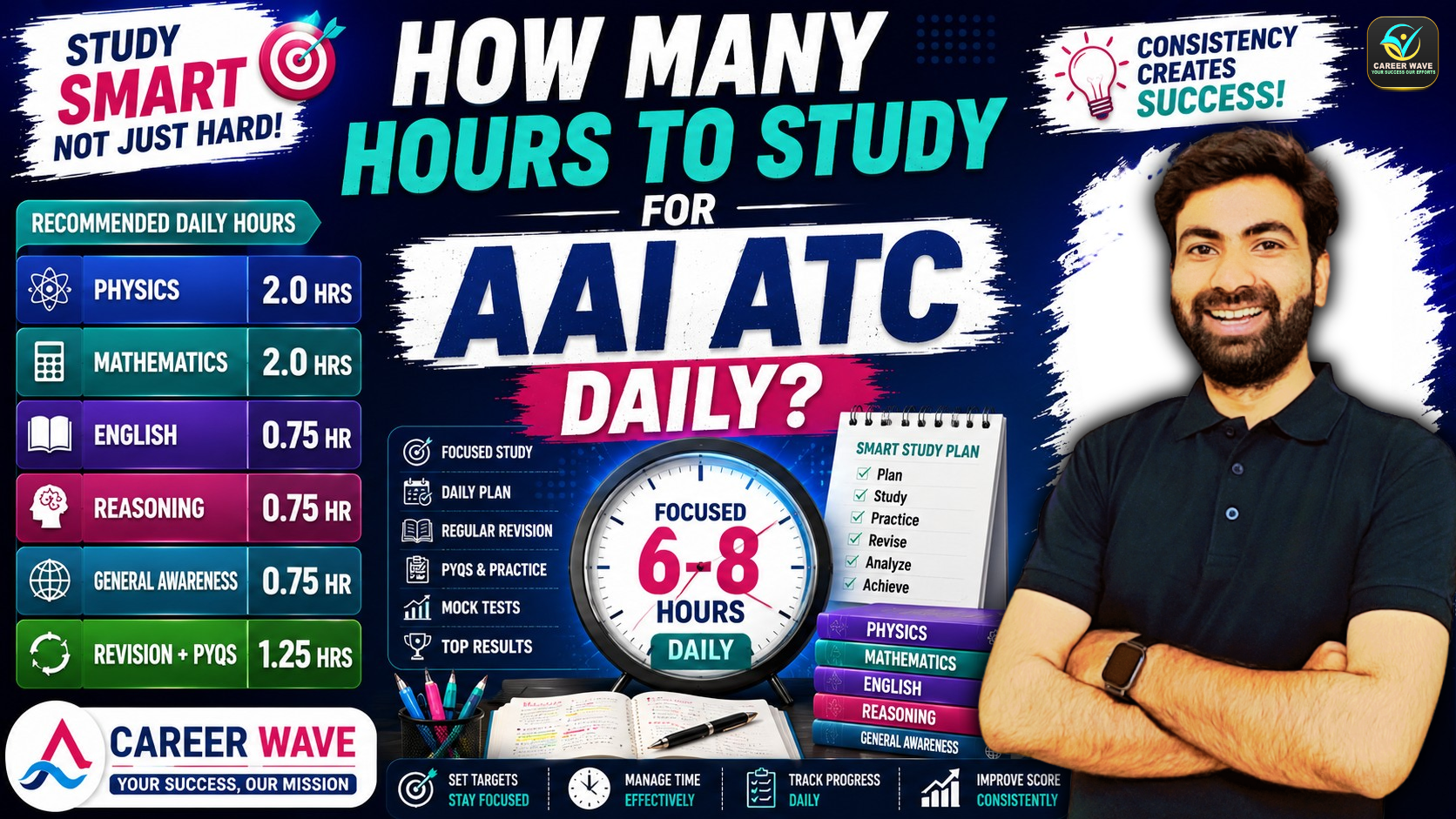
Wondering how many hours you
should study daily for AAI ATC? This detailed guide explains the ideal study
hours for beginners, college students, working professionals, and full-time
aspirants. Learn how to balance Physics, Mathematics, English, Reasoning,
General Awareness, PYQs, mock tests, and revision with Career Wave's practical
preparation strategy.
How Many Hours Should You Study Daily for AAI
ATC? A Realistic Guide for Aspirants
One of the
first questions every AAI ATC aspirant ask is:
"How
many hours should I study every day to crack AAI ATC?"
Some
students believe they need to study for 12–14 hours daily. Others think 3–4
hours are enough. After watching motivational videos and topper interviews,
many aspirants become confused because everyone gives a different answer.
The reality is simple.
There is no fixed number of study hours that
guarantees selection.
Your success
depends on how effectively you study, not just how long you study.
At Career
Wave, we have guided thousands of AAI ATC aspirants over the years. One thing
is common among successful students—they study consistently, follow a proper
strategy, revise regularly, solve PYQs, and analyse mock tests. Very few
selected candidates actually study 12–14 hours every day.
This guide will help you
understand how many hours you should study daily based on your current level,
available time, and preparation stage.
Does Studying More Hours Guarantee Selection?
The simple
answer is No.
Imagine two
students.
Student A
·
Studies 12
hours daily.
·
Watches
lectures all day.
·
Hardly
revises.
·
Solves very
few PYQs.
·
Rarely gives
mock tests.
Student B
·
Studies only
7 hours daily.
·
Revises
every day.
·
Solves
chapter-wise PYQs.
·
Gives weekly
mock tests.
·
Analyses
every mistake.
Who has a
better chance of selection?
Most
experienced mentors will choose Student B.
Why?
Because
competitive exams reward quality, not simply quantity.
AAI ATC is an exam of concepts,
accuracy, speed, and consistency.
How Many Hours Do Successful Students Usually
Study?
Based on
Career Wave's interaction with successful AAI ATC candidates, most students
fall into these categories:
Beginners
6–8
productive hours daily
Intermediate
Aspirants
5–7
productive hours daily
Final
Revision Stage
7–9 focused
hours daily
Working
Professionals
3–5
productive hours daily
Notice one
thing.
The word productive is
more important than the number itself.
What Are Productive Study Hours?
Productive
hours mean:
·
Full
concentration
·
No mobile
distractions
·
Active
learning
·
Solving
questions
·
Taking notes
·
Revising
formulas
·
Analysing
mistakes
Suppose you
study for 8 hours but spend:
·
1 hour on
Instagram
·
45 minutes
on WhatsApp
·
30 minutes
changing YouTube videos
·
1 hour
daydreaming
Your actual
study time becomes much lower.
Career Wave recommends tracking focused
study time, not total sitting time.
Factors That Decide Your Daily Study Hours
There is no
universal timetable.
Your study
hours depend on several factors.
1. Your
Current Preparation Level
Ask yourself
honestly.
Beginner
You need
more concept-building time.
Intermediate
You need
more practice and PYQs.
Advanced
You need
revision and mock tests.
Each level
requires different study hours.
2. Your
Educational Background
Students
from different backgrounds require different preparation.
For example:
A B.Tech
student may already have good Mathematics.
A B.Sc
Physics student may already understand Mechanics.
A
non-technical student may need extra time for Physics.
Therefore,
daily hours should be adjusted accordingly.
3. Available
Time
Every
aspirant has different responsibilities.
Examples:
College
student
Working
professional
Final-year
engineering student
Full-time
aspirant
Their daily
schedules will naturally differ.
4. Your
Target Exam Date
If the
notification is expected within three months, study hours should increase.
If you have
eight to ten months available, moderate daily study with consistency is more
effective.
Recommended Study Hours for Different Students
Full-Time
Aspirants
Recommended:
6–8 focused
hours daily
Suggested
distribution:
Physics – 2
Hours
Mathematics
– 2 Hours
English/Reasoning
– 1.5 Hours
General
Awareness – 45 Minutes
Revision +
PYQs – 1.5 Hours
This is
enough for consistent improvement.
College
Students
Recommended:
4–5 focused
hours daily
Suggested
routine:
Morning:
Formula
revision
Evening:
Physics and
Mathematics
Night:
English,
Reasoning, GA, and revision
Weekends:
Mock tests
Backlog
completion
PYQ practice
Working
Professionals
Recommended:
3–4 focused
hours daily
Morning:
Concept
revision
Evening:
Physics or
Maths
Night:
PYQs and
revision
Weekend:
Full mock
Sectional
tests
Weak-topic
improvement
Many students have cleared
competitive exams while working because they studied consistently.
How Should Beginners Study?
Beginners
should avoid studying too many books.
Instead,
focus on:
Understanding
concepts
Building
formulas
Learning
basic theory
Solving easy
questions
Starting
chapter-wise PYQs
Initially, 6
hours of focused study is sufficient.
There is no need to immediately
jump to 12-hour schedules.
Daily Study Plan for Beginners
Morning = Physics
Mid-Morning =
Mathematics
Afternoon = English
Evening = Reasoning
Night = General
Awareness
Revision = This keeps all
subjects active.
Daily Study Plan for Intermediate Students
At this
stage, concept learning decreases.
Practice
increases.
Suggested
plan:
Physics
Mathematics
PYQs
Practice
Sheets
Revision
Mock
Analysis
Most improvement happens here.
Daily Study Plan Before Exam
Last one or
two months should focus on:
Full mocks
Formula
revision
Mistake
notebook
Current
affairs
PYQ revision
Weak-topic
correction
Avoid studying completely new
chapters during the final phase unless absolutely necessary.
Subject-wise Time Distribution
Career Wave
recommends the following distribution for AAI ATC.
Physics = 30–35%
Mathematics
= 25–30%
English = 10–15%
Reasoning = 10–15%
General
Awareness = 10–15%
Revision +
PYQs = 10–15%
Students may modify this
according to their performance.
How Many Hours Should You Study Physics?
Physics is
one of the most important sections.
Daily
recommendation:
1.5–2.5
hours
Focus on:
Concepts
Numericals
PYQs
Formula
revision
Important chapters
How Many Hours Should You Study Mathematics?
Daily
recommendation:
1.5–2 hours
Maths
improves through practice.
Do not skip
it for several days.
Daily exposure is important.
How Much Time for English?
Daily
recommendation:
30–45
minutes
Practice:
Grammar
Vocabulary
Reading
comprehension
Error
detection
Consistency matters more than
duration.
How Much Time for Reasoning?
Daily
recommendation:
30–45
minutes
Focus on:
Series
Coding-decoding
Blood
relations
Analogy
Syllogism
Puzzle
basics
Reasoning develops through
repeated practice.
How Much Time for General Awareness?
Daily
recommendation:
30–45
minutes
Focus on:
Current
affairs
Static GK
Science
Polity
Geography
Economy
Daily revision is enough.
How Much Time Should Be Given to PYQs?
Career Wave
strongly recommends:
At least 1
hour daily
PYQs help
students understand:
Exam pattern
Repeated
concepts
Question
level
Important
chapters
Never leave PYQs for the last
month.
How Much Time Should Be Given to Revision?
Revision
should be compulsory every day.
Recommended:
30–60
minutes
During the
final stage:
1–2 hours
Revision
should include:
Formulas
Short notes
Mistake
notebook
Wrong PYQs
Mock
mistakes
Revision converts preparation
into marks.
How Much Time Should Be Given to Mock Tests?
Mock tests
should gradually increase.
Beginning
Phase: One sectional test weekly
Middle
Phase: Two sectional tests weekly
Final Phase:
Two or three full mocks weekly
Remember: Mock
analysis is as important as attempting the mock.
Is It Good
to Study 12–14 Hours Daily?
Not
necessarily.
Studying 12
hours for one week and then getting exhausted is not useful.
Studying 6–7
focused hours consistently for six months is much more effective.
Consistency always wins.
Signs That You Are Studying Enough
You are
studying enough if:
You complete
your daily targets.
You revise
regularly.
You solve
PYQs.
You analyse
mock tests.
Your
accuracy improves.
Your mock
scores gradually increase.
Your
concepts become stronger.
If these things are happening, do
not worry about comparing study hours with others.
Common Mistakes Students Make
Many
aspirants waste valuable time by making these mistakes:
·
Counting
sitting hours instead of productive hours.
·
Studying
only Physics and Maths.
·
Ignoring
English, Reasoning, and GA.
·
Watching
lectures without solving questions.
·
Not revising
daily.
·
Delaying
mock tests.
·
Ignoring
PYQs.
·
Following
unrealistic 14-hour schedules.
·
Comparing
themselves with toppers.
Avoid these mistakes to make
every study hour count.
Career Wave's Recommended Daily Formula
Career Wave
suggests a simple formula for AAI ATC preparation.
Every day
should include:
One
technical subject
One second
technical subject
One
non-technical subject
PYQ practice
Revision
Formula
revision
If possible,
end the day by reviewing mistakes made during practice.
This habit alone can improve your
score significantly over time.
Final Conclusion
There is no
magic number of study hours that guarantees success in AAI ATC.
For most
serious aspirants, 6–8 focused hours daily are sufficient if those hours
are used wisely.
Instead of
asking:
"How
many hours should I study?"
Ask:
·
Did I revise
today?
·
Did I solve
PYQs?
·
Did I
improve my weak subject?
·
Did I
analyse my mistakes?
·
Did I
complete today's target?
These
questions matter far more than simply counting hours.
At Career
Wave, we encourage students to prepare with discipline rather than pressure. A
consistent and well-planned study routine, supported by regular revision, PYQs,
and mock tests, is far more effective than extremely long but unproductive
study sessions.
Remember:
It is not about studying the
longest. It is about studying the smartest.
FAQs
1. How many
hours should I study daily for AAI ATC?
Most full-time aspirants should
study around 6–8 focused hours daily. Working professionals can prepare
effectively with 3–5 productive hours if they remain consistent.
2. Is
studying 12 hours daily necessary?
No. Quality study with revision,
PYQs, and mock analysis is more effective than simply studying for long hours.
3. Can I
crack AAI ATC by studying 4 hours daily?
Yes, especially if you are a
working professional or college student. Consistency and smart planning are
more important than long hours.
4. How much
time should I give to Physics and Mathematics?
Physics generally requires 1.5–2.5
hours daily, while Mathematics requires 1.5–2 hours, depending on
your preparation level.
5. Should I
study every subject daily?
Technical subjects should be
studied regularly. English, Reasoning, and General Awareness should also
receive daily or alternate-day practice to maintain balance.
Leave a Comment
21-Jul-2026 02:43 PM
Learn why most students quit AAI ATC preparation and how to stay consistent with the right study plan, Physics-Maths strategy, mock analysis, revision cycle, and...
20-Jul-2026 12:29 PM
Learn how to complete the AAI ATC syllabus without burnout using a realistic study plan, smart revision cycle, PYQ practice, mock test analysis, short notes,...
18-Jul-2026 03:53 PM
Learn what to expect from night shifts in AAI ATC, including duty routine, challenges, sleep management, alertness, work-life balance, and professional guidance from Career Wave...
17-Jul-2026 03:47 PM
Learn why your AAI ATC mock score is not improving and how to fix it with proper mock analysis, mistake notebook, formula revision, PYQ practice,...
16-Jul-2026 04:48 PM
Learn how to improve accuracy in the AAI ATC exam with concept clarity, formula revision, PYQ practice, mock test analysis, mistake notebook strategy, and guidance...
15-Jul-2026 04:25 PM
Learn what to do in the last week before the AAI ATC exam with smart revision, mock test strategy, formula recall, mistake notebook practice, and...
