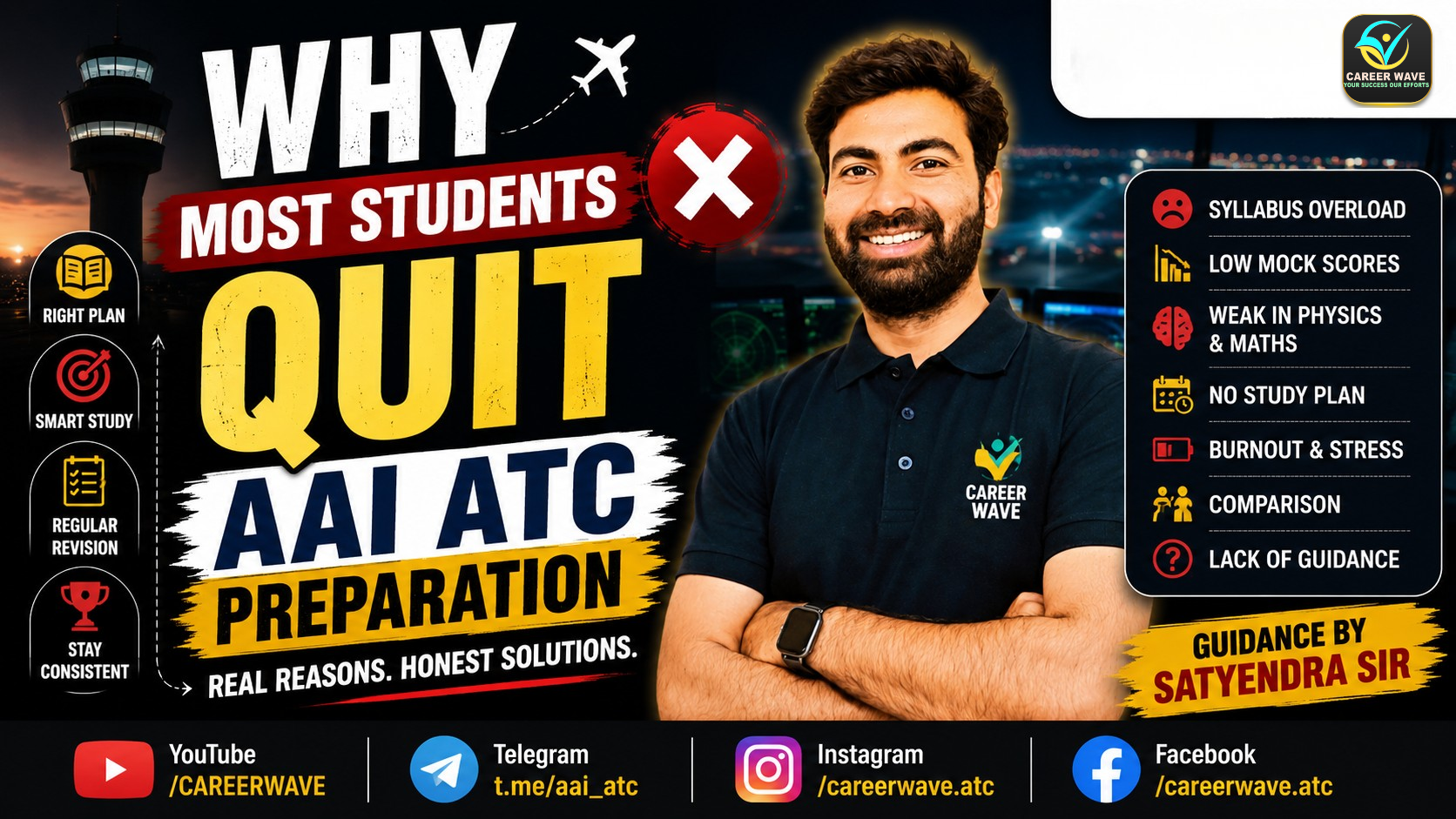
Learn why most students quit AAI
ATC preparation and how to stay consistent with the right study plan,
Physics-Maths strategy, mock analysis, revision cycle, and guidance from Career
Wave by Satyendra Sir.
Why Most Students Quit AAI ATC Preparation
AAI ATC is
one of the most respected and competitive exams for students who want to build
a career in aviation. The job profile, salary, responsibility, and career
growth attract thousands of aspirants every year. But the reality is that many
students start AAI ATC preparation with strong motivation and then slowly quit.
Most
students do not quit because they are incapable. They quit because they do not
have the right preparation system, realistic plan, proper guidance, and
emotional stability during the journey.
At Career Wave, Satyendra
Sir always tells students that AAI ATC preparation is not just a test of
knowledge. It is also a test of patience, consistency, discipline, and
self-control.
Why Do Students Quit AAI ATC Preparation?
Many
students begin preparation with high energy. They buy books, join classes,
watch videos, make timetables, and start solving questions. But after a few
weeks or months, they feel stuck.
The common
reasons are:
• Syllabus
feels too large
• Physics and Maths create fear
• Mock scores do not improve
• Students compare themselves with others
• Revision is weak
• Study plan is unrealistic
• Too many resources create confusion
• Lack of proper guidance
• Burnout and mental fatigue
• Fear of failure
Quitting usually happens when
pressure becomes greater than clarity.
1. Fear of Physics and Mathematics
Physics and
Mathematics are important parts of AAI ATC preparation. Many students feel
nervous because they think these subjects are too difficult.
But the
problem is not always the subject. The problem is the approach.
Students
often:
• Memorize
formulas without concepts
• Skip basics
• Avoid numericals
• Jump directly to difficult questions
• Do not revise formulas regularly
• Get demotivated after mistakes
Satyendra
Sir always advises students to build Physics and Maths step by step. First
understand the concept, then learn the formula, then practice basic questions,
and finally move to PYQs and mock tests.
Physics and Maths become
manageable when preparation is structured.
2. Unrealistic Study Timetable
Many
students make a timetable that looks perfect on paper but is impossible to
follow in real life.
For example:
• 10 hours
study daily from day one
• All subjects every day
• No rest time
• No revision slot
• No mock analysis time
• No buffer for college or job
When
students fail to follow such a timetable, they feel guilty and slowly lose
confidence.
A practical
timetable is always better than an aggressive timetable.
Better
approach:
• 4–6
focused hours daily
• Daily formula revision
• Weekly revision day
• Fixed mock analysis time
• Short breaks between study sessions
• Realistic targets
Consistency beats overplanning.
3. Mock Scores Not Improving
Mock test
score is one of the biggest emotional triggers for students. When scores remain
low or stuck, students start thinking that they cannot clear the exam.
But mock
score does not improve only by attempting more mocks. It improves when you
analyze mistakes properly.
After every
mock, check:
• Which
questions were wrong?
• Why were they wrong?
• Was it a concept error?
• Was it a formula error?
• Was it a silly mistake?
• Was it a time management issue?
• Which topic is repeatedly weak?
At Career Wave, Satyendra Sir
always tells students that mock tests are not for fear. They are for feedback.
A low mock score is not failure; it is a report card for improvement.
4. Lack of Proper Revision
Many
students keep studying new topics but do not revise old topics. After some
time, they feel that they have forgotten everything. This creates stress and
makes them feel unprepared.
Revision is
not optional in AAI ATC. It is the backbone of preparation.
You should
revise:
• Physics
formulas
• Maths formulas
• Short notes
• PYQ-based points
• Mistake notebook
• English grammar rules
• Current affairs
• Static GK facts
Use this
simple revision cycle:
• Daily
revision: 20–30 minutes
• Weekly revision: 1 full revision block
• Monthly revision: all completed topics
• Before mock: formulas and mistakes
Without revision, preparation
feels endless.
5. Too Many Resources
One major
reason students quit is resource overload. They follow one teacher today,
another PDF tomorrow, a new book next week, and random YouTube videos daily.
This creates
confusion.
Problems
caused by too many resources:
• No single
direction
• Repeated topics but no mastery
• Conflicting methods
• Wasted time
• Weak confidence
• Incomplete syllabus
For AAI ATC,
limited and trusted resources are enough.
Keep
resources for:
• Concept
learning
• Formula revision
• PYQs
• Mock tests
• Current affairs
• Short notes
Do not collect material. Complete
material.
6. Comparison With Other Students
Many
students lose motivation because they compare their journey with others.
They think:
• Others are
scoring better
• Others are studying more hours
• Others have completed more syllabus
• Others are stronger in Physics or Maths
• Others will clear, but I will not
This
comparison is harmful.
Every
student has a different background, speed, strength, and weakness. Your real
competition is your previous performance.
Track your
own progress:
• Mock score
trend
• Accuracy improvement
• Mistakes reduced
• Topics completed
• Revision consistency
• Time management improvement
Preparation improves when you
focus on your own data, not other students’ noise.
7. No Mistake Notebook
Students
repeat the same mistakes again and again because they do not record them.
A mistake
notebook helps you identify your actual weak points.
Divide it
into:
• Physics
mistakes
• Maths mistakes
• Reasoning mistakes
• English mistakes
• Aptitude mistakes
• GA mistakes
• Formula mistakes
• Calculation mistakes
• Silly mistakes
Before every
mock, revise your mistake notebook. This single habit can improve accuracy and
confidence.
Satyendra Sir often says that
repeated mistakes are more dangerous than difficult questions. If you stop
repeating mistakes, your score starts improving.
8. Burnout Due to Overstudy
Some
students study too much in the beginning and then lose energy. They ignore
sleep, breaks, health, and personal routine.
Burnout
signs include:
• Feeling
tired all the time
• Losing interest in study
• Forgetting recently studied topics
• Low mock confidence
• Irritation
• Lack of focus
• Fear before opening books
• Constant pressure
AAI ATC
preparation needs stamina. You cannot run the full journey with panic.
To avoid
burnout:
• Sleep
properly
• Take short breaks
• Follow a weekly plan
• Avoid random study
• Keep one light revision day
• Do not study only under pressure
• Maintain physical activity
A fresh mind learns faster and
performs better.
9. Fear of Failure
Many
students quit because they are afraid of failing. They think, “What if I give
so much time and still do not clear?”
This fear is
natural, but it should not control your preparation.
Instead of
thinking about failure, focus on process:
• Did I
study today?
• Did I revise formulas?
• Did I solve questions?
• Did I analyze mistakes?
• Did I improve accuracy?
• Did I complete weekly targets?
Results come from repeated
execution. Fear reduces action, but discipline creates progress.
10. Lack of Guidance
Without
proper guidance, students waste time on low-priority topics, wrong resources,
poor mock strategy, and unplanned revision.
A good
mentor helps students understand:
• What to
study
• What to skip
• How to revise
• How to attempt mocks
• How to improve accuracy
• How to manage weak areas
• How to stay consistent
At Career Wave, Satyendra Sir
focuses on structured preparation, PYQ-based learning, concept clarity, and
realistic guidance so students do not feel lost during preparation.
How to Continue AAI ATC Preparation Without
Quitting
1. Start
Small but Stay Regular
Do not wait
for perfect motivation. Start with a small daily target and complete it.
Example:
• 1 Physics
concept
• 10 Maths questions
• 15 minutes formula revision
• 10 English vocabulary words
• 5 Reasoning questions
Small
progress daily is better than irregular heavy study.
2. Make a
Weekly Target Plan
A weekly
plan is easier to follow than a long monthly plan.
Your weekly
plan should include:
• New topics
• Formula revision
• PYQ practice
• One sectional test
• One mock analysis
• Mistake notebook revision
• Short notes update
This keeps
preparation controlled.
3. Focus on
High-Return Topics
Do not waste
energy on everything equally. Give priority to topics that are scoring,
repeated, and manageable.
Focus on:
• Frequently
asked Physics concepts
• Formula-based Maths topics
• Reasoning patterns
• English grammar rules
• Aptitude basics
• Static GK and current affairs
• PYQs
Smart
selection saves time and reduces pressure.
4. Analyze
Mocks, Do Not Fear Them
Mock tests
are not final results. They are training tools.
After every
mock:
• Find
repeated mistakes
• Revise weak topics
• Solve similar questions
• Improve attempt strategy
• Track accuracy
• Avoid emotional reaction
A good mock
analysis can improve your next score more than a new chapter.
5. Keep
Motivation Practical
Motivation
should not depend only on videos, quotes, or mood. Real motivation comes from
visible progress.
Track:
• Topics
completed
• Mistakes reduced
• Mock accuracy improved
• Revision done
• PYQs solved
• Confidence gained
When progress is visible,
quitting becomes less likely.
Career Wave Strategy by Satyendra Sir
At Career
Wave, Satyendra Sir suggests this practical strategy for students who feel
like quitting AAI ATC preparation:
1.
Do not panic
because of the syllabus. Divide it subject-wise.
2.
Strengthen
Physics and Maths with concept clarity.
3.
Make short
notes for every chapter.
4.
Revise
formulas daily.
5.
Solve PYQs
regularly.
6.
Attempt
mocks with proper analysis.
7.
Maintain a
mistake notebook.
8.
Avoid too
many resources.
9.
Take care of
sleep and health.
10. Focus on consistency, not perfection.
This method helps students stay
disciplined and continue preparation without unnecessary pressure.
Important Career Wave Links
YouTube
Channel: https://www.youtube.com/@CAREERWAVE
Telegram
Channel: https://t.me/aai_atc
Instagram: https://www.instagram.com/careerwave.atc
Facebook: https://www.facebook.com/careerwave.atc
Conclusion
Most
students quit AAI ATC preparation not because they lack talent, but because
they lack a proper system. The syllabus feels difficult when preparation is
random. Mock scores feel painful when analysis is missing. Physics and Maths
feel hard when basics are weak. Revision feels stressful when short notes are
not prepared.
At Career
Wave, Satyendra Sir always guides students to prepare with clarity, patience,
and discipline. AAI ATC preparation is a long journey, but it becomes
manageable when you follow the right process.
Do not quit
because of temporary pressure. Fix your plan, revise regularly, analyze your
mistakes, and continue with consistency.
Your preparation does not need to
be perfect. It needs to be regular.
FAQs:
1. Why do
most students quit AAI ATC preparation?
Most students quit because of
syllabus pressure, weak Physics and Maths basics, low mock scores, poor
revision, lack of guidance, and burnout.
2. Is AAI
ATC preparation very difficult?
AAI ATC preparation is
challenging, but not impossible. With structured study, PYQ practice, formula
revision, and mock analysis, it becomes manageable.
3. What
should I do if I feel like quitting AAI ATC preparation?
Take a short break, analyze your
problem, reduce your daily target, revise easy topics, and restart with a
realistic weekly plan.
4. Why do
students lose motivation during AAI ATC preparation?
Students lose motivation when
they do not see score improvement, compare themselves with others, or study
without a clear plan.
5. How can I
stay consistent in AAI ATC preparation?
Follow a practical timetable,
revise daily, solve PYQs, analyze mocks, and track your weekly progress.
6. Can weak
students clear AAI ATC?
Yes. Weak students can clear AAI
ATC if they start from basics, revise regularly, practice questions, and
improve accuracy step by step.
How to Complete the AAI ATC Syllabus Without Burnout
Leave a Comment
22-Jul-2026 04:47 PM
Learn whether AAI ATC is a stressful job, why the role demands alertness and responsibility, how ATCOs manage pressure, and how Career Wave with Satyendra...
21-Jul-2026 02:43 PM
Learn why most students quit AAI ATC preparation and how to stay consistent with the right study plan, Physics-Maths strategy, mock analysis, revision cycle, and...
20-Jul-2026 12:29 PM
Learn how to complete the AAI ATC syllabus without burnout using a realistic study plan, smart revision cycle, PYQ practice, mock test analysis, short notes,...
18-Jul-2026 03:53 PM
Learn what to expect from night shifts in AAI ATC, including duty routine, challenges, sleep management, alertness, work-life balance, and professional guidance from Career Wave...
17-Jul-2026 03:47 PM
Learn why your AAI ATC mock score is not improving and how to fix it with proper mock analysis, mistake notebook, formula revision, PYQ practice,...
16-Jul-2026 04:48 PM
Learn how to improve accuracy in the AAI ATC exam with concept clarity, formula revision, PYQ practice, mock test analysis, mistake notebook strategy, and guidance...
