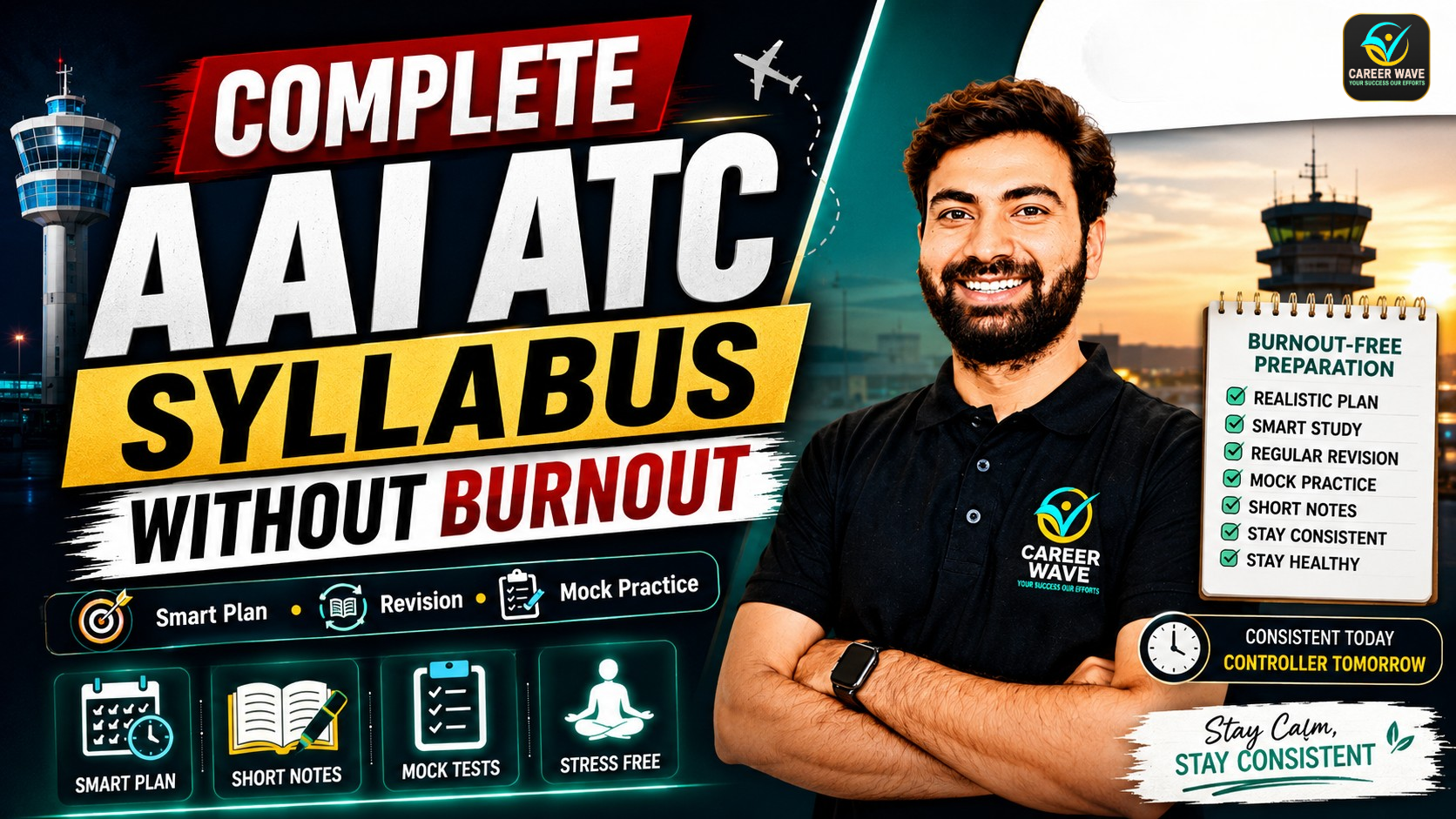
Learn how to complete the AAI ATC
syllabus without burnout using a realistic study plan, smart revision cycle,
PYQ practice, mock test analysis, short notes, and guidance from Career Wave by
Satyendra Sir.
How to Complete the AAI ATC Syllabus Without
Burnout
Completing
the AAI ATC syllabus is not only about studying for long hours. It is about
studying with a clear plan, balanced revision, regular practice, and proper
rest. Many students start preparation with full energy, but after a few weeks,
they feel tired, confused, and mentally exhausted. This is called burnout.
Burnout
happens when you study without structure, ignore rest, overload yourself with
too many resources, and keep chasing the syllabus without proper revision.
At Career Wave, Satyendra
Sir always guides students that AAI ATC preparation should be consistent, not
chaotic. You do not need panic preparation. You need a smart system that helps
you complete the syllabus and stay mentally fresh till the exam.
Why Students Face Burnout During AAI ATC
Preparation
AAI ATC has
a wide syllabus that includes technical and non-technical subjects. Students
need to prepare Physics, Mathematics, Reasoning, English, General Awareness,
and Aptitude. Because of this, many aspirants feel overloaded.
Common
reasons for burnout are:
• Studying
without a timetable
• Trying to complete everything too fast
• Using too many books and sources
• Not revising regularly
• Ignoring sleep and health
• Comparing preparation with others
• Taking too many mock tests without analysis
• Not taking short breaks
• Feeling guilty during rest time
• Lack of weekly targets
Burnout does not mean you are
weak. It means your preparation system needs correction.
Understand the Syllabus First
Before
making any study plan, understand the complete AAI ATC syllabus properly. Do
not start randomly.
Divide the
syllabus into two parts:
Technical
Section
• Physics
• Mathematics
Non-Technical
Section
• Reasoning
• English
• General Awareness
• Aptitude
Once the
syllabus is divided, preparation becomes easier. You can give more time to
difficult subjects and keep scoring subjects active through regular practice.
Make a Realistic Study Plan
A common
mistake students make is creating an unrealistic timetable. They plan 10–12
hours of study daily but fail to follow it after a few days. This creates guilt
and pressure.
A practical
daily plan is better than an impossible plan.
A balanced
routine can be:
• 1.5 hours
Physics
• 1.5 hours Mathematics
• 45 minutes Reasoning or Aptitude
• 30 minutes English
• 30 minutes General Awareness
• 30 minutes revision
You can
adjust this according to your college, job, or personal schedule. The target
should be regular study, not forced study.
Follow the
3-Part Study Method
To complete
the syllabus without burnout, follow a simple 3-part method:
1. Concept
Study
Understand
the topic properly. Do not rush.
2. Question
Practice
Solve basic
questions first, then PYQs and exam-level questions.
3. Revision
Revise
formulas, short notes, and mistakes regularly.
If you only study concepts and do
not revise, you will forget. If you only solve questions without concepts,
accuracy will drop. All three parts are important.
Do Not Study All Subjects Equally Every Day
Many
students try to study every subject daily. This can become tiring. Instead,
rotate subjects smartly.
For example:
• Monday:
Physics + Maths + English
• Tuesday: Physics + Aptitude + GA
• Wednesday: Maths + Reasoning + English
• Thursday: Physics + PYQs + GA
• Friday: Maths + Aptitude + Revision
• Saturday: Sectional Test + Analysis
• Sunday: Short Notes + Weak Topics
This keeps preparation balanced
without mental overload.
Give Priority to High-Weight and Weak Topics
You do not
need to give equal time to every topic. Some topics need more attention because
they are important or personally weak for you.
Prioritize
topics based on:
• Exam
importance
• Your current level
• PYQ frequency
• Formula dependency
• Scoring potential
• Time required to improve
At Career Wave, Satyendra Sir
always advises students to study with priority. Random preparation wastes
energy. Priority-based preparation saves time.
Make Short Notes From the Beginning
Short notes
reduce burnout because they make revision easier. If you do not make notes
during preparation, final revision becomes stressful.
Your short
notes should include:
• Important
formulas
• Key concepts
• Unit conversions
• PYQ-based points
• Common mistakes
• Short tricks
• Difficult facts
• Mock test errors
Do not write full theory. Short
notes should be clean, compact, and revision-friendly.
Revise Weekly, Not Only at the End
Many
students keep completing chapters but do not revise them. After one month, they
realize they have forgotten old topics. This creates stress.
Use this
revision cycle:
• Daily
revision: 20–30 minutes
• Weekly revision: every Sunday
• Monthly revision: all completed topics
• Before mock: formulas and mistake notebook
Revision should be part of the
syllabus plan, not a separate burden.
Practice PYQs Along With the Syllabus
Do not wait
for syllabus completion to start PYQs. Previous year questions help you
understand the real exam demand.
While
solving PYQs, note:
• Repeated
topics
• Important formulas
• Question pattern
• Difficulty level
• Common traps
• Time-taking areas
PYQs make your preparation
practical and help you avoid unnecessary study material.
Avoid Too Many Resources
Too many
resources create confusion. One good source followed properly is better than
five sources used randomly.
For AAI ATC
preparation, keep limited resources for:
• Concept
study
• Formula revision
• PYQ practice
• Mock tests
• Current affairs
• Short notes
Do not keep changing books, PDFs,
videos, and test series every week. This is one major reason for burnout.
Take Breaks Without Guilt
Rest is not
a waste of time. A fresh mind learns faster and remembers better.
Use short
breaks during study:
• Study for
50 minutes
• Take 10 minutes break
• Repeat the cycle
During
breaks, avoid endless phone scrolling. Walk, stretch, drink water, or relax
your eyes.
Your brain also needs recovery.
Do Not Ignore Sleep
Many
students reduce sleep to study more. This may work for one or two days, but it
damages long-term preparation.
Poor sleep
causes:
• Low
concentration
• Weak memory
• Calculation mistakes
• Irritation
• Low motivation
• Poor mock performance
• More silly mistakes
Sleep is part of preparation. AAI
ATC needs alertness and accuracy, so mental freshness is important.
Use Mock Tests Carefully
Mock tests
are important, but attempting too many mocks without analysis creates stress.
Correct mock
strategy:
• Start with
chapter-wise tests
• Move to sectional tests
• Attempt full-length mocks after syllabus coverage
• Analyze every mock properly
• Maintain a mistake notebook
• Revise weak topics before the next mock
A mock test is useful only when
it improves your next attempt.
Maintain a Mistake Notebook
A mistake
notebook reduces repeated errors and improves confidence.
Divide it
into:
• Physics
mistakes
• Maths mistakes
• Reasoning mistakes
• English mistakes
• Aptitude mistakes
• GA mistakes
• Calculation errors
• Silly mistakes
Before every mock, revise your
mistake notebook. This helps you protect marks.
Weekly Syllabus Completion Plan
A practical
weekly plan can be:
Monday to
Friday
• Study new
concepts
• Solve topic-wise questions
• Revise formulas
• Practice English or GA daily
Saturday
• Attempt
sectional test
• Solve PYQs
• Analyze mistakes
Sunday
• Revise
completed topics
• Update short notes
• Review mistake notebook
• Plan next week
This system helps you complete
syllabus without feeling overloaded.
Subject-Wise Burnout-Free Strategy
Physics
• Study
concepts slowly
• Revise formulas daily
• Practice numerical questions step by step
• Focus on units and dimensions
• Solve PYQs chapter-wise
• Do not memorize without understanding
Mathematics
• Build
formula command
• Practice standard question types
• Avoid jumping directly to difficult questions
• Revise identities regularly
• Practice calculation carefully
Reasoning
• Practice
daily in small sets
• Focus on pattern recognition
• Do not overthink simple questions
• Use diagrams for arrangements
• Review mistakes after practice
Aptitude
• Start with
basics
• Practice percentage, ratio, average, time and work, speed, and profit-loss
• Use shortcuts only after concept clarity
• Recheck calculations
• Practice timed sets gradually
English
• Revise
grammar rules
• Practice error detection regularly
• Build vocabulary daily
• Read complete sentences carefully
• Do not depend only on instinct
General
Awareness
• Study in small daily portions
• Revise static GK repeatedly
• Follow current affairs regularly
• Make short notes
• Avoid random last-minute sources
Signs That You Are Moving Toward Burnout
Be careful
if you notice these signs:
• You feel
tired even after sleeping
• You avoid studying because of pressure
• You forget recently studied topics
• Mock scores create panic
• You feel irritated all the time
• You keep changing plans daily
• You study for long hours but retain less
• You feel guilty during rest
If this happens, reduce load for
one or two days, revise light topics, fix sleep, and restart with a realistic
plan.
Career Wave Strategy by Satyendra Sir
At Career
Wave, Satyendra Sir recommends a simple and effective method to complete
the AAI ATC syllabus without burnout:
1.
Understand
the syllabus clearly.
2.
Divide
topics into strong, weak, and pending.
3.
Study
difficult topics in fresh hours.
4.
Revise
formulas daily.
5.
Practice
PYQs regularly.
6.
Analyze
mocks properly.
7.
Take weekly
revision breaks.
8.
Maintain
short notes and mistake notebook.
9.
Avoid random
resources.
10. Keep health and sleep stable.
This strategy helps students
prepare with discipline and consistency.
Important Career Wave Links
YouTube
Channel: https://www.youtube.com/@CAREERWAVE
Telegram
Channel: https://t.me/aai_atc
Instagram: https://www.instagram.com/careerwave.atc
Facebook: https://www.facebook.com/careerwave.atc
Conclusion
Completing
the AAI ATC syllabus without burnout is possible if you follow a structured
plan. Do not run behind long study hours. Focus on smart study, regular
revision, PYQs, mock analysis, and proper rest.
At Career
Wave, Satyendra Sir always guides students to prepare with balance. A tired
mind cannot perform well in the exam. Your preparation should make you
stronger, not exhausted.
Study consistently. Revise
regularly. Take care of your health. Complete the syllabus with discipline, not
panic.
FAQs:
1. How can I
complete the AAI ATC syllabus without burnout?
Complete the syllabus with a
realistic timetable, weekly targets, short notes, PYQ practice, regular
revision, and proper rest.
2. How many
hours should I study daily for AAI ATC?
It depends on your current level,
but 4–6 focused hours daily with proper revision can be effective. Quality
matters more than long study hours.
3. Should I
study all subjects every day?
Not necessary. You can rotate
subjects throughout the week while keeping formula revision, English, and GA
active regularly.
4. How do I
avoid stress during AAI ATC preparation?
Avoid random sources, make weekly
plans, take short breaks, sleep properly, and focus on progress instead of
comparison.
5. Are short
notes useful for syllabus completion?
Yes. Short notes make revision
faster and reduce pressure during the final phase of preparation.
6. When
should I start mock tests?
Start with chapter-wise and
sectional tests. Begin full-length mocks after completing a reasonable portion
of the syllabus.
7. How can I
manage weak topics without pressure?
Pick weak topics one by one,
study basics first, solve simple questions, then move to PYQs and sectional
tests.
Leave a Comment
21-Jul-2026 02:43 PM
Learn why most students quit AAI ATC preparation and how to stay consistent with the right study plan, Physics-Maths strategy, mock analysis, revision cycle, and...
20-Jul-2026 12:29 PM
Learn how to complete the AAI ATC syllabus without burnout using a realistic study plan, smart revision cycle, PYQ practice, mock test analysis, short notes,...
18-Jul-2026 03:53 PM
Learn what to expect from night shifts in AAI ATC, including duty routine, challenges, sleep management, alertness, work-life balance, and professional guidance from Career Wave...
17-Jul-2026 03:47 PM
Learn why your AAI ATC mock score is not improving and how to fix it with proper mock analysis, mistake notebook, formula revision, PYQ practice,...
16-Jul-2026 04:48 PM
Learn how to improve accuracy in the AAI ATC exam with concept clarity, formula revision, PYQ practice, mock test analysis, mistake notebook strategy, and guidance...
15-Jul-2026 04:25 PM
Learn what to do in the last week before the AAI ATC exam with smart revision, mock test strategy, formula recall, mistake notebook practice, and...
